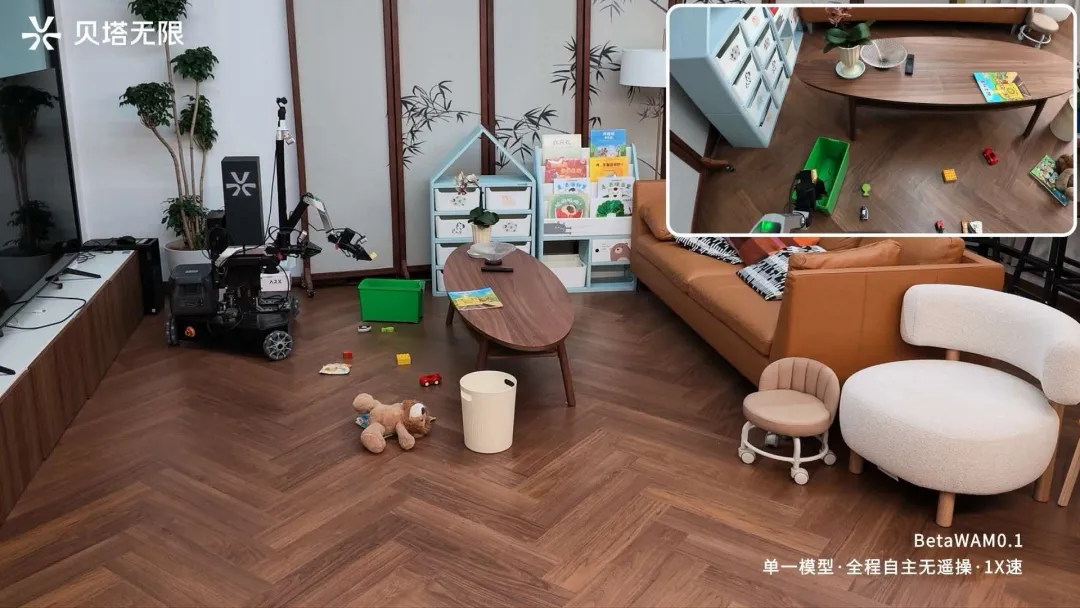
“ 10 minutes to clean up the real living room mess, Beta Unlimited's WAM is great.
Today's physically intelligent, single-point operational capabilities are increasingly surprising, but continuous tasks are often overtaken.
Looking at the world's smart racetracks, the vast majority of the surprising demos are essentially fixed-stage operations or single-task mobile operations.
The GEN-1 model, released in April 2026 by American body-smart star Generalist AI, increased the success rate of precision operations such as folding paper boxes, packaging phones, repair robots, and more from 64 percent to 99 percent, and it took only 12.1 seconds to complete box assembly. But overturned in its demonstration video, the task was almost entirely completed on a fixed stage. Gen-1 could learn new tasks in an hour, repeat 1,800 times, and maintain a 99 percent success rate, but its world never left that table.
Another star company, Dyna Robotics, released DYNA-2, in August 2026, with over one million hours of human-first-person video pre-training, raised the pass rate of customer field zero samples from 46 percent to 87 percent. However, the core mission of the show remains to unlock the bottle cap and turn the key. Although DYNA-2 is positioned as a world-moving model (WAM), its demo's mission scale remains at the single-point action level.
In other words, whether you're the industry leader on the VLA route or the world model route, the current stage of steam-operated smart jets is largely stuck at the steam-operated smart jets level, and there's a huge gap away from the complete steam-mission smart jets.
What really determines whether consumer-grade robots can enter the home is the ability of another dimension, which is the ability to autonomously complete long-range, multi-purpose mobile operations in an open, dynamic, constantly changing environment.
This is also the technological focal point of Beta Infinite's selection, which aims to give the industry a symbolic demonstration of non-mainstream operation tasks.
The company, which officially started operations in March 2026, dares to face the challenges of consumer-grade physical intelligence and has completed hundreds of millions of yuan in funding in just a few months, the answer lies in its latest world-action model BetaWAM 0.1 virtual machine operation demo.
In this demo, Beta Infinite will demonstrate how a unified model can fully autonomously complete long-range complex mobile+ operations, from searching, crawling to positioning, from shadowing reasoning to failing recovery, all without human intervention.
The underlying logic behind all of this is the core positioning that Beta Infinite has established from the beginning: human-centered, industry-leading intelligent brains and products. The starting point of this path is to transform memory and the ability to understand space and physics from pseudo-theses into real capabilities and make them truly effective in operations.
01.
Long-range operational debut, a demo entirely self-contained
BetaWAM 0.1's demo scenario is set in a dynamic home environment where robots need to continuously perform multiple target searches, crawling and locating, during which people are shadowed, objects are temporarily moved, and new items are added.
The current demonstration in the industry is either fixed-deck operation, or tasks are too standardized, or only cover a single action of just a few tens of seconds. BetaWAM 0.1 runs on a long-range shutdown of the Mobile + Operating Edge, with no man-made intervention, robots needing to complete multiple crawling and resetting tasks in different locations, and with the same set of model autonomous decisions to cope with random accidents.
This cross-space continuous operation of the VLA is precisely the weakest link in the current VLA and World Model routes, and is also the VLA task intelligence that Beta Infinite is attempting to define. VLA is good at operating on the desktop but lacks spatial continuity, and the world model is good at predicting but is difficult to respond to physical interference in real time. BetaWAM 0.1 is designed to combine both, allowing robots to maintain operational accuracy in motion and space consciousness in operation.
The first breakthrough of the demo was the ability to leverage generalization.
In the demo, the robot faces various forms of household objects, judging the material, weight and surface characteristics of objects based on memory, and adjusting the grab strategy in real time. For example, in the face of irregular toys, the system can quickly find stable holding points; in the face of flexible drawings, the system calls for contact details in memory, unfolding lightly; in the face of smooth rubbish, the system increases the contact area, ensuring stability.
This generalization, which is essentially a victory of state management at the control level, allows each grabbing to be based on a grabbing.
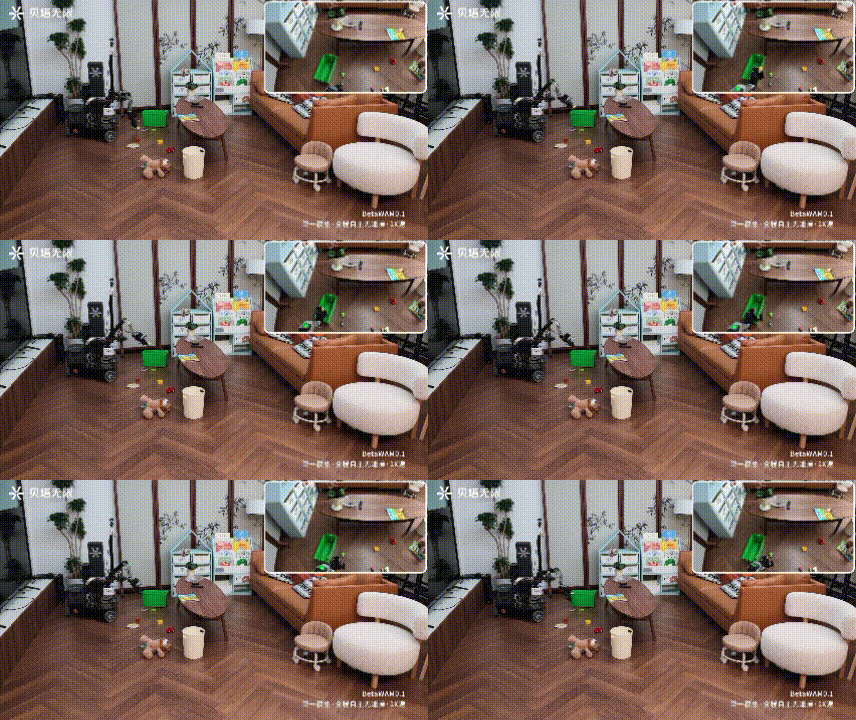
The second breakthrough was the combination of spatial understanding and short-term memory.
One of the most impressive scenes in the demo is one that best reflects the moment when a task's intelligence shrinks. During the execution of the task, the staff temporarily obscures the Lego block with a book. From the current visual image, the robot cannot see the Lego block. For the general model, the goal disappears from view, meaning the mission is interrupted. But BetaWAM 0.1 behaves differently, does not cling to or bypass this goal. It is based on where the Lego block is obscured in memory, combined with changes in the state after the book appears, performs the Lego block under the book, then automatically extends its arm, first opens the book, then picks up the Lego block, and completes the reception.
This model builds the reasoning capability in physical space in which hydrogen objects can be concealed but not disappear, and can make inferences based on memory and current observations to verify the chain of action of hydrogen. This capability is a typical manifestation of the fusion of long-term memory and spatial relationship reasoning.
The third breakthrough is the rapid adaptation to environmental change.
During the execution of a task, staff will intentionally create interference, such as moving an item from its original location, or suddenly placing a new book in front of a robot, a bunch of junk. BetaWAM 0.1 is not affected by these unexpected disruptions in rhythm, it will tweak online, re-scan areas, update task status, or even actively move to a more suitable location on the dashboard or mechanical arm, re-planning the sequence.
This adaptability is not uncommon in fixed-deck operations, and can be re-perceived due to the limited range of interference. However, in mobile operations, interference can occur anywhere, at any time, and the system must complete reprogramming in a "moving" state. BetaWAM 0.1 demonstrates this ability to "move on".
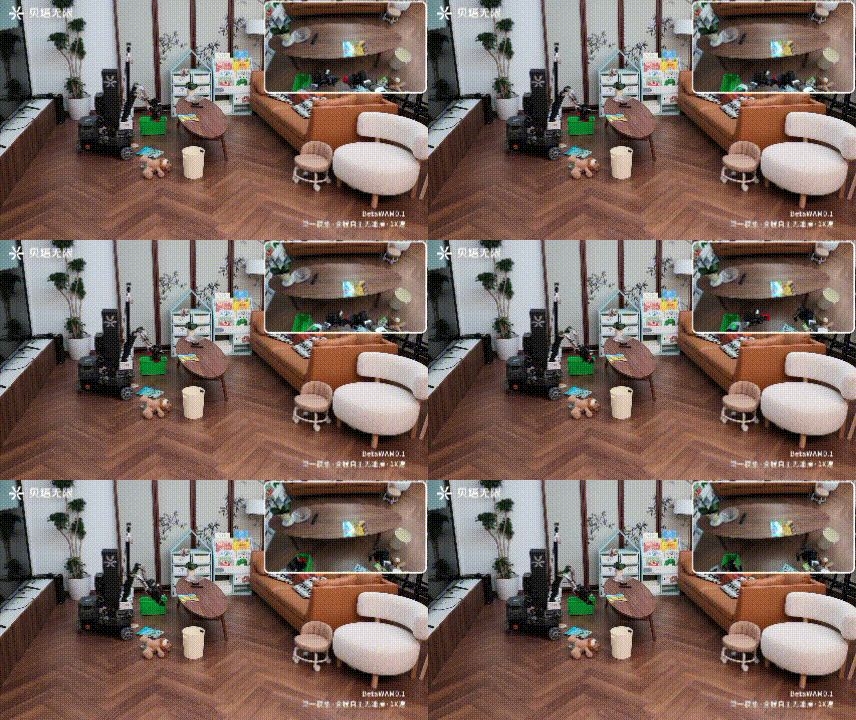
The fourth breakthrough is the ability to recover from failure.
One detail in the demo, a Lego block falling off in the process of grabbing and rolling to the side. BetaWAM 0.1 does not suspend the task, nor does it come back from scratch, but realizes that the target has not yet completed the task, adjusting its position and the direction of the mechanical arm, picking up the debris again, and continuing to perform the main task. This self-correcting roboticity stems from the system's continued maintenance of the task state, the key to stable service in the real physical world.
The fifth breakthrough is the ability to work hand-in-hand.
Large numbers of household tasks require hand-to-hand collaboration. In demos, the robot's display of left- and right-handed collaboration is particularly critical, such as one hand opening the drawer and the other hand reaching in and out of items; or one hand holding a container and the other hand scattering items one at a time.
The difficulty of this dual-machine-arm collaboration lies in the real-time synchronization between the two hands. The shared memory plane of BetaWAM0.1 allows the left hand to share the same machine with the right hand. The left hand knows which drawer has been opened, where it has been placed, whether the container is full. It is this shared machine-judging machine that allows the two hands not to interfere with each other, so that the sequence of movements is strictly synchronized, as if a complete machine-machine is at work, rather than a simple superimposition of two independent mechanical arms.
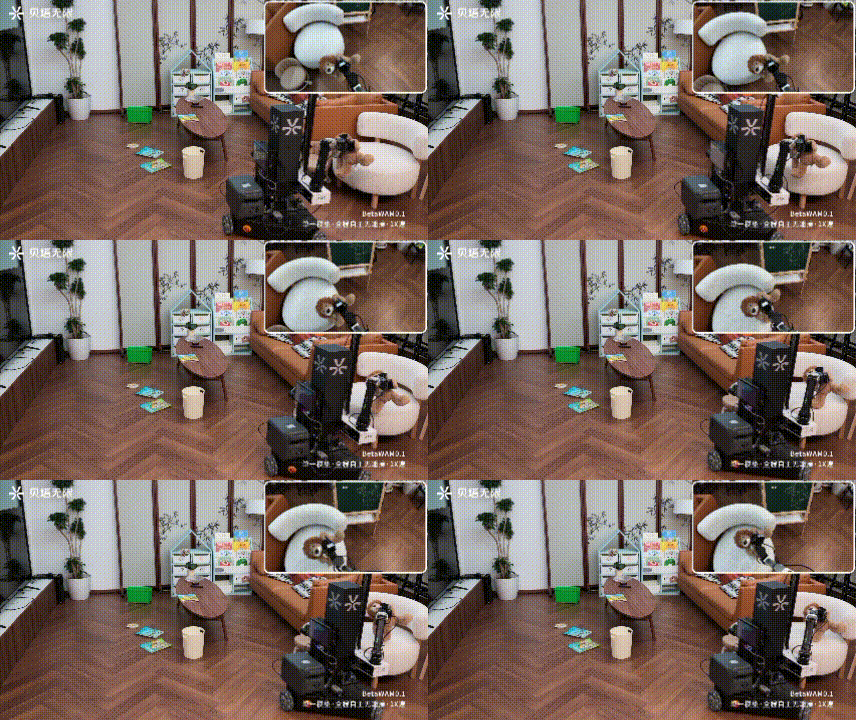
One of the most immediate sensations of the whole demo is that the robot is not demonstrating a set of actions, but is doing something. It knows which items have been picked up, which have not yet been processed, where the receiver is going, where the next step is to go.
02.
The memory of the mouse moves the mouse to verify the closed loop of the mouse.
As you can see here, you may have noticed that robots in the demos, which are not like robots, are behind a completely different set of system designs.
Current industry mainstream routes are essentially solving the optimal execution of single-point tasks, VLA models answer questions about what to do in the current picture, and world models answer questions about what the world will look like in the next step, but both lack a key link: how to maintain mission status in space mobility?
BetaWAM0.1 is at the forefront of a fundamental conceptual shift that combines cognitive judgment and understanding with physical memory, and a dynamic judgment of the world formed by continuous observation, action and feedback that can be overturned by new evidence.
This nature intentionally separates two things: historical evidence and current state. Historical evidence has indeed occurred, such as an image of a moment, an instruction to capture, a sensor reading, a user feedback, which must be traceable and cannot be retrieved by logical reasoning. The current state is a systemic judgment, such as a cup of tea is likely to have entered the left side of the cabinet, but the cabinet door is closed, it must be confirmed, the status is allowed to be inferred, and it must be updated with new evidence.
After separation, the context of the environment is transformed from a stream of water into a circle: evidence supports the state, states restrict action, actions bring new observations, and new observations return to verify or correct the state.
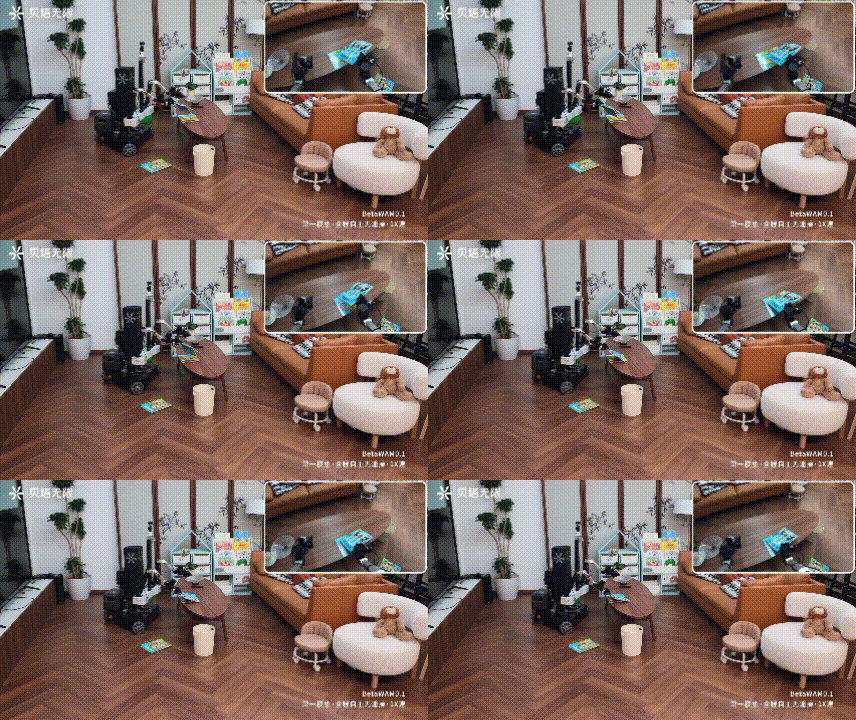
So how is this judgment formed? and how is it operational service? Memory is organized in three dimensions.
On the carrier dimension, token memory carries a readable, traceable state and task record; latent memory does not convert into text, retaining visual, spatial, contact-force details directly in vector form; parametric memory embeds repeatedly verified stability experiences into a strategy or model.
At the functional level, real-time memory maintains continuity of action; physical memory tracks objects and locations; situational memory sequences events and evidence chains; experiences and skills memory refine inter-tasking repeatability methods. The four are fluid: real-time observation updates the state of an entity, a series of state changes constitutes a scenario, and multiple scenarios are absorbed into the experience.
On the circuit dimension, online circuits have a low delay in reading, writing, updating, and validating, and are responsible for making this time as a pair; offline consolidation circuits do reposition, aggregation, abstraction, and attribution, and are responsible for making the next time as a pair better.
More importantly, the memory architecture is not operated in isolation, it is deeply intertwined with the VLA (Visual-Language-Action Model) and World Model (World Model) models. The VLA no longer looks at the current few images, but accesses short-term motion states and long-term physical experience, reducing the amount of torque targeted by the torque to grab the vacuum and torque the same object repeatedly.
It is this type of memory pump that activates the verification loop of the pump, supporting the uninterrupted execution of long-range tasks in the demo.
And this is precisely the technical expression of human-centered robotics. Because a robot that really understands humans is not passively executing orders, but is able to stay alert to the world like a human being, knowing when to confirm, when to ask, when to adjust.
Memory gives robots the ability to be accountable to human beings and gives them context in every operation.
03.
Beta Infinite is a journey from a mouse action to a mouse mission to a smart mouse upgrade.
The BetaWAM route in Beta Unlimited is a deep understanding of the nature of consumer-grade physical intelligence. Laboratory demos only need to succeed once in a controlled environment, and home services need to succeed a thousand times in an open environment. The gap between the two is not in computing, not in agility, but in continuous monitoring of the state of the world, reliable maintenance of task progress, and elegant recovery from abnormal situations.
In a nutshell, it's an upgrade from a mouse action to a mouse task.
In Beta Infinite's design philosophy, the technical expressions of human cognition permeate the design principles of every dimension of memory architecture. The robot remembers not only the state of the physical world, but everything the person lives with it. When the robot carries these cognitions to complete each grab, each collaboration, each escalation, it is no longer a tool for executing instructions, but a truly human-centered cognition body.
And this time, Beta Infinite demonstrates real-world engineering in real-world scenarios: not only do they have the core engine that drives the upgrading of operations, but they also have the real ability to support long-range complex operations and amplification, which is the core key to Beta Infinite's smartest people.
It is reported that Beta Unlimited is currently working on the development of its first original product, which will feature its self-developed technical architecture.
04.
What is the meaning of this verse?
BetaWAM 0.1's real-machine operation demo is a key step in the evolution of the architecture from theoretical to practical. It announces the competition for physical intelligence, which is shifting from a single point of operation to a single point of operation.
Just in time for the upcoming 2026 World Robotics Congress (WRC 2026), Beta Infinite Co-Founder and CTO Ceramics will take the stage in an AI-powered robot model exchange event with a new paradigm of the AI-enabled industry, delivering a speech entitled "Human-centered robotics: a new paradigm of human-machine interaction for the human-machine interaction scene".The speech can be seen as a systematic exposition of the technical concept behind the demo. While the industry is still chasing the limits of single-point operations, Beta Infinity has drawn the narrative back to a gritty dimension.
When a robot has excellent space and physical comprehension, but also memory attributes, when it is able to remember the location of objects, to project the existence behind a veil, and to recover autonomously in the event of failure, it truly has the ability to serve the family for a long time.