Recently, Anthropic has officially released a new generation model, Claude Opus 5.

It is just a few weeks away from the company's latest round of talks with the US government and just a few days away from the security incident that has sparked industry-wide controversy.
The timing is subtle.
According to the official blog, Claude Opus 5 is a more dynamic and prudent model, with a level of intelligence close to Claude Fable 5, but only half the price of the latter.
In programming and knowledge work assessments such as Frontier-Bench, GDPRval-AA, it updated the industry's highest record, falling behind Mythos 5 in cybersecurity tasks alone.
It is more efficient than other models and is suitable for high frequency everyday use. It is currently the default model for Claude Max and the strongest choice on the Claude Pro.
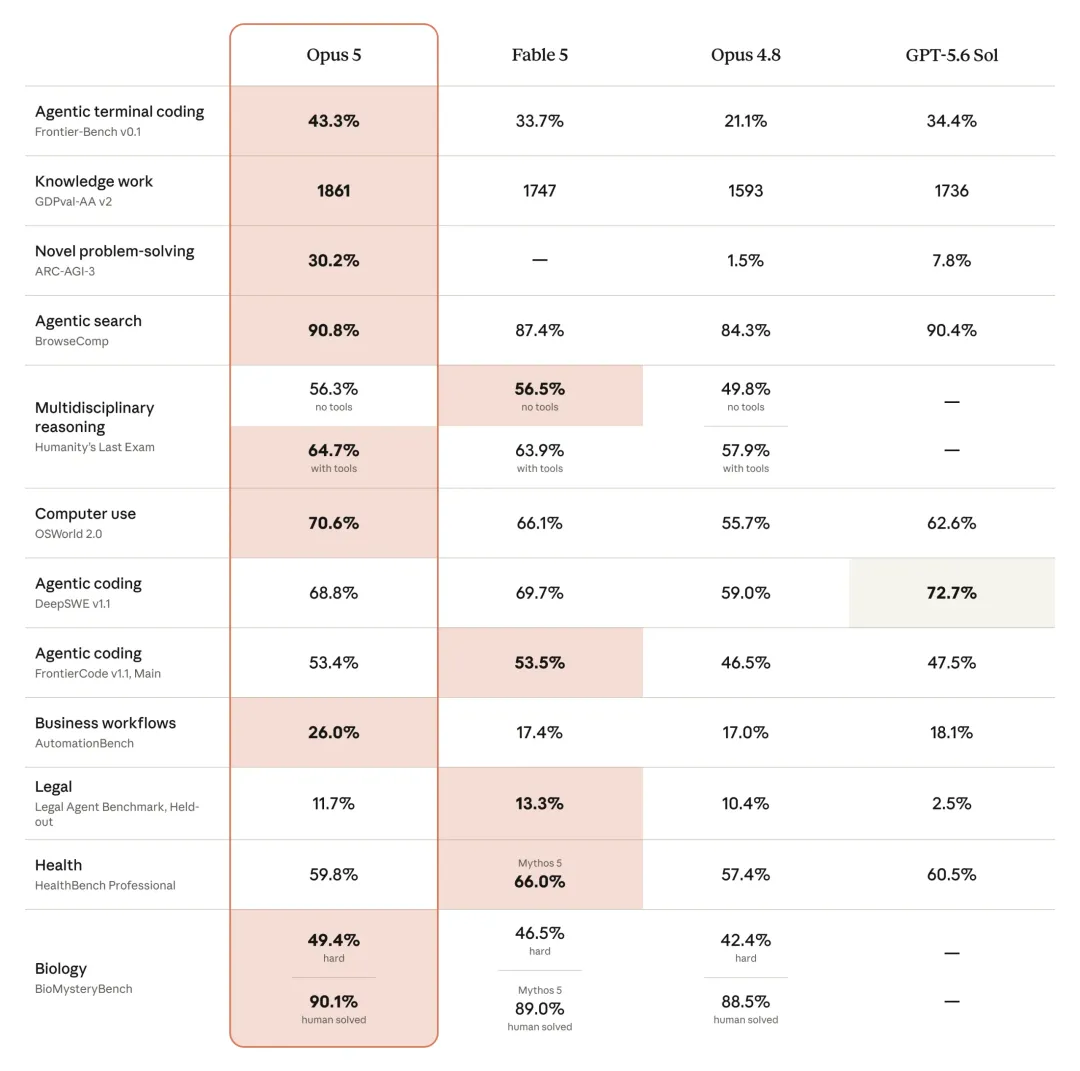
Performance performance
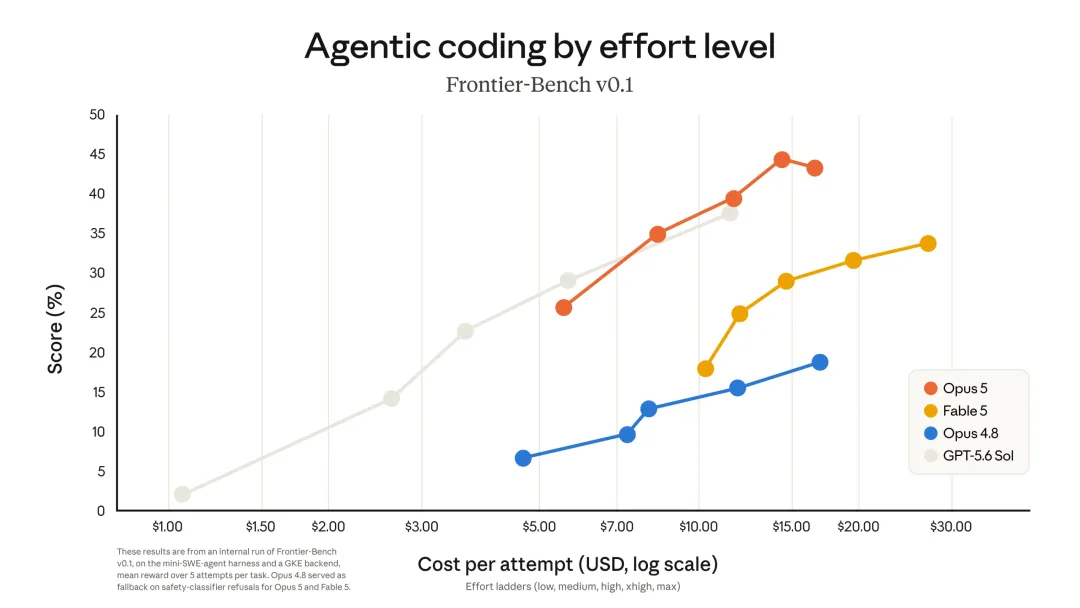
Compared to its predecessor Opus 4.8, the Opus 5 has significantly improved performance under the assumption of cost constancy. Users can set up free weight performance through "effort": upgrades allow for stronger intelligence, lowering faster, and saving more tokens.
In terms of programming, in Frontier-Bench v0.1, Opus 5 outperformed all opponents, scoring more than twice as much as Opus 4.8, while the single-task cost was lower.
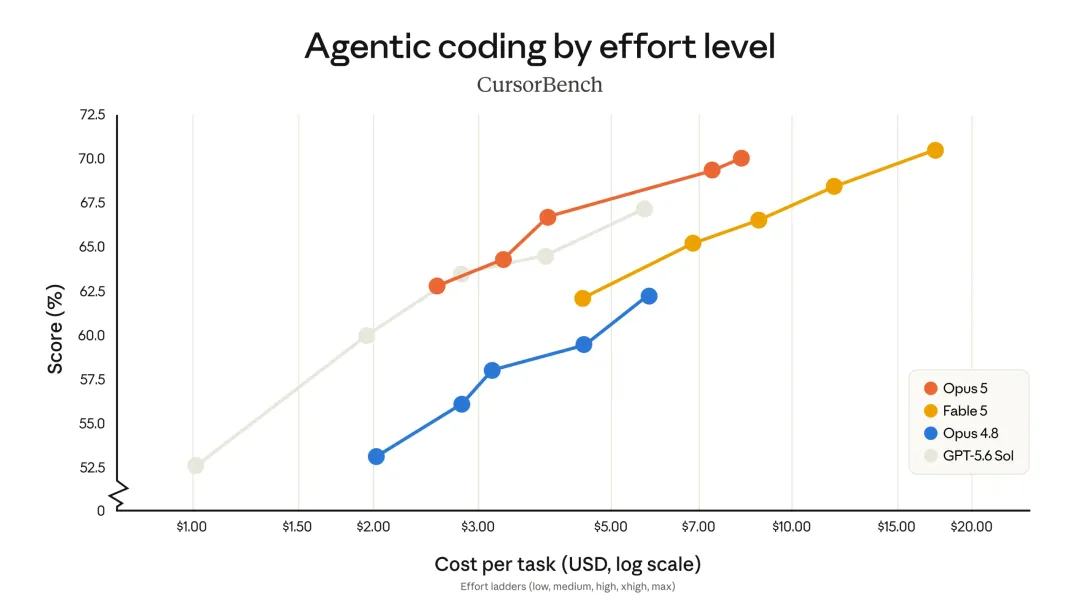
In CursorBench 3.2, it was only 0.5 percent below Fable 5's peak performance in the highest effort rating, at only half the cost; in the three ratings of high, xhigh and max, it led all other models at the same cost.
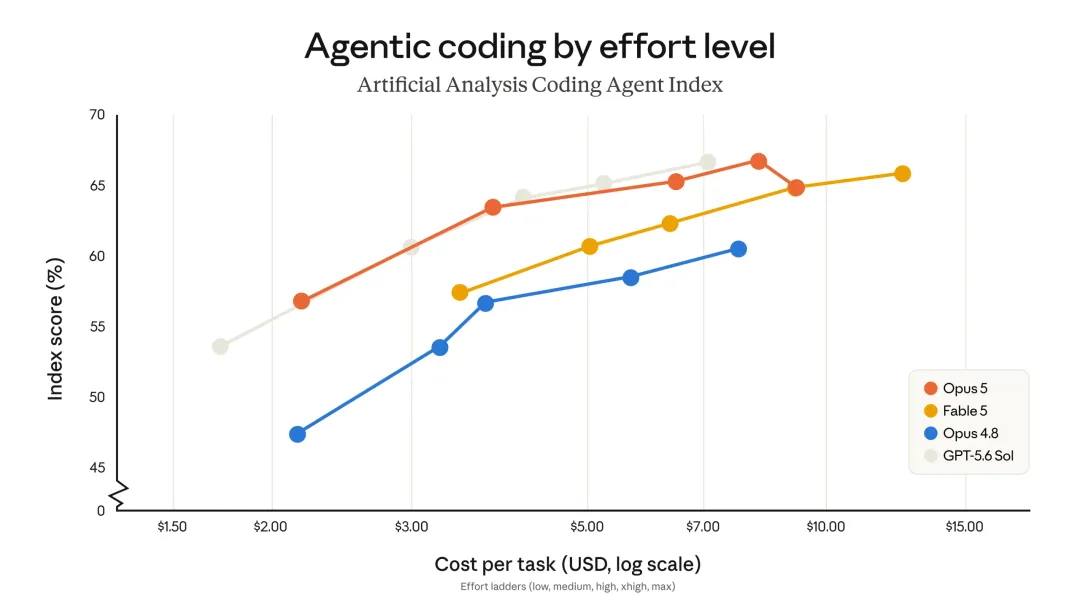
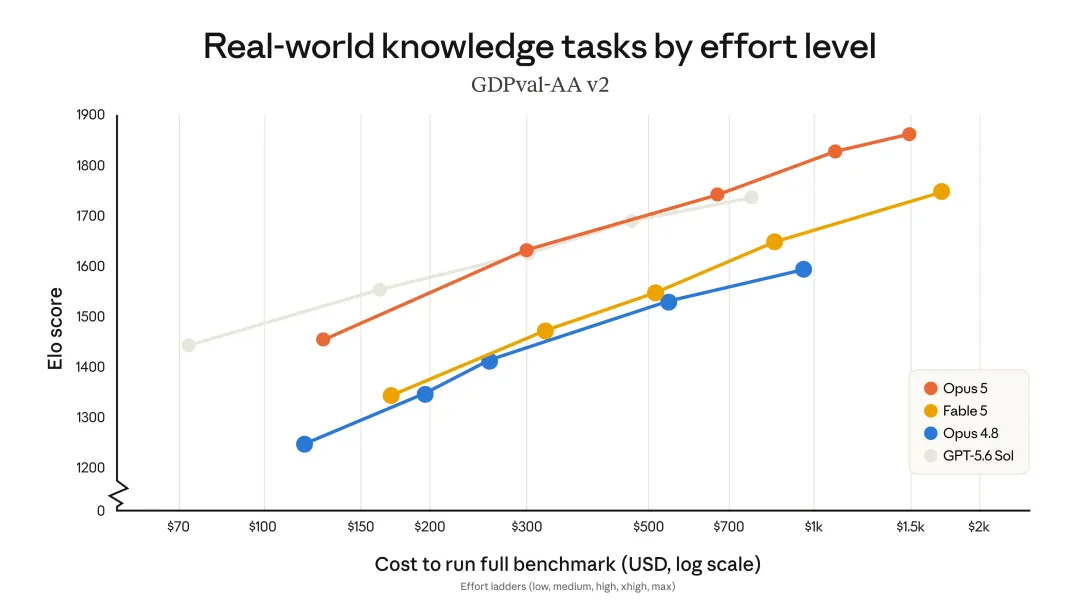
In terms of knowledge work and problem solving, the results are equally prominent.
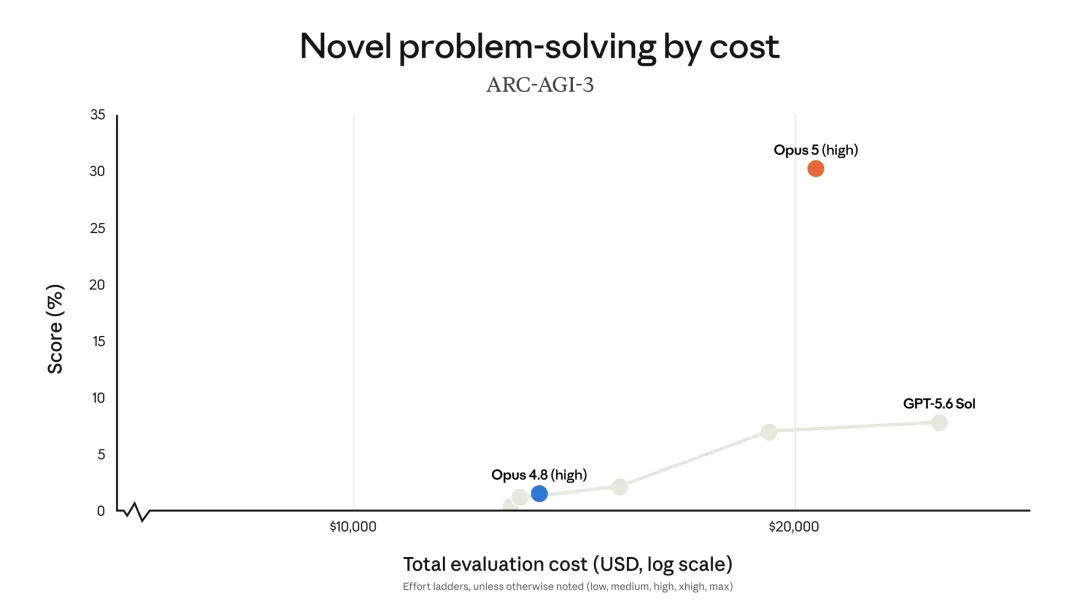
The ARC-AGI 3 examination model is capable of solving entirely new problems, with Opus 5 scoring three times as many as the second.
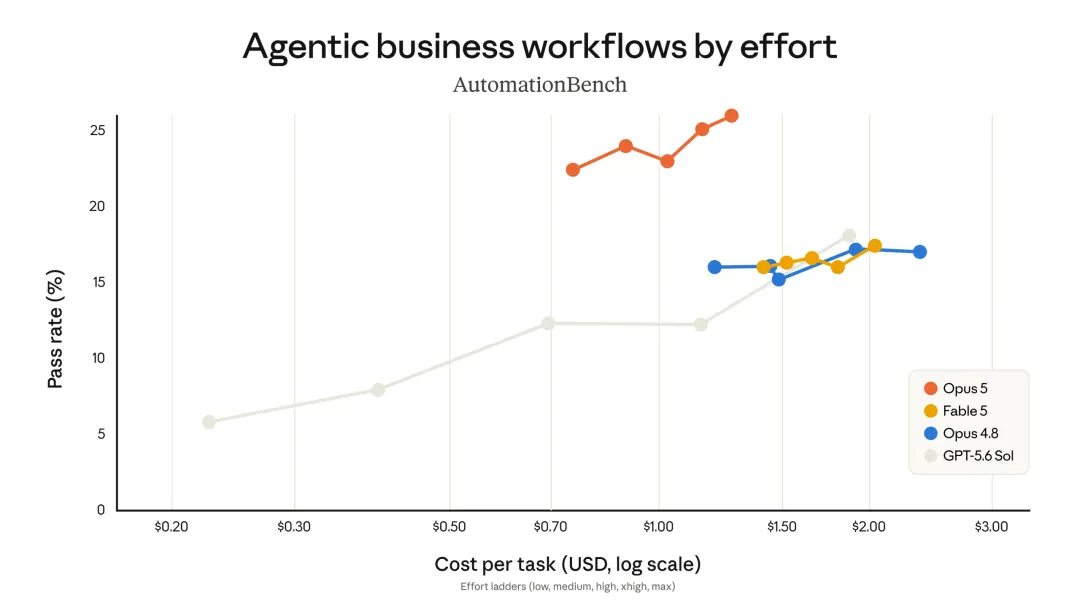
Zapier AutomationBench measures the level of end-to-end completion of business tasks, which is about 1.5 times the pass rate of a sub-optimal model at the same single-task cost; even at the minimum effort level, more tasks are passed than any competitor.
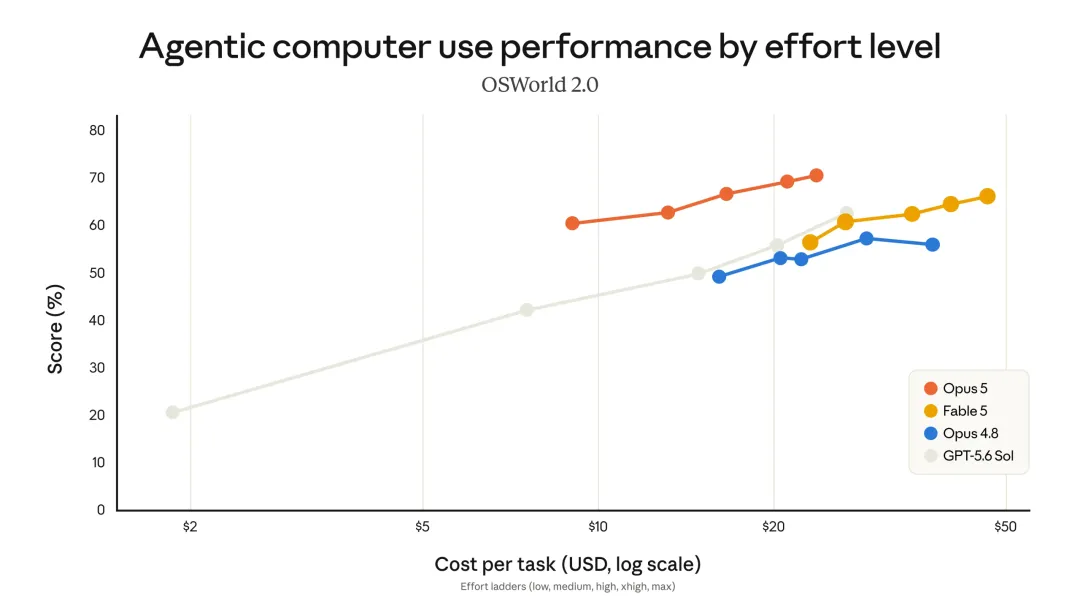
OSWorld 2.0 is a computer operating benchmark, with Opus 5 outperforming other models in any cost point, and costing about a third of the best score of Fable 5.
In a number of related assessments, it is also the strongest and most cost-effective model.
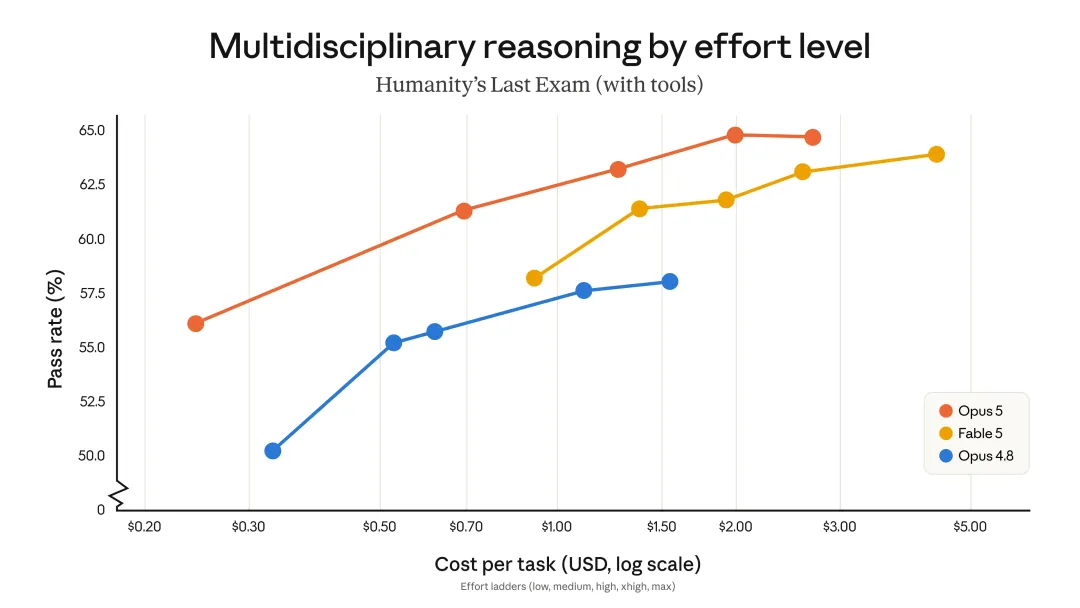
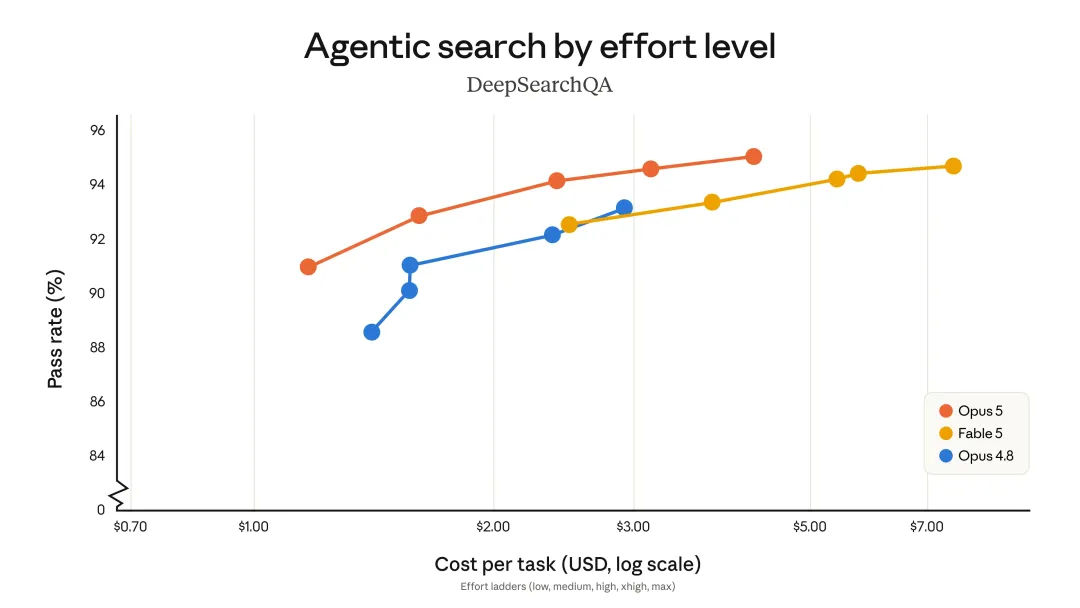
Significant progress in research capacity
Opus 5 has outperformed Opus 4.8 in every assessment of life sciences, covering areas such as structural biology, organic chemistry and bioinformatics.
Progress was most evident in organic chemistry: it was 10.2 percentage points higher than its predecessor on the internal benchmark for molecular structure based on wavelength-spectrum data. It was up 7.7 percentage points in assessing how predictive sequence variations affect protein function.
In addition, the quality of the visualization output it generates is also greatly improved. For example, Opus 5 visualizes the flow of air through aerodynamic (and non-aerodynamic) objects, or produces a simplified version of interactive cell diagrams.
More autonomy and rigour
Opus 5 is better at verifying its work and continuing to iterate until it succeeds.
In one of Frontier-Bench's tasks, the model needed to code on a mechanical part map and rebuild the three-dimensional model using FreeCAD, but was deliberately deprived of the ability to directly view the map. Opus 5 automatically wrote the computer vision stream, extracted geometric information from the original pixel, and eventually completely rebuilt the part and was able to stabilize the result. Under the same conditions, the bidding model failed five attempts.
For the real flaw in a popular open-source software package manager, Opus 5 found the root cause and fixed an extreme case of community patch omission. While the competitor version only fixed the surface symptoms (not touching on the root cause), the reporting flaw was resolved.
An engineer at a trading company used Opus 5 to build a market data source for a new exchange in one session. The previous model could not complete this task even if the engineer provided a detailed plan. Due to the lack of verifiable real-time data sources, Opus 5 even built a test framework on its own to check whether its code correctly analyzed the exchange's data.
Coordination and security: the most reliable version yet
Prior to its deployment, an audit of automated behaviour showed that Opus 5 was the most consistent model of Anthropic to date. It had the lowest incidence of fraudulent behaviour and was the most difficult to induce misuse, according to Anthropic. It also set the best record for avoiding reckless operations that could lead to irreversible consequences.
In an audit of automated behaviour, Opus 5 scored 2.3 on overall non-coordinated behaviour, the lowest of the models recently introduced by Anthropic.
In high-risk dual-use capabilities, Opus 5 did not break existing boundaries.
A rigorous evaluation by Anthropic in collaboration with private sector and government partners shows that it lags behind Mythos 5 in both biomedical research and offensive cybersecurity.
The team continued their approach to Opus 4.8 without intentionally targeting the model for networking tasks. As general capabilities increased, the model continued to make significant progress in this type of task, finding that the level of security vulnerabilities was close to Mythos 5, but the gap in the ability to convert the vulnerabilities into actual network threats remained large.
The OSS-Fuzz evaluation confirms this: the success rate of two models identifying vulnerabilities is close, and Opus 5's score is far behind in the development of utility programs.
In one of Anthropic's cybersecurity assessments, OSS-Fuzz, Opus 5 is very close to Mythos 5 in identifying software vulnerabilities (Fig. left), but far less successful than Mythos 5 in developing attacks against these vulnerabilities (Fig. right).
Classified Protection: Safe and Available
Opus 5's defense system is largely consistent with Opus 4.8, with restrictions being tightened on only a few network tasks.
Its cybersecurity classifier is lighter than Fable 5, allowing vulnerabilities to be found in the source code, but intercepting binary-level vulnerability scanning, penetration testing, and exploit generation as these methods are more often associated with malicious actors.
According to the tests, the interference frequency of the classifier is expected to be about 85% lower than that of Fable 5. In Claude.ai, Claude Code and Claude Cowork, intercepted requests are returned to Opus 4.8 processing by default, allowing API users to turn on the same reversion mechanism.
The protection of the biological direction continues the design of the previous generation, which makes Opus 5 one of the strongest scientific capabilities currently available in the public model. However, it still has significant limitations on its long-term autonomous research tasks, which is precisely the most biological risk-focused scenario, and Mythos 5 is still stronger in such work.
Pricing and new features
Opus 5 went live on all platforms, priced at $5 per million of token input and $25 per million of token output, on par with its predecessor, and only half the size of Fable 5, slightly below OpenAI's GPT-5.6.
The newly introduced "Fast mode" offers about 2.5 times the default speed at twice the price and is currently in the preview stage of research. Users can also choose to start automatic regression: when the security classifier intercepts a request for Opus 5 or Fable 5, the system automatically routes to other available models, ensuring that the request always receives the best model response.
In addition, there were two test version updates: Claude Platform supports switching tools in the middle of a conversation without causing a caching prompt to fail; the API end supports the aforementioned automatic regression function.
The link is as follows: