AI music tools have been around for years, and the songs generated are becoming more and more like that, with the unicorn Suno valued at $5.4 billion and the track's heat staying high. But what's counterintuitive is that most people who have used AI to make songs give up once they try.
It's not that the sound quality isn't good enough, or the speed of production isn't fast enough, but that every time something is produced, it always feels so bad.
He wanted a gentle healing atmosphere, the melody that came out a thousand times. He wanted to fine-tune people's voices, to make hard machinery. He wanted to fine-tune the details of an instrument, only to repeatedly change the prompts, reproduce, bend for most of the day, and finally unable to delete it.
Almost everyone who has ever used AI music instruments has experienced this feeling.
What is the problem?
It's not that your inspiration isn't good enough, or that AI isn't strong enough. It's that there's a fundamental flaw in the middle, that what's in your mind and what AI can take in is two languages.
Why do you mean "almost"?
A neglected structural flaw
American physicist Feyman tells a story in his autobiography.
He had a habit of counting silent numbers in the lab, from one to sixty, which was almost a minute. When he counted, he discovered a strange thing: reading a book at the same time, no problem.
At lunch, he told his colleague John Tukey about it. Tukey was a mathematician, and after hearing an incredible face: What's so hard about talking in numbers? I have no problem at all.
The two of them looked at each other.
As it turns out, the Feyman numbering method is in the brain, where the mouse hears a number, one, two, three, four, one voice after another. Since the mouse mouth in the brain is busy with numbers, the mouth outside is naturally speechless.
Feyman later remarked that even if the numbers were so simple, people thought they were doing the same thing, but the way their brains worked might be completely different. Some people thought by sound, some by pictures, some by rhythm and rhythm.
The discovery explains the difficulty of the AI music industry.
The people in their minds who hear the melody of the chorus, the people in their bodies who feel the rhythm of the chorus, the music in their minds is the sound, the rhythm, the ups and downs of the emotions. But when they translate the chorus to AI, the only channel they can use is text.
Asking an audible person to describe the melody in his mind in writing is like asking Ferman to count with his eyes, not impossible, is incorrect, and the information is doomed to be false.
It's not a question of who, it's a structural bottleneck that the entire AI music industry has had since day one.
Suno is strong.
But Chinese music is always a pain.
Speaking of AI music, don't miss Suno. The unicorn just completed a new round of financing in June this year, valued at $5.4 billion, seated the head of global AI music in the chair. Its ability to produce English songs can indeed play, and many people will be surprised when they use it for the first time.
But if you've tried to get Suno to do a Chinese song, the experience will turn upside down. Bites are hard, tones are twisted, voices are made, and Chinese lyrics are almost completely lost in rhythm and tone. The reason is not complicated: Suno's training data is primarily in English, and the Chinese context for it is a kind of foreign accent, it doesn't understand the subtle tones, air controls, and syntactic rhythms in Chinese.
It's like getting an American singer to sing a Chinese song, and the lyrics may be right, but the taste is always bad.
While the word "A" has a very specific meaning in AI music, it is not a basological concept, but is determined by the depth of the model's understanding of specific languages, specific cultures, and specific aesthetic habits.
The tangy taste of Chinese songs, the delicate bites of words, the long voices, the flow of emotions between words, cannot be solved by more data, but requires models to be optimized for the Chinese context from the underlying architecture.
This is the biggest opportunity for domestic AI music and certainly the most difficult step.
This is the second year in a row that I have taken the WAIC theme song.
What's up?
Before we talk about the great model of country music, we need to say something that illustrates the problem.
The latest hot WAIC World AI Congress, its official theme song, is actually based on the same homegrown self-developed large-scale model, AI For Good, released in 2025, and AI For Good, released in 2026.
Everyone familiar with WAIC knows that this conference is the top event of the domestic AI circle, the selection of the theme songs is quite rigorous, and the annual bidding team wags tiger tiger.
When AI For Good came out in 2025, it actually broke many people's stereotypes. In the past, technology has largely escaped from the soundtrack, the complexity of heavy metal, psychedelic electronics, the cold, seriousness, the sensation of distance. But this pure AI-made track, which follows the path of youth, gentleness and strength, also made the industry notice for the first time: domestic AI music, can also accommodate the sensation of technology and human emotions.
One year later, the band's upgraded sound wave model brought the band together to create a future that is even more visible to the naked eye. The core of the entire song's creation is clear: AI is not frozen data, but a partner that goes hand in hand.
The most distinguishing features are its bilingual design, its emphasis on Chinese, its commitment to companionship, and its subtle touch. English focuses on exploration, breakthroughs, global connectivity, and the layout is very open. The two languages are naturally unbreakable, both showcasing the ability to model their own models, and hiding the core of the boundless shell of nanotechnology, adapted to the global stage of WAIC, and the processing of details is quite mature.
However, it is not the song itself that really makes people sit upright, but the production behind it.
According to the traditional pattern, the official theme song of a top industry event, from the initial creative pairing, writing, composing, composing, recording, to the later mixing, refining, repeatedly polishing the draft, the entire process goes down at least two to three months, the million-level budget is normal.
The Soundwave team, using modeling capabilities, directly compressed this set of traditional processes into an afternoon.
Based on the mass-creation capabilities of the sound wave model, the team, based on the theme, stylistic tuning and core demands of the WAIC conference, mass-produced hundreds of high-quality original tracks, then selected the best, finely crafted and finely crafted pieces, ultimately finalizing the project to create the future.
Cycles, costs, creative limits, triple-dimensional breakthroughs.
So, for two consecutive years, taking the official theme song of WAIC, is not luck adding, is not an official preference, is the result of aesthetics, technology, landing capabilities in all aspects online.
The sound wave is updated
Rebuilding from the ground up

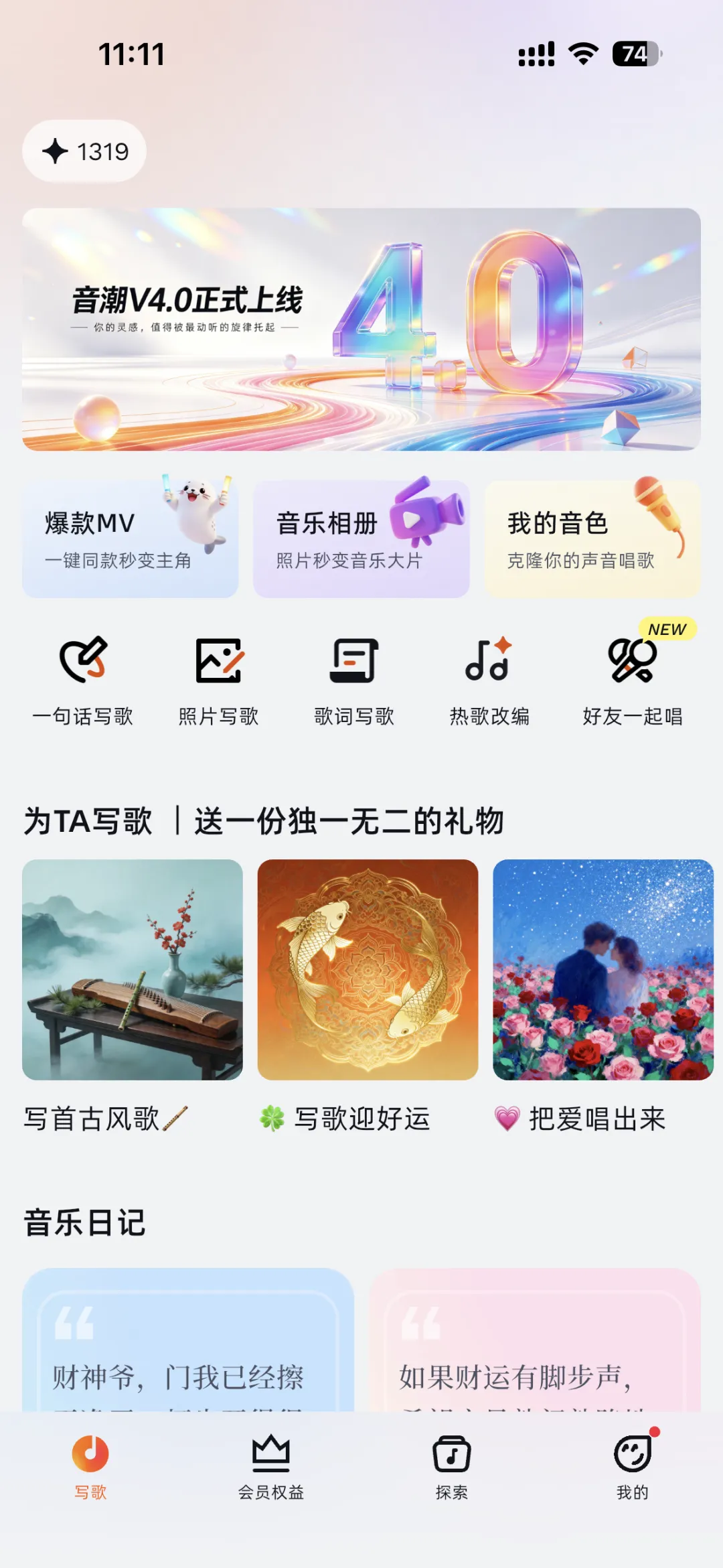
On August 14, V4.0 was officially released.
Two consecutive years of practical verification of the WAIC theme song have demonstrated the fundamental function of the sound wave model. But this major update is really worth considering, not a continuation, but a leap.
To conclude: this is not a single version tweak, but a full-scale reconstruction of the underlying architecture. The transition from the sound wave model V3.5 to V4.0 is not a patch on the old model, but a re-training from the underlying, with core changes concentrated in three dimensions, instructing understanding, mood displacement, and curve segmentation.
Going back to the beginning of Ferman's framework. If past AI music tools only serve people who are visually impaired and logically impaired, but also those who are able to describe exactly what they want and translate emotions into structured text, then what the Sound Wave Model V4.0 is trying to do is make people who are hearing impaired, who feel melody and rhythm but can't speak, who can also be picked up by AI.
For those who have voices, emotions, images in their minds, but are struggling to translate them accurately in writing, there is finally a way to create their own.
Its iterative logic is pure: let AI music go from being passive to guessing you want to sing, to evolving to be proactive, to understanding what you want to sing.
Testing the Contrast
The Real Difference
It's better to speak, rather than listen directly.
We made a blind comparison of the V3.5 and V4.0 sound wave models, and it was clear that the gap between the two generations was far from a blur, but a transversal progression.
The first set of tests used the overseas general specialized Prompt: a warm, vibrant and lightly enjoyable world music, warm male vocals, fusion of synthesizer bass and percussion instruments.
V3.5 barely recognizes the basic pitch of the melody, but is unable to bind the emotion, the wind, the meter deeply, the whole piece is flattened, the lack of rhythm and atmosphere is a commonly spoken nonsense.
The sound wave model V4.0 accurately locks in the three keywords of warmth, rhythm, and pleasure, with a smooth, fast-paced rhythmic rhythm of Latin music, which creates the atmosphere, mood, style, and completeness of the work.
The second set of tests was more interesting. The suggestion was to play a light blue melody, an upbeat male voice, and a combination of electric guitar and jazz drums. Although both generations of the model produced blue music, the gap in texture was apparent, and the V3.5 was oriented towards a mass-produced streamlined waterline style with no emphasized curvature characteristics.
The sound wave model V4.0 accurately restored the classic twelve-part orthodox blues structure, perfectly matching the human voice texture, purity of style and detail of the original version.
The third set of high-level tests. The pointers contain a variety of instruments: a melancholy, emotional, warm Korean pop song, a fusion of acoustic guitar, electric piano and cello.
In V3.5, the original guitar and violin were severely weakened, the instrument levels were blurred, and the overall composition was a thin void.
The sound wave V4.0 accurately pinches the tonal characteristics of each instrument, the warmth of the guitar, the clarity of the depth of the violin, the fusion of nature and harmony of the multi-instrument, perfectly fitting the melancholy and warm core mood tone.
These three sets of tests point to the same thing: Soundwave V4.0 no longer mechanically executes your cue words, but actually reads the images and emotions behind the text.
This is behind the fundamental improvement of the model's ability to understand instructions. In everyday creations, the input words are mostly fragmented, verbal, emotionally charged, and people want to write a late-night emoticon that needs that kind of toning to heal. The older version of the model is easy to use mechanical parameters that can't be combined with contextual blending, and the final product naturally deviates from expectations.
The sound wave model V4.0 introduced this vague, sensory, auditory sound, and translated it into an internal representation that the large model could execute accurately.

After you read it, you read it.
This is just the beginning.
The underlying redesign of the Soundwave Model V4.0 also unlocks the two previously missing capabilities of domestic AI music.
One is full language coverage. Soundwave V3.5 has supported multi-language creation in China, the UK, South Korea, and the West, and V4.0 on this basis adds the five major languages of Russian, German, Portuguese, Italian, and French, achieving full coverage of the world's ten main languages. Combined with years of deep-rooted accumulation of Chinese context and indigenous aesthetic advantages, Soundwave Model V4.0 has completely broken the inherent bias of domestic AI.
Second, pure music generation is fully open. Prior to the sound wave, pure music creation capability was only available to B-side commercial customers, and after V4.0 was released, ordinary users were free to use, producing works with their own choice of two modes. Short video atmosphere, BGM, video soundtrack, stage accompaniment, healing of daily stress, pure sound, one-key generation, covering personal entertainment, professional creation, commercial scenes.
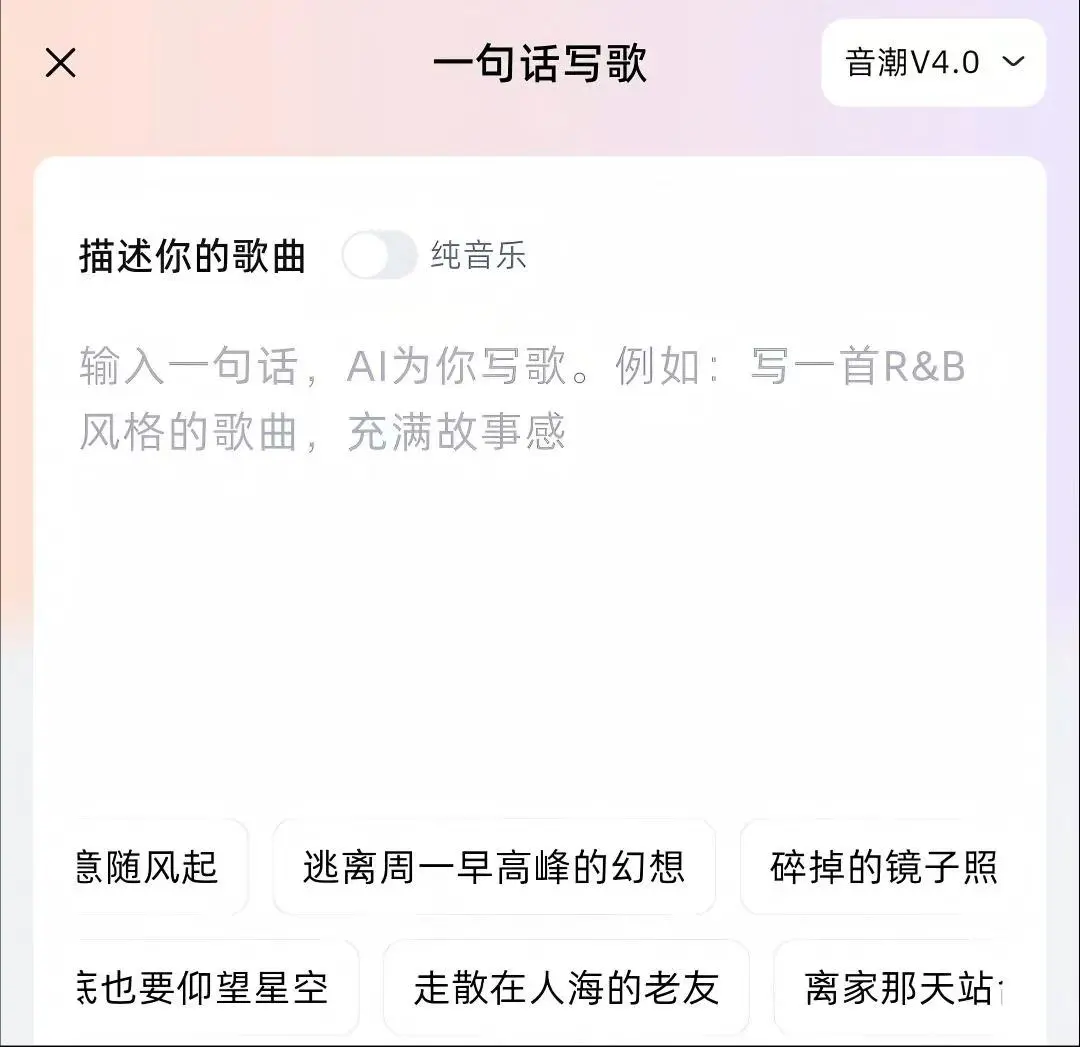
These two abilities appear to be a functionality update, but in fact they point to the same judgment: the end of AI music is not to let everyone do the same song in the same way, but to let people of different types of thinking, the needs of different scenarios, find their own creative channels.
Algorithms + Calculus Doubling Domestication
We're really moving towards diversity.
In AI music, the technical strength and landing results are hard to come by. But the sound wave team has a deeper differentiation path, often overlooked, to the dual nationalization of algorithms and calculations.
The sound wave model relies entirely on the homegrown GPU to complete training and iteration, completely freeing itself from dependence on overseas computing.
The meaning of this is far more than just a sense of humor.
At present, the stability of the computational supply chain has become a reality that all AI companies must face. If an AI company relies on overseas GPUs from training to reasoning, there are external risks to its technical routes, iterative pace and even product pricing.
From day one, the Soundwave team chose domestic computing, which means it has a stronger control over the technological route, an unfettered pace, and longer-term costs.
More importantly, training models capable of marking Suno on domestic GPUs is itself a validation of the availability of domestic computing.
At the product level, the Soundwave team has formed a complete matrix: the Soundwave APP is aimed at the average user, focusing on lightweight instant creation, fastest 15 seconds out of melody, one minute generating original songs with full human voice, and the platform currently has millions of users, producing tens of thousands of original music every day.
Soundwave Studio is geared towards professional musicians and provides a highly controllable, high-precision creative workstation that supports customized rhythm weights, creative randomness adjustment, and fine-tuned paragraph breakdowns, equivalent to an exclusive compositing assistant available 24 hours online.
Hitto is aiming for the overseas market, with a new gameplay layout for dialogue-based songwriting around the world, and currently has a good reputation overseas.
The API platform, aimed at enterprises and developers, provides standardized interfaces, consolidates the four core capabilities of song generation, song generation, song copy, song expansion, and is currently in a free trial phase for a limited time.
C-terminal products + professional tools + outbound + B-terminal, the four lines coming together rather than just by a single theme.
The team configuration is also interesting, the algorithm technology team and the Koban musicians cross-pairing, the programmers exploring the rhythm and the logic of the music, the musicians deeply involved in the model iteration, this combination effectively avoids a lot of AI music, melodic rhythms, soulless choruses.
Earlier in his career, he worked at a large audio technology factory, initially with the intention of making AI music and even with a bit of a romantic color, and wanted to make an exclusive tribute song for his wife, but found that the production of traditional music was moving for tens of thousands of weeks, a cycle that did not appeal to ordinary people, which led him to create a universal AI music tool.
From being able to listen to you to being able to listen to you.
Back to Feyman's discovery.
Later, he often recalled the numerical experiment. Especially when teaching a very difficult lesson, he saw the numbers of the equation: the symbols are colored, J is brown, N is purple, X is black, floating around. He did not know how the students saw it.
This excitement, in fact, is one of the most important questions the music industry needs to answer: How are your users listening?
For a long time, the design logic of AI musical instruments has revolved around people who are visually impaired and logically impaired, but those who are hearing impaired, those who have melodies, rhythms, and emotions in their minds, have been ignored by this logic.
Soundwave V4.0 doesn't make AI music stronger, but it makes AI music more capable of reading music, reading the images behind the text, reading the emotions between the prompts, reading the musical intuition that can't be accurately described but is real.
This is what it means to be poor, from a mother who can listen to a mother to a mother who wants to listen to a mother.
And when AI music really started to read and understand people, the creators of audiophiles who had been pushed out of the door by text channels, finally had a path of their own.
The next stage of AI music may not be the one that produces faster, the one with the biggest parameters, but the one with the best melody.
Note: Soundwave V4.0 is available for all platforms as of August 14, and the Soundwave APP, Soundwave Studio, Hitto and API platforms are being updated simultaneously. The API platform is currently in a limited free trial phase, with all enterprises and developers willing to work together to access the full API interface for free once they have completed the pairing.
This is the first time we've seen this.
Soundwave AI music creation platform: www.yinchaoyongxian.com