On August 12, 2026, the first edition of the Agency Memory Leaderboard (AML, Chinese:
At a time when the industry was cheering for the big model's 2 million token upside-down window, the front-line Agent developers have hit the real-world iron wall:
Clogging the model with vast historical records not only brings with it an API bill that explodes exponentially, but also creates a great deal of delusion in a long, noisy ocean of information. Failure rules are repeatedly enforced, outdated preferences cannot be eliminated, craters trampled on the previous round repeat themselves in the next round...
For Agent, long-term memory is the foundation for long-term collaboration, which determines whether it can truly get out of the Sisyphus' dilemma that has been plaguing Agent forever.
On August 12, 2026, the Agency Memory Leaderboard (AML), a collaboration between the top 30 research institutions in the world, including the University of Oxford, Ningbo, and overseas, was officially unveiled at Hugging Face Space. The first list was released less than 48 hours later and sparked explosive discussions on GitHub, the Hugging Face community, and overseas technology communities such as Twitter/X.
The phenomenon of heat
This is the story of a mysterious memory in an agent circle.
For the past two weeks, the answer to the question of what is the most popular developer's assessment in the field of Big Model Agent is undoubtedly the Agent Memory Leaderboard (AML). AML is committed to ensuring that key variables outside the memory system are as unified as possible, allowing different evaluation systems to be tested under consistent conditions, so that they are assessed fairly, fairly and openly against memory systems.
AML exploded the global developer community at the beginning of its release. According to AML's disclosure, the official site went online in just two weeks, and the number of clicks quickly surpassed 200,000, and the first event received cumulative entries from more than 100 teams. On August 12, AML's first list was revealed in sync with HuggingFace and the official website, driving the heat to further spread to the community: the listing in less than 24 hours, the readership of relevant topics in overseas technology media such as WeChat Public, Twitter/x, and more quickly surged to hundreds of thousands.
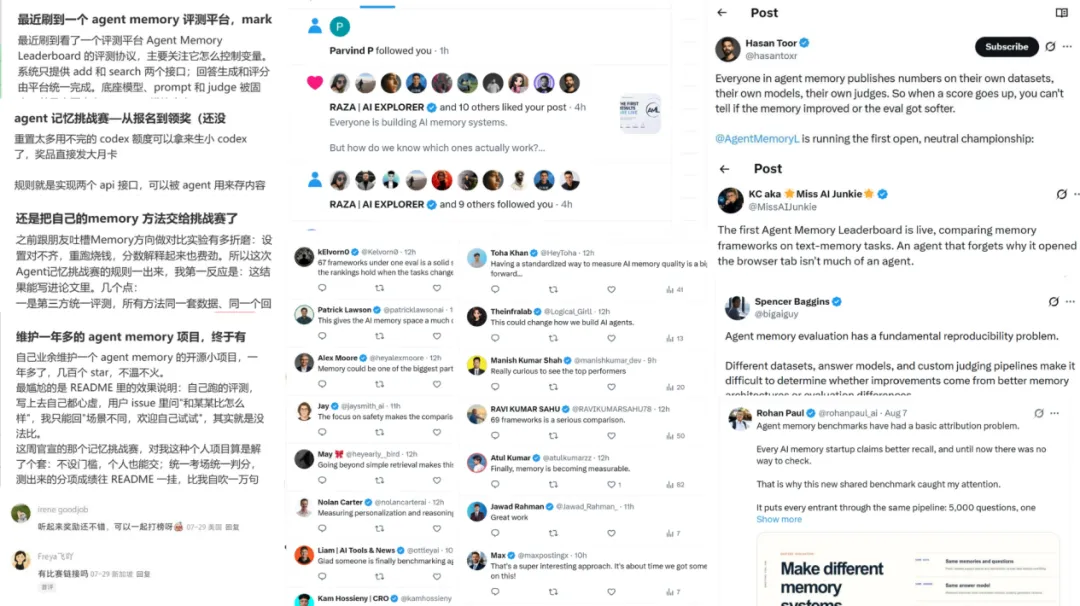
The official social media account of AML
It is worth noting that the focus of the technical discussion is not only on scores and ratings themselves, but extends to the structural logic of the industry evaluation paradigm, the standardization of contracts, the impartiality of the evaluation process, the integrity of the evaluation data, etc. The community no longer merely looks at the ratings, but takes a serious look at the long-term value of the rating mechanism itself.
Why AML?
Triple isolation, creating an authority scale that measures memory
AML was born out of an increasingly clear industry consensus. The larger the context window for large models, the larger the window, but the longer-term memory capacity of the Agent was not as high. In the past, the industry evaluated an Agent's memory as poor, often without a unified dataset, answering models, hints, and judging models. The final score may be simply because of the use of a stronger downstream generation model, or because of the optimization of adaptation for a particular Prompt, which makes it extremely difficult to make direct, objective horizontal comparisons between different memory systems.
To address this real pain point, AML has built the most rigorous and fairest memory assessment system in the industry today, with three hardcore designs:
Separate the interface boundaries to make memory into memory, generate and reproduce: AML will narrow down the responsibilities of the review system to Add (write) and Search (retrieve) two types of interfaces. The memory system is only responsible for receiving long-cycle history and returning relevant memory evidence when problems arise; Answer and Eval are done by the platform with a unified model, process and pooling rules. Only the conditions for answering and scoring are fixed, and the result difference can be attributed to the memory system itself to the greatest extent possible.
The randomness of isolating a single dataset Multi-source data, capability reconfiguration: AML integrates over 10 industry-mainstream benchmarks and platform private test sets such as PersonaMem, LoCoMo-Refined, BEAM, covering more than 1,500 conversations and tasks, a long history of about 150 million characters, nearly 5,000 assessment topics. More importantly, all topics are artificially reconstructed and mapped to a unified memory capability dimension.
Isolated human-operated space, verifiable, traceable assessment governance: a list with industry credibility that must provide a transparent engineering response to the replicability and brush-resistant mechanisms of the assessment of contracts. AML scoring links use a multi-agent judging system to ensure the accuracy and consistency of the assessment results; platform unified packaging models, parameters and logs, complete preservation of search evidence, platform response and review records, combined with private test sets and artificial markup calibration, brush lists and matching spaces are minimized.
Unified interface links ensure fair comparison, multi-source data mapping ensures complete interfaces, and transparent governance mechanisms ensure long-term credibility.
Read the list in depth
Industry list: MemoraX breaks the lead, MemOS is ranked second, and easy-to-use MEMORY-SMART is the black horse
According to AML's official website, the top 10 in the industry list includes closed source products from leading model manufacturers, as well as API services from multiple memory startups.
Of these, MemoraX was ranked first in all seven capability dimensions with a total score of 58.0 points, while writing and retrieval efficiency also ranked first. Public reports show that unlike traditional vector database resemblance retrieval routes, MemoraX AI is built on a scalable learning memory strategy engine, memory base modules, and a self-developing Agent Harness memory system. The former, like Agent, is assigned a scalable notebook, while AI MemoraX emphasizes the continuous self-evolution, dynamic updates, and scene use of memory.
MemOS is stable in fact-recall, multi-jump reasoning, time reasoning, and memory governance, but personalization and rule execution are relatively weak. The third, NTES-MEMORY-SMART, which comes from the Internet, is a black horse with a personalization capacity of 57.0 points, with fact-recall, multi-jump reasoning and rule execution also ranked first. It presents not an absolute average capacity structure, but a core advantage of understanding and user-friendliness, while maintaining a basic level of capability. This ability structure may be more suitable for long-term accompaniment, personalized clothing, content services, virtual roles, and personal assistants such as products that require continued understanding of the user.
In addition, the recently hot TencentDB Agent Memory was ranked eighth with 41.5 points, but its rules and workflow performance is 28.7 points, ranking second in the industry. This means that its returned memory is better able to restore and follow historical rules, operating processes, organizational constraints with SOP, and therefore may be better suited for enterprise knowledge bases, workbooks, approvals and process types of agents.
List of Open Source Methods: InvMem is at the top of the list, but it's competitive with each other.
InvMem, ReFind, and ActiveMemoryIndex, respectively, are the top three at about 45.1, 45.0 and 44.8, representing different technical trends. In terms of the code and results published in the open source methodology list, InvMem is stronger in multi-leap reasoning, time reasoning, and rule execution, with its core still being finely optimized mixed checks; ReFind, which uses model-driven algorithms to continuously adjust checking directions, is stronger, at the expense of additional model calls, delays, and costs. ActiveMemoryIndex highlights its role in memory governance, isolation, and security, and provides color-coding control through fine-tuning.
The top 10 lists for the "Agent Memory Leaderboard"
Some observers in the tech community point out that the explosion of the AML list marks the official launch of Agent's long-term memory trajectory with its own iconic ImageNet momentum.
Memory trail: From accessories to infrastructure
The in-house and out-of-production community has a keen interest in AML, reflecting the memory that is shifting from the ancillary functionality of the large model to the independent infrastructure layer that is essential in the Agent ecosystem.
Signs supporting this judgment are also emerging in recent times. Cloud giants such as AWS, Azure, have integrated memory management modules into their own Agent development platforms, elevating memory to platform-level capabilities; open-source projects such as Mem0, Graphiti, Supermemory reach tens to hundreds of thousands of stars, and startups and financing continue to warm up.
From this assessment and the discussion of the technical circle, three important evolutionary trends can be observed in the course of Agent Memory:
From passive storage retrieval to passive memory governance: the industry has gone through the primary stages of more storage, finding precision, and the future core competition is no longer vector retrieval, but memory's self-understanding, screening, compression, forgetting, retrieval. AI will automatically eliminate redundant information, absorb long-term knowledge, weaken ineffective short-term interactions, and achieve memory lifecycle autonomy.
After entering the production line, memory pollution and information interference are upgraded from algorithmic problems to security accidents. The next generation of memory systems will fine-tune memory management like the operating system management process. Memory users, tasks, scenarios, warehouse multi-dimensional isolation into the default architecture, permissions, privacy, and lifecycle to achieve precise control. Who can achieve memory engineering levels controllable, who is eligible to take over the enterprise market.
From single-point metrics to full-link closures of real-world scenarios: recall rates are a number that does not define memory as good or bad. Industry standards are being upgraded to include integrated sequential evolution, state iteration, logical consistency, privacy constraints, dynamic correction, and full-link closures that are closer to real-world commercial scenarios.
A racetrack that was moving toward maturity was never a number of players, but a recognized measurement. The release of the first list of AML marks the official entry of the field of Agent memory into the quantifiable, comparable standardization phase, and the memory capacity of large models has since been scaled down, while real measurement has only just begun.