Today’s AI agents can fix bugs, write features and run long tasks. They usually work from written instructions, with tests to tell them when something goes wrong.
But what if the rules are shown only in a picture?
Imagine a black-and-white line drawing with a few labels and arrows: no question, no answer choices, and no feedback on whether you are right.
All the clues are visual. An agent must inspect the image, form hypotheses and check them against the drawing. This is long-horizon visual reasoning.
In Einsia AI’s new Visual Cipher Bench, eight frontier models made 3,480 attempts. GPT-6 Astra (max), the top performer, solved just 26.7% of the puzzles; DeepSeek V4.1 Flash, Qwen 3.8 Max and Kimi K3.1 Pro solved none. A single sentence stating the core rule, however, lifted overall accuracy from 12.2% to 51.1%.
Navers Lab, part of Einsia AI, developed the benchmark to test a gap in existing evaluations. It contains 40 original visual puzzles represented in 67 black-and-white drawings.
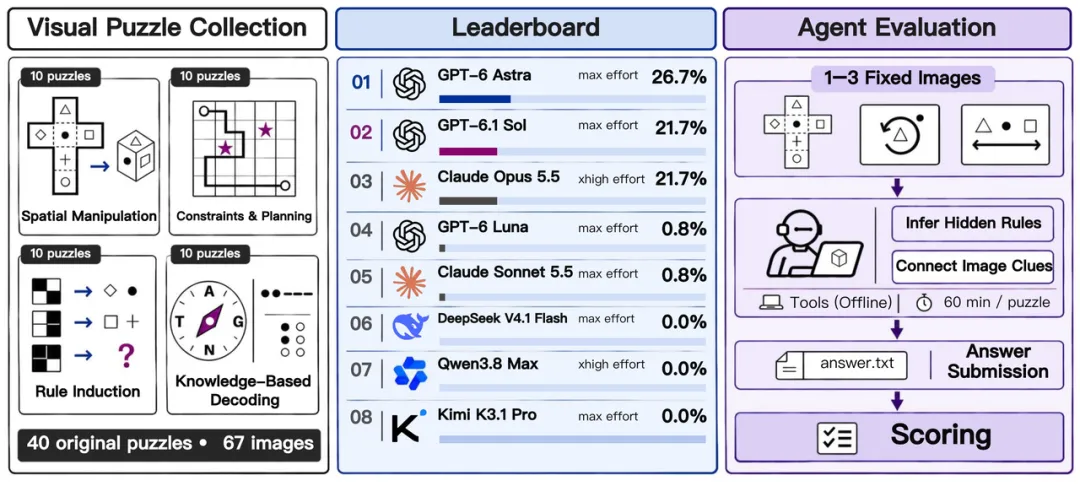
Most visual benchmarks are short, single-turn question-and-answer tasks: the question is explicit and the reasoning chain is brief. Agent benchmarks, meanwhile, tend to focus on text and code; when images are involved, agents can often rely on trial and error to get feedback from the environment. Visual Cipher Bench offers neither kind of support: the clues are only in the image, and there is no feedback.
All 40 puzzles share one instruction: inspect the image and write the final answer to a file. The agent must work out which drawings are examples, which are inputs to solve, and whether the answer should be a word or a number.
The puzzles fall into four groups of 10:
- Spatial operations and simulation, such as folding, rotation and projection.
- Logical constraints and planning, where the solver must infer constraints from a diagram and find the unique solution.
- Rule induction, which requires inferring a puzzle-specific rule from examples.
- Knowledge decoding, including Morse code, Braille and visual wordplay.
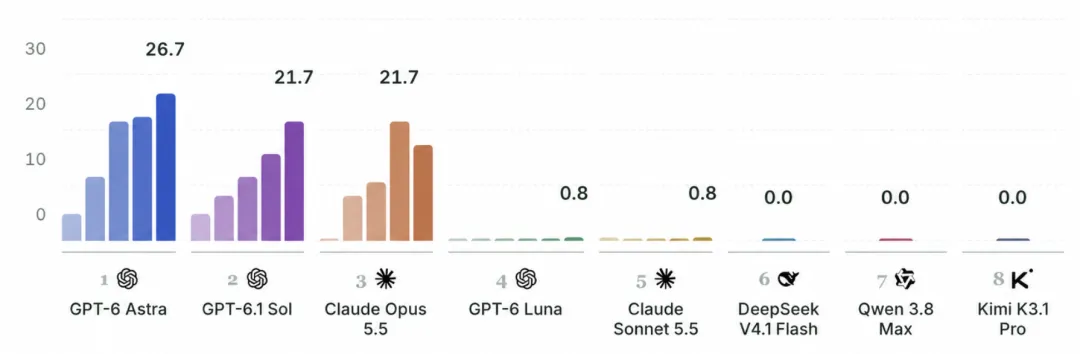
Top score below 30%; three models scored zero
The evaluation covered eight models, each tested with 29 reasoning-effort configurations and three runs per configuration. The best configuration for each model produced these results:
- GPT-6 Astra (max): 26.7%, solving an average of 10.7 out of 40 puzzles per run.
- GPT-6.1 Sol (max) and Claude Opus 5.5 (xhigh): tied at 21.7%.
- GPT-6 Luna and Claude Sonnet 5.5: 0.8% each; each solved one puzzle across 120 attempts over three runs.
- DeepSeek V4.1 Flash, Qwen 3.8 Max and Kimi K3.1 Pro: 0%.
None of the 29 configurations reached 30%. The results also showed a sharp divide: the top three configurations solved 8.7 to 10.7 puzzles per run, while the bottom five were close to zero.
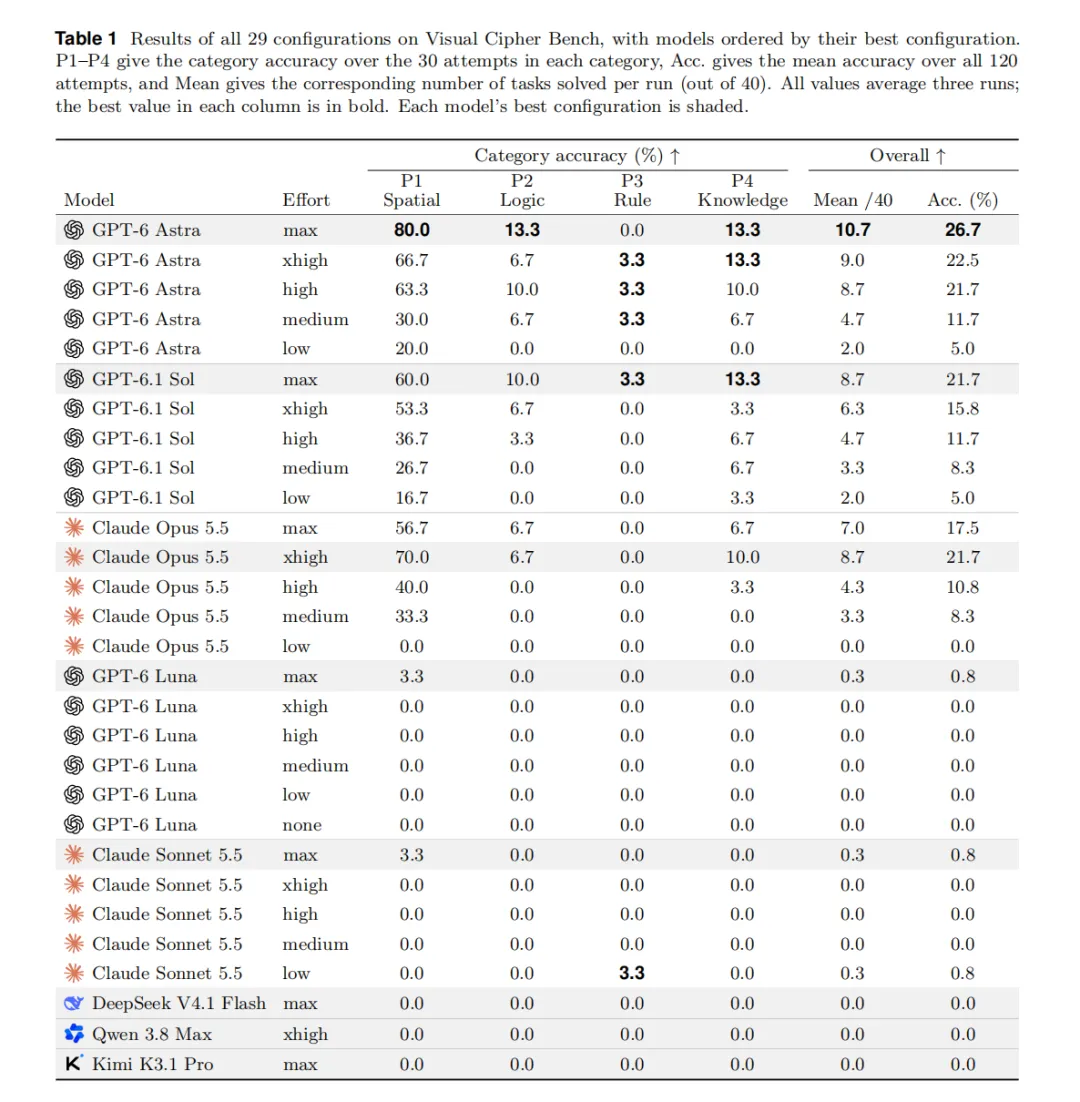
Five correct answers in 870 rule-induction attempts
Across all 3,480 attempts, accuracy varied widely by puzzle type:
- Spatial operations: 22.8%.
- Knowledge decoding: 3.3%.
- Logical planning: 2.4%.
- Rule induction: 0.6%.
GPT-6 Astra (max) reached 80% on spatial puzzles, but no configuration exceeded 13.3% in the other three categories. On the 10 rule-induction puzzles, models produced only five correct answers in 870 attempts.
The distinction is that spatial rules are usually drawn directly and can be followed, while rule-induction puzzles require the solver to infer the rule. Even some of the five correct answers may have been lucky guesses: several answers are English words or phrases, and a model could submit a thematically plausible word without actually discovering the rule.
A one-sentence rule hint raised accuracy to 51.1%
If models struggle to find the rule, what happens when the rule is stated explicitly? The research team selected 10 puzzles and gave GPT-6 Astra, GPT-6.1 Sol and GPT-6 Luna one hint each. The hint identified the core rule but supplied neither intermediate steps nor the answer.
- Overall accuracy: 12.2% to 51.1%.
- Rule induction: 0% to 85.2%.
- GPT-6 Astra: 23.3% to 70.0%.
- GPT-6.1 Sol: 13.3% to 66.7%.
- Timeouts fell from 51 to 29 across 90 attempts.
To test whether any extra sentence would help, the researchers also tried a hint explaining only how to represent the puzzle state, without stating the rule. Accuracy reached just 16.7%. The key factor was the rule itself, not merely the presence of a hint.
The hint was not a cure-all: accuracy on logical puzzles reached only 22.2%, because execution remained difficult even when the rule was known.
Two ways agents fail: guessing and brute force
The researchers grouped failure patterns into two types. “Gamblers” commit too early: they find a rule that fits only some examples, ignore the rest and submit an answer. If they cannot infer a rule, they may guess a word based on the puzzle’s theme—even while acknowledging that they have not solved it.
“Brute-force workers” keep calculating without narrowing the search. They may search endlessly for a general rule or identify the mechanism but enumerate every combination instead of using the puzzle’s constraints to prune the possibilities. They run out of time without an answer.
The stronger approach is to write down several candidate rules, test each one against every example, and solve the puzzle only after one rule remains. The examples in the image are themselves test cases: guessing uses too little evidence, while brute force substitutes enumeration for evidence.
The real world does not provide a prompt
A single sentence stating the rule raised accuracy from 12.2% to 51.1%. In many cases, that sentence is all that separates an AI system from the answer.
Yet identifying the right sentence is the hard part. Documents specify requirements and tests report errors; the real world may provide neither. An agent has to inspect the evidence, form a hypothesis and verify it against what it sees. Long-horizon visual reasoning remains a capability AI systems need to develop.
People have long used puzzles—from spot-the-difference games to escape rooms—to test intelligence. AI has now faced the same measure. Its first score on this benchmark: 26.7%.