By Zhou Yongliang, GeekPark | Edited by Zheng Xuan
XPeng Group released its third-quarter 2026 results on November 16. The report was mixed, but stood out against a domestic auto market that had contracted by about 20%.
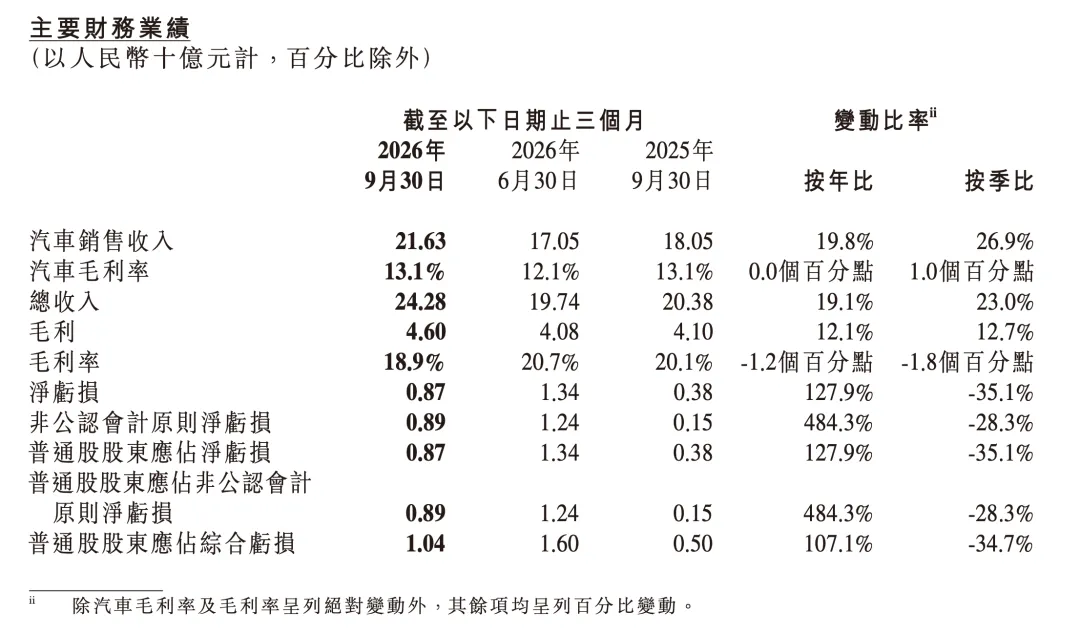
XPeng delivered 118,400 vehicles in Q3, up 2.1% year over year and 14.6% quarter over quarter. Revenue reached RMB 24.28 billion, up 19.1% year over year and 23.0% quarter over quarter. Both deliveries and revenue were quarterly records.
Gross margin was 18.9%, with automotive gross margin at 13.1%. Cash reserves stood at RMB 45.41 billion as of September 30, an increase of about RMB 4.93 billion from June 30.
Losses remain: the quarterly net loss was about RMB 870 million, wider than the RMB 380 million loss a year earlier but significantly narrower than the RMB 1.34 billion loss in Q2. At the time of the report, XPeng shares were up 5.74%; the company’s market capitalization was HK$74.2 billion.
The market is watching two other questions: how fast XPeng can grow overseas, and whether its robotics ambitions can become a real business.
Overseas growth is becoming essential
According to the China Association of Automobile Manufacturers, China exported 8.205 million complete vehicles from January through September 2026, up 65.8% year over year and already above the full-year 2025 total of 7.098 million. Exports are expected to exceed 10 million this year.
For Chinese automakers, going overseas has shifted from an optional strategy to a necessity. As competition intensifies at home, overseas markets are becoming a priority.
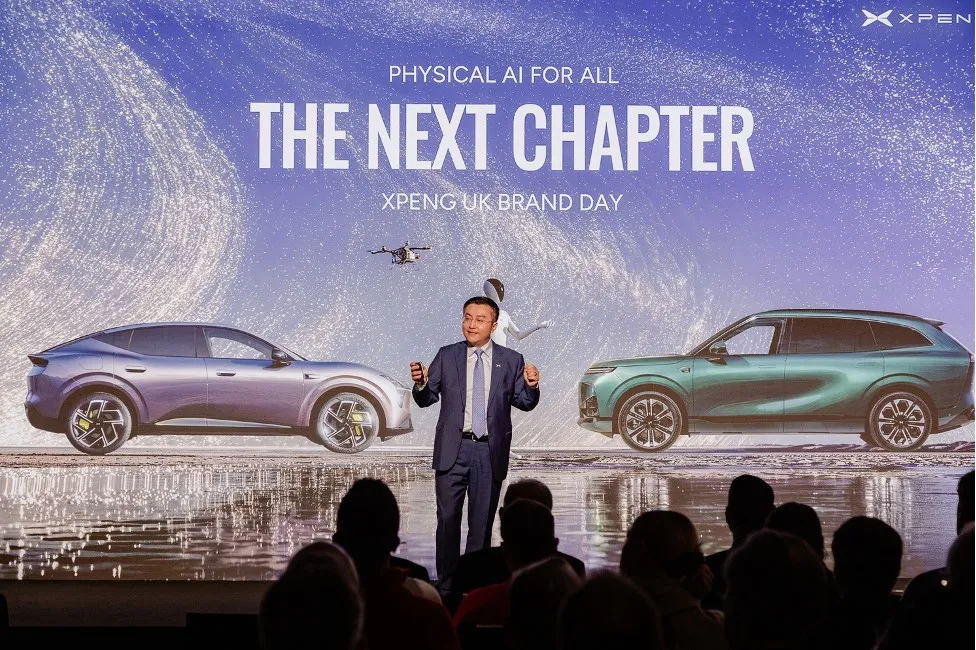
XPeng delivered 59,500 vehicles overseas in the first nine months of 2026, twice the year-earlier figure. Q3 overseas deliveries reached 27,900, up 153%. October overseas sales hit a record 13,000, up 166% year over year.
 △ Image provided by XPeng
CEO He Xiaopeng set a clear target: more than 40,000 overseas sales in Q4 and over 100,000 for 2026 as a whole, the company’s first time above that threshold. XPeng aims to more than double overseas sales in 2027 and expand its sales network to over 1,000 stores.
Profitability may matter more than volume. XPeng’s finance chief said overseas gross margins are more than twice domestic margins, with an even larger gap at the net-profit level. In some markets, distribution through dealers means gross profit is close to net profit.
Pricing is another difference. In Europe, XPeng is positioning itself against BMW, Mercedes-Benz and Audi. The G9L starts at RMB 231,800 in China and sells for €74,990 in France—about RMB 550,000. Tariffs, distribution, certification and logistics account for some of the difference, so it should not be read as pure profit. The pricing does show that XPeng is seeking a technology-led premium overseas rather than relying on low prices to gain share.
On the earnings call, XPeng’s overseas lead outlined three routes to more than doubling sales next year:
- Keep new models on sale for a full year. The G9L, MONA L03, L05 and GX are intended to be global models. The MONA L03 was available overseas for less than a quarter this year; 2027 would be its first full year.
- Cover several product segments. The L03, L05 and G6 target the family market; the GX targets the premium segment and has reportedly received nearly 4,000 orders in the Middle East, though pricing has not been announced. The X9 MPV also has a foothold in Southeast Asia and Europe.
- Expand distribution. XPeng plans to continue investing in its overseas sales network.
An analyst asked how the company would handle China’s export tax rebate declining from 13% to 9% in 2027, a challenge for the industry as a whole. XPeng executives cited faster localization, noting that the change affects complete-vehicle exports more than parts and knock-down kits; they also said new-car pricing already factors in the 2027 change and product planning accounts for a possible further reduction in 2028. XPeng works with Magna in Austria and has production operations planned or underway in Malaysia and Indonesia.
For Physical AI, the “physical” matters more than the “AI”
Overseas expansion is the growth story; robotics is the story of future potential. XPeng’s published robotics roadmap is ambitious:
- September 2026: its first advanced, general-purpose humanoid robot production line began operating, with automation exceeding 80% in core processes.
- January 1, 2027: start of mass production.
- Q1 2027: initial robots to be trialed in selected XPeng stores.
- Q2 2027: the IRON robot to be launched for external commercial customers, with deliveries beginning.
 △ Image provided by XPeng Group
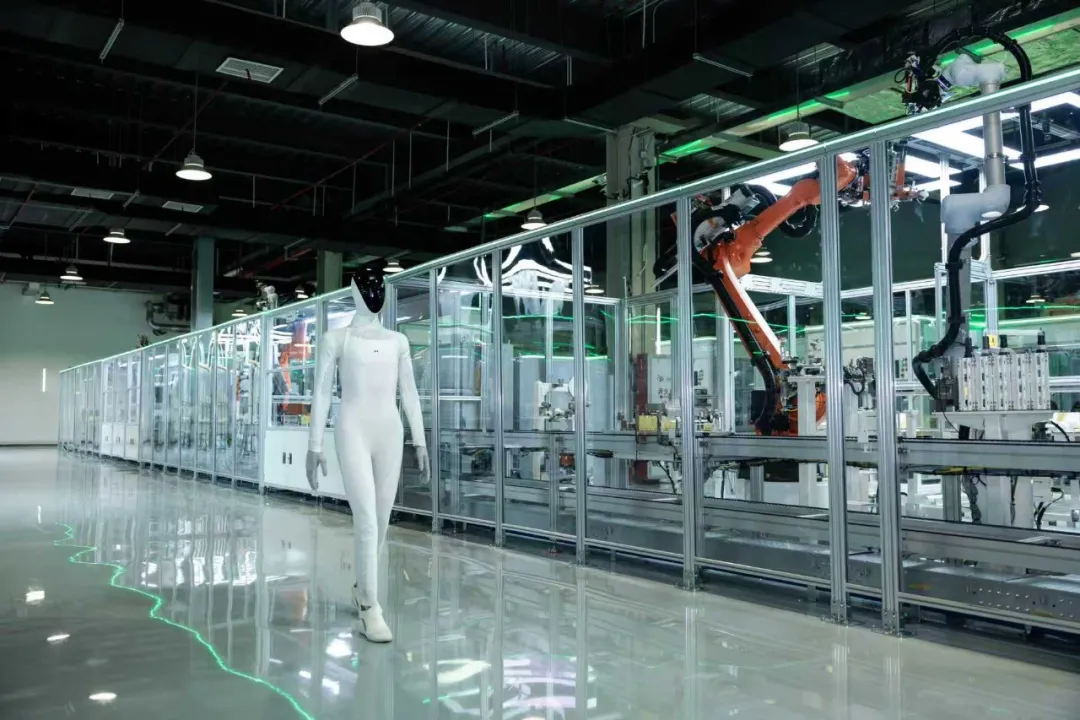
Only about six months separate the line’s launch from planned external deliveries—a fast schedule for a new product category.
He Xiaopeng said on the earnings call that he had been deeply involved in robotics research and development and organizational management in recent months, and that his confidence was growing. He sees the potential in robot sales and gross profit as eventually exceeding that of today’s most popular premium vehicle models.
XPeng’s robotics business has completed a first funding round of more than US$900 million, at a post-money valuation exceeding US$6.3 billion. The company described it as a record single-round private financing for China’s embodied-AI sector.
An analyst asked what would constitute a robotics company’s moat as large-model developers enter Physical AI. He Xiaopeng first pointed to the history of autonomous driving. From 2015 to 2020, simulation-only demonstrations did not translate into deployment because of limits in accuracy and safety. Around 2018, many Level 4 companies produced impressive demos, but real-world rollout was slower than expected. Cloud-connected approaches also struggled, in part because of latency.
His conclusion: relying on one general-purpose model—the “System 2”—to handle every capability is unlikely to work in the near term. XPeng sees four requirements: the robot hardware itself; manufacturing and sales at scale; high-quality, diverse data; and computing at both the edge and in the cloud.
He stressed that the core of Physical AI should be “physical,” not “AI.” In particular, he highlighted tactile data—pressure, temperature and bodily sensation—as the equivalent for robotics of visual data in autonomous driving.
Where will robots be deployed first? XPeng says it will avoid custom projects for large enterprises and focus on standardized products for small and medium-sized businesses, eventually extending to individual and household customers. Large custom projects may bring sizeable orders, but each requires new adaptation, limiting scale and making it harder to spread development costs. Standardized products follow a model closer to cars: build one product, then lower costs through volume.
He sees industrial applications as the strongest fit from a European and U.S. perspective, while commercial and household uses may be more suitable for a China-to-global strategy. Industrial settings demand dexterity and low cost; commercial and household settings put a premium on safety and appearance.
He also argued that many robots are left unused in warehouses because safety and quality are not good enough. The first companies to deliver high-quality, safe robots will have an advantage. The industry’s question is no longer simply whether robots can be built, but whether people will want to use them over the long term.
The real test: several battles, one pool of cash
XPeng is fighting several battles at once. China’s auto market remains a red ocean, with price competition continuing. Overseas sales offer growth but bring lower tax rebates and localization requirements. Robotics is a long-term investment. The company is also pursuing flying cars and robotaxis.
These businesses move on different timelines but draw on the same resources. The challenge is to sequence them so that earlier businesses can fund what comes next.
He Xiaopeng said the priority in the short and medium term is to bring the auto business to positive cash flow and profitability, providing a base for investment in Physical AI. “Physical AI is not a 100-meter sprint; it is a decade-long run.”
XPeng still reported operating and net losses in Q3. Executives expect the group’s full-year 2026 gross margin to remain in the mid-to-high teens. In 2027, they expect R&D spending to grow moderately and sales spending to become more efficient, improving both expense ratios.
The Q4 outlook is strong: deliveries of 169,000 to 174,000 vehicles, up about 45% to 50% year over year, and revenue of RMB 30.4 billion to RMB 31.8 billion. He Xiaopeng said October deliveries topped 50,000 for the first time and that November was expected to exceed 60,000.
One more milestone is approaching. XPeng’s AI Tech Day and the Guangzhou Auto Show this month are expected to feature the latest IRON robot. He Xiaopeng said it would demonstrate “a series of distinctive capabilities.” The answers are expected in the coming days.