Best papers from ICRA, RSS, IROS and CoRL
With CoRL 2026 concluding in November, all four major robotics conferences—ICRA, RSS, IROS and CoRL—have announced their paper awards.
Together, 12 award-winning papers point to a broader shift in robotics research. The field is still teaching robots new skills, but it is also working to train those skills faster, execute them more reliably and keep systems operating in real environments. The work spans turning human motion into robot-ready data, cutting reinforcement-learning time from hours to minutes and helping robots remember how their surroundings change.
ICRA 2026: learning actions and completing tasks
Held in Vienna in June, ICRA recognized work on transferring human motion, planning long-horizon tasks and improving robustness when camera viewpoints change.
OmniRetarget: why can’t a robot simply copy a human?
Awards: Best Conference Paper Award; Best Paper Award on Robot Manipulation and Locomotion. Team: Amazon FAR, MIT, UC Berkeley, Stanford, Carnegie Mellon and others.
Motion capture can record people walking, jumping and carrying objects, then convert those motions into robot training data. But human and robot bodies differ in proportions, joint limits and balance. A motion that is easy for a person may cause a robot to slip, collide with its surroundings or lose balance.
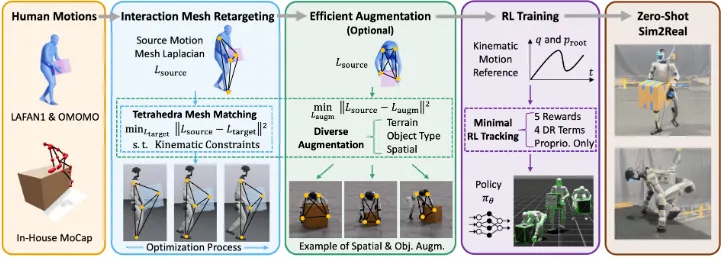
OmniRetarget argues that robots should preserve the important physical interactions in a movement rather than imitate human joint poses exactly. When stepping over an obstacle, for example, the key is that the robot’s foot clears it without a collision—not that the knee bends at the same angle as a person’s. For object handling, contact between the hand and object may matter more than the arm’s exact pose.
The method models interactions among the body, objects and terrain, then generates motions suited to the robot’s own structure. The team used it to generate large-scale motion data and demonstrated whole-body skills on a Unitree G1. The central idea is to reproduce the physical interaction a movement accomplishes, not just its appearance.
SymSkill: opening a drawer is not the same as tidying a room
Awards: Best Conference Paper Award; Best Paper Award on Planning and Control. Team: University of Pennsylvania.
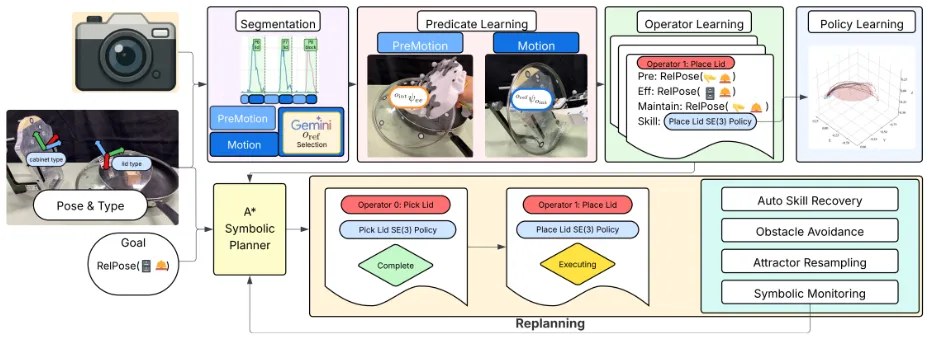
A robot may know how to open a drawer and still fail at “put the objects on the table into the drawer.” It must decide when to open the drawer, when to pick up each object, what to do next and how to recover if an action fails. Imitation learning can teach individual actions but often struggles to order them into a complete plan.
SymSkill learns both reusable action skills and the conditions under which each skill applies. From about five minutes of unlabeled free-operation data, it discovers skills and symbolic state relationships—for example, that a drawer must be open before an object can be placed inside. When the environment changes, the system can reorder the skills. The work shifts the challenge from mastering isolated actions to organizing them into a responsive, long-horizon task.

Do You Know Where Your Camera Is? View-invariant policy learning
Award: Best Paper Award on Robot Learning. Team: Toyota Research Institute, Toyota Technological Institute at Chicago, Johns Hopkins University and others.
A grasping policy can fail when a camera moves from the front of a table to the side, even though the cup itself has not moved. A model may have memorized where objects appear in training images without learning how image coordinates relate to three-dimensional space.
This paper explicitly supplies camera geometry to the robot policy. It uses Plücker rays to describe the spatial ray associated with each image pixel, giving the model information about where and from what direction a scene was observed. The added geometry helps distinguish a change in camera viewpoint from a real change in object position and improves manipulation across camera configurations.
RSS 2026: faster training and models grounded in physics
The three highlighted RSS papers target inefficiencies and modeling gaps in algorithms that are already widely used, from reinforcement learning and diffusion trajectories to low-level motor dynamics.
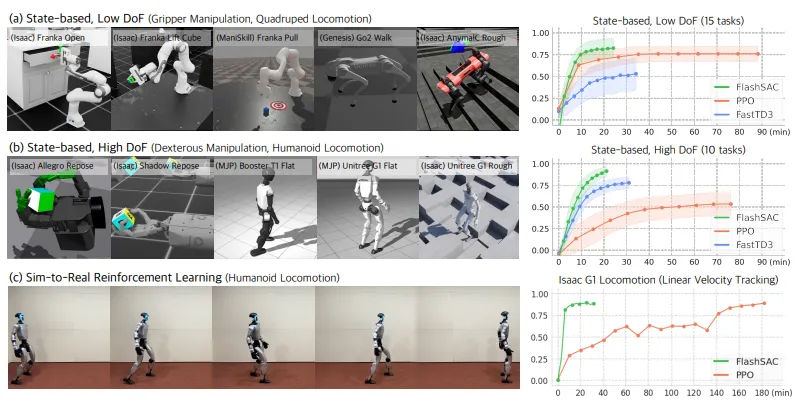
FlashSAC: can robot walking be trained in minutes?
Award: Outstanding Paper Award. Team: Holiday Robotics, KAIST and KRAFTON.
PPO is stable and widely used for robot locomotion, but repeatedly collecting new training data makes it slow. Off-policy methods reuse past experience but can become unstable in high-dimensional robot control as value-estimation errors accumulate.
FlashSAC addresses the tradeoff through larger networks, higher data throughput and constraints on weights, features and gradients that limit error growth. In a real Unitree G1 experiment, it learned a stable flat-ground walking policy in about 20 minutes, compared with roughly three hours for PPO. Faster training can make it practical to test more motions, environments and robot platforms.
Muninn: faster trajectory diffusion without retraining
Award: Outstanding Student Paper Award. Team: University of Illinois Urbana-Champaign, Florida International University and others.
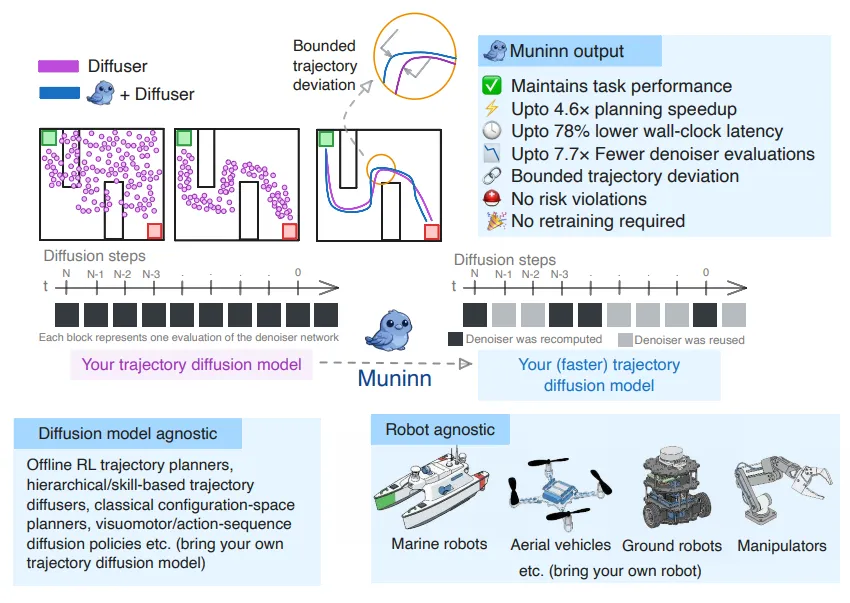
Diffusion models can generate smooth, diverse robot trajectories, but each result requires repeated denoising steps. That computation can prevent a robot from updating its actions quickly enough as the physical environment changes.
Muninn accelerates inference without retraining. It observes that some intermediate results change very little between adjacent denoising steps. A cache stores reusable computations, while an error estimator checks whether reuse is still safe; the model recomputes when predicted error exceeds an acceptable range. The method delivered up to 4.6× speedup while maintaining trajectory quality and related safety measures, with tests on an unmanned boat, a drone and a robotic arm.
NeuralActuator: estimating forces without expensive torque sensors
Award: Outstanding Systems Paper Award. Team: MIT and Amazon Robotics.
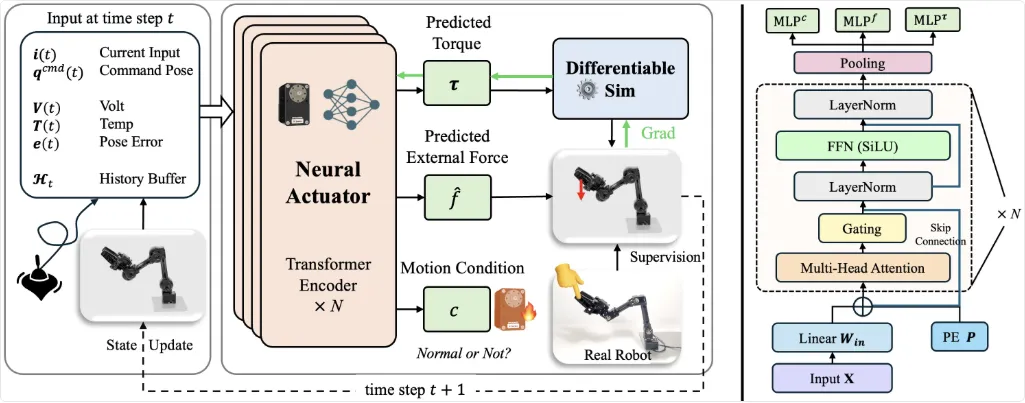
Low-cost motors do not always behave according to ideal physical models. Gear friction, mechanical backlash and temperature changes can create a gap between simulated torque and real output. Without precision torque sensors, it is also harder for a robot to estimate how much force it is applying or whether it has contacted an external object.
NeuralActuator uses a Transformer to learn a motor’s nonlinear behavior from histories of motor commands, current, voltage, temperature and joint state. It predicts motor torque, external contact force and operating state. The team tested the approach on arms with different costs and structures, showing how learned actuator models can support dynamics estimation and grasping without relying entirely on expensive force sensors.

IROS 2026: long-term operation and reliable task completion
IROS recognized work in visual-language navigation, humanoid mobile manipulation, lifelong scene memory and industrial grasping.
LT-Mem: what should a robot remember after a year in one place?
Award: Best Paper Award. Team: Daegu Gyeongbuk Institute of Science and Technology.
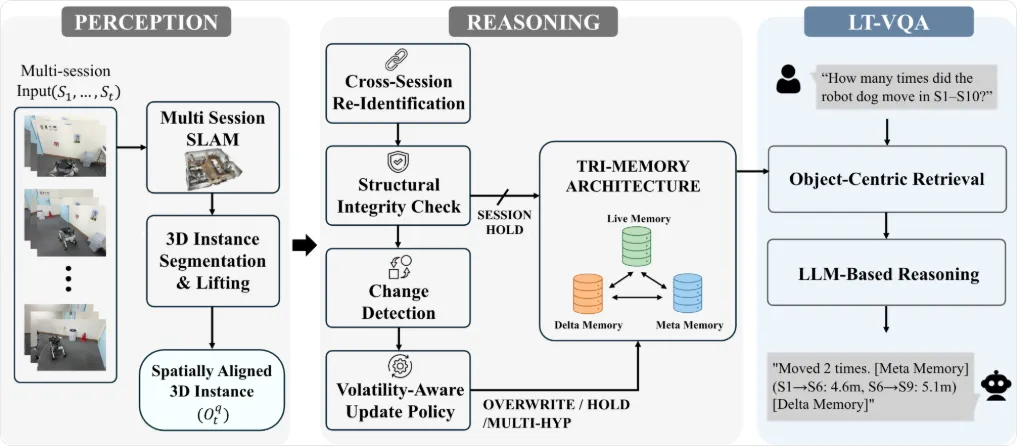
A chair may move from beside a conference table to a doorway and later return. If a robot updates its map every time, it may retain only the latest position and lose the history of those changes. Long-term scene understanding needs both a current map and a record of what has changed.
LT-Mem associates objects observed across repeated visits, tracks how often each one moves and decides which information to update and which history to retain. It separates memory into Live for current state, Delta for changes and Meta for long-term statistics. A robot can answer where a green chair is now, how many times a basket has moved, or which objects make reliable long-term navigation landmarks. The approach improves lifelong scene understanding while reducing the need to send repeated historical images to a large model.
SteadyTray: why is carrying a tray hard for a walking robot?
Award: Best Paper Award on Mobile Manipulation. Team: University of California San Diego.
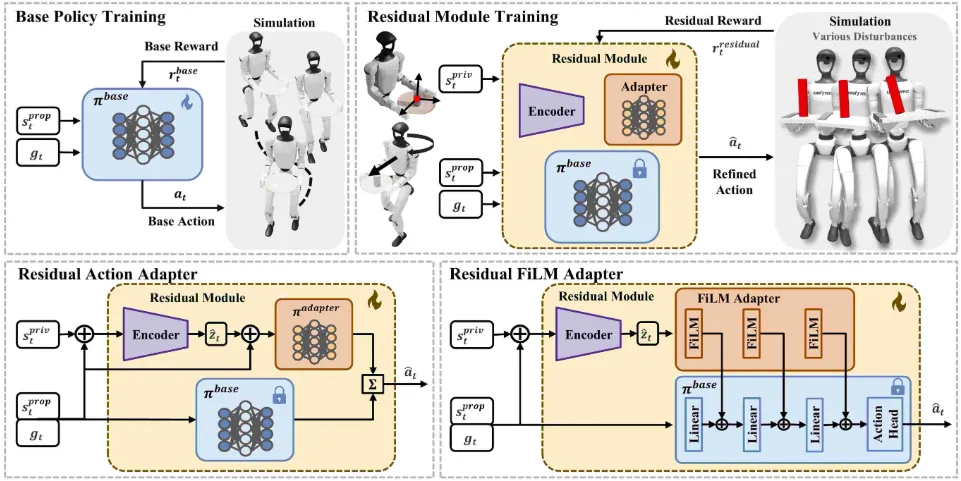
Each step of a bipedal robot creates body sway and footfall impact. Those disturbances travel through the arms to a tray, causing unsecured objects to slide or fall. Training one large policy from scratch to walk and balance a tray is costly and may compromise walking skills the robot already has.
SteadyTray keeps the existing walking policy in charge of locomotion and adds a residual reinforcement-learning policy to control the upper body and arms, counteracting motion disturbances. Tested on a Unitree G1, the system lets the robot walk while keeping a tray stable. The approach combines mature skills instead of retraining one model to do everything.
VL-Nav: understanding the instruction is not enough
Award: Best Paper Award on Cognitive Robotics. Team: University at Buffalo, Carnegie Mellon University and others.
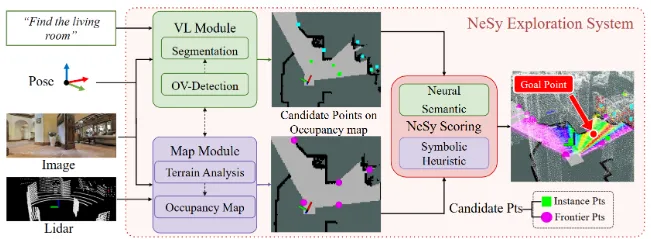
To “find the chair next to the printer,” a robot must locate the printer, identify nearby chairs and select the correct destination. The challenge is not just object recognition; it is reasoning about spatial relationships.
VL-Nav combines neural perception with symbolic reasoning. A vision model identifies objects and semantic information, while structured reasoning handles relations such as “next to,” “to the left of” and “on the same floor.” The result is converted into a navigation goal. Explicit relational structure can be more reliable than leaving every spatial relation implicit in an end-to-end black box.
Picking Bins Empty: a high grasp rate is not the same as emptying a bin
Award: Best Paper Award for Industrial Robotics Research for Applications. Team: Mercedes-Benz and the German Aerospace Center.
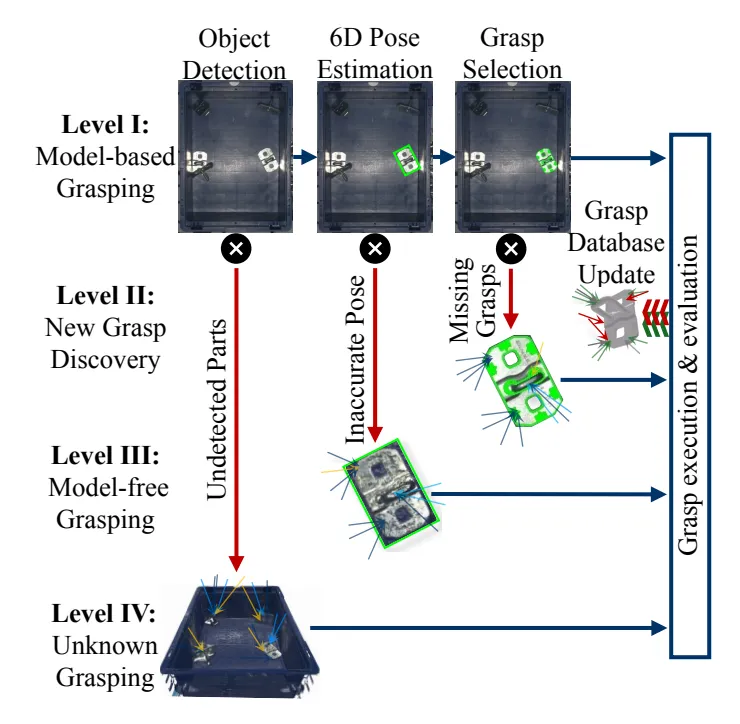
A robot may grasp many parts successfully but get stuck on the final pieces when they are occluded, unusually oriented or lack an accessible grasp point. In a factory, picking 90% of parts is not equivalent to emptying the entire bin.
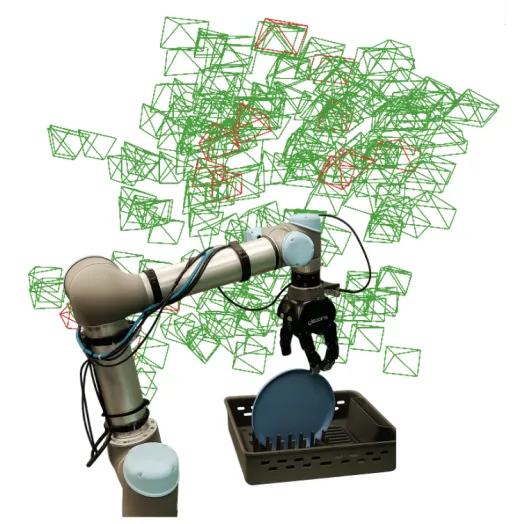
Picking Bins Empty combines precise model-based grasping with model-free exploration. When a standard grasp fails, the system changes strategy according to the failure and searches for another feasible grasp point. It also updates reliability estimates online from the gripper’s motion feedback, gradually avoiding grasp points that often fail. In the paper’s industrial-parts experiment, the bin-emptying rate rose from a 50.9% baseline to 100%.

CoRL 2026: world models and longer-term learning
The two featured CoRL award winners address training efficiency and memory: one uses a differentiable world model to reduce humanoid training costs; the other lets a robot use longer histories while it works.
SuperMimic: matching a seven-day, 128-GPU run in about three hours on one GPU
Award: Best Conference Paper Award. Team: University of California Berkeley.
Training humanoids for many whole-body motions typically requires large-scale reinforcement learning in physics simulators. Computation rises sharply as the number of motions grows from dozens to thousands.
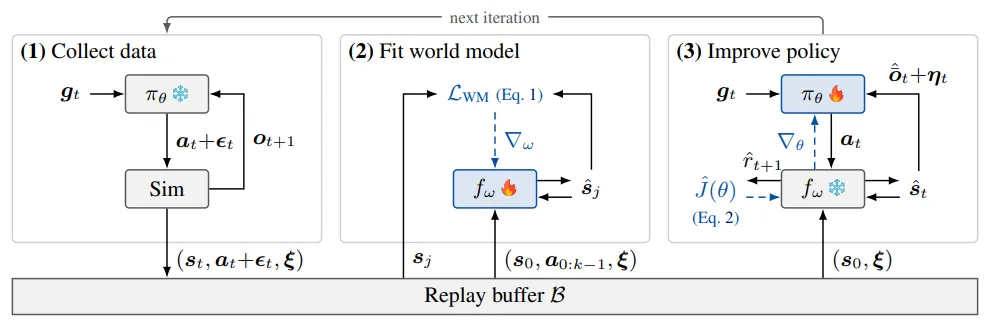
SuperMimic first learns a differentiable world model that predicts robot motion, then trains a policy inside it. Unlike a conventional simulator, the model can provide gradients showing how changes to an action affect the outcome, reducing reliance on trial and error. In the reported benchmark, one GPU trained SuperMimic for about three hours and surpassed the corresponding performance of SONIC, which required 128 GPUs for seven days. The team also demonstrated complex motions on a real Unitree G1.
RoboTTT: helping a robot remember what happened earlier in a task
Award: Best Student Paper Award. Team: NVIDIA, Stanford University and the University of Texas at Austin.
In a multi-minute assembly task, a robot must remember which parts are installed, which steps failed, where to resume and how past actions should affect the next decision. Many policies use only the current frame and a short history, increasing the risk of repeated actions and mistakes as tasks grow longer.
RoboTTT uses test-time training to write visual and action experience into rapidly updated model parameters instead of continually expanding a history cache. The policy’s context was extended to 8,000 time steps. On a real robot, the team completed a roughly five-minute, multi-stage bimanual assembly task and demonstrated assembly of a new configuration from a human-operation video.
What are robotics researchers trying to solve in 2026?
The 12 papers suggest three broad directions.
First, making robot learning more efficient. OmniRetarget turns human movement into robot-ready data; FlashSAC shortens reinforcement-learning time; Muninn avoids repeated diffusion computations; and SuperMimic uses a differentiable world model to reduce humanoid training costs. Together, they address a constraint that cannot be solved indefinitely by adding compute and manually collected data: making each training run more effective.
Second, moving from single actions toward long-term execution. SymSkill organizes multiple skills, LT-Mem maintains a lasting record of a changing scene, RoboTTT uses longer action histories and Picking Bins Empty measures whether an industrial task is fully completed. A successful grasp, navigation step or demo does not by itself mean a robot can work autonomously over time. Real tasks require robots to understand their surroundings, remember prior events, recover from failures and adapt what they do next.
Third, confronting the physical world. NeuralActuator models real motor dynamics; SteadyTray addresses disturbances from bipedal walking; OmniRetarget accounts for differences between human and robot bodies and contact; and VL-Nav makes spatial structure explicit. Even as large models improve in vision and reasoning, robots still have to deal with forces, friction, collisions, geometry and hardware limits. Stronger models need reliable sensing, control and engineering to turn intelligence into action.

These 12 papers do not represent every direction in robotics or settle the debate over any single technical approach. They do show sustained attention to lowering training costs, completing long-horizon tasks and making algorithms work reliably in the physical world. If recent years have asked what else robots can learn, this year’s award-winning research increasingly asks how they can do what they have learned well.
Selected paper titles
- OmniRetarget: Interaction-Preserving Data Generation for Humanoid Whole-Body Loco-Manipulation and Scene Interaction
- SymSkill: Symbol and Skill Co-Invention for Data-Efficient and Reactive Long-Horizon Manipulation
- Do You Know Where Your Camera Is? View-Invariant Policy Learning with Camera Conditioning
- FlashSAC: Fast and Stable Off-Policy Reinforcement Learning for High-Dimensional Robot Control
- Muninn: Your Trajectory Diffusion Model But Faster
- NeuralActuator: Neural Actuation Modeling for Robot Dynamics and External Force Perception
- LT-Mem: Volatility-Aware Spatio-Temporal Memory for Lifelong Scene Understanding
- SteadyTray: Learning Object Balancing Tasks in Humanoid Tray Transport via Residual Reinforcement Learning
- VL-Nav: Neuro-Symbolic Reasoning-Based Vision-Language Navigation
- Picking Bins Empty: A Hierarchical Hybrid Approach with Online Self-Learning of Grasp Points for Reliable Industrial Bin-Picking
- SuperMimic: Scaling Humanoid Whole-Body Control with One Differentiable World Model
- RoboTTT: Context Scaling for Robot Policies