The leading market-oriented institutions are the second layer. The entry of institutions such as Hongtai Fund, Hony Capital, Shanzheng Investment, New Future, Junan Holdings, and Shaanxi Guosheng is based on the judgment of the window period for the scale of the humanoid robot industry, and they are optimistic about Bluepoint Touch's leading market share and long-term growth certainty in the six-axis force/torque sensor track. What they can bring is cross-industry industrial resource links, as well as professional support in global market layout and subsequent capital market planning.
What really makes the difference in the D3 round is the third layer - the industry leader in the vertical field. Machine vision leader OPT and industrial capital Xichen Capital have re-invested, forming a technologically complementary relationship with Bluepoint Touch. The two parties can jointly create a "vision + force" multi-modal fusion sensing solution, covering high-end industrial scenarios such as precision assembly and flexible manufacturing, and breaking the application limitations of a single sensing mode. Once this direction is successful, Bluepoint Touch will open up not only the sensor market, but also incremental scenarios.
In addition to CATL, SAIC, GAC, Zhiyuan Robotics, Galbot, SMIC Juyuan, and Deye Group that have already settled in previous rounds, Bluepoint Touch’s shareholder ecology has covered several core links including power batteries, vehicle manufacturing, robot bodies, high-end semiconductor manufacturing, and new energy storage. What is being supplemented in the D3 round is the three dimensions of local industry support, market-oriented capital empowerment, and cross-field technology collaboration. This kind of "full-chain collaboration" shareholder structure is rare in the domestic robotic force sensor track.
72.6% of the market share is due to orders
Capital is willing to make collective bets, provided that the company has proven itself in the market. The way to prove it is share.
According to data from the Advanced Robot Industry Research Institute (GGII), in the first three quarters of 2025, Bluepoint Touch has occupied 72.6% of the domestic market share of six-axis force/torque sensors for humanoid robots. This number was almost unimaginable three years ago. Before 2023, the domestic six-axis force/torque sensor market was still dominated by foreign brands; in 2024, domestic brands began to enter the core supply chain with the advantages of cost performance, response speed and industrial chain synergy; in 2025, they completed the overtake in share.
What supports the overtaking is first of all the hard indicators. Bluepoint Touch's six-axis force/torque sensor and joint torque sensor achieve 0.1% FS measurement accuracy, high-frequency response above 10kHz, and 500% overload resistance. At the same time, it has completed the ultimate small and lightweight transformation, reducing the sensor volume by 90% and the weight by 80%.
In addition, Bluepoint Touch's core R&D team comes from top scientific research institutions such as the Aerospace Science and Technology Group, the University of Science and Technology of China, and the Chinese Academy of Sciences. It has transferred high-precision force sensing technology tempered in extreme scenarios such as spacecraft docking and aircraft wind tunnel experiments to the fields of robotics and industrial manufacturing.
But what really quickly increases market share is mass production consistency. In 2026, humanoid robots are leaping from the thousand-unit level to the 100,000-unit level. Machine manufacturers are no longer just focusing on the performance parameters in the laboratory, but whether the force sensors of each offline robot can be consistent and whether they can be delivered on time. Bluepoint Touch has built a production base of over 10,000 square meters in Guangdong and a fully automatic production line for floor-standing robot force sensors. It has a designed annual production capacity of 1 million sets of joint force sensors and 200,000 sets of terminal six-axis force/torque sensors.
What's more critical is the delivery rhythm: the customization delivery cycle of leading overseas manufacturers is usually 8-12 weeks; Bluepoint Touch has compressed the delivery cycle to 2-3 weeks. In the BOM of humanoid robots, force sensors (including 4 six-axis force/torque sensors and 28 joint torque sensors) account for about 15% of the total machine cost. Almost no machine factory can withstand it becoming a stuck point in productivity ramp-up.
This delivery capability is not supported by production line planning documents, but is verified by customers with actual orders. Head machine manufacturers such as Zhiyuan Robot, Galbot, Xiaomi Robot, UBTECH, Zhongqing, and Xinghaitu have all installed Bluepoint Touch products in batches, and multiple single customers have achieved shipments of 10,000 units. From sample delivery, small batches to repeated purchases of tens of thousands of units, the entire process has been completed.
Force sense has changed from "high-end" to "must-have", and the value of card slots has been re-priced
Behind the repeated capital injections is an increasingly clear judgment on the industry: force sense is changing from a "high-end function" of robots to a "must-have infrastructure" for large-scale implementation.
This cognitive change only took two years. From 2023 to 2024, more people in the industry will regard force sensors as the icing on the cake; by 2025, as large models enter the stage of large-scale application, force sensors will become the core link. Without force feedback, the capabilities of large models will be difficult to replicate on a large scale in the physical world.
When the robot enters the real scene, vision solves the problem of "seeing" - where the objects are and which floor the shelves are on. But when it comes to actually doing things, pouring water, pinching eggs, and picking up a bag of potato chips from the shelf, the "last millimeter" of these actions needs to be completed by real-time force perception. This is true in life scenes, and even more so in industrial scenes. Assembly, labeling, and box handling in automobile factories will only require higher precision and consistency of force sense.
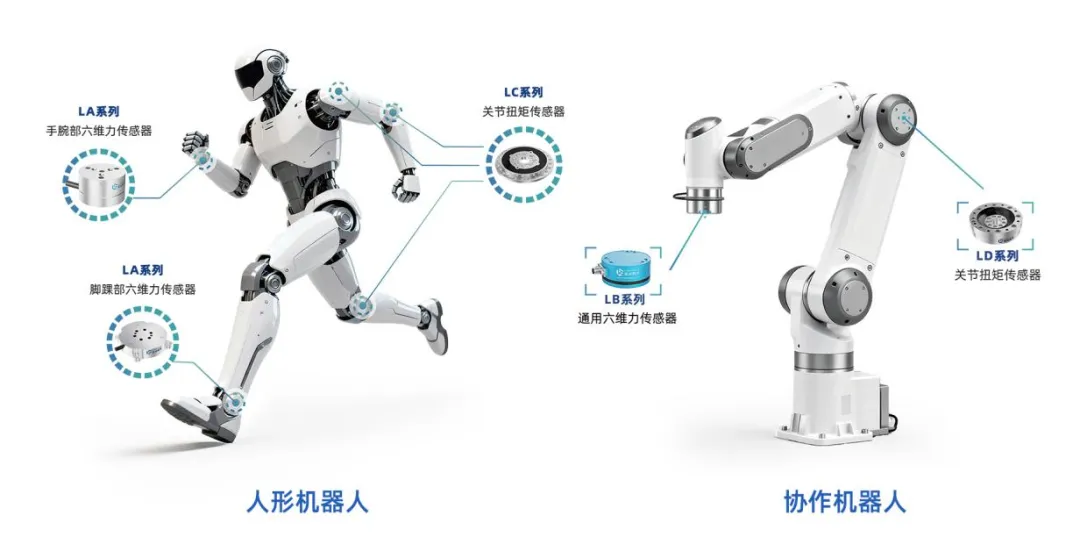
Bluepoint Touch products have been embedded in these scenarios. For example, the Xiaomi robot explores the folding and recycling of material boxes and car labeling operations in the assembly workshop of the automobile factory. Equipped with a Bluepoint Touch six-axis force/torque sensor, the robot can sense the deformation and buckle position of the material box, and find a balance between force and flexibility; during the labeling operation, the sensor measures the force and torque in any direction in the three-dimensional space in real time, and feeds back the contact force to the control system, allowing the robot to perceive force and angle like a human. This kind of seemingly simple operation is precisely the threshold that traditional "blind" robots cannot cross.
From the perspective of the industrial chain, force sensors are at the intersection of the two trillion-dollar tracks of "cars + robots". Car companies provide complete machine and production line scenarios, and batteries and energy storage provide precision manufacturing scenarios. Together, these parties form the most intensive demand hinterland for force sensors. Bluepoint Touch's position at this intersection has been repeatedly confirmed by industrial capital.
After round D3, there is a new goal
After the card position is confirmed, where the money is spent often tells more about the development stage of a company than the financing itself.
Gaogong Robot has learned that Bluepoint Touch’s current round of financing will be mainly used for the research and development of new generation robot force sensor products, production capacity expansion and global market layout.
Of these three things, the first two are to build up internal strength, and the third is to move outward. To dare to write "globalization" into the use of funds, the premise is that the domestic market has given a strong enough foundation: a higher market share means that Bluepoint Touch has completed the "domestic substitution" segment in the local market.
After the D3 round, Bluepoint Touch has a new goal: moving from the domestic market to the global market, striving to become an important partner and core supplier of overseas head humanoid robot companies in 2026, and achieve a high market share in the global market from 2027 to 2028.
Whether this goal can be realized depends on two things: whether the new generation of products can continue to widen the technological generation gap, and whether overseas production capacity and delivery systems can replicate domestic experience. 14 institutions collectively placed bets in the D3 round, betting on the certainty of these two events. What Bluepoint Touch wants to do is to transform the technological accumulation of aerospace-grade force control into actual productivity for industrial implementation, so that "Blue Dot Manufacturing of Global Robot Force Sensors" can turn from a vision into a path that can be verified by orders and production capacity.