When AI watches long videos, the model needs to encode the images into visual tokens frame by frame, and then send them to the language model for understanding.
When the number of frames is too high, repeated images will eat up computing and GPU memory; but if the compression is too harsh, short-lived clues and changes in actions before and after can easily be missed.
In response to this problem, research teams from Sun Yat-sen University, Hong Kong Polytechnic University and other schools proposed V-CAST: screening and pruning visual tokens before they are sent to the language model. The entire process requires no training and is plug-and-play.
How much understanding can be retained after pruning? The team conducted verification on 6 model configurations, 10 video and audio and video benchmarks of Qwen3-VL, LLaVA and Qwen2.5-Omni:
- In the 256-frame long video evaluation, the average score of V-CAST is 1.5 points ahead of the sub-optimal compression method;
- In the 768-frame audio and video experiment, 97.1% of the performance of the uncompressed model was retained, and the total inference time was reduced by 50.0%;
- In the 32-frame experiment of Qwen3-VL-8B, only 25% of the visual tokens were retained, and the average performance was still 98.2% of the original model.
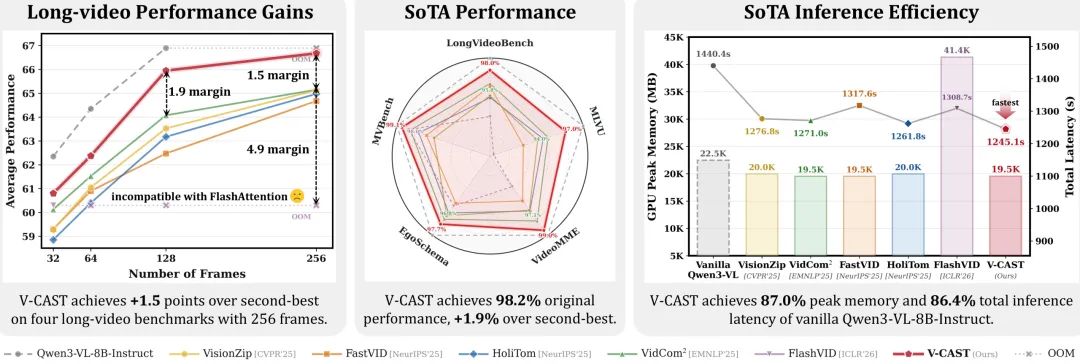 △V-CAST's long video understanding performance, performance retention rate and reasoning efficiency.
The key to compressing video tokens lies in spatio-temporal information coverage
The video model encodes images into visual tokens. The higher the number of frames, the heavier the prefill calculations before the language model generates the answer. Repeating backgrounds and actions will also occupy computing and GPU memory, so you can filter out some tokens first.
The difficulty is that action sequencing, counting and event positioning require stringing together clues from different moments. If the budget is concentrated on a few frames, the model may miss the changes before and after the action. Therefore, compression must cover different time periods and preserve intra-frame details. V-CAST first decides how many tokens to keep in each frame, then decides which ones to keep, and retains the original space-time coordinates.
Two observations: time coverage and location correspondence
Observation 1: The same budget may have different time coverage
How many tokens should be allocated to each frame? Even distribution takes care of every moment without distinguishing between brief action transitions and long, repetitive backgrounds.
Allocating budgets based on global differences can easily find special images, but may miss changes between stages. V-CAST focuses on transitions between adjacent frames, allocating more budget to moments when the action or scene is changing.
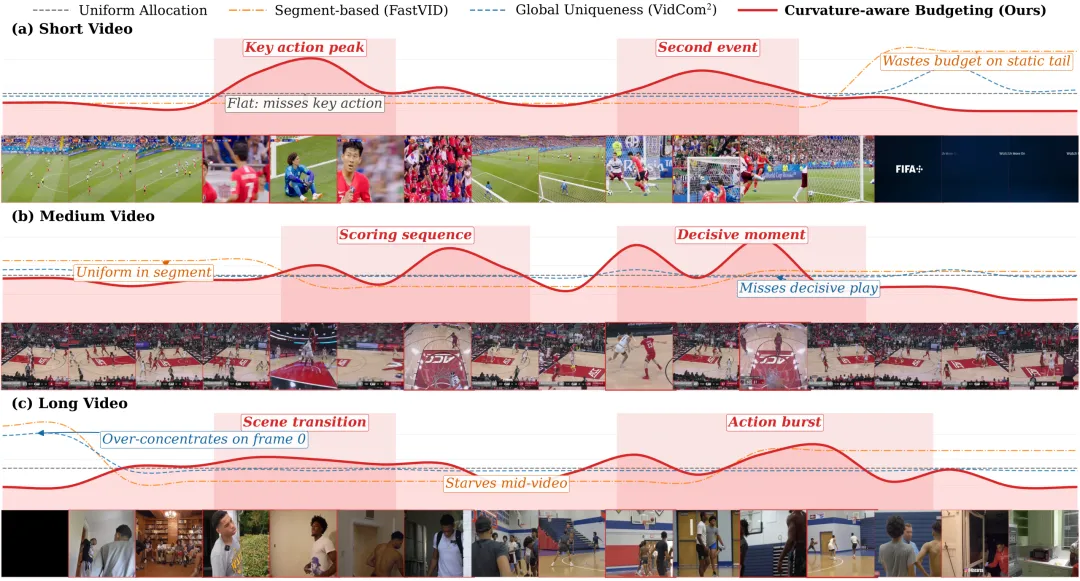 △Frame budget allocation in long and short videos with different strategies.
Observation 2: After feature compression, the positions still need to correspond
The compressed content must also correspond to the original location. Qwen3-VL records time, height and width coordinates for visual tokens. After merging tokens from different locations, it will be difficult for the new features to correspond to an original location.
V-CAST directly selects a Token subset, retaining the original order and coordinates. To verify this choice, the paper compares local pooling, fixed position selection, and random selection.
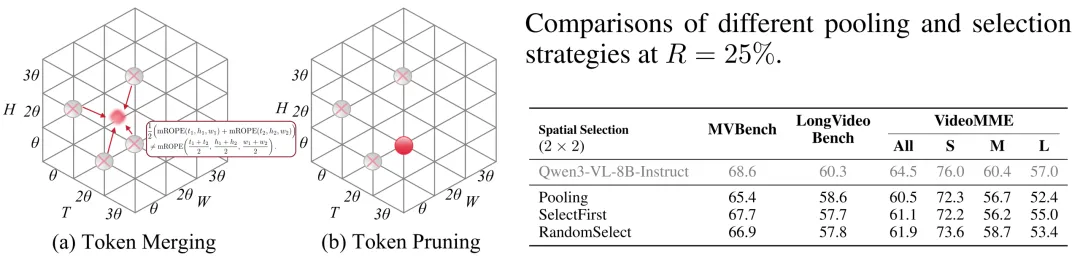 △Left: Position changes when merging and directly selecting tokens; Right: Comparing the effects of pooling and direct selection within a 2×2 local grid.
Under the same 25% retention rate, both direct selection strategies are better than local pooling, supporting the design of retaining position correspondence.
Two-step compression: first divide the budget, then choose the details
Based on these two observations, V-CAST sequentially completes inter-frame budget allocation and intra-frame filtering after visual encoding and projection and before language model prefill.
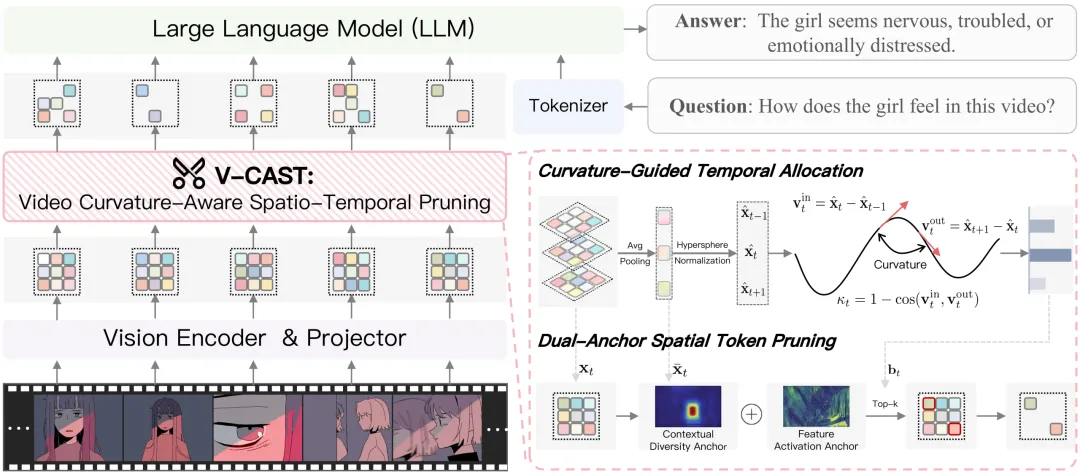 △V-CAST first allocates the token budget of each frame and then filters the tokens within the frame.
- Allocate budget based on changes in adjacent frames
V-CAST uses average features to summarize each frame, and then uses local curvature to measure the transition of features over time. The more obvious the transition, the more tokens are allocated, while retaining a minimum amount for each frame to take into account changes and coverage.
- Use two complementary signals to select intra-frame Token
After getting the budget for each frame, V-CAST calculates two scores for Token:
- Differences from average features across the entire frame. Helps preserve local details such as small objects in the corner of the screen.
- Feature activation strength. Helps preserve areas where visual encoder responses are strong.
After the two scores are added, the high-scoring token is retained according to the budget in each frame, taking into account conspicuous areas and local details. The whole process does not need to calculate the similarity between tokens, and the additional overhead is small.
- Retain original order and space-time coordinates
The selected Token follows the original order, spatiotemporal coordinates and position coding. The entire process requires no training and no need to extract decoder attention weights.
Mainly Qwen: 6 model configurations, 10 benchmarks
The experiments are extended from Qwen3-VL-8B to 32B, MoE, LLaVA and audio and video models, and compared with five other methods under unified settings.
Qwen3-VL-8B: Comparing input length to compression budget
The main experiment of Qwen3-VL-8B covers 32/64 frame input, 25%/15% visual token retention rate, and compares performance on four video understanding benchmarks.
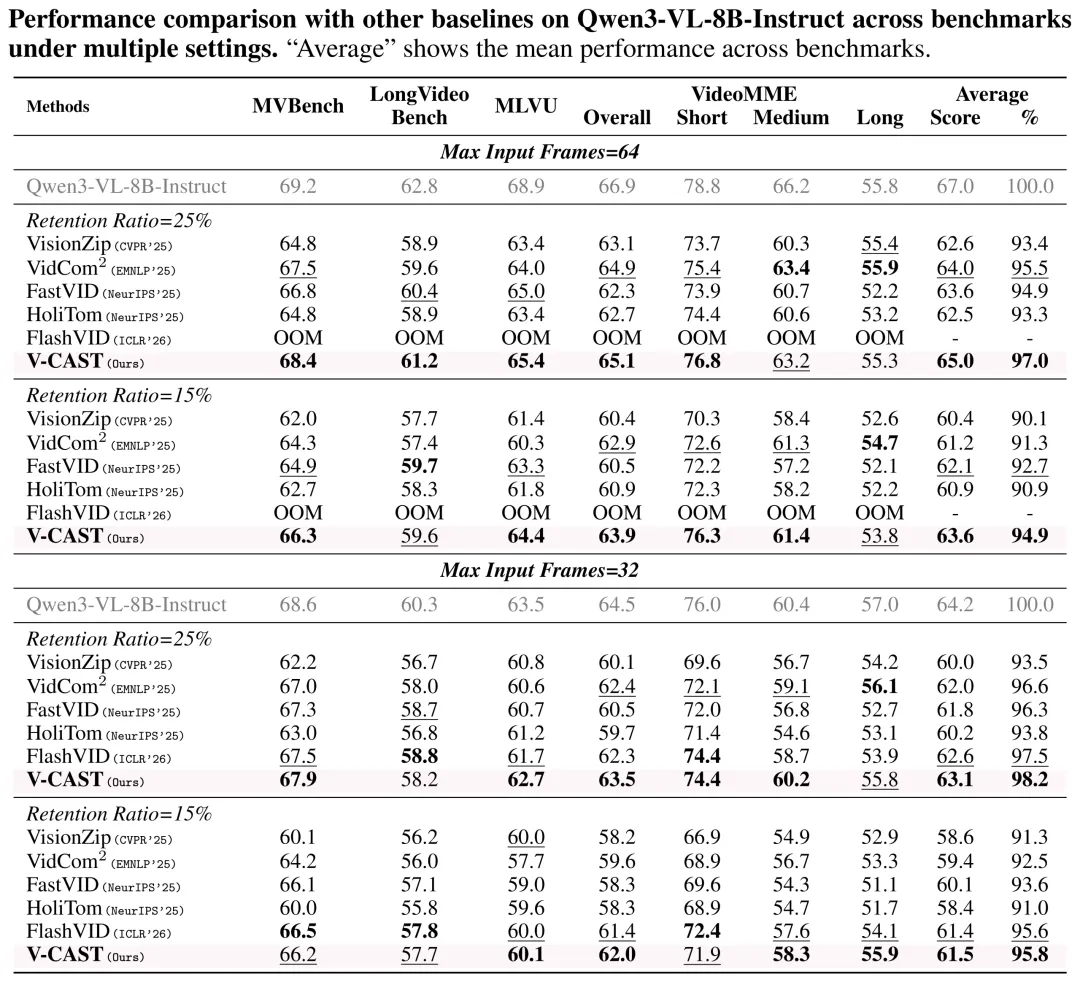 △Qwen3-VL-8B-Instruct main experiment.
Under 32 frames and 25% retention rate, the average score of the four V-CAST benchmarks is 63.1, reaching 98.2% of the original model. It scored 65.0 points at 64 frames, which is 1.0 points higher than the sub-optimal method VidCom². When the budget is reduced to 15%, the average scores of 32 frames and 64 frames are still the highest among the compared compression methods.
From 8B to 32B and then to MoE
After extending to Qwen3-VL-32B-Instruct, at 32 frames and 25% retention rate, V-CAST achieved an average score of 66.5, which is higher than VidCom²’s 65.6.
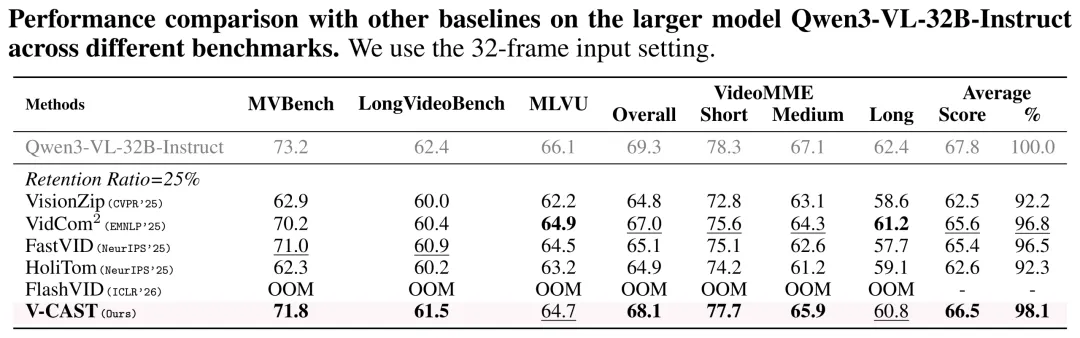 △Evaluation results of Qwen3-VL-32B-Instruct under 32-frame input.
Pruning also allowed some of the video-memory-limited reviews to be completed. Under the same running configuration, the uncompressed Qwen3-VL-30B-A3B-Instruct cannot complete the 64-frame evaluation; V-CAST completed the evaluation at 25% retention rate, with an average score of 68.1.
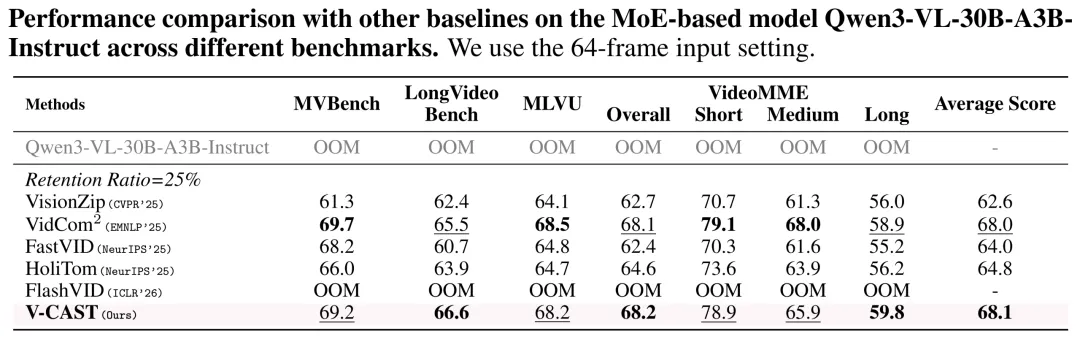 △Evaluation results of Qwen3-VL-30B-A3B-Instruct under 64-frame input. OOM means insufficient GPU memory.
Extended from Qwen to LLaVA and audio and video models
Switching to LLaVA-OneVision-7B (32 frames) and LLaVA-Video-7B (64 frames), retaining 25% of the visual tokens, still achieved the average performance of 99.5% and 95.4% of the original model respectively.
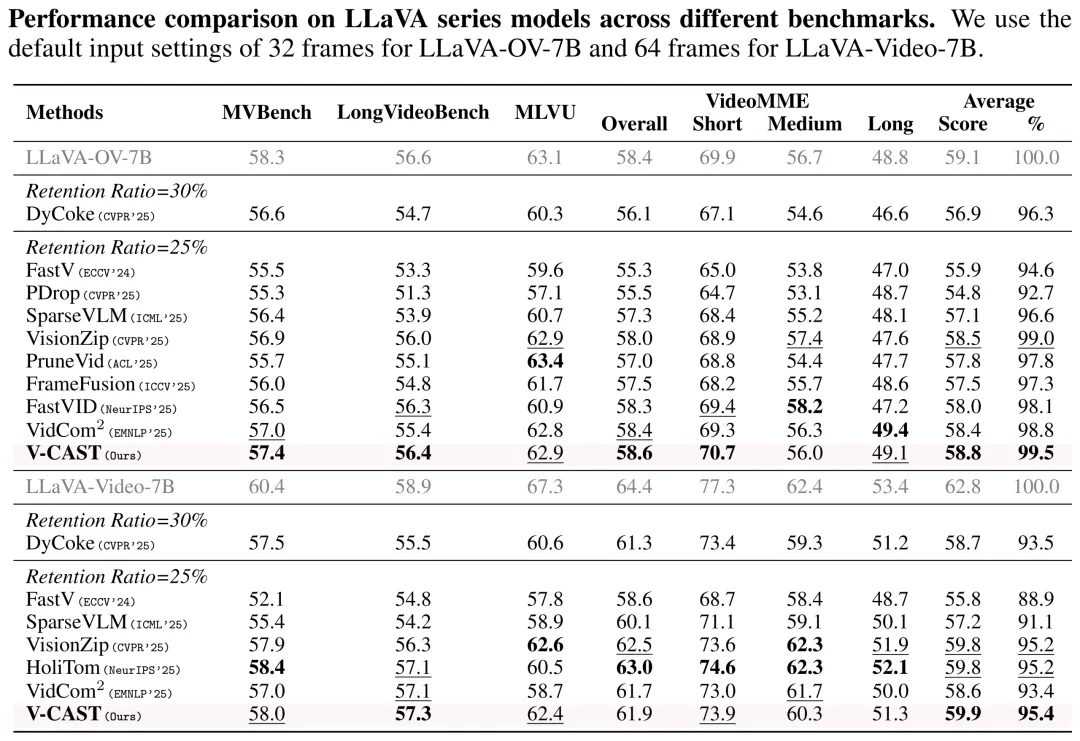 △Evaluation results of LLaVA-OneVision-7B and LLaVA-Video-7B.
In the 768-frame experiment of Qwen2.5-Omni-7B, the audio input remained intact and 25% of the visual token was retained. The average score of V-CAST's five benchmarks is 49.6, reaching 97.1% of the original model, and the total inference time is reduced by 50.0%.
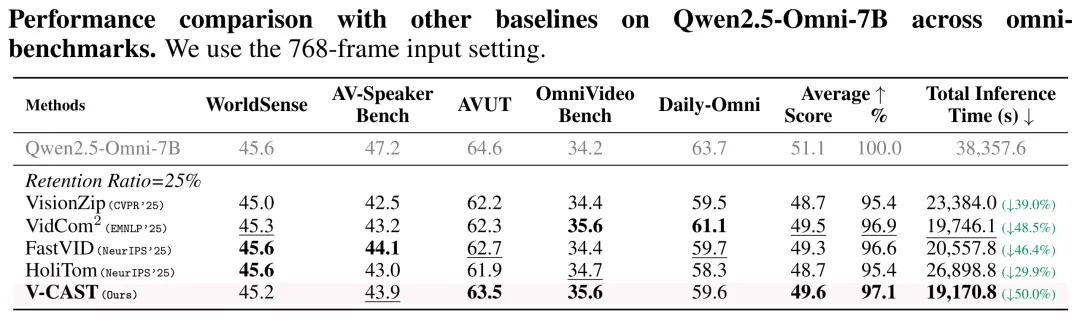 △Five benchmark scores and total inference time of Qwen2.5-Omni-7B under 768 frame settings.
From 32 frames to 256 frames: Examining long video context exploitation
More frames bring both new clues and repetitive footage. The experiment increased the input from 32 frames to 256 frames to test whether the model can utilize the new information. At 256 frames, the average score of V-CAST's four long video evaluations is 1.5 points ahead of VidCom².
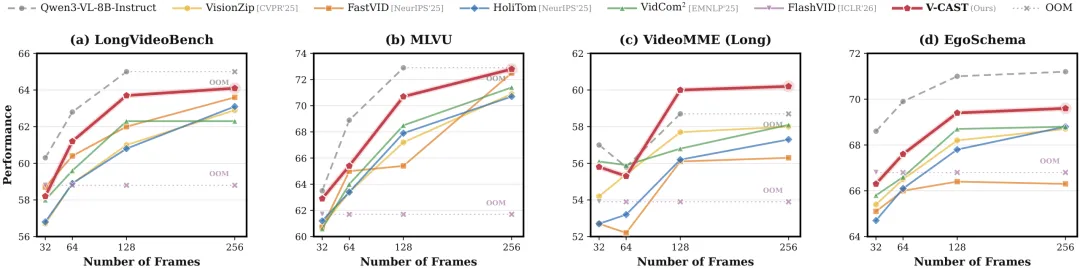 △Long video understanding performance of different methods under 32-256 frame input.
Efficiency: Pre-fill delay is reduced by 51.2%, and total time is reduced by 13.6%
Pruning mainly reduces pre-filling calculations, and the full evaluation also includes video reading, visual encoding, and answer generation, so the total time-consuming reduction is smaller. The test uses Qwen3-VL-8B-Instruct, inputs 32 frames on VideoMME, and retains 25% of the visual token.
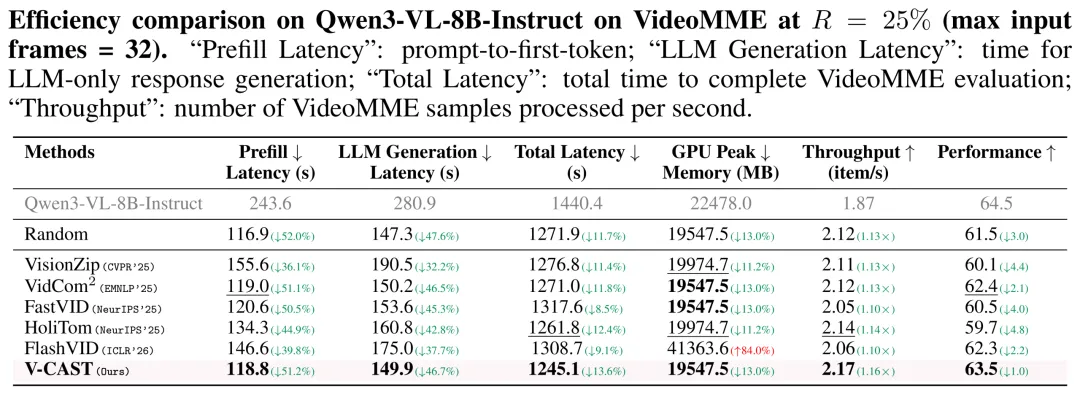 △Evaluation scores and inference overhead of Qwen3-VL-8B-Instruct on VideoMME.
Compared with the uncompressed model, V-CAST prefill delay is reduced by 51.2%, peak GPU memory is reduced by 13.0%, and the complete evaluation time is reduced by 13.6%. The prefill time of LLaVA-OneVision-7B also dropped from 96.6 seconds to 26.5 seconds, and the peak GPU memory was reduced by 11.4%.
 △Prefill latency, generation latency and peak memory of LLaVA-OneVision-7B.
Ablation vs. Migration: Where the Benefits Come from
After replacing each component under the same budget, curvature distribution achieved the highest average score at both 32 frames and 64 frames. Taking 32 frames as an example, the average of the overall scores of MLVU and VideoMME increased from 62.6 for the global uniqueness strategy to 63.1.
Intra-frame screening also requires two complementary signals: looking only at feature differences may miss key information similar to the features of the entire frame, and looking only at activation intensity may leave repetitive areas. When the two scores are combined, the average score is the highest.
Curvature assignments can also be reused individually. The experiment retains the original compression mechanisms of VisionZip and VidCom² and adds curvature budget allocation. At 25% retention rate, both improved on LongVideoBench, MLVU and VideoMME.
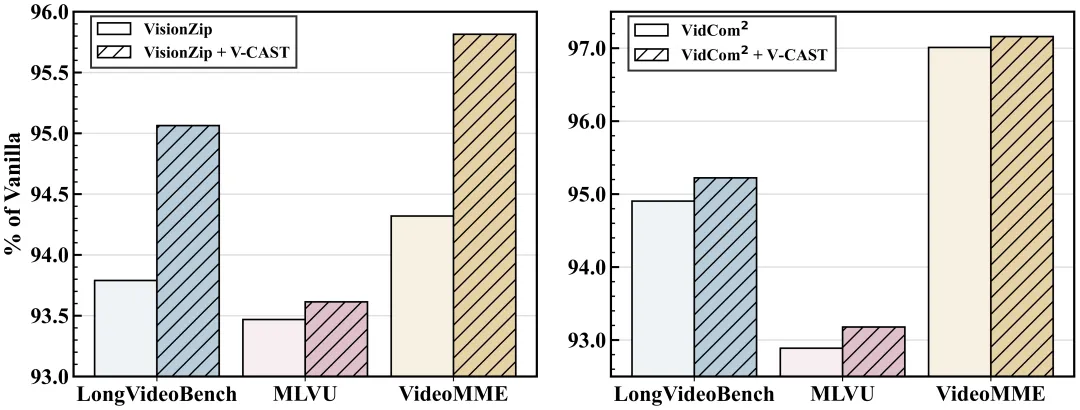 △Performance before and after adding curvature budget allocation to VisionZip and VidCom².
Case: When is the budget allocated?
In the case of finding the date of the zodiacal light, the key clue only appears for a moment; counting the types of glaze colors requires focusing on multiple glazing stages. V-CAST retains more tokens in the clips where celestial phenomena appear and at the turning point of glazing.
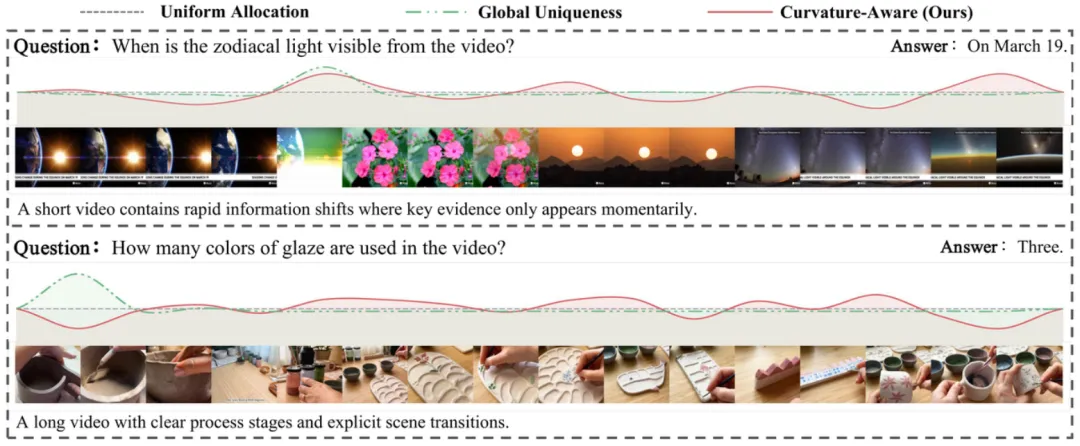 △The number of tokens retained in each frame of the two videos. The red line indicates V-CAST.
The retained images also influence the final answer. In the two cases of wedding episode positioning and acrobatic movement recognition, V-CAST gave the correct answer.
△Answers to different methods in plot positioning and acrobatic identification cases.In general, V-CAST allocates time budget through curvature, filters spatial details through dual anchor point scoring, and retains original coordinates to compress visual tokens without training.
The results on different models and input lengths show that rational allocation of limited budget can help balance video understanding performance and reasoning efficiency.
Authors: Xinying Lin, Xuyang Liu, Yiyu Wang, Teng Ma, Jiasheng Li, Zichen Wen and Wenqi Ren. Affiliations: Sun Yat-sen University Shenzhen Campus, Shenzhen Loop Area Institute, Hong Kong Polytechnic University, The Hong Kong University of Science and Technology (Guangzhou), and Shanghai Jiao Tong University.
Project page: V-CAST | Code: GitHub repository