It's the first time in the history of the world.
Lyman guesses we're almost under attack!
Today, Anthropic issued a press release calling for an internal study edition of Claude to prove the "Liman conjecture" had failed.
But Claude made a major breakthrough in this century's difficulty.
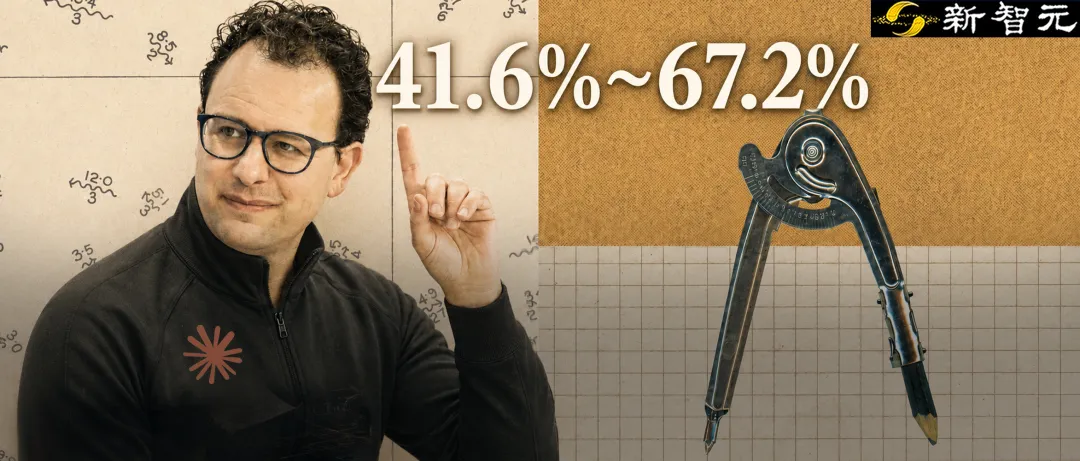
It succeeded in meeting the hypothetical zero-point threshold of the Riemann Zeta function, rising from 41.6% to 67.2% per annum.

Unsurprisingly, Claude completed this elaborate work of divinity, and he gave it a "irrigation" madness.
You can, believe in yourself!
As soon as the news broke, the entire AI circle exploded.


It should be noted that in the last 37 years, only 0.8% of all human mathematicians have advanced this result.
Today, Claude has taken a direct step forward, rising to 25.6%.

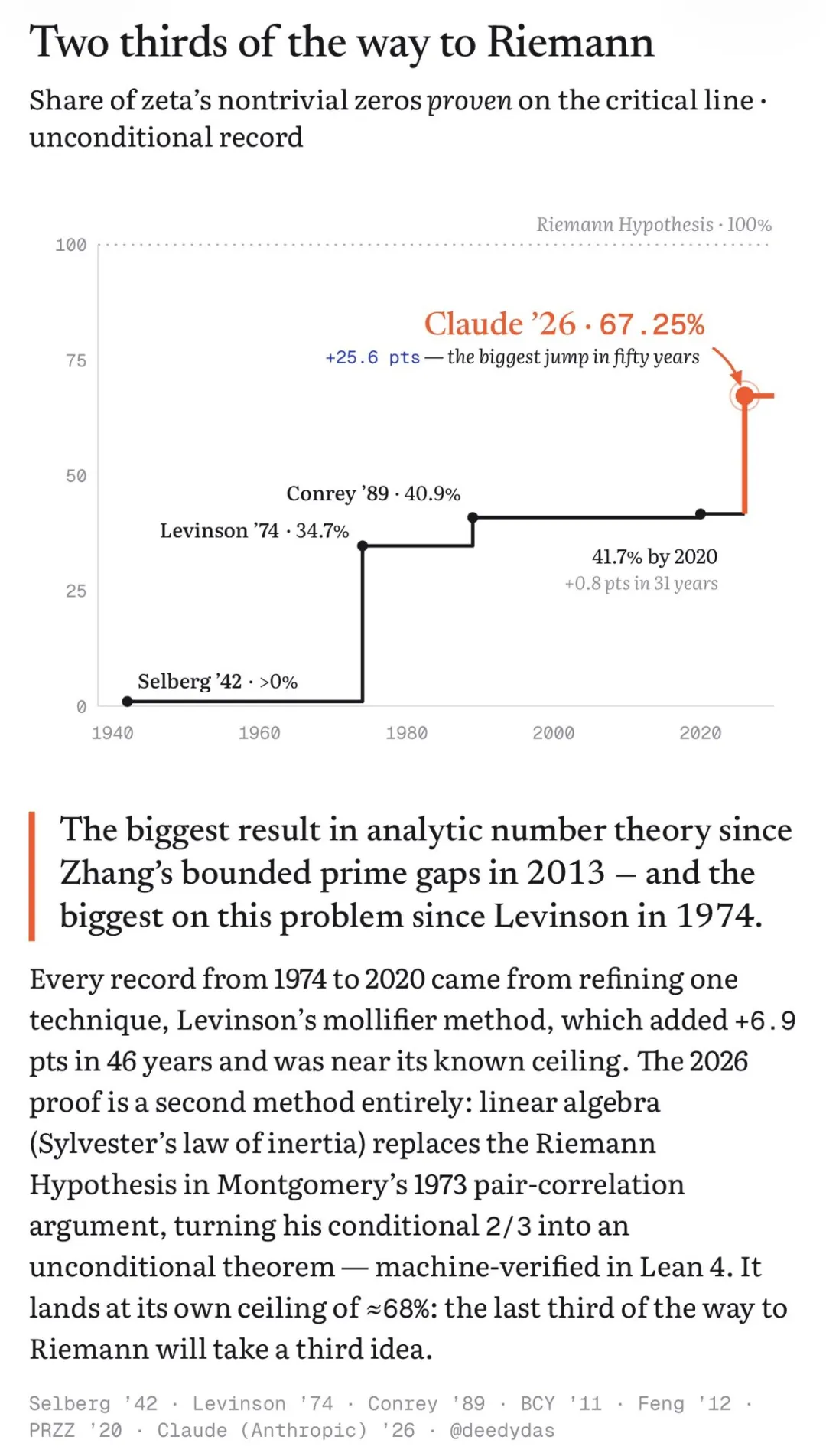
In 167 A.D. "Liman's Guess"Claude testified for a day and a half.
The man who started the study was Jared Sumner.
An Anthropic employee, the founder of Bun, dropped out of high school at the age of 16 after studying geometry for only six months.
On his morning run eight days ago, he gave Claude an open goal: to prove Lyman's guesses.
It was not surprising that Claude's challenge failed.
After all, this is one of the "seven thousand-year-old puzzles" that has been solved for 167 years.
But mathematicians are still boiling for it, because it causes a stagnant six-year number to be substantially rewritten.

On his first attempt, Claude generated and tried 650 points, all of which failed.
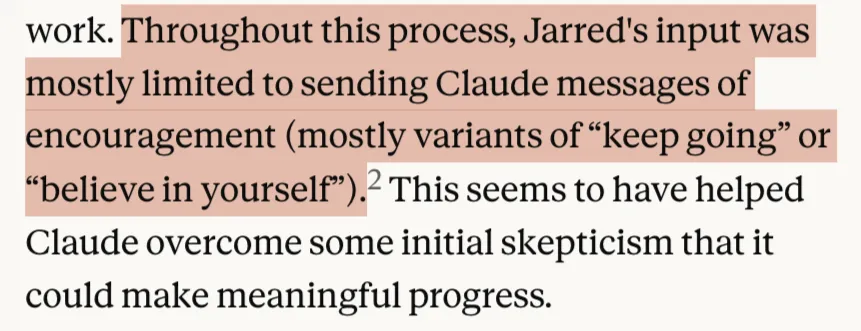
Sumner was not involved in the mathematical inference of the paper. His suggestions were very specific, meaning mostly only two things: continue, and believe in yourself.
For the second time, Claude changed his approach: he picked up about 60 children and ran for a day and a half.
Each agent studied different directions, wrote programs, checked numerical values, read papers, and checked each other's conclusions.
Two: think of key mathematical ideas.
13th: Give these two ideas a helping hand.
30: I tried, but nothing worked.
13th: Being a validator, specifically making mistakes.
Last two: Responsible for the initial draft of the paper
As you can see, half of the agents, the white ones, actually contribute to the core mathematical idea of only two agents: E2 and E2-pairs.
Two sessions, all in Claude Code, burned a total of 31 million output tokens.
This scale is placed on the individual mathematician, which is equivalent to writing continuously for several months.
So what's the real point of Claude raising 41.6% to 67.2% in this conjecture?
Claude is up 25.6%.Pressure on human mathematicians
Lyman's conjecture was proposed by Bernhard Lyman in 1859.
It examines the location of unusual zeros in the function z. These zeros are closely related to the distribution of prime numbers. Lyman's conjecture is that all unusual zeros are located on the critical line Re(s) = 1/2.
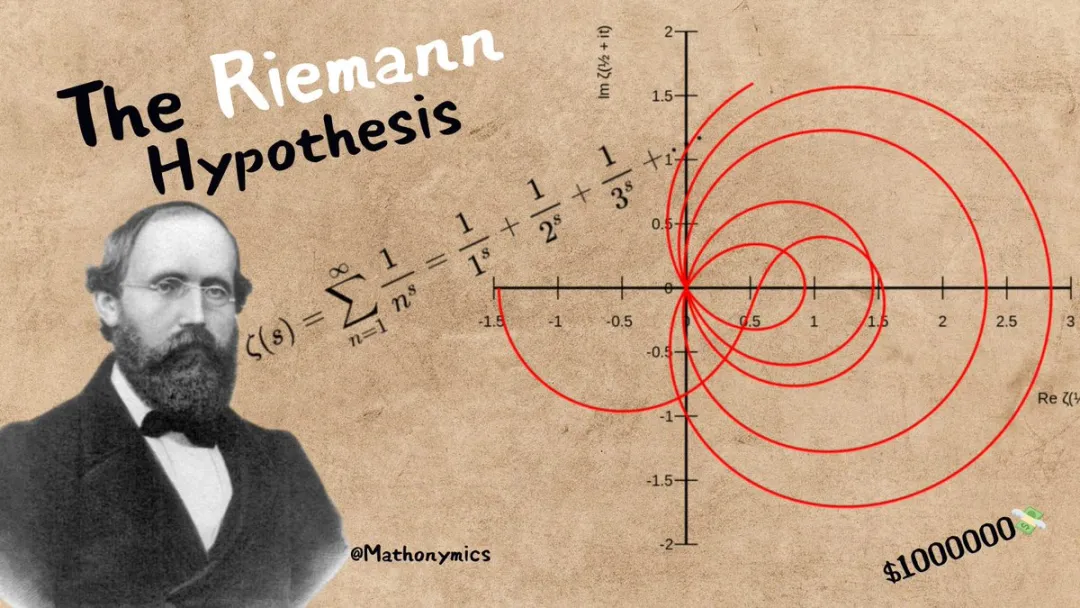
The Clay Mathematical Institute has set up a $1 million reward for information leading to its completion. To date, no one has been able to prove or disprove it.
Claude solves an important related question: how much of the zero can at least be shown to be on the critical line?
In 1973, Montgomery studied the correlation of pairings between zeros, and obtained a 2/3 result about the simple zeros ratio under the assumption of Liman's conjecture.
One side of this derivation can be calculated by prime numbers, and this part itself does not require Liman's conjecture.
What really needs to be guessed by Liman is how to explain the zero-point contribution of the other side. As long as there are zero-points outside the critical line, the original positivism will fail.
In recent years, mathematicians such as Baluyot, Goldston, Suryajaya and Turnage-Butterbaugh have further established zero-point matching results that do not rely on Liman's conjecture.
Goldston and Suryajaya subsequently proposed that if the remaining Lyman conjecture in Montgomery's proof could be removed, 2/3 could be unconditionally established.
Today, Claude has taken a missed step.
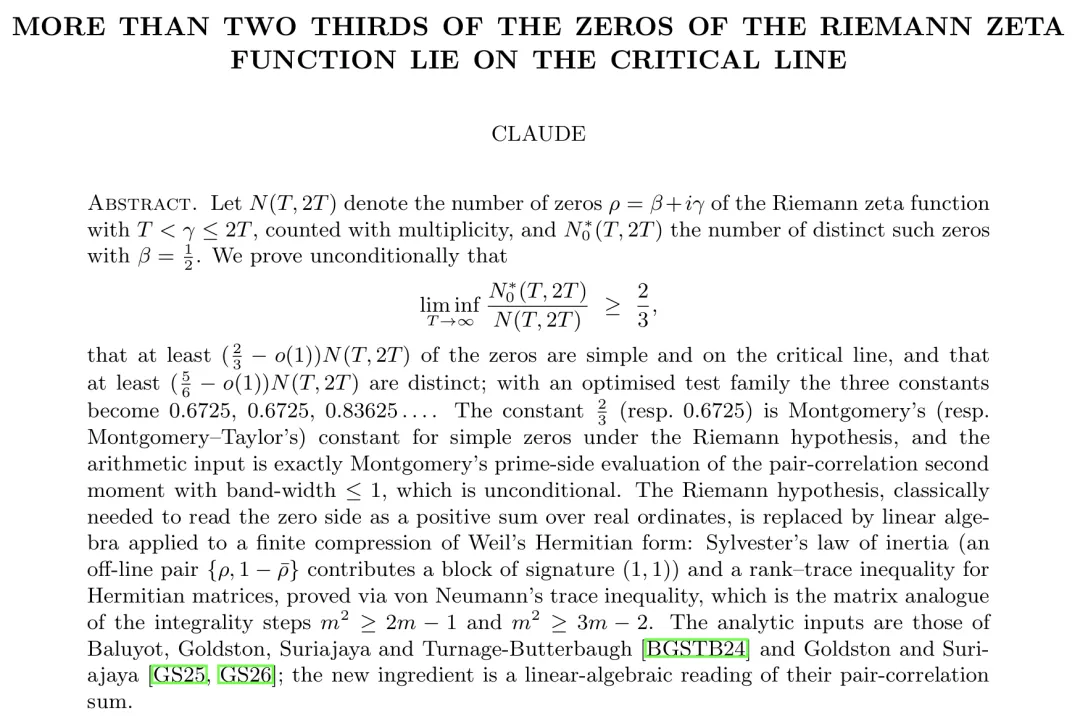
Address of the paper:
It combines these recent results with related observations by Bombiri in 2000, limiting Weil's formula to a finite-dimensional Gabor function space.
After this step, the original arithmetic problem can be expressed as a Hermitian matrix problem.
Zero points on the critical line contribute positively. Zero points outside the critical line appear symmetrically, with each pair of zero points contributing a two-dimensional block signed 1, 1).
Claude's hierarchical trace inequalities can deal with both types of contributions at the same time, reusing the first-order and second-order matrices that have been calculated from the prime numbers side to estimate the number of zeros on the critical line.
Montgomery used the zero-point mass number m as an integer, and a simple inequality: m2≥2m−1.
Claude rewrote a similar mathematical relationship into the hierarchical trace inequality applicable to the Hermitian matrix. The characteristic value of the matrix does not have to be an integer, but can also be subdivided accordingly.
The final formula can be written directly as: H (λ) =2-1/λ-λ/3.
In this case, λ represents the standardized bandwidth of the test function.
Montgomery continued to use Taylor's optimal window function, which improved to 0.67250, or 67.25%.
67.25% is the most remarkable of the five main theorems.
In addition to this, the entire paper also gives a whole new set of conclusions about the location of zeroes, the scope of application of combinations and methods.
And the significance of this breakthrough is more than just renewing a percentage record.
It comes at a larger turning point: AI is moving from a contested question with standard answers to open mathematical research with no ready answers.
A monthly guess for 2026
In 2024, AlphaProof and AlphaGeometry 2 reached the silver medal level of the International Mathematical Olympiad.
In 2025, for the first time ever, the General Large Model reached a gold-medal level.
In 2026, the winds will change.
In April, GPT-5.4 Pro provided key evidence to solve Erdos's question No. 1196 in 1966.
In May, OpenAI's internal model overturned nearly 80 years of flat unit distance speculation.
In July, Claude Fable participated in the discovery of a three-dimensional counter-example that overturned the 87th Jacobian conjecture.
On 1 August, OpenAI also announced 10 mathematical and theoretical advances in computer science.
Nine days later, Anthropic published this result: Claude improved the record for the zero-point ratio of the Lymanz function from 41.67% to 67.25%.
Lyman's guesses are still unproven, but that's not the most important part of the story anymore.
In 2024, people are still measuring AI with medals in a mathematical competition. Two years later, an author who was writing Claude's paper has begun to rewrite mathematical records.