In a press release today, X announced that the company will work with six major financial institutions, including Apollo, BlackRock, Blackstone, Brookfield, Goldman Sachs, and KKR, to promote NVIDIA AI factory computing as a new "invested infrastructure asset class".
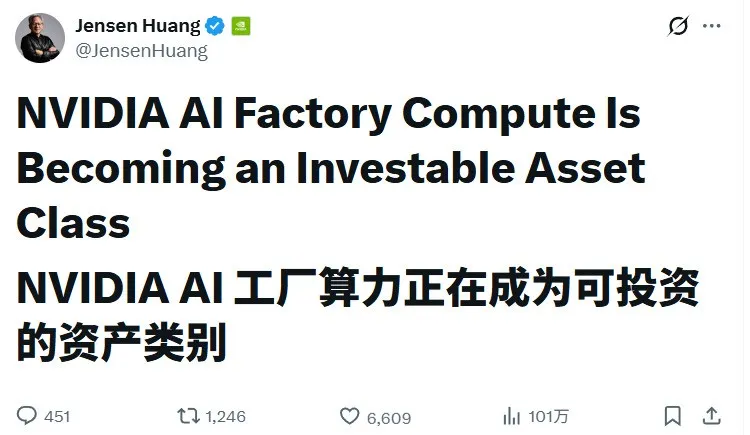
Huang said the collaboration will create an independent computational financing platform, with the goal of increasing the number of mobile users over time.$50 billionThird-party capital to support the construction of global AI infrastructure.
This means that NVIDIA is trying to move AI computing from traditional "enterprise purchasing GPUs, building data centers one at a time" to a financing model similar to electricity, communications and transportation infrastructure.
In the words of Huang Yin,"In the age of AI, computing is income".
He emphasized that $50 billion is not NVIDIA's revenue or the size of a single fund, and that financial institutions will independently assess customer needs, utilization rates, cash flows and asset residuals; NVIDIA may provide up to 25% residual support in some projects.
In a subsequent tweet, Huang Jin said it was a "significant moment" for NVIDIA and the computing industry.The company is completing the transition from "manufacturing chips" to "creating a new investment asset class".

The following is the full text of Huang's speech:
Today, we announced a partnership with Apollo, BlackRock, Blackstone, Brookfield, Goldman Sachs and KKR to jointly establish an independent funding platform that plans to raise over $50 billion of third-party capital over time to support AI infrastructure construction.
This is an important milestone for NVIDIA and the entire AI industry. In the past, businesses typically bought chips and built data centers on a project-by-project basis; today, this pattern is changing. AI factories are starting to get financing like any other productive infrastructure, supporting their construction and operations through replicable financing platforms, long-term institutional capital, and a diverse customer base that leverages computing to generate revenue.
AI has reached an important turning point, moving from the research stage to mass production applications. AI is creating real economic value while the infrastructure that supports AI is also becoming one of the most productive assets in the world.
In the age of AI, computing is income.
A new infrastructure asset
NVIDIA is not just a chip, it is a complete AI factory platform, including accelerated computing, networking, system software, AI frameworks, and global developer ecosystems.
The NVIDIA DSX AI plant can operate a wide range of AI models, models, and algorithms across the globe, covering areas such as language, vision, speech, biology, physical AI, and robotics. A NVIDIA AI plant can serve multiple customers at the same time and carry multiple different workloads, thus offering greater flexibility and interchangeability.
At the same time, the AI plant is built on the NVIDIA architecture, which is widely used globally. The architecture is widely adopted by major cloud service platforms, system manufacturers, and global businesses. When demand changes, an AI plant can be switched to serve another customer, another cloud provider, or another operator.
CUDA will also make AI plants that are already deployed more valuable over time. With each generation of software upgrades, NVIDIA can further improve the performance, efficiency and overall cost-effectiveness of existing infrastructure. In other words, hardware capabilities do not stop growing the moment installation is completed. Continuous software innovation can allow an AI plant to produce more "smart" at a lower cost throughout its lifecycle, thus extending its actual economic life.
The NVIDIA A100 is a very representative example. Six years after NVIDIA launched the A100 based on the Ampere architecture in 2020, it is still widely used for commercialized AI training, fine tuning, reasoning, and high-performance computing. Customers are still signing a multi-year deployment agreement for the A100, bringing its economic lifespan gradually closer to a decade.
Market prices also show the resilience of NVIDIA's computational economics. The one-year lease price of the H100 went from about $1.70 per hour per GPU in October 2025 to about $2.35 per hour in March 2026; the median price of computational on-demand between different vendors, also from about $2.00 per hour per GPU in October 2025, to $2.70 per hour in June 2026. Blackwell's computational surplus is further realistic, with the B200 reportedly renting at about $5.30 to $7.05 per GPU per hour.
This is the key difference between the NVIDIA AI plant and traditional infrastructure. Its value is not fixed once installed: CUDA will continue to improve its output efficiency; equipment already deployed will continue to create production value after the initial accounting depreciation period; and the same standardized architecture can serve a huge and growing global AI workload market.
These characteristics fit the definition of an investment-friendly infrastructure asset: it can generate revenue, serve a broad market, improve performance over time, and be redeployed.
Putting capital into AI factories
The market demand for AI infrastructure is very strong, but the ability of different companies to access capital is not balanced. Many excellent AI companies, enterprises and AI cloud service providers already have a clear need for computing, but are still unable to get financing at the scale and financial cost needed to build, making it difficult to rapidly expand infrastructure.
This is why NVIDIA has partnered with the world's leading providers of long-term capital.
Apollo, BlackRock, Blackstone, Brookfield, Goldman Sachs and KKR are also the world's leading infrastructure investors with extensive experience in risk assessment and investing in long-term, productive assets. NVIDIA will work with these institutions to build replicable financing platforms to help build the AI factories needed to build an entire AI ecosystem.
These platforms are designed to help qualified AI labs, enterprises and AI cloud providers access AI factory infrastructure on a larger scale. The so-called "more than $50 billion" refers to the total amount of third-party capital that these platforms plan to move over time. It is not NVIDIA's revenue, nor the size of a separate fund, nor the financing commitments made to a particular client.
Each financial institution independently evaluates specific investment opportunities, including customer quality, real needs, utilization of equipment, cash flow and residual value. NVIDIA provides an AI factory platform, while the financial institution provides long-term capital and financing expertise.
Several important questions
Is this circular financing?
The plan was designed to respond to outside concerns about "circular financing". NVIDIA hopes to introduce independent, long-term institutional capital rather than relying on mutual funding within the industrial chain to generate demand.
The demand for AI infrastructure is real in itself, with sources including cutting-edge AI labs, AI native startups, enterprises, cloud service providers, and countries that are building AI services and sovereign AI capabilities. Capital providers independently assess each project, including customers, needs, usability, cash flow and residual value. NVIDIA provides a platform, but ultimately whether or not it is financed is decided independently by investment firms.
From NVIDIA's perspective, this is actually driving an open AI infrastructure capital market.
Why should NVIDIA support funding?
In some cases, NVIDIA may provide a maximum of 25% of the project's residual value support mechanism for a particular project and will carefully evaluate each project on a case by case basis.
This support is limited, based on residual value, and is intended to complement independent risk assessments rather than replace financial institutions' own investment judgments. NVIDIA says this support is significantly lower than other arithmetic financing arrangements on the market.
The reason for this support is that NVIDIA considers its computing assets to be strongly interchangeable, have a high global adoption rate, can be continuously upgraded through software, and can be redeployed in a large customer ecosystem. Therefore, even if the needs of the original customers change, the devices themselves have a greater chance of continuing to be used by other customers.
NVIDIA's core role in this mechanism is to help fuel a huge pool of independent capital while controlling its own risk portfolios to a limited extent.
Is the market able to digest that much computing power?
NVIDIA's answer to this question is: The key is not to "build more data centers", but to "build AI factories that can continue to create economic value".
The essence of an AI factory is that it transforms energy and data into valuable intelligence. It serves a very wide range of customers, including cutting-edge AI labs, AI cloud providers, traditional enterprises, and national customers. These customers continue to increase their input into AI because AI has begun to play a role in real-world business and to complete economically valuable work across industries.
At the same time, this financing model also has a clear investment discipline. Each financing partner independently assesses market demand, equipment utilization, cash flow and residual value. In other words, new computing power should not be built off of real needs, but should be developed around the economic model of real customers.
Where does the return on investment come from?
NVIDIA's answer is straightforward: The return on investment comes from the practical value of AI itself.
Companies have started using AI to write software, discover medicines, design products, serve customers, automate operations, and create new products and services. AI factories are the infrastructure that supports these activities.
This is a self-reinforcing cycle: more computing can produce better AI, better AI brings more use, more use generates more revenue, and more revenue further drives the demand for computing.
NVIDIA sees it as a vertical loop in the industrial revolution of AI.
Infrastructure in the Smart Age
Every industrial revolution is built on massive infrastructure. From electricity, transportation, to communications and computing, the expansion of almost all important infrastructures is dependent on external capital and long-term financing.
In NVIDIA's view, AI factories are the new infrastructure of the smart age.
Through this collaboration with the world's leading financial institutions, NVIDIA is attempting to create a new financing mechanism to finance the infrastructure needed to drive the AI industrial revolution. Its goal is to make AI factories more accessible to businesses, industries and countries that are building the next generation of products, industries and national AI capabilities.
The era of AI has arrived. The next thing to be built is the infrastructure that supports this era.