
On August 17, global programmers were forced to come up with a collective puzzle.
When the code was written, the push point, the progression bar, was switched; the automatic test card died, the merger request failed to enter, and even the AI programming assistant Copilot went offline.
This card lasted more than seven hours, and on that day, global developers were waiting for it to breathe.
Three days later, the chief technology officer of GitHub, Vlad Fedorov, issued an apology:
If you're going to release software that day, we've disappointed you.

The reason he gave was: traffic surged to new highs, a key component of the central data center in the United States didn't keep up with the expansion, the pressure spread, and multiple services connected collapsed.
GitHub describes the incident as:Capacity failure」This is their second major accident in August.

GitHub Official Chart: During the August 17 crash, the number of failures of requests at the entrance was more than 50 percent.
As early as March and April, Fedorov had written about initiatives to improve the reliability of GitHub. He wrote in a tweet that the work is still ongoing.
How much traffic is generated on GitHub?
In September, developers and AI entities submitted 7.38 billion passwords on GitHub, more than five times as many as a year ago.
Just as people marvel at the speed at which AI writes code, the question arises: Where to put the code written?
The answer lies in the challenge that GitHub has faced for six months: the bottleneck of AI writing code has shifted from "writing out" to "saving in, getting in".
Who is blowing up GitHub?The first step is to distinguish between the two actions of a programmer who writes code:
Commit (commit) is an archive of the code locally.
Push is the process of uploading files to GitHub.
Human programmers often file a piece of code after it has been written, while AI is a "preservation madman".
In an official blog post, GitHub engineers wrote that almost every step of the way an intelligent body takes to save an archive. The number of push times has also been rampant, rising to 499 times, from 690 million to 335 million a month.
As early as August, Hackers News had some tweets: the number of submissions that GitHub actually deals with or pushes, this indicator is hydrated.
Some people immediately reacted: "A push with 100 submissions is more resource-intensive than a single one".
This means that submissions must be pushed to GitHub, and the more submissions that can be pushed to GitHub at a time, the heavier the bit that needs to be processed.

Hacker News netizens have debated the issue of "submitting countless times".
This refutation accurately reflects the pain of GitHub: Intelligent entities prefer "shredded storage". The more shredded, the more times, the greater the pressure.
More importantly, each push follows a series of "connected calls": the code is uploaded once, automated testing, code scanning floods, and the same code is pulled over and over again.
In a busy warehouse, you can pull a thousand times a minute. It's like you're just submitting a questionnaire and thousands of robots rush to review it at the same time.
In September, GitHub's Automated Streams (Actions) ran 32.6 million times, more than four times as many as a year ago.
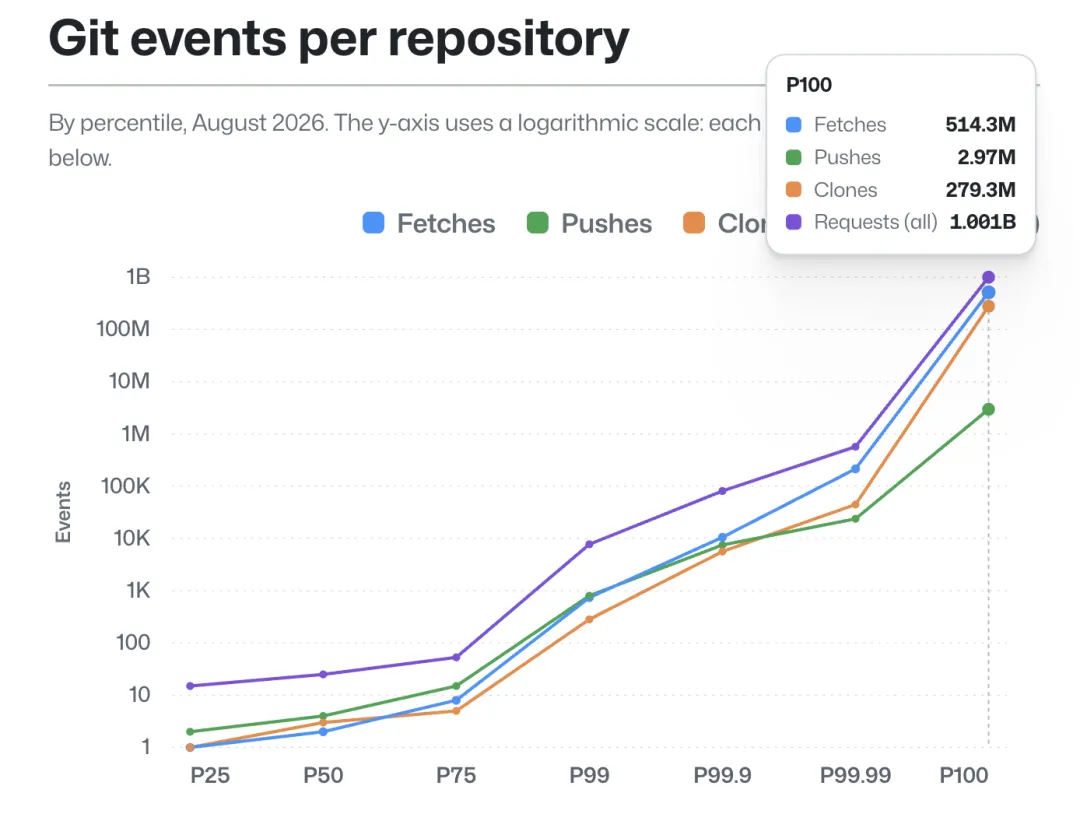
The level of occupancy of GitHub warehouses varies greatly: In August 2016, the busiest single warehouse received about 1 billion requests.
According to The New Stack, GitHub attributes this wave of growth primarily to "smart body demand":
An unprecedented number of new users have arrived. They don't sleep for 24 hours, and the biggest hobby is pressing the save button.
Why more backupsHow much slower?If you understand the craziness of the smart body, you will understand the difficulties of the old GitHub architecture.
For loss prevention and for distributed code readers, GitHub provides five full backups per warehouse by default, distributed across five servers.
This design is very stable in human times: one is not afraid to lose, and more people can read and distribute.
GitHub also relies on this old architecture to house 1 billion code repositories.
But in the age of the intelligent, the dead body is exposed.
The first block is in "Archive".
According to the old rule, every time a new code is stored, five backups are required, and the final speed is determined by the slowest server.
It's like asking five accountants to write a book together, and each new book has to wait for five people to sign it, and the slowest one to sign it.
Moreover, one can only record one note, the first one is not signed, the second one can only line up. The more people check the accounts, the more companies ask for accounts, the more accounts can be held, the longer the signing process.
In older architectures, reading and writing are dragged back and forth. The more GitHub wants to share the pressure of reading with backups, the slower the archives become.
Smart bodies are archived every minute, and every time they have to wait for the accountants to sign.
Even more dangerous is that the backup is too bad, and the archives will stop right away. It's like the account is too sick, and the account can't be remembered anymore.
The second block is "Merger".
All code changes will eventually be merged into the same main branch.
Over the course of a year, the volume of mergers on GitHub grew nearly four times as much as it did when thousands of cars crammed into the same charging station.
How slow is the queue? GitHub engineers counted a check in their blog.
When the backup of a warehouse is divided into two locations, the GitHub machine is about 1,600 kilometers away from the Microsoft Cloud, returning about 25 milliseconds per second, and storing a few tons per file.
What's even more important is that the entire warehouse can only put in one note at a time. The first one is not finished, the second one can only be done.
At 25 milliseconds, human programmers can't even close their eyes. For intelligent agents, this is the locking ceiling: how fast an intelligent body works depends on how quickly a push is completed.
Over the years, GitHub's proudest stability has become stuck in the era of smartphones.
Pioneering hardwareThe electricity in the engine room is running out.The first response of GitHub to the traffic boom was to add machines.
As of August, GitHub has added more than 3 million new CPU cores and 120PB of storage.
But the embarrassing thing happened: there was not enough electricity in the engine room.
Fedorov wrote in the review: "How much hardware can the electricity of the old engine room burn, how much have they installed".
Not only is the electricity in the machine running out, the electricity in the area where the machine is located has reached the top. The plug is plugged in, and if you want to add the machine, you can only move.
As a result, GitHub began to accelerate its migration to Microsoft's cloud platform (Azure): In May, Microsoft Cloud shared only 12% of the workforce; by August, this figure had risen to about 58%.
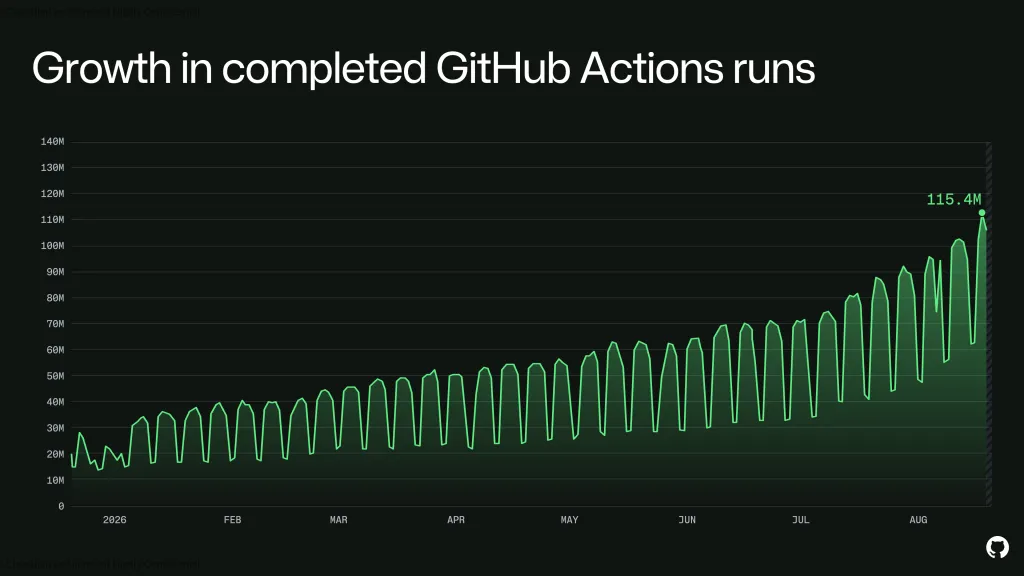
Between early and August 2026, GitHub Actions' completed operations increased from about 15 million tons to about 115 million tons.
At the GitHub Annual General Meeting on October 28, the database was refreshed once again:
This year, 4 million new CPU cores, 160PB of storage (about 160 million GB) were added, and network bandwidth increased by 50TB per second.
However, Microsoft executive Jay Parikh is still deeply rooted in the blogosphere of the day: just adding capacity is not enough, and architecture needs to be changed.
It's a lot of money to make a pile of hardware, to buy time to breathe, to cure the old problems of poor underlying architecture.
Change your seat.Remove the ledger and the counterI'm still going back to the metaphor of the previous five accountants.
In the old fashioned way, every accountant kept a desk with a full ledger in his hand, both to receive the guest's checks and to keep a low-key account.
The new method is to put the ledger in the general library, where the counter can only receive. The code is unified into the large warehouse of Microsoft Cloud, and the loss prevention and backups are stored at the bottom of the warehouse, the front server unpacks the packaging, only receiving requests.
There are three advantages to this demolition.
The first is reading and writing.
There will be more people to read the code, and it will not slow down the speed of the code. The front desk can be switched on and off, and the traffic will come and go, and the traffic will be switched off, which one is broken and the other can be switched on immediately.
Secondly, the surplus signatures were also cut off.
The only thing that really needs to be done in a push is this step of "updating branch guidelines" - moving goods to the warehouse, checking the integrity, scanning the leaked keys, all done without queuing up and so on.
Third, the backdrop was cleared.
Previously, cleaning up old data was done on the reception machines of the guests, with the reception of resources. Now all handed over to a dedicated "cleaner" machine, which slowly collects in the background against the warehouse.
Internal testing shows that the new architecture can swallow up to 35 times the number of entries per second.
The real challenge is that this massive, musculoskeletal surgery has to be done while GitHub is running normally.
This is equivalent to replacing the engine of a passenger plane flying at a height of one million meters.
GitHub is offlineYour brain has to shut down.
You might think that what does GitHub have to do with the average developer?
It's a big deal.
It doesn't matter which model you're using, which shell you're using, what code it's writing, a lot of it's going to go to GitHub.
On August 17, the same day as the launch of GitHub, Cursor released its own code-hosting platform, Origin, which is seen by the outside world as an alternative to GitHub.
But on the same day, the Cursor status page also posted an announcement:
The GitHub fault wave and some of the services of the Cursor, including automation and cloud intelligence, lasted 6 hours and 6 minutes.
Cursor status page: On August 17, the GitHub fault wave and some of its services lasted for 6 hours and 6 minutes.
There are alternatives to code management, but the workflow of the smart body is not yet separate from GitHub.
That afternoon, a post on Hacker News that said "there's an alternative to GitHub" peaked at 649 points.
What's even more magical is that while GitHub is crowded with smart phones, it's making more smart phones.
At the conference on 28 October, GitHub launched a new set of tools that allow smart bodies to work in parallel.
The lower the cost of writing code, the less the bottleneck will disappear, the more AI will move backwards.
It was "written out" and the big model solved it. Now it's "saved in" and GitHub is taking down the ledger, changing the bottom.
And then there's "getting along".
The GitHub engineer himself acknowledges that the next can still be written. The old way of bringing GitHub to a billion warehouses doesn't bring the next billion.
In the end, it's "who signed".
GitHub writes a principle in its blog: The more intelligent a person is, the more code owners will be able to review, understand, patch, untested changes, and not be able to access the main branch.
This is a crucial step on the way to ASI.
AI is already writing code, but to really deliver the software, the entire human-made infrastructure, it has to be rebuilt.
GitHub isn't going to be the last one squeezed into the corner.
Microsoft executive Jay Parikh also made a bold prediction:
All the software written by humans together could be less than 1% of the total in the next five years.
If he were even half right, waiting for more code to be tested that day, more scarce than the CPU, there would be an ever-touching submit button, and someone who dared to tap the board together.