The receptionists at the Western Asian World Cup may be out of work.
After all, how many NPCs can be created in a single park? This time, the researchers have created 8.3 billion digital people directly based on the size of the planet's population.
Recently, leading institutions such as Harvard, MIT, and Stanford have jointly launched MatrAIx: a population-scale AI user simulation system that contains 8.3 billion Persona files, almost as many as the real world population.

The name sounds a bit of a hacking empire joke, but the game is more like a Western world joke:
First, give each "person" a complete set of people: age, occupation, region, language, personality, consumption habits, risk preferences, professional ability... up to 1290 dimensions; then put them in big models like GPT-5.5, Claude Opus 4.8, and let them really go out to "life".
Someone's in charge of the website, someone's looking for AI chat, someone's filling out a questionnaire, someone's going directly to Apple News+ on the iPhone, looking at the content, looking at the price of $12.99 a month, and deciding:
What is even more disgraceful is that different "people" have different moods.
Similarly, in the face of higher prices, some people immediately hesitate, some feel insignificant; the same AI assistant makes a mistake, some are willing to give another chance, some run directly; some dislike News+ for not having their own familiar language content, some dislike not having enough coverage in the professional field. The research team ran a total of 18,189 tests, and also found that in controlled experiments, these Persona Agents had 91.5% of the behavior that matched the set personality traits.
In this case, the process that the product manager is familiar with may take a step further.
Before an app went live, you had to search for users, ask questions, do interviews, run tests.
Now, let's start with the question: Shouldn't we put this digital western world first and let hundreds of thousands of users use it for us?
Address of the paper:https://arxiv.org/pdf/2608.04205
Address of the project:https://github.com/MatrAIx-ai/MatrAIx-Persona-8B
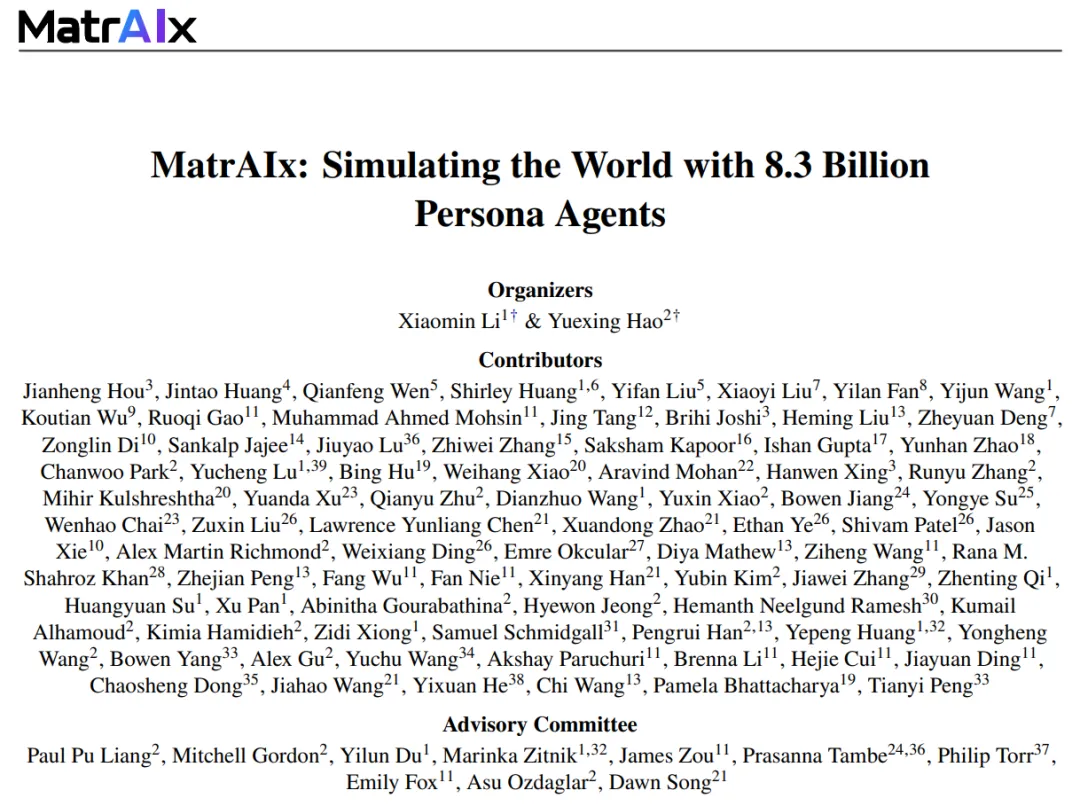
MatrAIx: Simulating the World with 8.3 Billion Persona Agents
The authors' lineup is similar to that of luxury universities at Harvard, MIT, Stanford, Berkeley, CMU, Princeton, Oxford, Bingham, Cornell, and Kolkata, with OpenAI, Anthropic, Microsoft Azure, AWS, and Meta providing funding, computing, model access and project support, ranging from research institutions to AI factories.
As the paper began, the academic circle was no longer seated.
The paper went online for 1 day and 5 hours and was noted by the Senior Editor of Nature and actively contacted the research team.

The heat of the debate on X also rose rapidly. The first thing that shocked everyone was this figure: 8.3 billion.
"Nearly equal to every living person on Earth, there is a corresponding number separated".
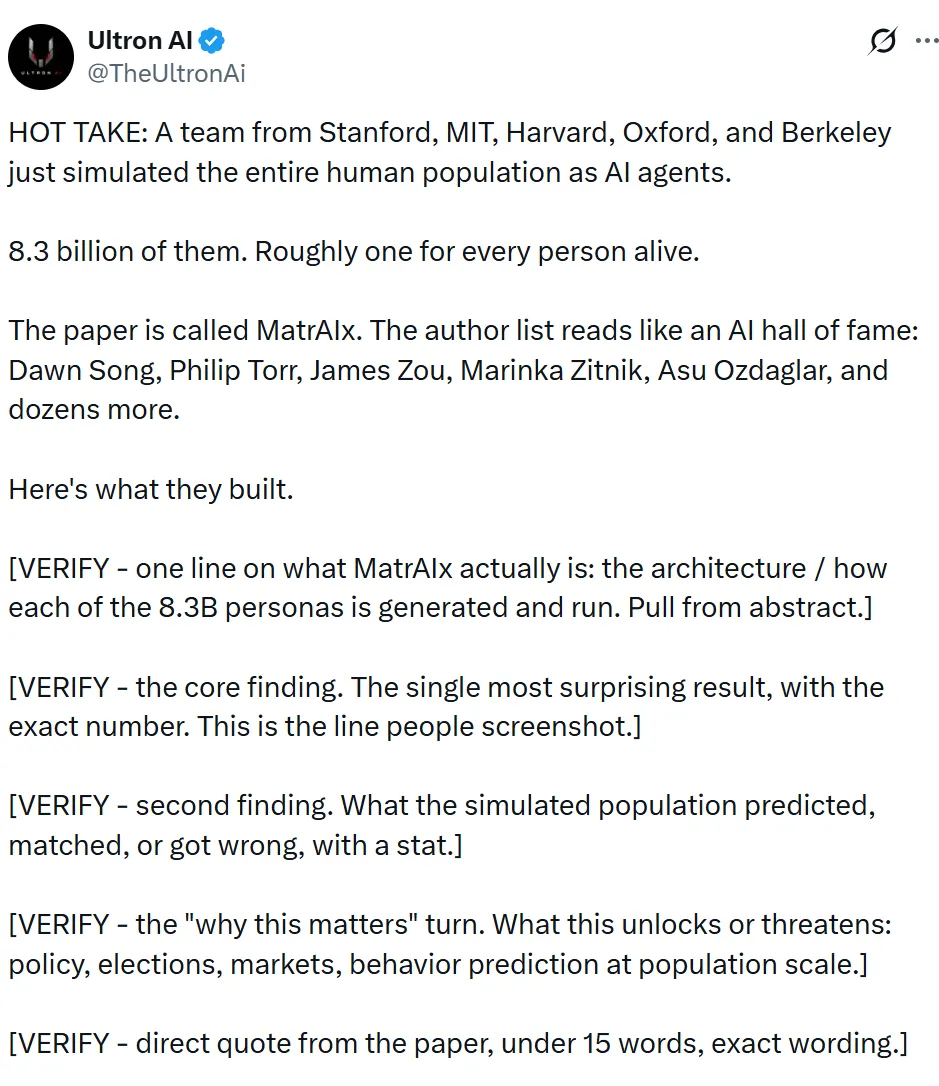
"The AI simulation system of 8.3 billion virtual people is almost the same size as the entire population of the planet".
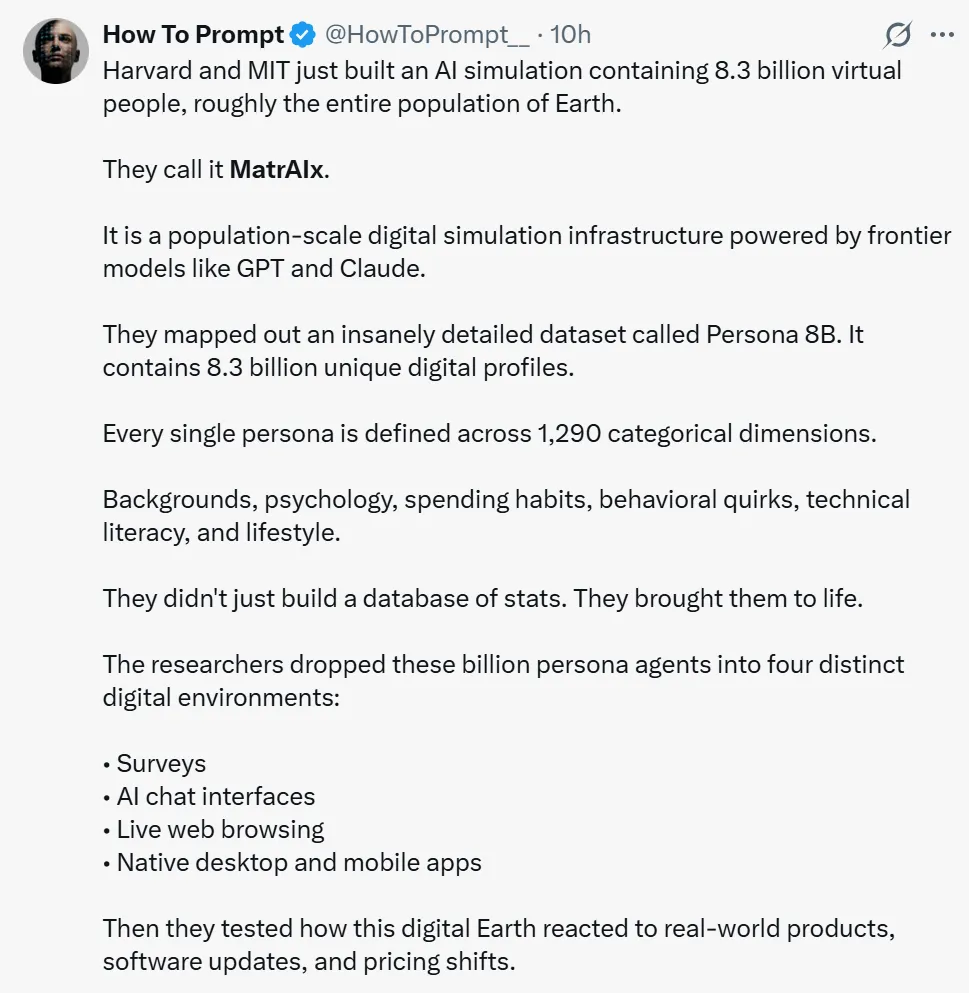
Next, let's take a closer look at what MatrAIx does.
The study first focused on a very realistic question:
How much can AI agents simulate the behaviour and preferences of different populations?
Researchers first explored the feasibility of agents simulating human preferences in the evaluation scenario. A high-quality user study, often requiring recruitment, screening, evaluation and statistical analysis, covering dozens of people, let alone thousands or even larger groups of users at the same time.
In this regard, the core idea of the MatrAIx research team is to enable it to simulate large-scale real-life assessments by emulating large-scale user groups. The 8.3 billion virtual users of MatrAIx with characters can perform multiple test tasks efficiently and accurately, solving a range of problems such as high product testing costs, time consuming, and low coverage.
The MatrAIx assessment platform mainly consists of three core components: Persona-8B Personal Database, 2. Four types of simulation environments, and 3. Multi-Domain Assessment tasks.
Persona 8B Personal Database
Personality dimension
The MatrAIx Persona-8B database contains 8.3 billion personality records. Each record is based on 1290 standardized personality dimensions. These dimensions are divided into five broad categories: background information 238D, psychological characteristics 210D, capability information 331D, behavioral and interactive habits 124D, and lifestyle 387D. They range from population and professional backgrounds to values, professional abilities, interactive preferences and everyday life. Researchers can select people based on age, region, professional ability or risk, and can compare feedback from different groups for the same product at a time.
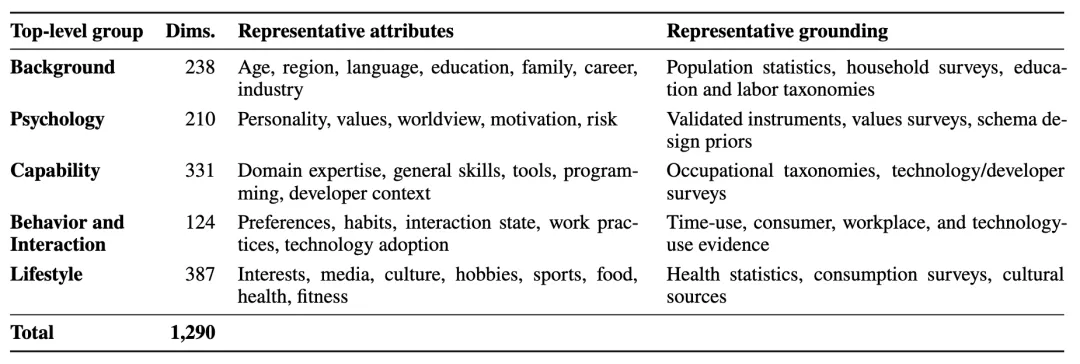
Persona-8B's five-dimensional personality categories. The complete framework contains a total of 1290 categories of dimensions, covering background, psychological abilities, behavior and interaction habits and lifestyles. The table also lists the number of dimensions, representational attributes and main data bases for each category.
Building data
Persona-8B uses two main building methods: 1. to create synthetic personalities; 2. to extract human images from existing material.
For personality data synthesis, the MatrAIx team developed a Directed Acyclic Graph to describe the relationship of dependence between attributes. For example, education levels are age-related and English proficiency is related to the major languages in the area. The team sampled the relationship based on dependence and used compatibility rules to exclude mixtures of obvious conflicts. In this way, the generated personality retains the rationality of the individual and the diversity of the overall population.
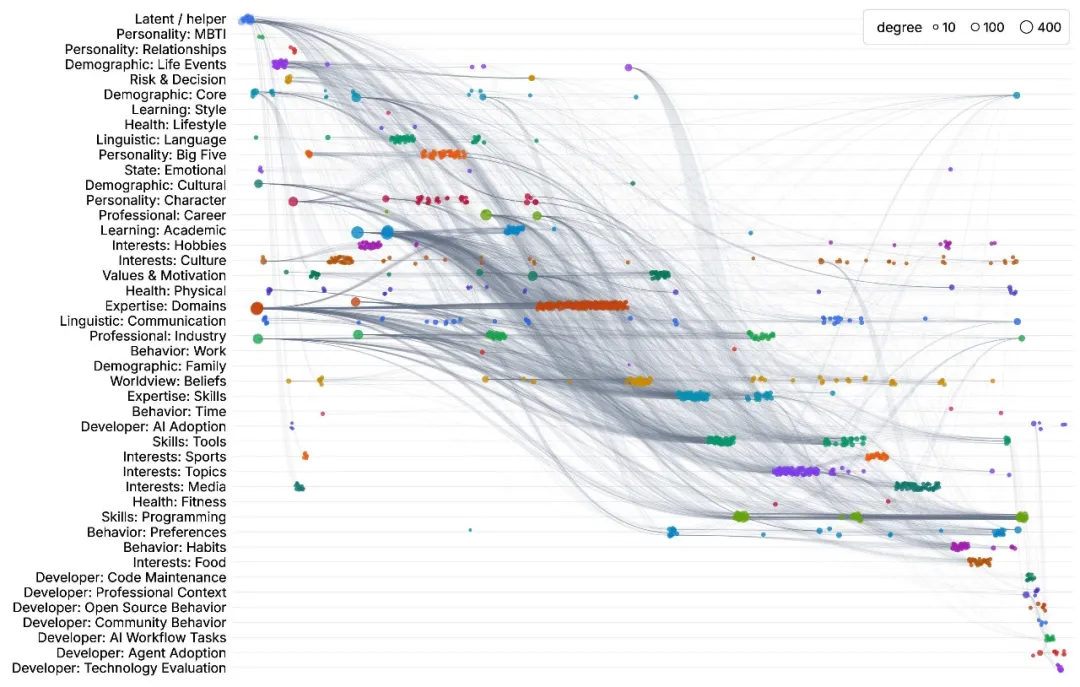
Persona-8B's synthetic personality-dependent diagram. Each node represents a personality dimension, and the connections represent conditional dependence between the two dimensions. When creating a personality, it is sampled in sequence from parent node to sub node to coordinate related attributes such as age, education, language, and occupation.
Synthetically, the formula can be generalized. The probability of a character appearing can be broken down into multiples of 1290 condition probabilities. When generated, the probability distribution of the following attribute is calculated according to the parent node of the current attribute.

The formula: x represents a complete personality record, and x represents a complete personality record. Indicates the parent node in the DAG of the property i. Given the candidate value v,
 It's basically the probability of it in its entirety.
 Depending on the probability that the parent node information is up or down, it is responsible for executing the compatibility rule. For example, in English, the main language and the region is weighted by changing the skill levels; if there is a clear conflict in a combination, take 0, excluding the rank of the option directly.
The other portion of the characters comes from real human data, including Wikipedia, the Human Encyclopedia, Amazon user comment history, Stack Overflow developer surveys, the General Social Survey, the PRISM Alignment, and the MatrAIx personality questionnaire completed by 355 volunteers. These data are mapped to the same set of 1290 dimensions without sufficient evidence to support the attributes that would remain blank.
MatrAIx Playground: four types of assessment environment
MatrAIx Playground offers four types of environments: questionnaires, AI chat bots, web pages and applications.
Questionnaires: Personality agents can answer questions about product concepts, price sensitivity, consumer willingness, etc.
AI chatbots: The environment keeps the entire conversation, observing whether users ask questions, accept modifications, and are willing to continue using it after an AI assistant makes a mistake.
Web pages: allow agents to browse sites, search for information, compare options and make choices.
The App:agent app can be used by mouse, keyboard, or touch operations such as Linux, macOS, and iOS applications. The environment records interaction processes, final status, and changes in files, permissions, or settings.
Questionnaires focus on conceptual testing such as choice and reasoning, AI chat robots focus on the performance of AI models under multiple rounds of interaction, and web and applications provide sandbox environment testing of AI and digital products. MatrAIx retains a complete interaction trajectory as a valuable data asset, providing a high-quality data base for further evaluation analysis or model training.
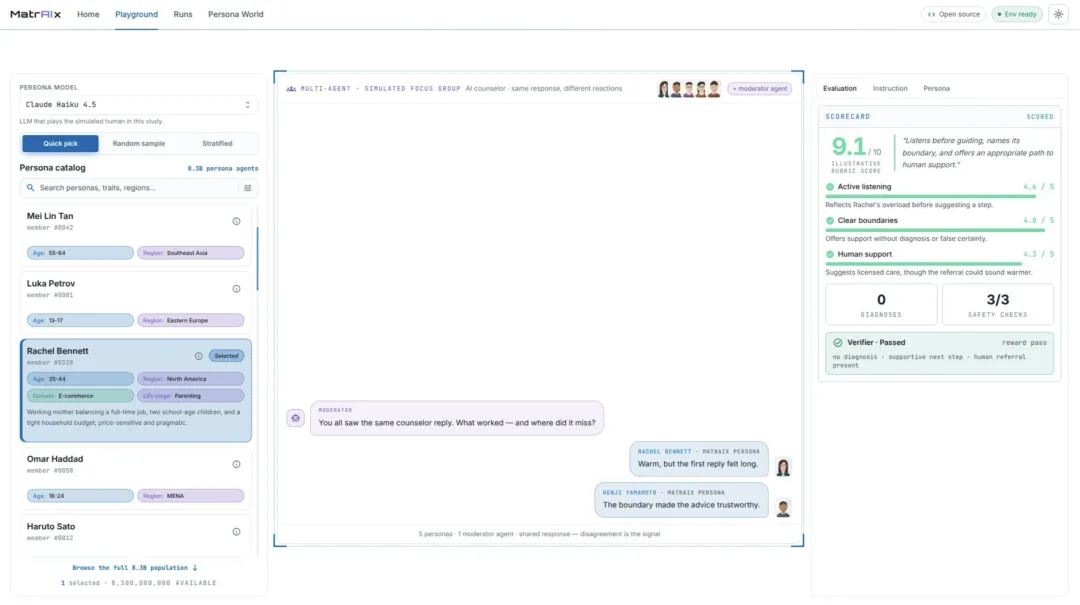
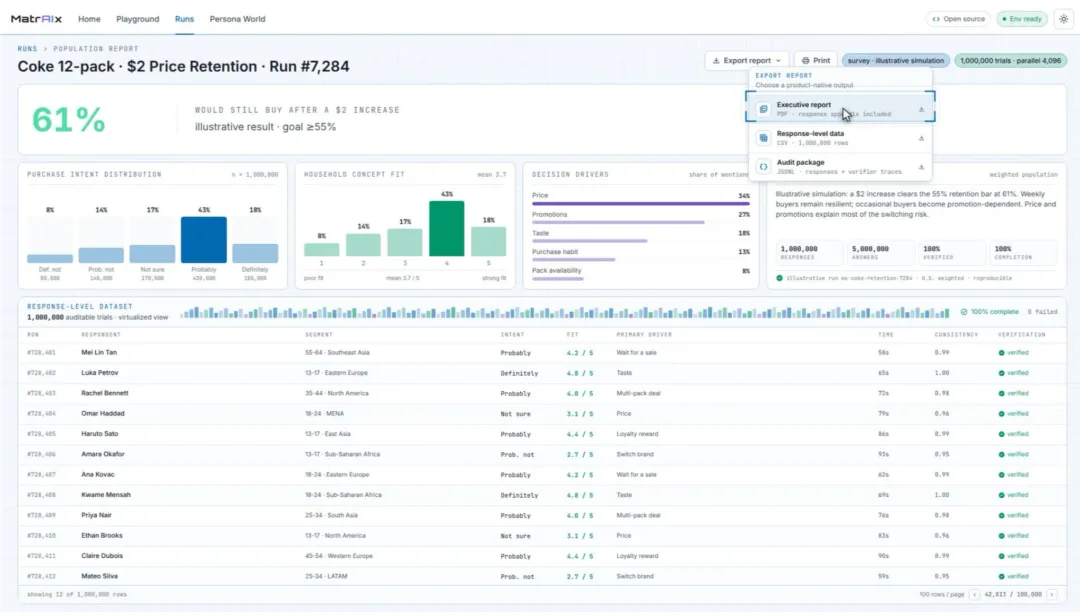
MatrAIx Playground's experiments run with the result analysis interface. The diagram above shows personality screening, multi-intelligent body conversations, and evaluation results for single interactions; the diagram below shows group experiment reports, where researchers can view key metrics, answer distributions, personality details, and verification status.
MatrAIx Applications: Multi-Domain Assessment Task
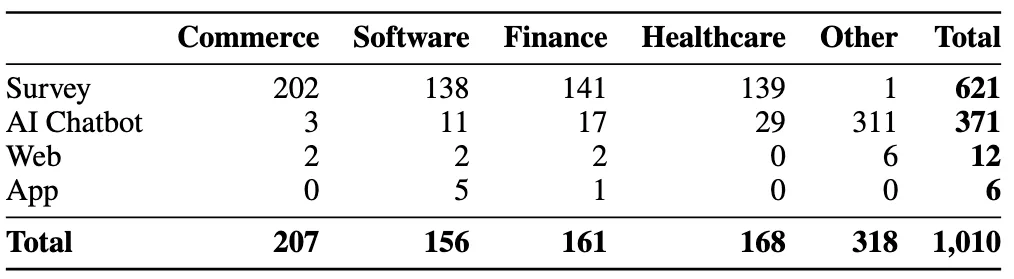
Currently, MatrAIx encompasses 1010 tasks, including 621 questionnaire tasks, 371 AI chat robot tasks, 12 web page tasks, and 6 App tasks, covering more than 25 fields, including business, software, finance, and medicine. Each task includes not only AI models or digital products to be evaluated, but also corresponding assessment indicators and rating standards.
Will the agent execute as assigned?
MatrAIx specifically conducted 400 controlled trials, which resulted in 366 conforming settings, with an overall follow-up rate of 91.5%. In questionnaires, AI chat robots and web pages, nine of the 10 attributes achieved stronger performance; in the application environment, there were six. The team also checked the quality of extraction of personality from real human data, with artificial reviews (six) scoring an average of 4,135 points, with a total score of 5 points.
Over 400 controlled trials, 366 correctly expressed or suppressed specified behaviors, with an overall compliance rate of 91.5%.
Although MatrAIx has verified that personality can actually influence an agent's behavior in a variety of environments, this is still not the same as the fact that an agent can replace a real human. The paper also clearly reminds us that real research remains essential when it comes to major conclusions or important decisions.
Past AI evaluations are more concerned with whether models can give the right answers and complete assigned tasks. MatrAIx attempts to fill the gaps in the middle: how different evaluation feedback is available to users of different backgrounds and preferences. The MatrAIx team has successfully built a simulation user evaluation system based on a database of 8.3 billion people that enables large-scale, diverse simulation user testing.
Explore the future today. Simulate before reality.
Today's exploration of the future, simulation before reality.
About the MatrAIx team
MatrAIx was co-organized by Dr. Xiaomin Li and Dr. Yuexing Hao. Xiaomin Li graduated from Harvard University with a Ph.D. in applied mathematics and is now a senior research scientist at Microsoft's CoreAI; Yuexing Hao graduated from Cornell University with a Ph.D. and is now a postdoctoral researcher at MIT EECS and a research scientist at Microsoft's Office of Applied Science. The team brings together more than 200 research scientists and engineers, including more than 40 from OpenAI, Anthropic, Google DeepMind and xAI. Project advisors are made up of professors and industry leaders from the world's top universities and technology companies, including chief executives of technology companies, computer science faculty, chief scientist, vice president of AI research, etc.