“ In the meantime, we're going to have to get to the bottom of the ocean and get to the bottom of it.
Wearing skeletons, the battlefield was on the ground for a long time.
Most teams have a clear mindset, providing power and empowerment to the human body. However, there is an ongoing dispute: who is dominant in human-machine collaboration, human or skeletal?
The team at Shenzhen Advanced School of Medicine, Shenzhen, has been answering this question for more than a decade and has expanded the application of the outer skeleton from land to underwater.
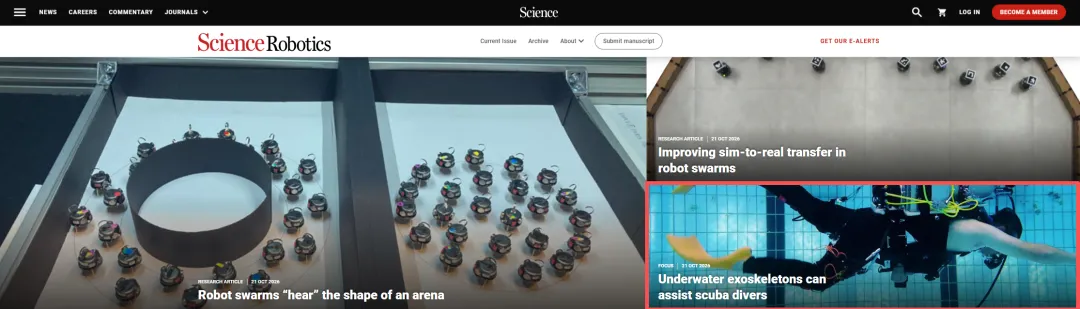
Recently, the focus papers that Wang Wang Wang and researchers such as Yang Yi, Liu Yi, Chen Chunjie and others have completed together have received the main recommendations of the Science Robotics website. The paper system addresses the technological framework and development pathways of submerged skeletons in systems integration, sports model adaptation design, assisted joint selection and human-machine synchronous control, and will also go through the concept of human-machine synchronous research and development of the team, leading to this whole new scenario of underwater operation.
This idea was first developed during the development of the rehabilitative exoskeleton.

01.
Rehabilitation of the exoskeleton: From walking around with people to following people's rhythms
Many people are familiar with the team, which was the first in the country to support the self-balancing lower limb exoskeleton AutoLEE for amputees.
At that stage in the market, there was a lot of recovery of the outer bones, which was written in advance with a set of fixed walking movements, machines moving the legs, people following the rhythm coupled, upper limbs need to hold the crutch to maintain balance. Although walking can be achieved, the upper limb strength of the wearer is extremely high, and if the crutch is not maintained, it is easy to destabilize the risk of falling.
The team soon realized that if there was a set of methane that could be worn on the aircraft, it would produce enough power for the occupant to walk, while independently maintaining balance, regardless of body shape and texture.
Around this bold idea, they began attacking the AutoLEE system, an outer skeleton with high stiffness and resistance to disturbance, and completed the first self-balancing walking training in the country. To date, the team has evolved three generations and expanded the rehabilitation training group from amputees to quadriplegics, fulfilling the dream of walking again.


AutoLEE structure and wear layout
Although the device looks heavy, but is aimed at disabled people, the outer bone must completely dominate and neglect the responsibility of safe walking, for which the team conducted a large amount of research to eliminate external disturbances, uncertainty of terrain, and fluctuations in the patient's body, each step behind a seemingly simple pace, undergoing a large and comprehensive real-time operation.
Although the heavy-duty methane can carry a patient for walking, it is difficult to accept in everyday auxiliary situations. Unlike the traditional rigid exoskeleton, the team has proposed a lighter, more flexible flexible exoskeleton. The design, combined with rope-driven and flexible fabrics, supports the calculation of the rhythm of human movement, and helps the user not only get up and down, but also walk naturally and save energy.
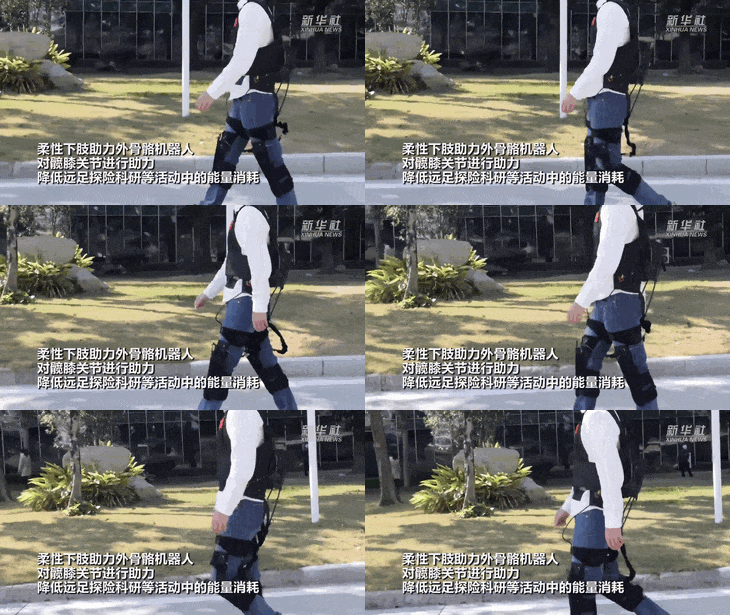
Flexibility of the exoskeleton to assist daily walking
Because of their small size, these flexible exoskeletons naturally extend from daily walking to personalized gait rehabilitation. The team continues to develop flexible gait exoskeletons that are adapted to children with cerebral palsy, moving models to accommodate all types of abnormal gait, bringing care and growth hope to children with cerebral palsy.
This route does not stop at the paper, the series of recovery samples get medical device-related qualifications, support step-by-step evaluation tools, and turn algorithmic capabilities into rehabilitation solutions that can be deployed in clinics.
From robots driving the human body to complete self-balancing walks, to robots perceiving, following human movements and influencing and acting on steps, the ultimate goal of human-machine dominance is the perfect realization of functions.


Children with cerebral palsy wear outer bones for step-by-step correction
02.
Special and extra-industrial skeletons: non-specific movements in real work conditions
Although the recovery scene varies from person to person, walking is still a regular and cyclical movement. The problem is completely different until the outer bones move to the waterline of the factory, rugged mountains.
In firefighting operations, the transfer of materials is often accompanied by rough terrain and heavy movements. Factory workers bend over, overturn, and lift work day after day, repeatedly causing long-term muscle damage. Many auxiliary equipment only perform steadily when running at a steady speed, and when the movements break down, manned assistance is easily disconnected.
Faced with the fire scene, the team developed the lower extremities' heavy outer bones, creatively proposed the artificial spine and lower extremities' life-supporting structures, which form a heavy chain that can carry 60% of the load to the ground, while allowing the wearer to complete movements such as a shovel, deep shovel, and experiment with fire brigades in multiple locations.


The test subjects wore negative exoskeletons to make the transition possible in complex mountainous conditions
Addressing the needs for multiple aids in manufacturing, the team later developed an adaptive waist-supported exoskeleton, an upper extremity aids exoskeleton and a lower extremity posture to maintain the exoskeleton. The exoskeleton only plays a role in critical joints in the human body, not binding the body's natural activities, breaking the solidifying idea of using a single exoskeleton to complete all tasks.
Focusing on the needs of the scene, the development of only the most economical and efficient external skeleton equipment, the related equipment generated by this concept, has quickly landed pilots in the mechanical installation and maintenance scenarios.
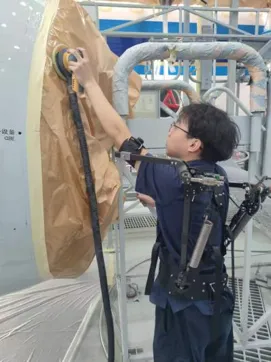
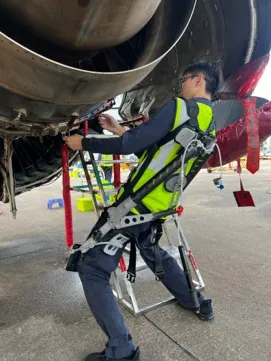
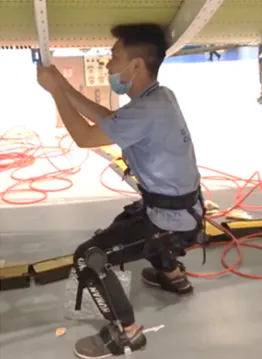
Upper, lower extremity and waist-supporting outer bone systems for mechanical installation and maintenance
Through continuous offensives across multiple fronts, including rehabilitation medicine, special-weight, industrial manufacturing, the team continued to accumulate new technical toolkits. This set of sunken technical systems did not just stay on the ground. The team re-emerged against the unique underwater posture, high-pressure low-temperature environmental characteristics, thickness and thinness, and became an important foundation for the development of the two PEAKED, KAED submersible skeletons.
03.
Submarine skeletons: a new set of engineering logical solutions
Water and air are two completely different mechanical environments.
Underwater, gravity is offset by the floating force, but new problems arise. Continuous water resistance overlaps with high-pressure low-temperature effects, plus oxygen bottles, heavy blocks clutter up space, and the design of wearing robots is very restrictive.
Submersible propellers, unmanned submersible craft are good at moving long distances. But cavity search and rescue, close-range patrol missions are different, the environment is narrow and complex, requires on-site observation, dynamic adjustment, and unmanned submersibles are difficult to replace. This is also the meaning of the existence of the submersible skeleton, which is not an underwater transportation tool, but an enhanced submersible capability.
The diversity of underwater diving movements, the team did not directly focus on the mature program of moving land, but rather through the biomechanics of human swimming, developed underwater propulsion structures to meet the needs of various underwater diving movements, such as alternating legs, swimming legs and walking down water. At the same time, targeting the characteristics of high resistance underwater, to achieve the support of the entire leg cycle, to minimize the energy consumption of underwater movements.
As the research deepened, the team moved in parallel around the two routes.
Flexible PEAKED prioritizes freedom, compatibility with alternating batting, swimming legs, and underwater walking modes, maximizing diversity of submersible assistance needs; rigid KAED master and existing underwater equipment integration, cleverly replacing power and controllers with traditional waist weights, plays an important role and saves space.
In addition, the team developed an efficient forecasting algorithm to ensure that the timing of the assistance is always up to date with human movements.

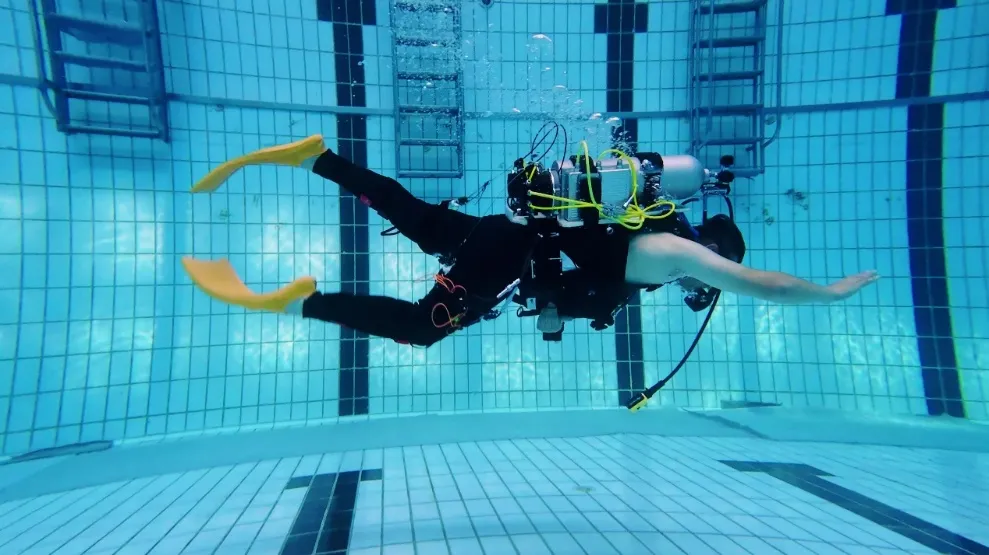
Submarines sprayed 50m underwater using the PEAKED flexible outer bone system to increase speed and reduce metabolic consumption.
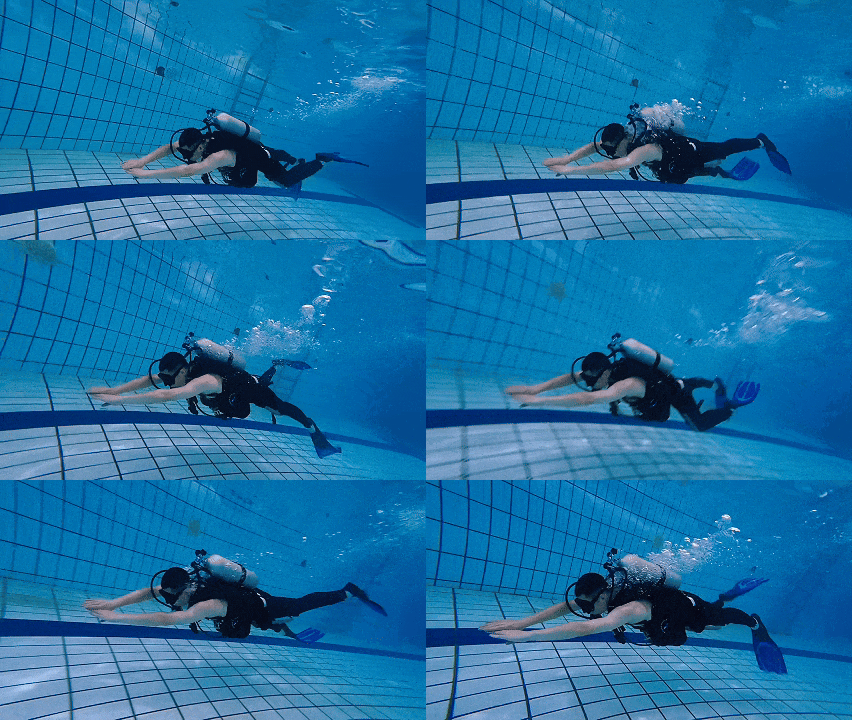
Submarines wearing KAED rigid outer bones gain precise leg assistance and extend the range of underwater exercise
The focus paper on Science Robotics, which jumps out of the single-pilot sampling, summarizes the technical framework for submersible skeleton in systems integration, sports model adaptation design, assisted joint selection and human-machine synchronous control, and is recommended on the homepage of the Science Robotics website, reflecting the ongoing interest in the international robotics field in the emerging direction of underwater wearable robots.
Of course, underwater bone research is still in its early stages, and all validation is basically under controlled conditions. In the future, the challenges will be even more challenging in complex environments such as rough flows and low visibility. How to improve auxiliary efficiency has a long way to go.
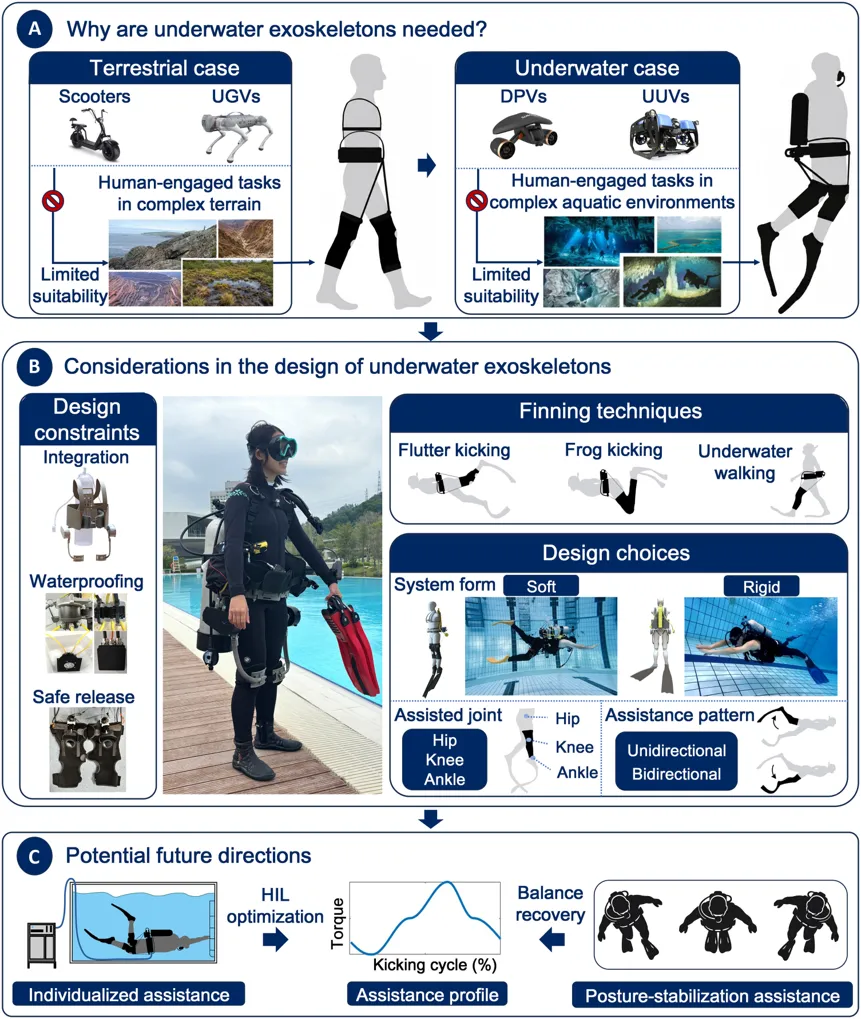
Submarine skeleton technology framework and development pathways
04.
Across the main line at all times: art is specialised, the outer bone is the same
From medical rehabilitation, industrial special assistance, to submersible bones, the logic of the research carried out by the team has always been consistent.
Judging the outer bone as bad is not how bright the indicator itself is, but whether it can efficiently improve performance while reducing the adverse effects of additional loads.
Although it has been a human desire for decades, it is also characteristic of humans. Different scenarios, task needs, and medium environments have natural constraints on the design of the outer bone.
How to design on the basis of these constraints, and to grasp the main contradictions in solving specific problems, is an important rule of thumb to really push the outer bone into everyday application.
05.
It's just a new puzzle underwater, and the outer skeleton is still expanding.
Underwater skeletons have been an important area of exploration for the team in recent years, but not all.
As a long-time scholar of the coexistence of robotics and human-wearing intelligence, Liu Niyu, who led the team to construct the theory of human collaboration in multiple scenarios covering medical rehabilitation, industrial assistance, special operations, and so on, opened up a whole technical pathway from mechanical analysis of movement, structure and control design, intent perception prediction, to machine development and demonstration applications, and won the first prize for technological advancement in Guangdong province and a prize for technological invention.
In the team's exoskeleton sampling matrix, the submerged exoskeleton is essentially a proof of human-machine collaboration theory in a new environment.
As extraterrestrial skeletons gradually move to industrialized lands, the team is answering a new question: When humans extend the boundaries of inaccessible activity, wear robots, in what form, become the wearer's ability to conquer the new world.