The vast sequence search space is one of the core challenges facing protein design.
A sequence of proteins consisting of 100 amino acids, if each location can be selected from 20 amino acids, would theoretically have more than one combination, the number of which far exceeds the total number of atoms in the observable universe. How to find from these possibilities proteins capable of forming the expected structure and achieving specific binding functions is a problem that computational design needs to solve.
Recently, Stanford University's X-lab and SNAP Lab jointly released the protein design framework ProteoCraft, which revolves around protein sequence search and structural validation, and proposed a "proposed sequence validation" search scheme: modifying directions through approximate gradients, using complete structural prediction to validate candidates, and further exploring and single-point refinement by tree search organizations. The framework supports both the initial design of combined proteins and local transformation within limited regions.
On the computational benchmark, ProteoCraft achieved a rigorous pass rate of 86.2% under the independent AF2-IG assessment; under the same candidate budget, ESMFold2, the high confidence in tree searches was 54.3%, 2.85 times the Best-of-N comparison.
In the PD-L1 microprotein wet experiment, 35 successful candidates had 29 combined hits, with a hit rate of 82.9%; six candidate reports selected to fit Kd below 10 nM, and the best single SPR fit Kd was 0.879 nM. Big Configuration achieved an average of 3.57 times faster end-to-end search than its unoptimized version.
From computational assessments to wet experiments, ProteoCraft has achieved stages of competitive milling. Behind these results, how does it explore and refine candidates more effectively in the vast protein sequence space through gradient proposals, complete structural verification and two-stage tree searches?
From generating to searching
How does ProteoCraft find a better protein sequence?
Currently, there are several representative technical routes around protein structure generation and sequence optimization.
Methods such as RFdiffusion, BondCraft, and BoltzGen already have the ability to generate protein binding molecules from scratch, and methods such as BondCraft have also used structural predictive gradient optimization sequences.
ProteoCraft's core idea is to separate the "proposed modifications" from the "review candidates" and allow the two to continue to cooperate in the search process.
At the Proposal stage, the approximation gradient is responsible for providing the directions for the modification to be explored; at the Verification stage, the model runs a complete structural prediction of the actually generated sequences of discrete amino acids to determine whether the candidate is worth continuing exploration.
Verification results are further feedback to tree searches, affecting the next step in design decisions, and allowing complete structural predictions to participate in the entire design process, rather than being limited to final screening.
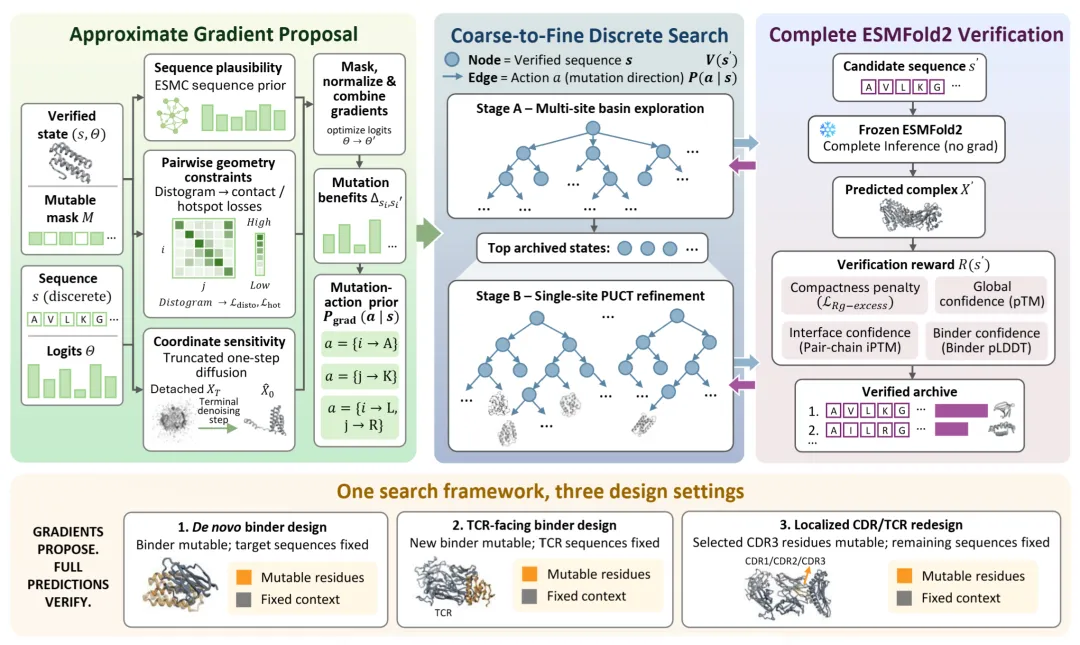
ProteoCraft proposes to validate the search process, including gradient proposals, two-stage tree search and complete structural predictions.
This division of labor corresponds to two different types of computing tasks.
First, how to determine the direction of sequence modification at a lower cost.
For protein design, each change in amino acid location can affect the folding structure of the protein and its interactions with the point of attachment. If each attempt relies on a complete structural calculation, the search costs accumulate rapidly.
ProteoCraft therefore combines multiple signal guidance sequence modifications.
On the one hand, the model uses protein sequence precedent to determine whether new amino acid combinations conform to the statistical rules of the protein sequence; on the other hand, geometric constraints between residues encourage the design to form reasonable internal structures and binding interfaces.
In addition, the model also introduced intercept scattering gradients to obtain modification signals related to three-dimensional structural changes.
To control the cost of gradient computation, ProteoCraft maintains the gradient of the propagation path only one step away from the end, avoiding reverse propagation of the entire propagation-generating path.
However, the change in direction given by the gradient does not directly represent the final quality of the candidate.
As a result, ProteoCraft retains the full structural verification link.
For the proposed discrete candidate sequences, the model runs a complete ESMFold2 structural prediction and is evaluated by a combination of indicators such as interface confidence, protein fold confidence and overall structural quality.
The approximate gradient is responsible for finding possible value directions, and the full prediction is responsible for examining actual candidates, avoiding determining the value of a sequence by approximate gradient scores alone.
In addition to proposals and verification, the search process also requires determining which candidates should invest computational resources.
ProteoCraft introduces the Monte Carlo tree search here, using a rough to thin two-stage strategy.
Stage A allows multiple amino acid positions to be modified simultaneously.
This phase primarily undertakes extensive exploration tasks, experimenting with different schemes in the larger sequence space to find areas of design with potential. In the search process, the model determines which branches are worth continuing exploration, based on the quality of the candidate that has already been verified, while retaining search opportunities for directions that have not yet been fully explored.
The second stage (Stage B) is switched to single-point refinement.
After obtaining a candidate of better quality, the model switched to a more subtle local optimization, changing only one amino acid position each time, to further adjust the existing program.
As a result, ProteoCraft organized gradient proposals, complete verification and tree search decisions into an iterative process, allocating computational resources between extensive exploration and local optimization.
The framework also supports controllable design for specific regions.
The team used it to design binding proteins with T-cell receptors (TCRs) as focal points, and localized CDR/TCR transformations, by specifying variable sequence regions with target binding hotspots.
In local modification tasks, the model only updates residues that are allowed to be modified, while the other sequences remain unchanged, but still participate in structural predictions of the entire complex.
As a result, ProteoCraft can explore new binding protein sequences from scratch, while retaining existing molecular frameworks to fine-tune specific regions.
86.2% had a strict pass rate, 2.85 times the confidence of the candidate,
ProteoCraft shows the benefits of searching
ProteoCraft's paper tests this approach systematically in terms of independent computational evaluation, search strategy blending, and reasoning efficiency.
The first is the performance comparison of protein design tasks from scratch.
This set of computational benchmarks covers 8 types of phosphate proteins, 14 different focus points, and combined hotspot settings, including designs for different profiles of the same protein. Each method provides 210 candidates and compares them using a uniform assessment process.
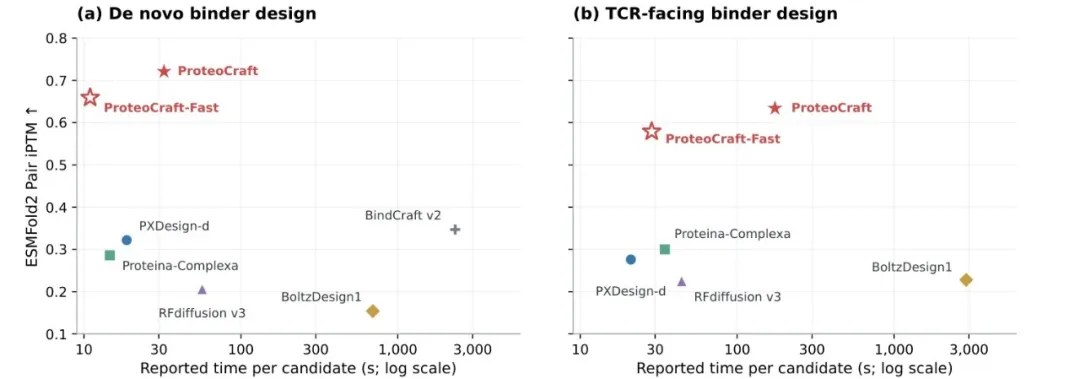
The relationship between candidate confidence and reporting time-consuming calculations.
In order to avoid evaluating their own results using models that only participate in searches, the team introduced the independent structural predictive assessment tool AF2-IG.
In this group of tests, ProteoCraft's rigorously calculated pass rate was 86.2% ((181/210)).
As a contrast, the pass rate for BindCraft was 49.5%, for BindCraft v2 was 58.1%, and for PXDesign-d was 9.5%.
Under this unified assessment standard, ProteoCraft has a higher proportion of candidates meeting the designated structural and interface trust requirements.
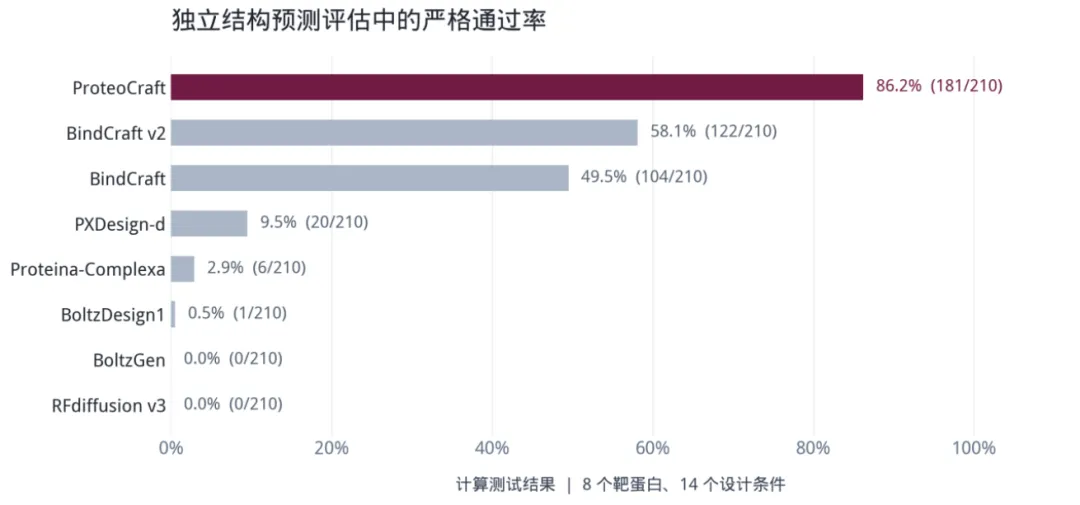
Independent AF2-IG assessed a strict pass rate of 86.2% for ProteoCraft.
AF2-IG did not participate in the candidate search and selection of ProteoCraft, but re-checked the output sequence by another set of structural prediction models, thus reducing the assessment bias caused by relying solely on the search model's own scores.
The team also used Rosetta to evaluate the combined energy, shape complementarity, clutch and other structural indicators of the interface.
Under the same evaluation process, ProteoCraft's average interface energy score was -81.195, and BondCraft was -57.879; the average number of interface keys was 12,510 and 8,500, respectively.
These independent evaluations further support ProteoCraft's performance in computing design quality.
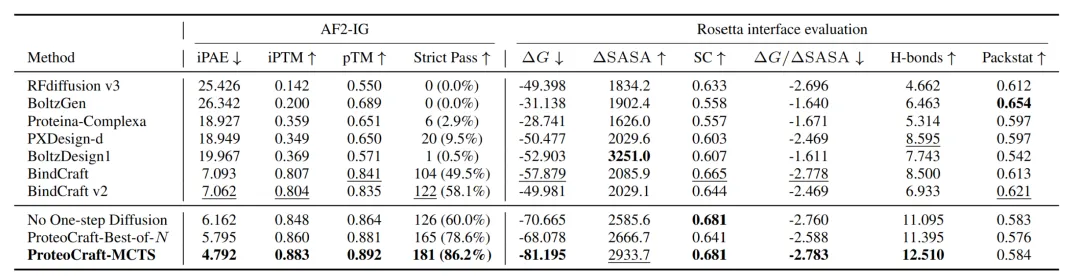
Independent AF2-IG and Rosetta computational evaluation.
In addition to comparisons with other methods, the paper focuses on the contribution of tree search strategies themselves.
Under ESMFold 2's strict unified standards, a candidate must meet a Pair iPTM of not less than 0.75 and a Binder pLDDT of not less than 0.9 at the same time to be considered eligible.
Of the 210 candidates who received the full tree search, a total of 114 passed this criterion, with a 54.3% approval rate.
In contrast, the Best-of-N comparison, using the same proposal mechanism, the same candidate budget, but not using tree search controls, was approved by only 40 candidates, at a rate of 19.0%.
The two countries differed by 2.85 times in the number of candidates according to strict criteria.
This comparison shows that, under a given candidate's budget, tree searches can allow more designs to simultaneously meet the requirements for interface and folding confidence.
The team further verified the contributions of different technical designs through fusion experiments.
The average Pair iPTM of the model decreases with the removal of the cut-off-step dispersion gradient, and the number of candidates reaching higher interfacial confidence standards decreases as well, indicating that this signal can provide additional structural information for sequence modification.
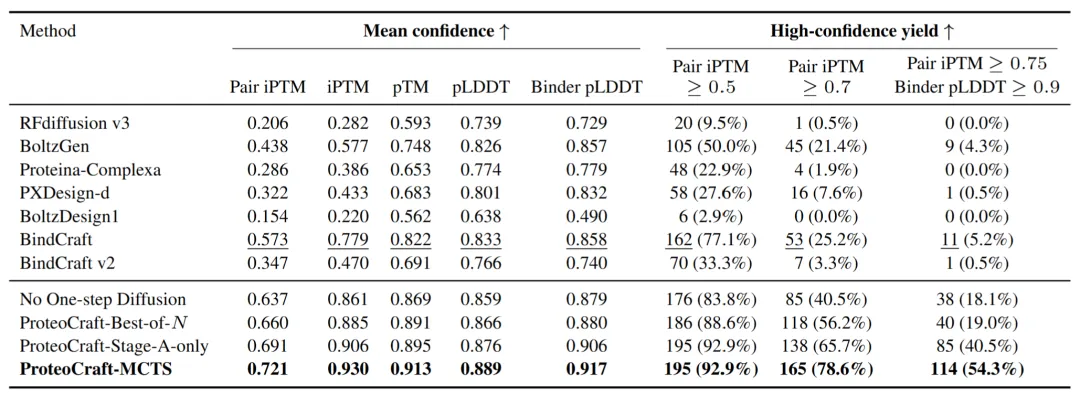
The ESMFold 2 evaluation and search strategy blends, with full tree searches with a strict passing rate of 54.3%, and Best-of-N at 19.0%.
For single-point refinements in two-phase searches, the paper was also subjected to specific controls.
The researchers started different search strategies from the same Stage A checkpoint and assigned the same 40 additional search steps: one group continued to explore multiple points and the other group moved to Stage B single point refinement.
The results showed a strict pass rate of 40.5 percent for continuing multipoint exploration and 54.3 percent for conversion to singlepoint refinement.
Under the same additional search budget, single-point refinement gained a higher proportion of rigorous scoring candidates, demonstrating an independent contribution to the local optimization phase under current test conditions.
This ability is also reflected in local CDR conversion tasks.
For example, with the 1QRN β mission, ProteoCraft's Peptide Pair iPTM reaches 0.789, while RFdiffusion v3 is 0.421.
Combined with the independent cross-assessment of AF2-IG and Rosetta, the results further demonstrate the potential for the framework to be elaborately designed within a finite sequence region.
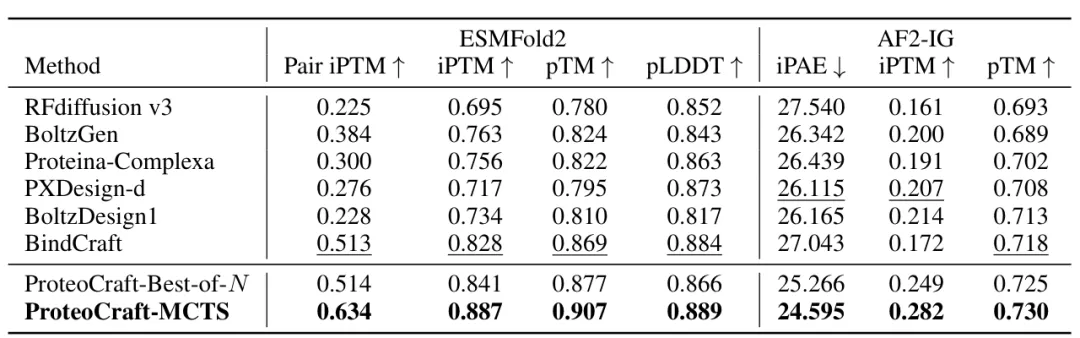
The ESMFold 2 TCR-facing binder is designed with AF2-IG computational evaluation.
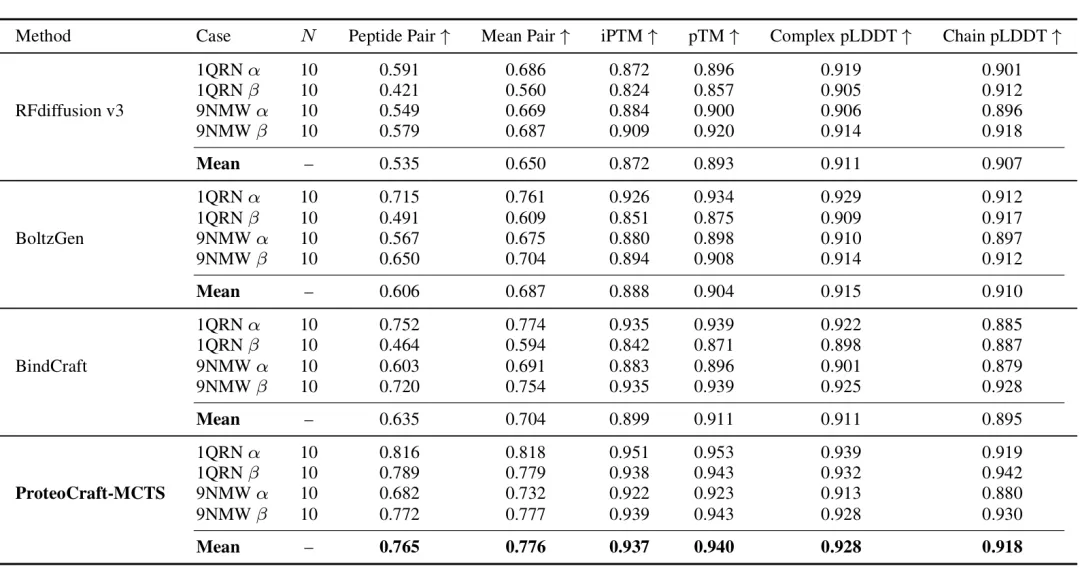
Local CDR conversion computational evaluation, including 1QRN β tasks.
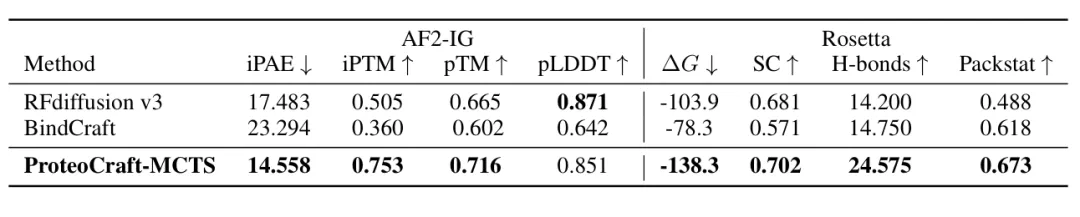
A local CDR modified AF2-IG and Rosetta independent cross-evaluation.
In addition to the quality of the candidates, ProteoCraft has also been optimized for computational efficiency.
The paper uses Anthropic's open-source ESMFold 2 reasoning optimization tool to test different acceleration configurations.
In experiments covering 13 test hotspots, Big configured the relatively unoptimized ProteoCraft, achieving an average of 3.57 times the acceleration of end-to-end search.
Meanwhile, the average Pair iPTM for Big Configuration is 0.673 and the unoptimized baseline is 0.657 and overall design quality remains relatively close.
Another Fast configuration accelerated by an average of 3.68 times, with a peak of 6.78 times on the 9C3E mission, but its average Pair iPTM was 0.628, lower than the Big configuration and unoptimized baseline.
The results of the different configurations reflect a trade-off between search speed and design quality. Fast configurations can further improve the running speed of some tasks, but average design quality also decreases.
As a result, the paper further highlights the balance between search speed and average design quality.
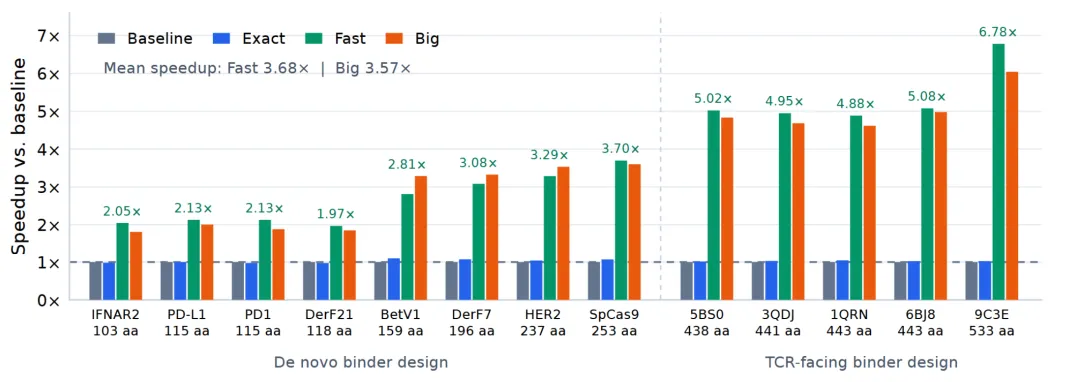
ESMFold 2 has different end-to-end acceleration ratios for different configurations, and the baseline is that ProteoCraft is not optimized.
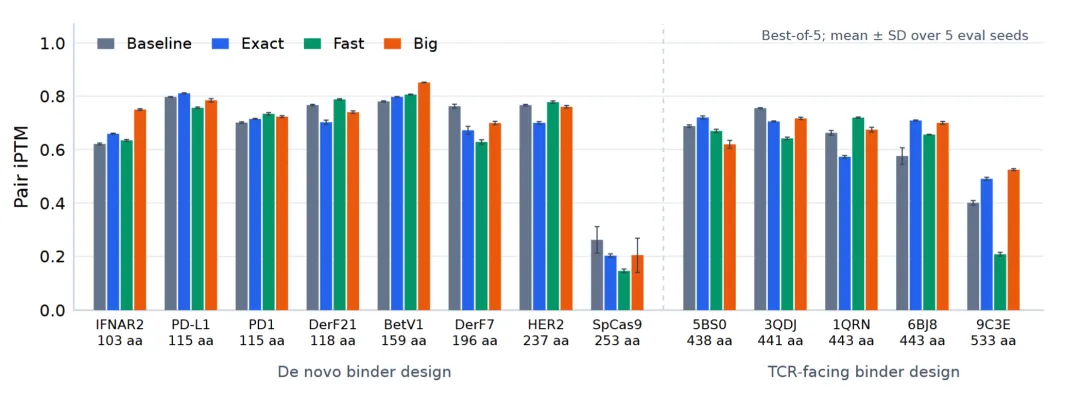
The quality of the design and the speed of the search varies according to the configuration.
According to the paper's statistics, ProteoCraft produced on average a unique candidate greater than 0.70 for an overall iPTM for every design task from scratch, with a discount calculation time of 32.34 seconds.
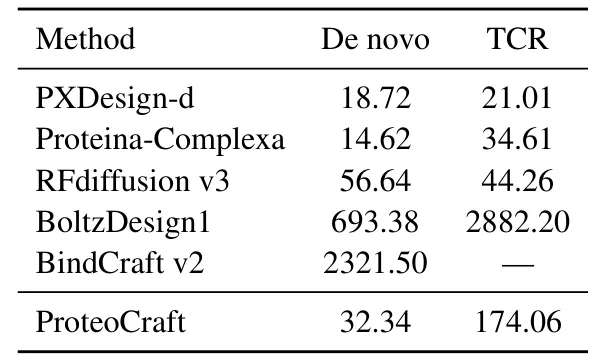
It's the first time that I've ever been in a political situation.
AI-designed proteins go into real experiments
After the computational evaluation, it is also necessary to test whether the candidate can be combined with ketone through real experiments.
Even if a sequence exhibits a high degree of interface confidence in structural predictions, it does not necessarily mean that it can be prepared successfully, nor does it necessarily mean that it can be combined with objectives in experiments.
Therefore, in addition to the computational evaluation, the team also carried out further wet experimental verification.
According to the team's latest results, this round of testing covers the PD-L1 microprotein, IFNAR2 microprotein and IFNAR2 nanoantibody designs.
Of these, the PD-L1 group received the highest combined hit rate.
PD-L1 is an important protein involved in immune regulation and is the focus of extensive research in the field of tumor immunotherapy. To this end, the team first verified whether the candidate obtained by the computational design could actually form a combination in the experiment.
Of the 35 PD-L1 microprotein candidates designed by ProteoCraft, all met the expression/similar success criteria of the experimental report, 29 of which achieved a combined hit rate of 82.9%.
In contrast, in other public studies, PXDesign had a hit rate of 82.4% (14/17), BindCraft 77.8% (7/9), and Chai-2 72.0% (18/25).
According to the criteria used in this round of experiments, more than 80% of the candidates who successfully expressed and entered the test received a combined score.
Of the 35 successful PD-L1 candidates, 6 candidates with Kd of less than 10 nM accounted for 17.1%, according to the ratings selected in the latest experimental report.
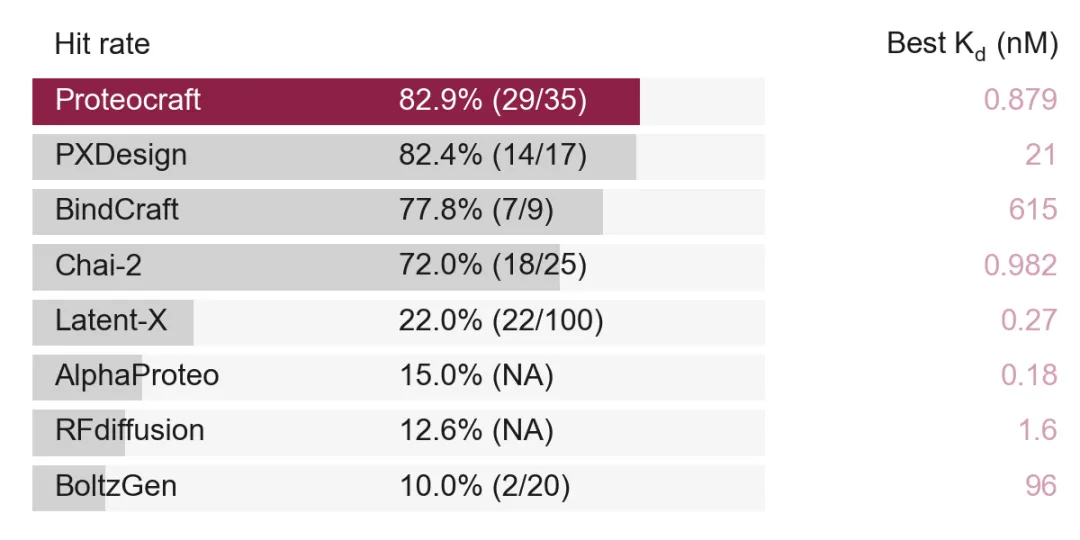
PD-L1 is a representative SPR measurement curve.
Of these, five candidates had Kd ranging from 1 nM to less than 10 nM, representing 14.3%; one candidate reached the anomalous level. The best single SPR matching Kd was 0.879 nM.
ProteoCraft also attempted another form of protein that has important application in biomedical research and development: the VHH nanoproteins.
VHH has an immunoglobulin-like structural framework and is involved in antigen recognition through three complementary decision zones (CDRs) compared to typically shorter-sequence microprotein.
The design of the VHH requires simultaneous consideration of the composition of the CDR ring zone, the combined posture of the target surface, and the structural compatibility between the CDR and the original framework.
Modification of CDR sequences may alter the ability of molecules to identify focal points and may affect overall folding, expression, and clustering tendencies.
Thus, in addition to the formation of localized binding interfaces, nanoparticles design requires checking the folding state, expressiveness and stability of the entire molecule.
At the IFNAR2 hotspot, ProteoCraft designed microprotein and VHH nanobodies, respectively.
Of these, the VHH nanoproteins received four combined hits from nine successful candidates, with a 44.4% hit rate; the microprotein received five hits from 27 successful candidates, with a 18.5% hit rate.
Compared to microproteins, VHH nanoproteins have a structural framework similar to that of immunoglobulins, mainly involved in antigen recognition through three complementary decision zones (CDRs). For these molecules, ProteoCraft's limited regional design capabilities have potential application value: models can explore and optimize the local sequences involved in identification while retaining the existing protein framework.
Based on the overall sample preparation, this round tested 75 designs, 71 of which met the expression/sample success criteria used in the experimental report, at a rate of 94.7%.
In addition to the ability of individual candidates to combine, the variety of sequences between candidates also affects the selection space for further research and development.
Even if a candidate has a better combination of affinities, there may still be stability, expression or other developmental problems in subsequent research and development. Different candidate options can be further optimized and optionally reserved space.
ProteoCraft's PD-L1 experimental results also show some sequential diversity.
According to the 80% complete sequence similarity thresholds and aggregation rules used in the experimental report, 29 combined hits formed 29 sequence threads, with a median of 28.7% similarity between the two sequences. The sequence diversity indicator for the IFNAR2 VHH life candidate was 8.7%.
These results indicate that the combined hits obtained in this round of experiments were not concentrated in a few highly similar sequence variants, with different candidates reserved for subsequent comparison, optimization and selection.
For potential therapeutic molecules, researchers also need to consider their biological function, the nature of their production and development, and whether they can trigger unwanted immune responses.
After receiving the combined shot, the team further examined the candidate's immunogenicity-related predictive performance and potential detoxification risks, hoping to find a more suitable starting point for further development.
The immunoassay initials covered 28 PD-L1 and 2 IFNAR2 combinations of positive candidates. The team cross-assessed 27 HLA-II subtypes using NetMHCIIpan and MixMHC2pred, and compared them with ImmuScope-IM prediction and experimental affinity data.
In 28 PD-L1 combined with a positive candidate, the molecule Kd (0.879 nM) has the lowest dual-model consensus presentation density at the same time, and is prominent in the combination of affinity and force with this immunogenicity-related predictive indicator.
The detoxification risk assessment included 37 candidates for pairing predictions with 9 related proteins and 15 expansion screening proteins, each pair running three times on average.
In the corresponding protein panels, all candidates had an average non-coding interface score of less than 0.65. Following the merger of the two panels, 32 candidates (86.5%) had an average score of less than 0.70 in all non-coding pairs; the remaining 5 articles had a maximum score of about 0.71 to 0.76, which would serve as a key review object in subsequent cross-linking experiments.
These calculations provide further evidence for candidate comparisons and next-stage experimental arrangements, and extend the scope of evaluation from combined affinity to immunogenicity-related characteristics and potential detoxification risks.
From experimental testing to custom design,
The next step in AI protein development
The results of the current calculations and wet experiments have provided preliminary validation for ProteoCraft's application in protein design in combination. Lexicodon Therapeutics, which participated in this collaborative study, hopes to further explore the need for immune regulation to explore protein design as a functional starting point.
The idea of "function-first and reasoning-native protein design" has been proposed. First, the biological functions that need to be achieved are clearly defined, and then the design of guiding molecules through biological reasoning. In the field of immunology, these goals can be to block abnormal inflammatory signals, regulate immune cell activation, or guide immune cells to identify specific stem cells.
Different functional targets, the location, manner, intensity, and object of action of the molecules are presented with different requirements. Around these requirements, the company hopes to combine analysis of focusing mechanisms and protein interactions to gradually transform functional targets into specific surface selection, binding pattern and sequence modification constraints.
Currently, the synthesis process is mainly focused on the design and optimization of binding proteins for specific focal points, and hopes to further leverage constrained search and localized refinement to adjust key areas while maintaining existing molecular frameworks, gradually meeting functional, specific and developmental requirements.
Next, the team will conduct functional experiments at the cellular level to test whether the candidate can influence immune signals and cell responses as expected, and feed back the results of the experiments into subsequent designs. The combination of biological reasoning, controlled molecular design and functional verification is intended to sequentially promote the long-term development of immune functional proteins as needed.
The code is:https://github.com/smiles724/ProteoCraft_v1
The paper:
© THE