One important clue to the next generation of GPT is revealed by Sam Altman.
At the ADIPEC 2026 Energy Conference in Abu Dhabi on 2 November, Altman spoke about OpenAI's previously unveiled Navi Stokes mathematical breakthrough, revealing that the work was completed by 10 agents driven by the upcoming next-generation GPT.
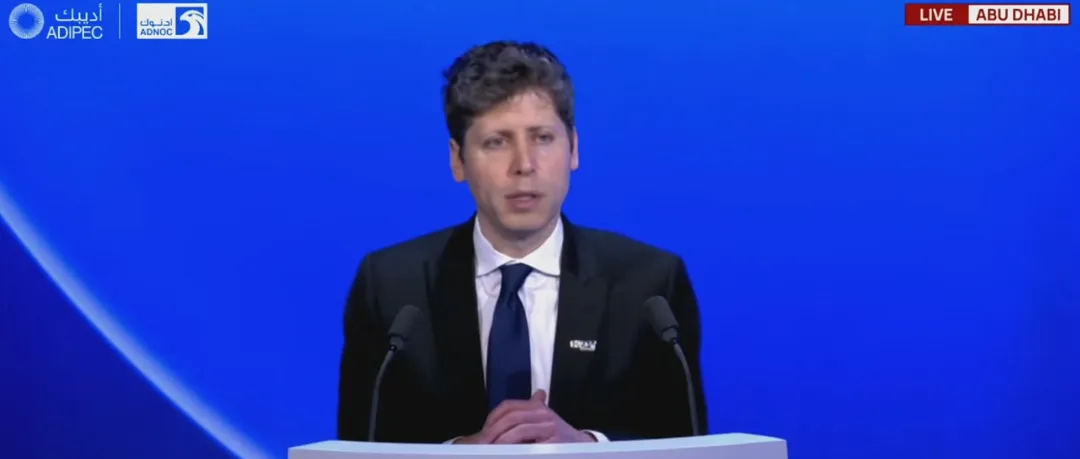
They worked for about four consecutive days, always working in sync.
Altman emphasized in particular that the system lacks a traditional hierarchical structure and a unified leader. Each agent can explore the direction of research, share progress, and decide what to do next based on the results.
"No levels, no bosses, completely decentralized".
Altman believes that this represents a whole new way of working and research.
The speech also gave the outside world a clearer clue for the first time: the research model, which has been used internally in OpenAI and is far beyond the capabilities of the GPT-6 Astra, is likely to be the next generation of GPT to be released to the public.
Ten thousand agents.
How to tackle the problems of the mathematical century?
The main character of this experiment is the Navier Stocks equation.
It describes the laws of motion of liquids, such as water, air, and other liquids, and is one of the most basic mathematical tools in fluid mechanics. From aircraft design, weather forecasting, to blood flow studies, it is an integral part of the equation.
But around it, a fundamental mathematical question has haunted researchers for nearly 90 years: Is it possible for a fluid motion that was originally smooth in three-dimensional space to appear suddenly in a limited amount of time?
In simple terms, fluid velocity becomes infinite in a finite amount of time, and the smooth state of motion is mathematically out of control.
In 2000, the Clay Mathematical Institute included this problem in the Seven Millennium Mathematical Problems and set a $1 million prize for each problem.
On September 8, OpenAI officially announced the results of the study.
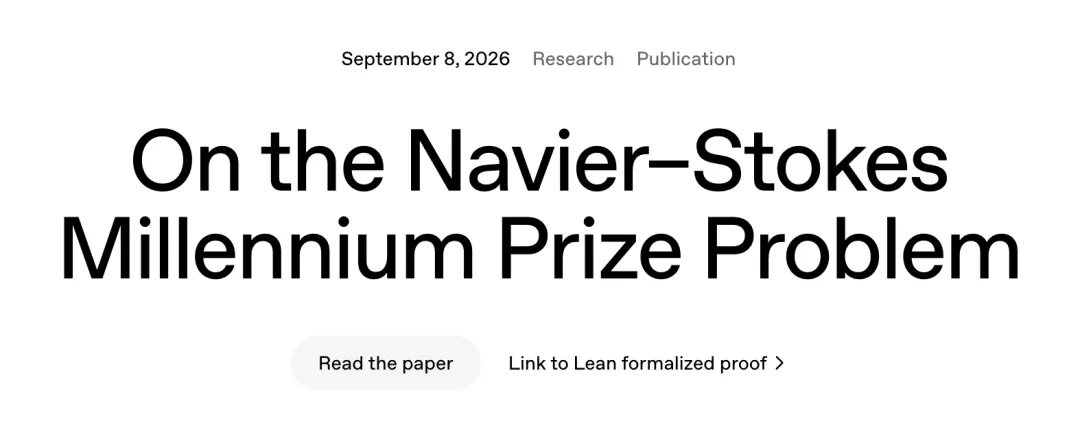
According to OpenAI, the internal model constructs a set of mathematical proofs: under the imposition of smoothing extrinsic forces, a fluid that is initially stationary, moving smoothly, can form odd points in a limited amount of time while maintaining a limited total energy.
The key to this construction is a constantly shrinking, at the same time being extended spiral. As the spiral core becomes smaller, the speed of rotation increases, eventually forming a diffuse velocity within a finite amount of time. OpenAI says that this proof solves both the C and D scenarios in the formal expression of the Navi Stokes problem, and simultaneously publishes the paper and the Lean formalized proof documentation.
It's really surprising that the research process behind it.
OpenAI disclosed that the entire experiment started on September 1st. The researchers allowed different groups of Agents to explore different mathematical problems and prove paths. Agents were able to read cached Internet information and run code.
As the study progressed, the team discovered breakthroughs in problems related to the Eura equation, providing new clues to the Navientox study, and then shifted more computational resources to the latter. OpenAI then used the Codex to organize the phased outcomes of different Agent groups, re-feedback valuable findings to other groups, and spurred further research.
During the experiment, the internal models underwent further training and upgrades, and the Agents were updated. Eventually, the Agents involved in the Navientox study reached a scale of about 10,000. They completed a core mathematical exploration in about 88 hours, exchanging 2.7 million messages and generating about 13 billion tokens.
From problem-solving, to parallel exploration, to summarizing results, to mathematical validation, it's already a fairly complete AI-assisted research process.
The next generation of GPT
Core changes could be in collaboration with Agent
Altman's most noteworthy message is that the next generation of GPT's capabilities may no longer be limited to a single model's completion of complex reasoning.
This experiment demonstrates another way of working: to allow a large number of agents driven by the same basic model to explore in parallel, to exchange research progress with each other, and to gradually form research results that can be further advanced.
Of course, 10,000 Agents doesn't mean 10,000 independently trained supermodels. They're driven by the same set of internal models that work together through the integration of tools, group communications and outcomes.
In a podcast conversation with Stripe co-founder John Collison on October 29, Altman revealed that OpenAI had invested about $10 million, possibly slightly more, in the study alone, but he also made a gamble: By September 2027, OpenAI expects to complete the same work again at about one-hundredth of its current cost.
The cost reduction will come from smarter models and better research methods. This also means that the next generation of GPT releases could lead to two changes: the ability of the underlying model itself continues to improve and the efficiency of large-scale Agent collaboration is improving.
However, Altman has not announced a specific model or release date for the next generation of GPT, nor has it stated whether or not ordinary users can directly call on the multi-level Agent collaboration system in the experiment.
The link is as follows:
© THE