
It's the first time in the history of the world.
301,490 kg.
The National Bureau of Statistics has published data on summer food, with a total production of 301.49 billion kg, the first stop at 300 billion kg, setting a new record.
But behind these numbers, there is an accelerating wave of technological change.
A group of scientists are usingAIAnd then again, "Design"seed".
At the beginning of November, the Glast Senior Seminar of the Eighth International School of Agriculture (GLAST) was inaugurated in Hainan.
Presidents of the Faculty of Agriculture in more than 40 countries and representatives of the United Nations Food and Agriculture Organization (FAO) and the International Consultative Organization for Agricultural Research (CGIAR) gathered to discuss one key issue:How technological innovation shapes the future of agriculture.
At the convention's sidelines, a 10-minute talk by Pi Junjie, a researcher at the Institute of Crop Sciences at the Chinese Academy of Agricultural Sciences, demonstrated a system that is changing the underlying workflow of breeding.
Explorers, the country's first agricultural research intelligence body. The technology partner is Huawei Cloud.
The three structural bottles of breeding scienceTo understand the problem of this system, we need to see where traditional breeding science needs to break through.
Upstream gene exploration, multivariate analysis, and gene editing have reached molecular accuracy, but downstream is still heavily dependent on repeated trials and multiple screening, with cycles lasting more than 10 years.
The contradictions are concentrated in three places:
The success rate is low.Agricultural biological traits are regulated by multi-genetic networks, with key genes found to rely on long-term experience and multiple rounds of verification by researchers.
The data is difficult to use.The genome information of the core species, the billions of biological data scattered across different databases, the format is not uniform, the tools are not interconnected.
The process is fragmented.From document retrieval to data analysis to breeding program design, each link is not connected enough. A round of complete breeding program development may take 3 to 6 months to begin.
In 2025, the State Council issued an Opinion Paper on the deepening of the implementation of the "AI+" initiative, explicitly proposing "accelerating the upgrading of the digital transformation of agriculture".
Multi-intelligent architecture driven by modelsIn response to the above bottlenecks, the technological path taken by Huawei Cloud and the Chinese Agricultural Institute is not an "agricultural version of ChatGPT", but a system of intelligent agents capable of autonomously planning, executing and verifying scientific research tasks.
From the bottom up, agriculture discovered that the technology of explorers was divided into four layers: the arithmetic base, the model's core engine, the smart body synergy and open ecology, and the smart body platforms that carry all of these functions.
The first level: the base of arithmetic.Based on HUAWEI's cloud superintelligence integrated basic computing resources, pre-training, post-training and post-training rationale deployments of all types of models are implemented through the ModelArts platform; the third-party open-source LLM model is modeled through the MaaS platform, while the scientific research model unifies the business application of multiple models in the AI asset marketplace.
For scientific research institutions, there are two things that are of real value:
One is that the growing support for the pre-training, post-training and reasoning of large models has matured, and that scientific models no longer need to be used separately to adapt to computing;
The second is that the cloud's unified coordinating capabilities combine a set of multi-intelligent systems that simultaneously run general models, specialized models for scientific research and hundreds of analytical tools. Unified coordinating within the same system ensures that the entire system is stable.
The second layer: the model's central engine.The core of the system is based on the HUAWEI Basic Model, a basic model system in the field of agriculture based on pre-training and post-training knowledge of agricultural literature in bulk, the model performs various tasks such as natural language understanding and interaction, multi-step reasoning and scientific research task planning.
One category is "understanding" when scientists ask questions in natural language, systematically understand intentions, retrieve literature, and generate knowledge; the other category is "reasoning" when systems plan experimental pathways, make genetic functional inferences, and predict characteristic expressions. The coordination of different tasks is more controllable in terms of task accuracy and illusion control.
Level 3: Multi-Smart Collaboration with an Open EcologyThis is the level that scientists directly use.
The system uses the MCP (Model Context Protocol) architecture and is controlled by the model's central engine.
Scientists have proposed research problems such as "finding the key genome combinations to control hydrochloric acid production", where the central engine breaks down the problems into subtasks and assigns them to different specialized intelligences: "knowledge intelligences" to locate relevant research results from knowledge repositories; "data intelligences" to take over genomic data analysis; "analytical intelligences" to complete statistical modeling and correlation analysis; and "model intelligences" to execute character prediction and breeding program design.
When the central engine receives complex instructions, a single sentence triggers more than a thousand computational processes: autonomously dismantling tasks, scheduling knowledge, data, analytics and other intelligent execution, completing intelligent integration from the collection of documentary evidence, cross-group connections to network construction and inference.
This layer also has a design that decides how far a system can go:Skills of intelligent agents (Skill) were not written by engineers but by scientists at the Faculty of Agriculture themselves.
This is a true co-creation of agriculture:Huawei Cloud provides a framework and operating environment, with field knowledge written by the most knowledgeable people in the field.
These Skills, tools, MCPs, prompts and models are integrated into the Huawei Cloud AI Asset Square to be piped and distributed, and open to development and operating platforms such as Smartphone AgentArts.
One institute has written an analysis of the hydrochloric properties of Skill, which another institute can call directly, without having to start from scratch.
I'm not sure if I'm going to be able to do that.Agricultural discoveries and explorersThe scientific computing area is one of the seven major areas of the Huawei Cloud AI Dream Factory.
To date, the industry's AI Dream Factory has brought together more than 200 core partners, more than 1,500 industry assets and more than 1,000 landing projects, covering seven areas of smart healthcare, physical intelligence, scientific computing, smart finance, smart manufacturing, AI hardware and government.
Fourth level: the smartphone platform AgentArts.These smart entities, Skills and assets need to operate in a stable and secure manner and need a working and governance base.
AgentArts is an enterprise-level smartphone operating platform for Huawei Cloud, which is responsible for the operation and scheduling of large models and tools in a multi-smartphone architecture.
It offers four key capabilities:
One is.Safe and isolated operating environmentThrough the Runtime, Sandbox and identity verification mechanism, it is a prerequisite for research institutes and enterprises to collaborate with multiple organizations on the same set of systems.
The second one.Long-term layered memoryEvery time a scientist completes a study, the results of GWAS analysis, candidate gene annotations, QTL positioning information, field verification feedback are structured into a substrate, and subsequent studies can be retrieved on demand to avoid repeat analysis.
Three is.Unified tool accessThrough the MCP Gateway, 100+ Bioinformatics Analysis Tools and Genome Databases are packaged as standardized call capabilities to support interdisciplinary intelligence collaboration.
Four is four.All links are visibleEach intelligent organism's call chain, task execution time, abnormal information can be traced, scientific analysis process can be reviewed and interpreted.
In a nutshell, this isEach scientist is assigned a 7×24-hour continuous work schedule.AIResearch and development team.
This is the general scientific standard for the system.
Agriculture involves a number of fields, including crops, livestock, poultry, aquaculture, microbes, grassland, and the same set of intelligent body structures for the cultivation of different species, requiring different data, field tools, and specific verification methods.
The model isLandingIt's all about collaboration.
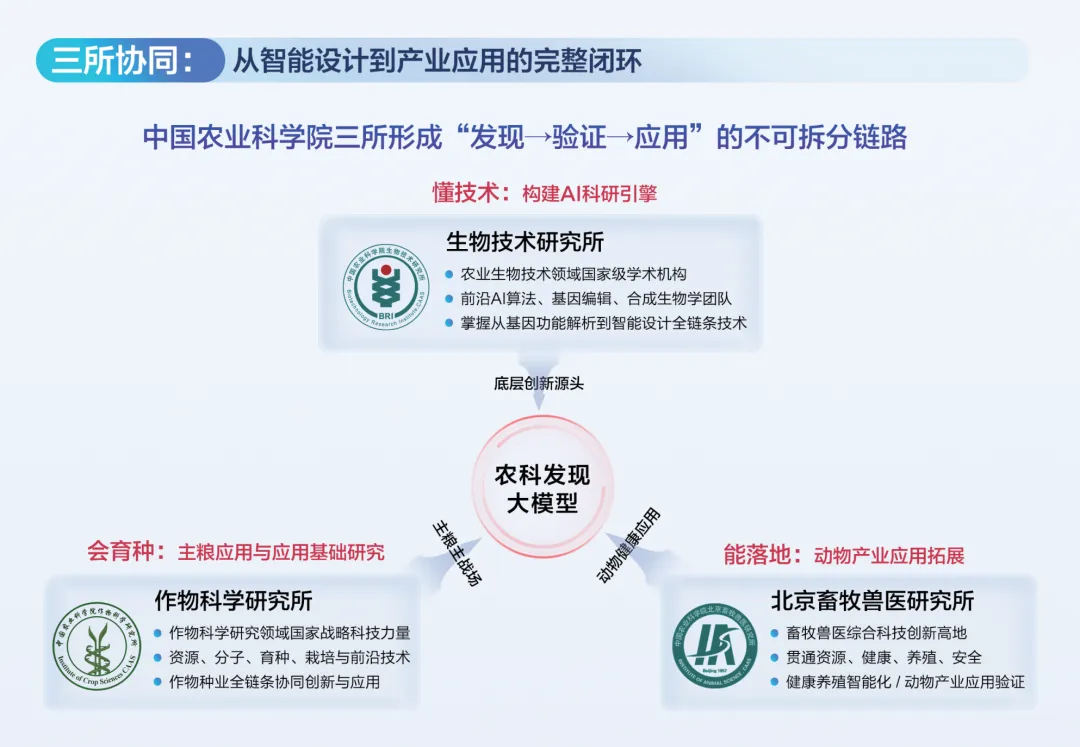
On the side of the Chinese Academy of Agricultural Sciences, led by the Institute of Biotechnology, the Joint Institute of Crop Sciences and the Beijing Institute of Veterinary Medicine, the whole chain of "discoveries→verification→applications" is formed:
The Institute of Biotechnology is responsible for the research and development of underlying technologies such as AI algorithm engines and gene editing, which are the source of scientific research capabilities; the Institute of Crop Sciences provides basic food application and application research to ensure that AI outputs are realized under real conditions; the Beijing Institute of Veterinary Medicine is responsible for expanding the direction of animal breeding and completing end-of-industry application validation.
The three logics of division of labor are:It's about understanding technology, cultivating it, and being able to do it.LandingIt is the first of its kind in the world.
On the Huawei Cloud side, it provides a full-fledged technology base:Upgraded computing power + ModelArts + MaaS ((three-way open source model) + disk-sized model + Smartphone AgentArts platform +AI DataLake。
From underlying computing, to AI DataLake's data governance, to the eco-openness of the AI asset base, to the scientific intelligence landscape carried out by Smartphone AgentArts, this is an end-to-end link, all within the same platform system.
Data governance is an easily overlooked part of it. From formatting and multivariate data, from storing, cleaning, training, and reasoning, the whole process is done on the same platform, separated by project and authorization.
The two sides launched the system for the first time globally at the Huawei Developers Conference (HDC) in June 2025, and officially unveiled the "AI Agriculture Joint Innovation Laboratory" in June 2026.
Flight data: 3000 experiments accumulatedAfter the system went live, a mechanism that has been mentioned repeatedly is the "data plane".
This concept needs to be dismantled and examined.
The accumulation of traditional scientific data is linear: an experiment is performed, a set of data is produced, a paper is published, and the vast majority of data is stored in hard drives with low efficiency.
Agriculture discovers that explorers are different
Each study's raw data, analytical conclusions, and methodological pathways flow back into the system through automated cleaning, quality testing, and structured repositories to become replicable digital assets. The system continues to optimize model performance through RLAIF (a reinforcement learning mechanism based on AI feedback).
To date, the system has accumulated more than 3,000 real agricultural research and development process experiment data.
The big model lacks the most in the literature and public databases, the least in wet experimental data:A handful of real laboratory and field results.
Agricultural discoveries and explorersThe more than 3,000 experimental data collected were generated in the same set of systems, according to uniform standards, and cleaned up and standardized the entire process data, from problem-setting, program design, data analysis to field feedback, chain completeness.
This means that the system is not a static tool, and every time it is used, it optimizes the output quality for the next one.
After the wheel turns, the persuasiveness of AI breeding ultimately depends on one question: Can the program designed really improve the characteristics of the target and perform well at the same time?
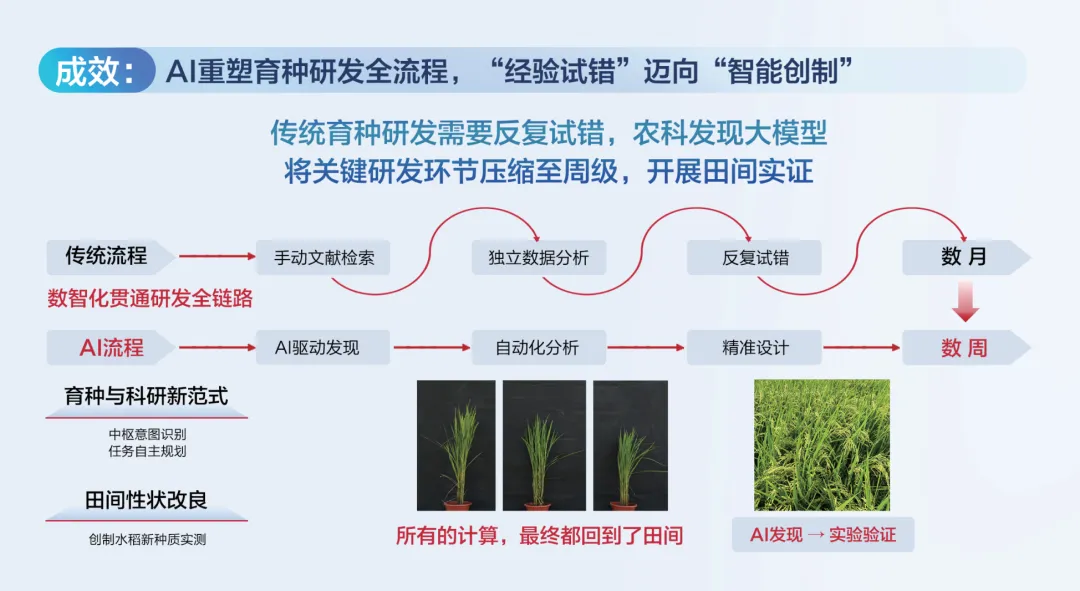
A core case that has been publicly disclosed: the research team's goal is to develop new materials for hydrochloric acid that are resistant to ups and downs. Under traditional routes, it may take months to simply screen candidate genes.
Using agricultural discoveries and explorers, the intelligent organism completes literature retrieval, genetic data mining, optimal gene pool locking, and directly generates breeding programs. The breeding program research and development cycle is compressed from 3 to 6 months to weeks; over 1,000 steps of data analysis are completed within 24 hours, saving 90% of analysis time; and human resource efficiency is increased by more than 10 times.
The project did not stop at the theoretical level. The team took the AI-designed project back to the field for parallel verification of several experimental focus points, and analyzed the results: the resistance of the new materials to rollover is significantly improved, and production is not affected.
In a speech at GLAST, researcher Pei Jun Jae said one thing that was particularly good:"All the calculations, eventually, are back in the field".
 From lab to industry
In addition to technical verification, advances at the industrial end are particularly noteworthy, with the findings of Agriculture Explorers empowering leading farming companies to increase efficiency and reduce costs in industrial chains such as sample analysis, breeding gene mining, genetic evaluation, and production control.
In June this year, the Institute of Biotechnology of the Chinese Academy of Agriculture unveiled the "AI Agriculture Joint Innovation Laboratory" with Huawei. Agriculture discovered that the explorers were the first to enter the AI dream factory science computing speciality in the cloud industry in Huawei in the same month.
At the World Conference on Artificial Intelligence (WAIC) in July, the Agricultural Discovery of Explorers was described as "a typical example of a high-value application scenario".
And now it's time for Glastonbury to have the heads of agricultural schools in more than 40 countries around the world sitting at the same table.
For many agricultural research institutes in Southern countries around the world, there is also a need for an AI-powered research system that offers a path to realization based on an open, intelligent ecosystem: computing, models and operating platforms are ready, and scientists need to write their crops and knowledge of cultivation in their regions into Skills and access the same system.
China's accumulated technological programming and industrial landing experience in the direction of intelligent breeding was first unveiled to international peers.
Written at the endI was standing in a hurricane and looking back at all this, and there was a wonderful sense of time and space.
The whole world is talking about how AI writes poetry, paints, cuts videos, but a group of scientists and engineers chose a quieter route.
In a time of extreme climatic frequency,AIIt is also important to ensure that the seeds are adapted to environmental changes.All of you.Eat moreNutritionIt's more.Health。
In 2024, the Nobel Prize in Chemistry was awarded to AlphaFold, which predicts the structure of proteins and shows the world the explosive power of AI in the life sciences.
And on Chinese soil, AI is pushing this capability from the lab to the field.
This is probably one of the best places for AI to go.