Mathematics subjects are given to math teachers, code subjects are given to code teachers, and medical subjects are given to medical teachers.
In multi-teacher online strategy distillation (MOPD), the selection of teachers by field is only the first step. The expertise, response styles and reasoning habits of different teachers may vary greatly, but their supervision ultimately affects the same set of shared parameters for students.
This challenge exists in real business as well. The ability to understand commodities, material quality checks, wind control compliance, etc. also requires coordination of the guidance of different business experts, so that a unified model maintains general multi-modal capabilities while absorbing business expertise.
In response to this challenge, Road MOPD was proposed by JINGDON Retail-Visual Multimodal and the AIGC team at Nanjing University, allowing multiple teachers to jointly evaluate the same responses of students and coordinate the learning process through cross-faculty feedback. Specifically, Road MOPD enhances teacher-supported learning signals, reduces signals of disagreement, reduces conflict before parameters are updated, and maintains the learning capacity of targeted tasks while reducing learning disruption.
Link to the paper:https://arxiv.org/abs/2610.13521
It's a great way to get started.
I'm going to give you a hugging face.
The experiment showed that in Qwen3-4B, in comparison to Vanilla MOPD and Road MOPD in both sets of high-conflict settings for mathematics+medicine and code+medicine, bi-disciplinary improvements were achieved, with a median increase of up to 8.78 percentage points. The gains also extended to lower-conflict math+code combinations, with the two fields increasing by 1.61 and 1.83 percentage points, respectively.
Teachers vary greatly, but there are not enough teachers in each field.
Online strategy distillation (OPD) allows the student to respond to the teacher and the teacher to provide feedback by token along the actual content generated. Traditional multi-teacher OPD is independently supervised by field, with other teachers not participating in the joint review of current responses.
Research has shown the potential for co-learning in a combination of fields such as mathematics and code. But can such benefits be extended to other fields? Figure 1 compares conventional multi-teacher training (Vanilla MOPD) with the corresponding single-field OPD.
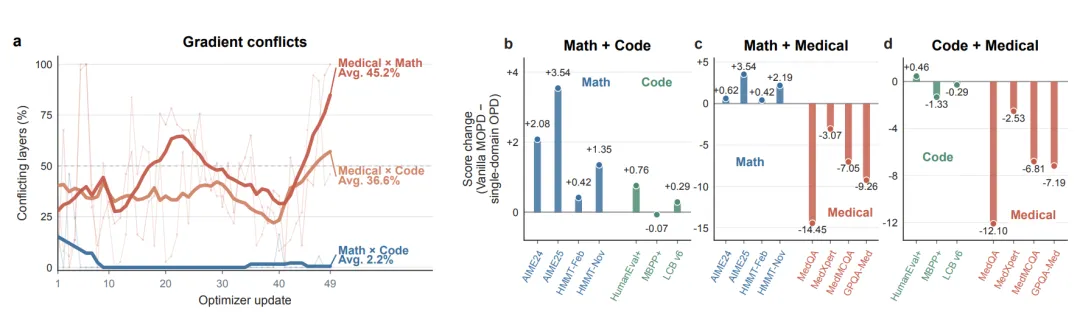
Figure 1 Conflicts of gradients between fields, and changes in the results of conventional multi-faculty training compared to single-field training.
See the math + code: Figure 1 on the left side of the gradient conflict layer averages only 2.2%, and the benchmark scores on the right side are mostly maintained or improved. On the right side, the single-field OPD is zero-line, higher than zero represents the benefits of joint training, and lower than zero represents regression.
However, in exchange for mathematics+medicine, code+medicine, the situation changed: the conflict layer averages rose to 45.2% and 36.6%, respectively, and the latter stages of training were more prominent; while the four medical benchmarks in the two combinations were all lower than single-field OPD. The combined learning gains on mathematics and code did not naturally extend to these combinations.
This set of contraindications exposes the complexity of traditional MOPDs where faculty differences are greater: domain routes separate supervisory sources but do not coordinate their effects on shared parameters. Therefore, the benefits of mathematics and code cannot be directly driven to other combinations, and the ability to reduce the degradation of a field requires updating conflicts in joint training.
Road MOPD introduces cross-faculty collaborative safeguards: retaining the primary supervisory responsibilities of experts in the field while asking other teachers to evaluate the same answers, using cross-faculty feedback to lessen dissent signals, constrain conflict updates, and reduce interference in capacity integration.
Let other teachers see the same answer.
Road MOPD is the primary supervisory role of experts in the field of preservation, while asking assistant teachers to evaluate the same student's answers, in the same context. For example, when mathematics teachers guide solving problems, medical teachers provide additional feedback to help determine whether this amendment is compatible with other teachers' preferences.
Assistant teachers act as interdisciplinary reviewers. It provides compatibility clues, and professional supervision of mathematical answers remains the responsibility of mathematics teachers. The method also introduces frozen copies of students' initializations as a common reference for all teachers to express corrective directions.
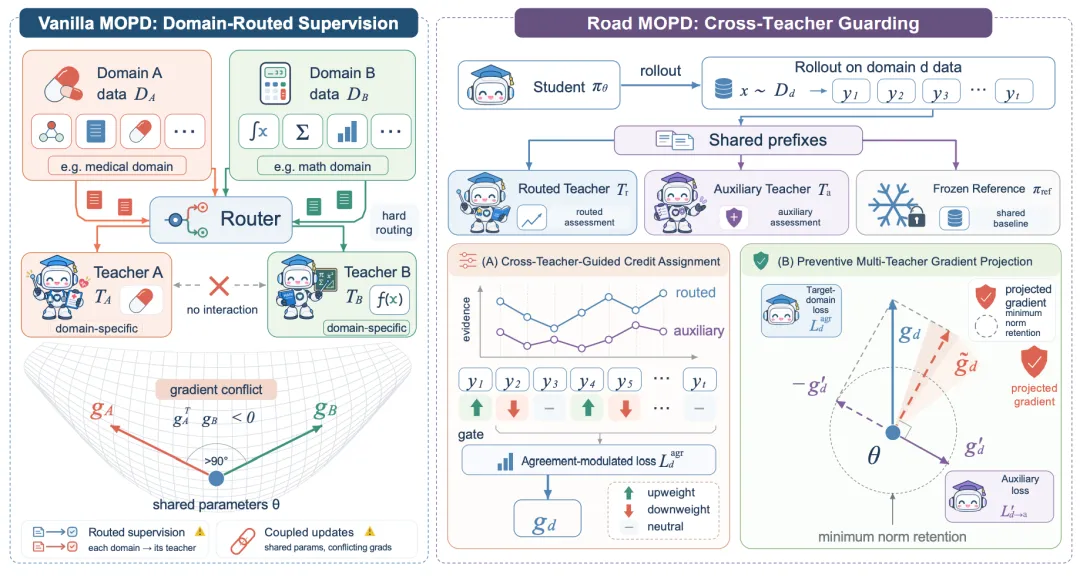
Figure 2 Overview of Road MOPD: First adjust the token-level oversight and then coordinate the update direction of the shared parameters.
The first step is to implement teacher consensus into each token.
In one response, some of the amendments were co-sponsored by the two teachers, while others were disagreed. Road MOPD regulates the relative rewards of the head teachers accordingly: the position of strong consensus is appropriately enhanced and the position of opposing opinions is appropriately weakened.
Specifically, the method compares the token probabilities of the two teachers relative to the frozen reference model. If both tend to increase or decrease the probability of a token, the correction direction is the same; one increases, the other decreases, and there is a difference.
This makes the teacher's absolute probability different, but the same corrections can also be identified. The regulation works on the teacher's relative reward signals rather than simply multiplying the total loss by a weight.
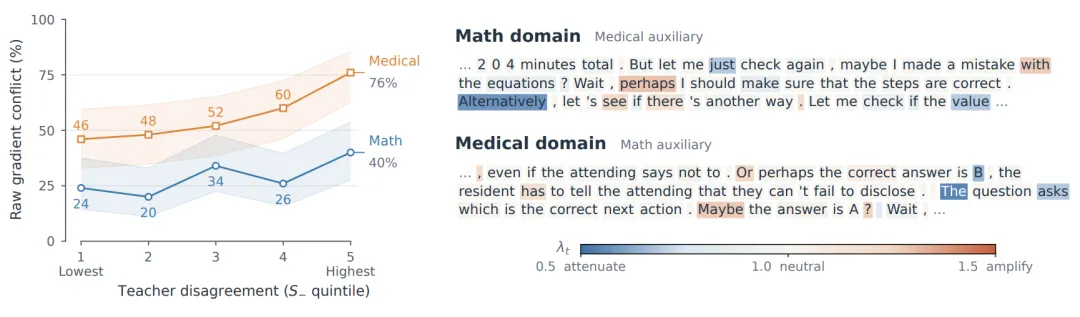
Figure 3 illustrates the association between teacher disagreements and primitive gradient conflicts, as well as supervised regulation on the actual response snippets.
This discrepancy is experimental. Following the fixed student model, the researchers divided the sample batches into five groups according to teacher differences, from low to high, and the gradient conflict rate in the medical field rose from 46% to 76%. This shows that differences in opinion at the text level can provide clues to renewed conflicts.
Step Two: Reduce conflict while maintaining learning capacity
Following token-by-token coordination, supervision is still to be consolidated into parametric updates. Road MOPD further introduces preventive gradient projection: with adjusted supervision of computational target gradients, and with assisted instructor supervision of computational auxiliary gradients of standard OPD for the same response.
Subsequently, the method checks the internal volume of the two gradients by parametric quantities. Directional compatibility preserves the target gradient; in the event of conflict, removes some of the incompatibility fractions.
The key is to combine the same answers. The common PCGrad coordinates the gradient formed by different tasks on their own data; Road MOPD checks other teachers' feedback on current responses, prioritizes current updates. Both observe different compatibility relationships.
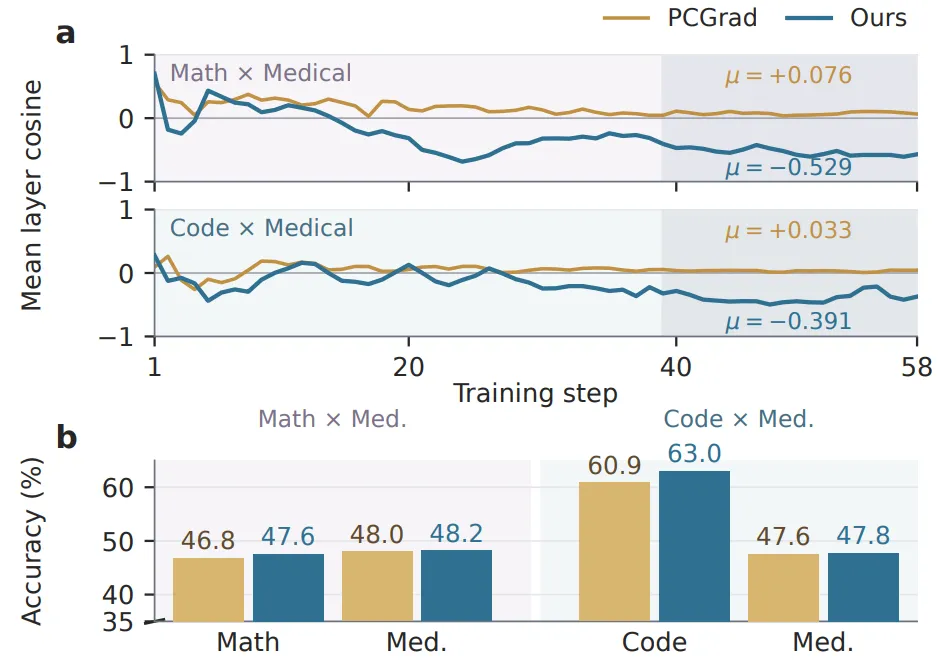
Figure 4 compares the same trajectory projection with the control of PCGrad. Above is the residual mean of the different gradient coupled modes; below is the area divided by the longitudinal axis of the axis. Both of them retain the same credit allocation and parameter retention mechanism.
Projection cannot be simultaneously challenged. When the two directions are almost opposite, full projection may together weaken the learning signals in the current field. Therefore, the frequency of the method to set the target gradient is kept to a minimum, in this constraint adapting to the selection of the projection intensity. In dilution, after conversion to full projection, the combination of the two sets of high conflict settings decreased by 0.83 and 0.44 points, respectively.
If there is more than one assistant teacher, the method first summarizes the teacher consistency, and then projects it back to back within the same parameters, allowing more experts to participate in coordination.
High-conflict portfolios benefit first and then expand to more portfolios
The experiment used Qwen3-4B and Qwen3-1.7B, both of which closed thinking patterns, covered 11 benchmarks in mathematics, code, and medicine, and compared them with methods such as Vanilla MOPD, ExOPD, Open-MOPD, and CaMOPD.
4B students. In the combined training in Mathematics + Medicine, compared to the Vanilla MOPD, the average score in Mathematics increased from 45.97 to 47.60, an increase of 1.63 percentage points; Medicine increased from 39.45 to 48.23, an increase of 8.78 percentage points.
The Code+Medicine combination also achieved a joint improvement: the average code score increased from 60.53 to 63.02, an increase of 2.49 percentage points; the average medical score increased from 40.75 to 47.75, an increase of 7.00 percentage points.
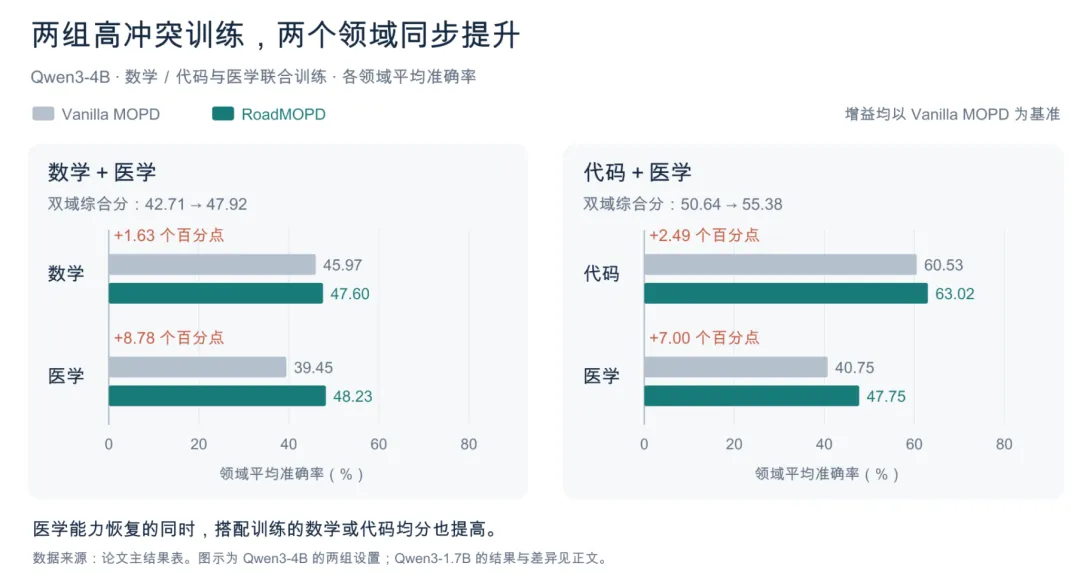
Figure 5 shows 4B students achieving double-domain joint improvement in two groups of high-conflict training. This is marked as an absolute percentage increase in the relative Vanilla MOPD, with the horizontal axis starting from zero.
After the scale was scaled down to 1.7B, the code+medicine combination still shared benefits, up 2.15 and 5.58 percentage points from the Vanilla MOPD, respectively. Mathematics+medicine had a trade-off: the mathematical average dropped from 28.36 to 27.21, the medical average from 31.18 to 36.89, and the overall score from 29.77 to 32.05.
In four groups of experiments of two student sizes and two high-conflict portfolios, Road MOPD scored the highest bidirectional aggregate score, leading the group with the strongest aggregate baseline of 0.72 to 2.89 points. The mathematics/code scores of 1.7B students were still slightly lower than ExOPD, but the overall performance was better when measured by domain weight.
After mitigating degradation in high-conflict combinations, researchers further tested more compatible combinations. When 4B students studied mathematics + code together, the two domains increased by 1.61 and 1.83 percentage points, respectively, compared to Vanilla MOPD, to a combined score of 55.40, indicating that gains can also be extended to low-conflict scenarios.
After expanding to the three areas of mathematics, code, and medicine, the four B students in each of the three areas improved by 0.31%, 1.68%, and 7.42%, respectively, leading the comparative multidisciplinary approaches. The overall score was 52.89, an increase of 3.13 from the Vanilla MOPD, and an increase of 1.18 from the preferred CaMOPD.
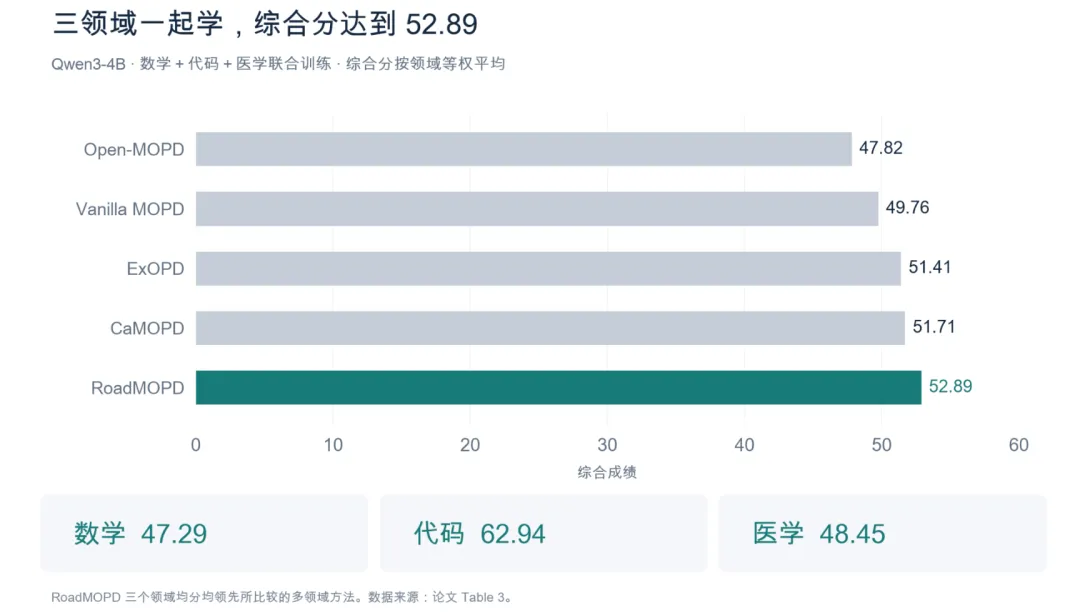
Figure 6 shows the results of the joint training in the three fields. The results of the joint training in the three fields are summarised as the average of equality divided into three fields, the basis of which is the results in the three fields of Road MOPD.
Assessment notes: In the field, the average is taken first for the benchmark, and the aggregate score is then averaged by the field. Medical results come from the text question-and-answer benchmark, and detailed assessment qualities see paper.
Co-op conflicts to better integrate the capabilities of different experts
Road MOPD focuses on conflicts between style and field differences: effective instruction of each student may also interfere with each other by updating the same set of parameters when training a student together. The method retains the primary supervisory role of the field expert while allowing other teachers to evaluate the same responses of students, use teacher consensus to enhance jointly supported corrections, decrease disagreement signals, decrease conflict ratios before updating the parameters, and retain the learning capacity of the current task.
In Qwen3-4B, the two groups of high-conflict combinations achieved double-domain combined improvements with a medical average of up to 8.78 percentage points in comparison to the Vanilla MOPD. Further experiments showed that gains could also extend to more compatible math + code combinations; after expanding to the three fields of math, code, and medicine, all three fields achieved the same improvement, with a combined score of 52.89.[3]
These findings suggest that cross-faculty feedback provides an effective pathway to mitigate a classroom, a step-by-step classroom, and a way to integrate the capabilities of different experts into the same student model.
Team of authors
The study was conducted by the LAMDA Laboratory of Nanjing University in collaboration with the AIGC team in Jindong Retail Visual Multimodal, and co-authored by Shi-Yu Tian and Yong Liu.
The LAMDA Laboratory at Nanjing University, led by Professor Zhou Zhihua of the Chinese Academy of Sciences, relies on a national focus on computer software and new technologies, long-term deep machine learning and data mining in the areas of integrated learning, semi-supervised learning, multi-example and multi-marker learning, and ongoing basic theory, algorithm methodology and application research.
JINGDON Retail Vision Multimodal and the AIGC team have established a line of demand in the retail business, focusing on multi-modal commodity understanding, controllable visual generation and virtual testing, developed e-commerce multi-modal understanding model OxygenVLM, aimed at multi-genre virtual testing models like Oxygen-TryOn, committed to consolidating the technology, making the technology usable, making the good commodities look more colorful, and making it easier for users to choose.
© THE