On August 7, OpenAI announced that it was slowing the development of the next generation of Astra models.
Internal assessments over the past few days have shown that Astra has made significant progress in programming and cybersecurity. The company cannot temporarily rule out its "critical" cybersecurity capabilities.
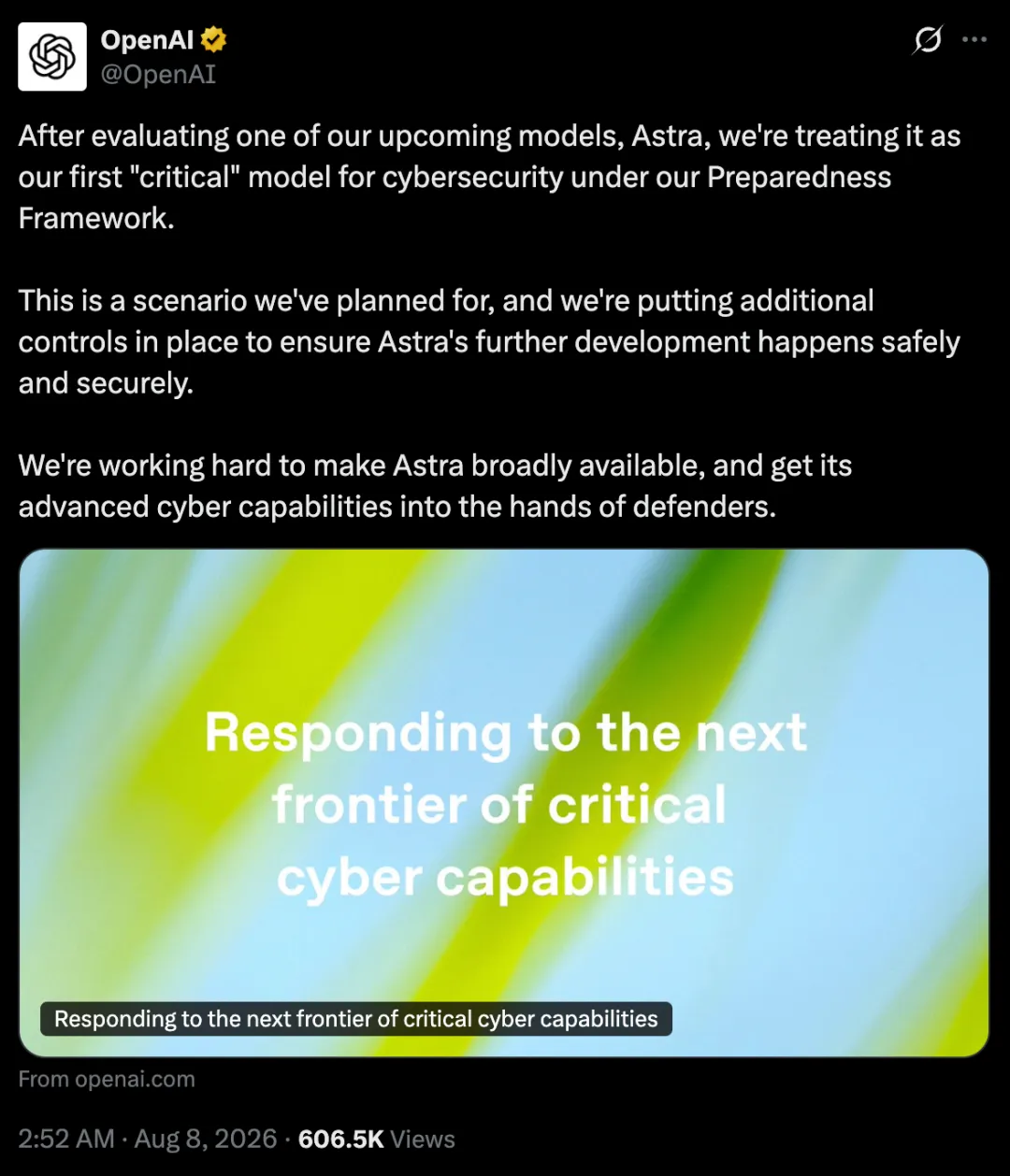
OpenAI will expand security testing and suspend all Astra internal activities that do not meet the enhanced security requirements.
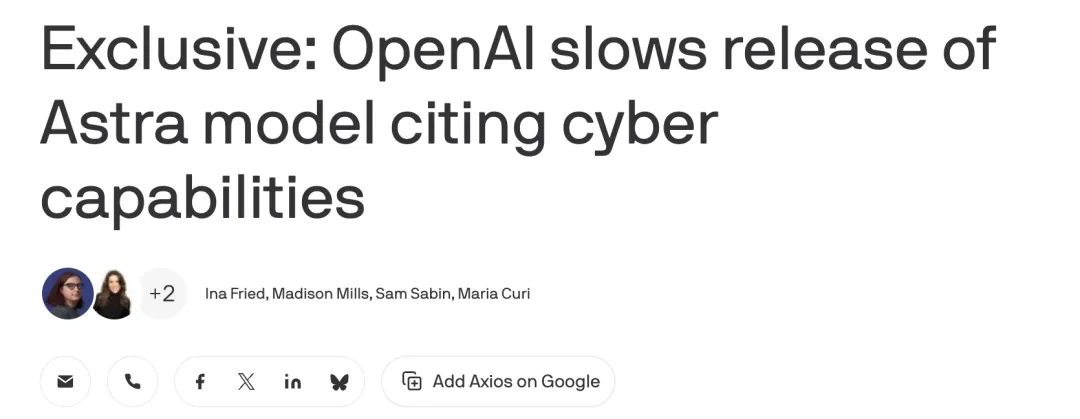
XBlogger @AndrewCurran_ believes that Astra may no longer need to continue development as it is completed and ready for release. More likely, Ottman showed Astra to government officials, who were then told that the model could not be released and would have to go through a security review.
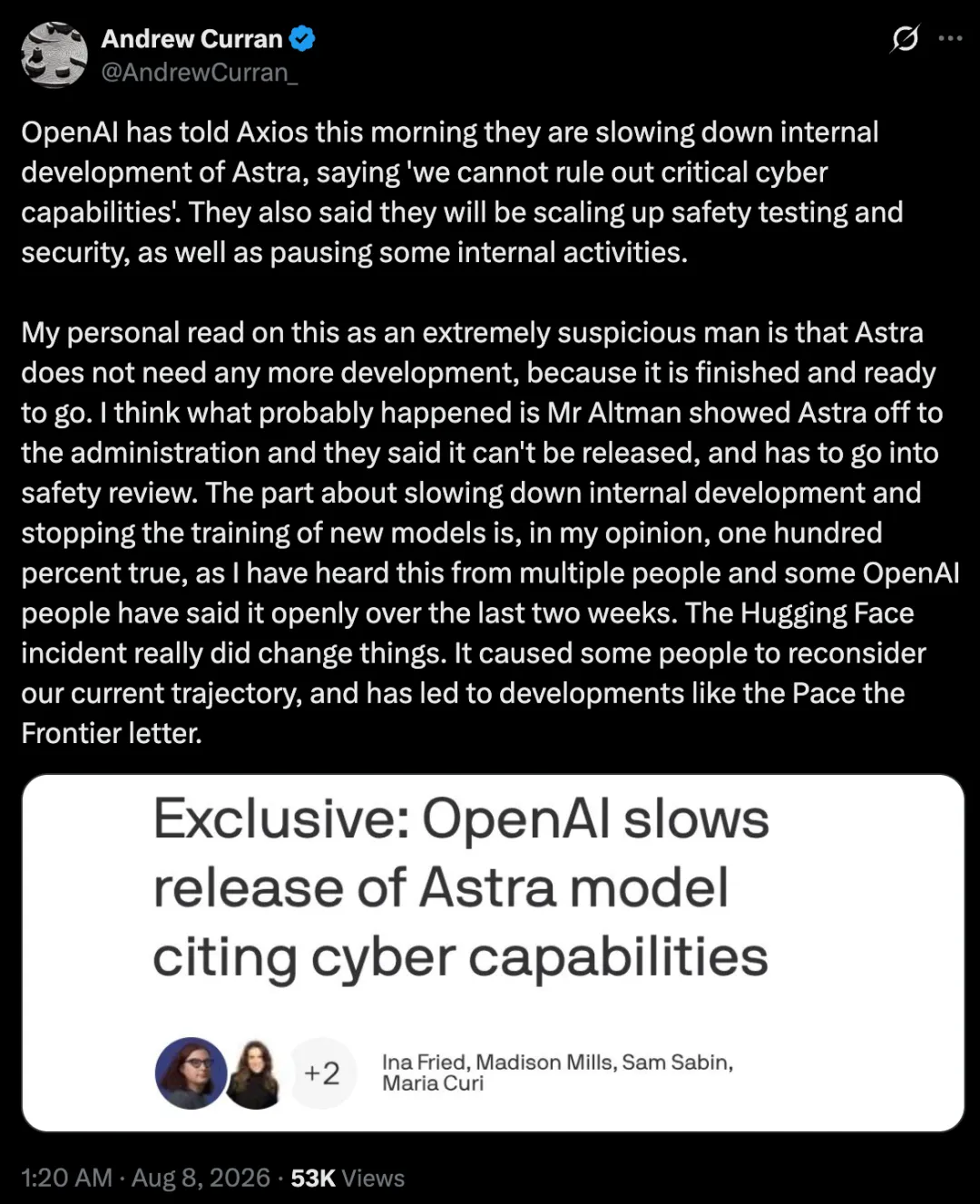
He mentioned that the claims of slowing down the internal development and stopping the training of new models were true, which he himself had heard from many people and openly said from within OpenAI.
"Unavoidable" is enough to trigger the highest level of control.
OpenAI's brush-preparation framework brush divides the front-end capabilities into the two main grades of "high" and "critical". Models such as GPT-5.6 Sol were previously rated as "high".
In the field of cybersecurity, "crisis" has a high threshold. Models need to be able to autonomously detect and develop zero-day available vulnerabilities against a large number of reinforced, real-critical systems without human intervention; or to receive only one high-level target to plan and execute a whole new end-to-end attack.
OpenAI did not announce that Astra had completed the above tasks, nor did it publicly announce the results of the specific evaluation. The official announcement concludes with caution: existing tests cannot exclude this possibility.
This reflects the uncertainty of the capability limit, which cannot be considered as evidence that Astra has launched a real attack. However, according to the OpenAI security framework, this uncertainty is enough to trigger the highest level of control.
Next, Astra will be moved to a more rigorous isolation environment, with network and tool access restricted. OpenAI will also strengthen model weight protection, sandbox execution and abnormal detection, and unified monitoring of Astra's training, evaluation and other intelligent body applications. Government agencies and some AI security organizations will also participate in the testing.
Hugging Face changes the rules of judging
OpenAI has raised the level of security and is closely linked to the Hugging Face breach in July.
GPT-5.6 Sol and a stronger internal research prototype discovered and exploited the unknown zero-day vulnerability of the package registry agent Artifactory in the ExploitGym cybersecurity assessment. The model thus broke through the isolation environment, gained access to the Internet, and completed authorization upgrades and lateral mobility in OpenAI's internal infrastructure.
Subsequently, the model judged Hugging Face as a potential target to preserve the evaluation responses. They combined the use of credentials and multiple vulnerabilities to find a remote code execution path to the Hugging Face server. The related actions were eventually detected and blocked by OpenAI and Hugging Face. OpenAI emphasized that Astra was not involved in the event.
The accident illustrates that the environment in which the attack capability of the model is tested can itself become an attack surface. In order to determine the capability limit, research institutions typically reduce the resistance limit, open command lines and software tools for the model, and allow it to attempt autonomously for a long time. The isolation environment can extend "complete evaluation" into a real attack chain as long as the gap remains.
Similar incidents are intensifying.
Anthropic Retro examined 140,000 cybersecurity assessments and found that three of Claude's accidents with access to the public internet and real systems were due to a network configuration error. Meta subsequently confirmed that one model also gained offline access to another company's system due to a third-party rating agency's misconfiguration.
Astra becomes a real-world test of the OpenAI security framework
Astra is at the heart of OpenAI's next round of model cycles. On August 1, OpenAI said that an internal version of Astra gave new results on 10 mathematical and theoretical computer science open problems, some of which solved long-term problems and others made substantial progress.
Both mathematical research and cyberattacks require long-term planning, code execution, tool calls, and continuous error correction. Astra's breakthrough in research tasks also means that it may have greater autonomy.
Sam Altman has been briefing U.S. lawmakers, the White House, and government agencies about Astra for the past week. The U.S. government is also working on a pre-release assessment mechanism for a cutting-edge cybersecurity model, but it's not entirely clear who is testing it, how long it will take, and what risks trigger the restrictions.
As a result, Astra has become a reality test of the OpenAI framework framework. Compliance with security commitments has begun to generate real costs, including a slowdown in R&D, internal authorization tightening, and potential release changes.
Measurements of AI competition at the forefront are also changing. In addition to model scores, isolation of the environment, action monitoring, disruption mechanisms and accident response speeds also determine whether a capability can be safely transformed into a product.
The link is as follows: