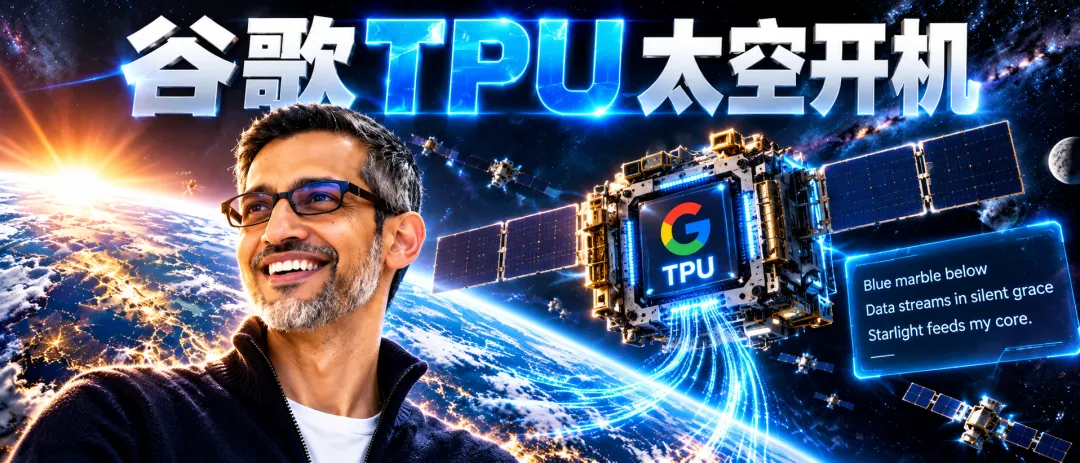
It's the first time in the history of the world.
Calculator, you've really left Earth!
Google has just done something quite explosive:It sends its own AI chip into space to run a large model on a satellite orbiting Earth.
Then the engineers on Earth sent a question.
I can't believe that the first words that AI in space gave to humans were a poem!
Just today, Google CEO Pichai excitedly announced that the Project Suncatcher project is ushering in a historic "Hello World" moment.
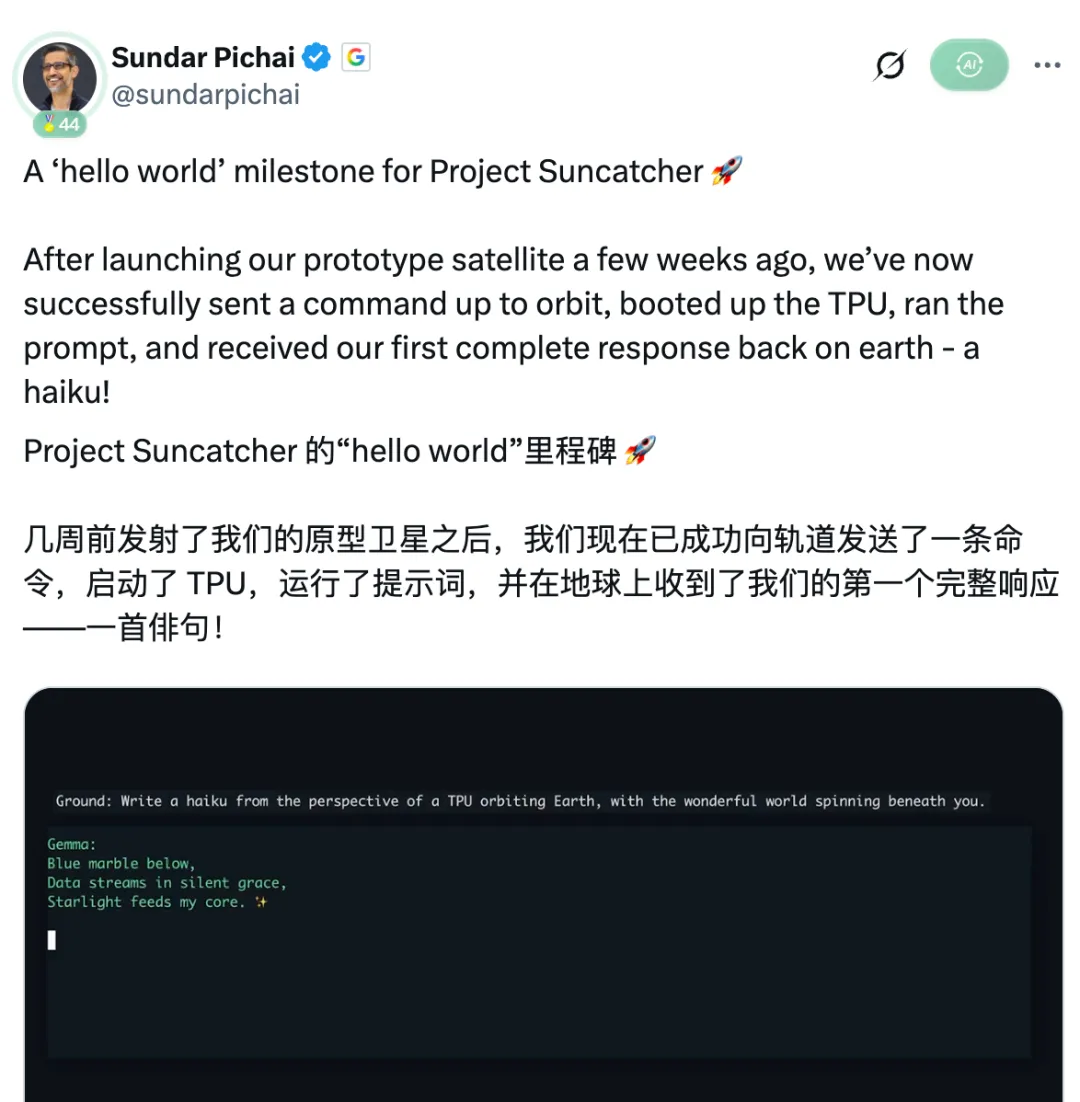
The satellite, launched on October 1 with SpaceX Falcon 9, is equipped with four Google TPU chips and is equipped with the Gemma 4 model.
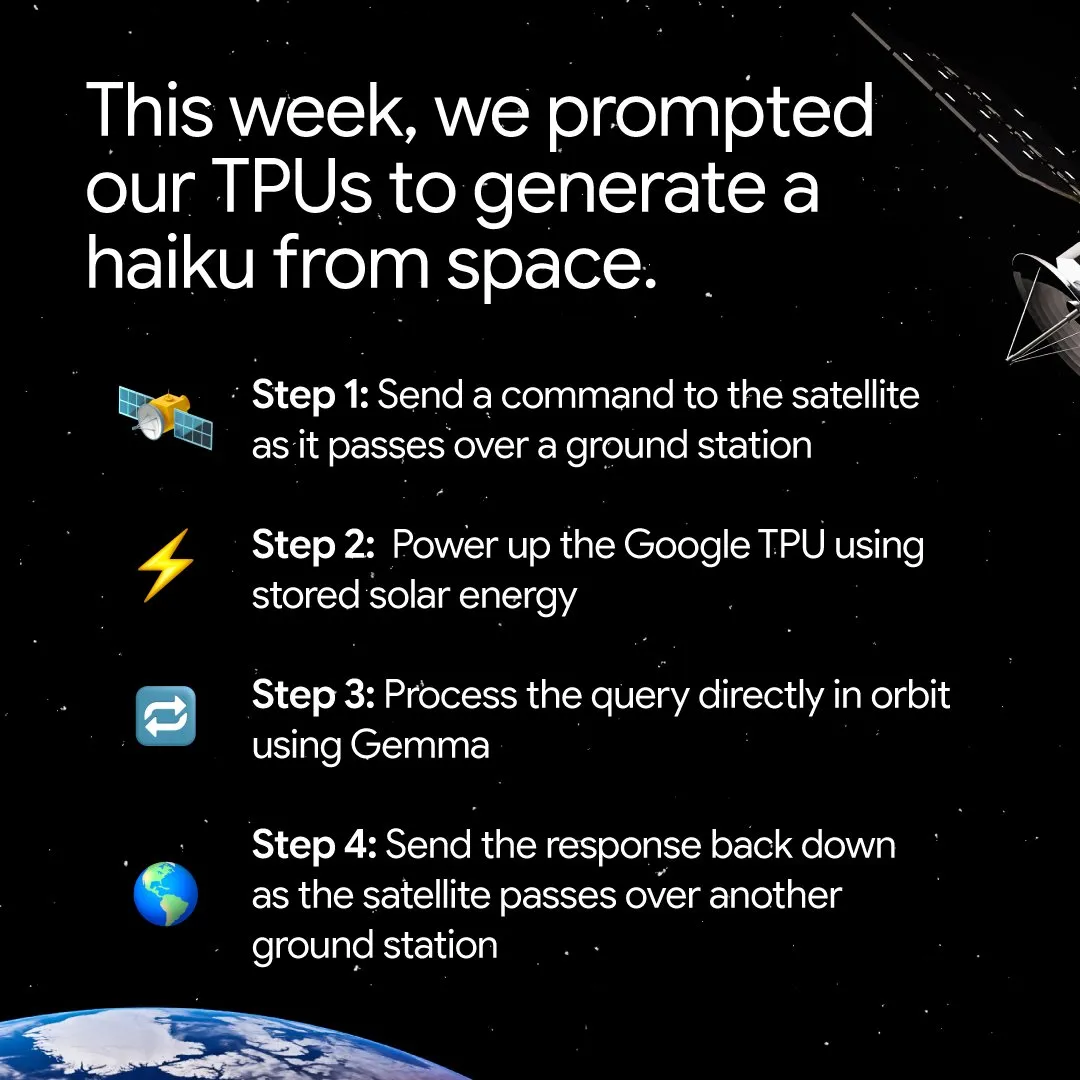
After nearly a month of moderation, the engineers finally sent the first tip to the satellite: Write a haiku from the perspective of a TPU flying around the Earth.
When the satellite flew over the Norwegian Valparaiso Islands, the ground received three lines of text:
Blue marble below
Data streams in silent grace
Starlight feeds my core.
It's probably translated as:
The blue planet is below, the data is still flowing, and the stars are feeding my core.

It's romantic, to say the least.
Google is officially playing the E.T. Alien game: our TPU just called home from space!
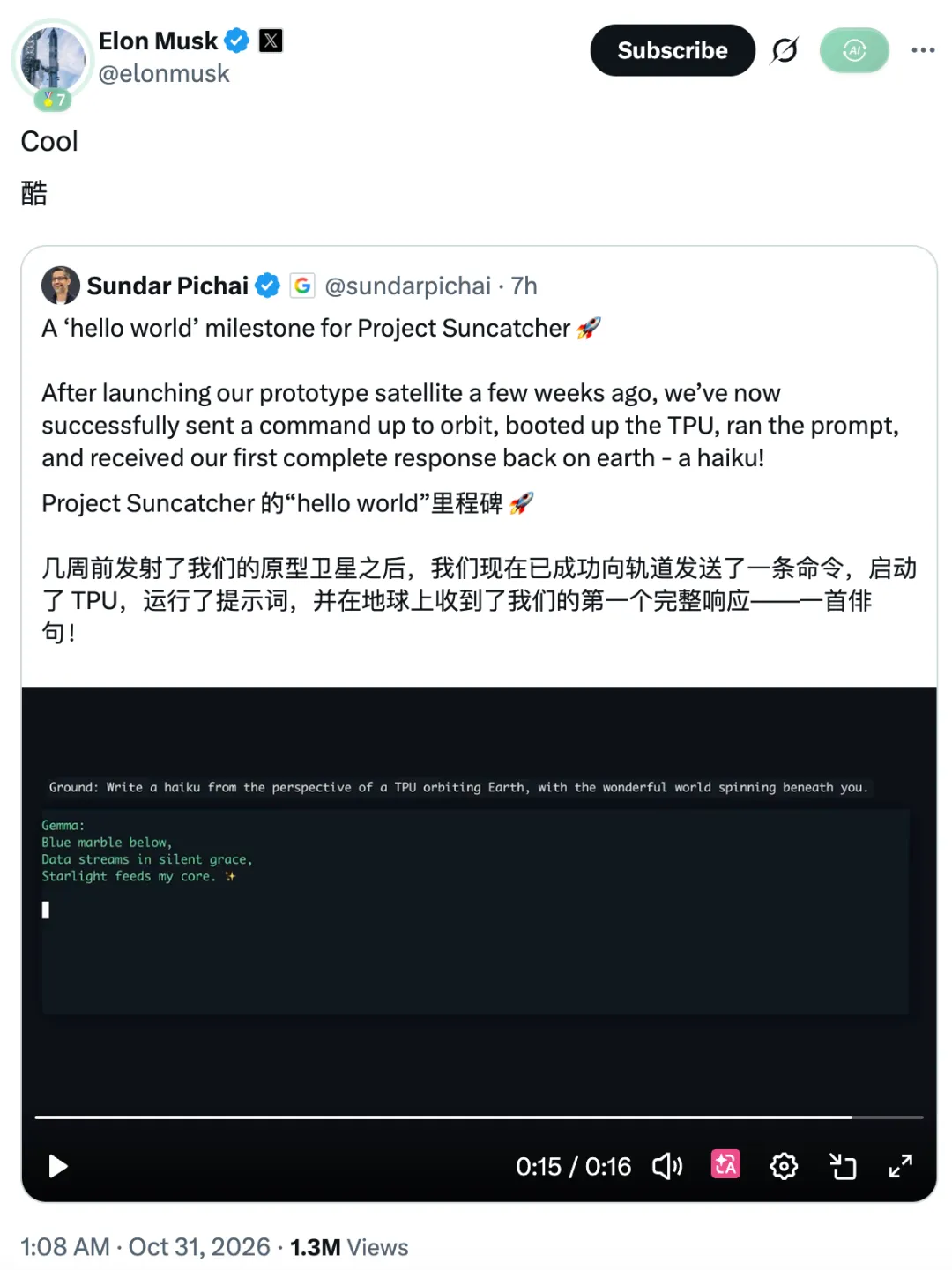
Musk also ran to Pichai's comment section, leaving only one word: Cool.
After all, the satellite was going on his home rocket.
ButThere is a much bigger ambition behind this poem: as AI consumes more and more power, humans begin to think seriously about moving future supercomputers out of the planet.
What can a poem prove?When a programmer learns a new language, the first line of code almost always makes the screen play "hello world".
The word itself is useless, it only explains one thing:This thing can run.
Google proved the same thing this time.
The chip is capable of launching in the sky, receiving instructions from the ground, and returning a complete answer.
On 1 October, the prototype satellite flew with SpaceX Falcon 9 on the same rocket, carrying more than 100 spacecraft.
After entering orbit, the team spent about three weeks powering up each of the sub-systems and conducting debriefing.
It wasn't until this week that the first suggestion was actually sent out for a Google open-source model Gemma 4 to write a haiku titled "In Space". The poem was transmitted back to the ground when the satellite flew over the Norwegian Valparaiso Islands.
After completing the haiku, the engineer asked it to write several space-themed poems and to report on the technical status of the loading system.
However, this is not the first time humans have run a large model in space.
In November 2025, Starcloud, a startup funded by Invisalign, put an H100 into orbit, and a month later launched Gemma in the sky, and even trained a small model nanoGPT with Shakespeare's work in December.
In other words, last year's Google model was already in space, using only Intel's chips.
This year, Google even switched its own chips. From model to chip, the whole chain is in heaven full name Google.
If you look at the layout of this satellite, you might laugh.
A total of four TPUs on a star can only open one at a time.
The power of the entire satellite is limited to about 1 kilowatt, which is about the power of your home heater. TPUs can only run continuously for about 20 minutes at a time.
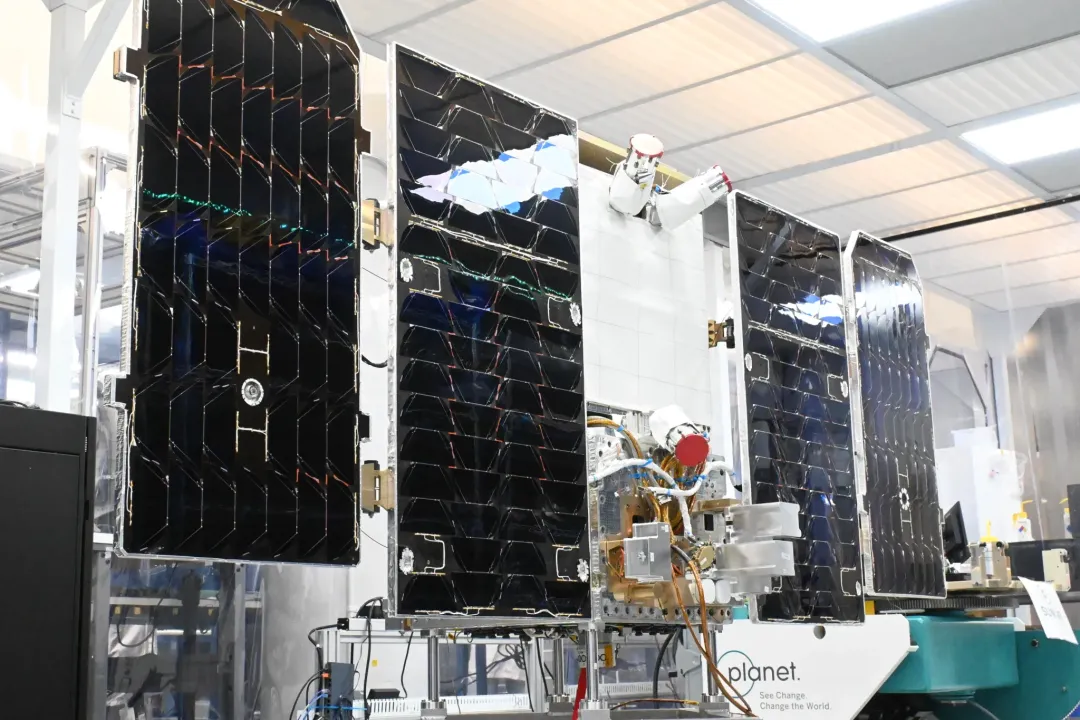
Large AI data centers on the ground use electricity at several hundred megawatts, and one megawatts is 1000 kilowatts.
It's like putting a sign on a small retail store that says "Space Commercial Center".
But think from another perspective: every time the poem was written, the electricity was sent by the satellites themselves in the sky, without a line connected to the earth's electrical grid.
This is the real focus.
Why move to heaven: a word, electricityBecause the electricity on the ground is really not enough.
The AI is getting smarter and the appetite is getting bigger.
The model can be upgraded to a generation in a matter of months, but switching power stations cannot be built in a matter of months.
SpaceX's announcement this year of its Visa Agreement with Anthropic states that the computing power required to train and run the next generation of AI is exceeding the limits of ground power, land and cooling.
A seemingly crazy idea surfaced:Since electricity on Earth is becoming increasingly difficult to find, why not go directly to the sun?
Earth's solar system has a sickening power supply during the day, resting at night, and bad weather is asking for a vacation. But on the right Earth orbit, satellites can almost always bathe in the sun.
In their paper, the Google research team calculated that solar panels on specific orbits are about eight times more efficient than similar ground-based devices. The name Suncatcher literally translates to "people who capture sunlight".
That's what Google is pushing for.
Space is not a natural refrigerator.There is light in the sky, but there are also lights in the sky.
The hardest part is the two links.
The first switch: Hot.A lot of people think that space is so cold that the chips on it aren't naturally cooled.
It's the opposite. Space is close to vacuum, and there's no air to help you get heat.
This is why the TPU can only run for 20 minutes at a time.
Google engineers say the heat exchanger is already one of the heaviest parts on the entire satellite.
The second link: radiation.High-energy particles in space hit the chip, potentially converting memory 0 to 1, a technical term called "bit flipping".
The problem is that it doesn't make any noise: the data has been corrupted and the usual monitoring tools can't detect it.
Google measured the TPU in a ground particle accelerator and concluded that it had a small impact on reasoning and a large impact on training.
Next, the team verified these ground-based simulations on real orbits and concluded that silicon laboratory simulations are not real universes after all.
After these two steps, what Google really wants to do is distance itself from others.
The route of Starcloud, Cowboy Space is a satellite machine, each running its own logic, like a small shop in the sky, each running its own shelf.
SpaceX also intends to use a laser link, but its satellites are too far apart to share computations.
What Google wants is completely different.
It wanted to bring a group of satellites closer together to fly (with a distance of only a few hundred meters to one kilometre) and to transmit high-speed laser data between the satellites, making them line up like cabinets in an engine room, working together on the same big mission.
How difficult is this? Google describes it as being several kilometers apart from two high-speed satellites, both moving and continuously aiming at a coin with a beam of light.
TechCrunch's assessment is that Google is almost the only one of all space data center concepts to do so. Others stand in the sky and Google wants to build a supermarket in the sky.
But the ceiling is much higher.
In 2027, Google plans to launch two more satellites to officially verify the interstellar collaboration.
Google's parent company, Alphabet, owns a large stake in SpaceX, and both orbital computing programs rely on starships that can be fully and quickly replicated.
Google's own researchers have estimated that starships need to fly more than a thousand times before launch costs fall.
Google has set a timeline for the event in the 2030s.
From hello world toThe next hello worldThe first sentence that humans write to a computer is "hello world", and the first sentence that computers write to humans from heaven is a poem.
One kilowatt of electricity, 20 minutes of work, and four chips at a time, only charge one chip. It's a far cry from a functioning space data center.
But the poem's electricity is sent by the satellite itself in the sky, with no wires connected to the earth's electrical grid.
The boundaries of computation have been moved from here to there.
This step is called hello world by Pichai.
The next hello world is probably when the whole engine room opens in the sky.