Training robot control strategies rely heavily on simulation environments, but the scale of traditional hand-built simulators is extremely high.
Today, the Center for Human Resources Research officially released PrimeSim, a world model simulator aimed at robotic manipulation tasks. It is based on a pre-trained video generation model, modified in two stages by mid-training and post-training, with the ability to replace traditional simulators.
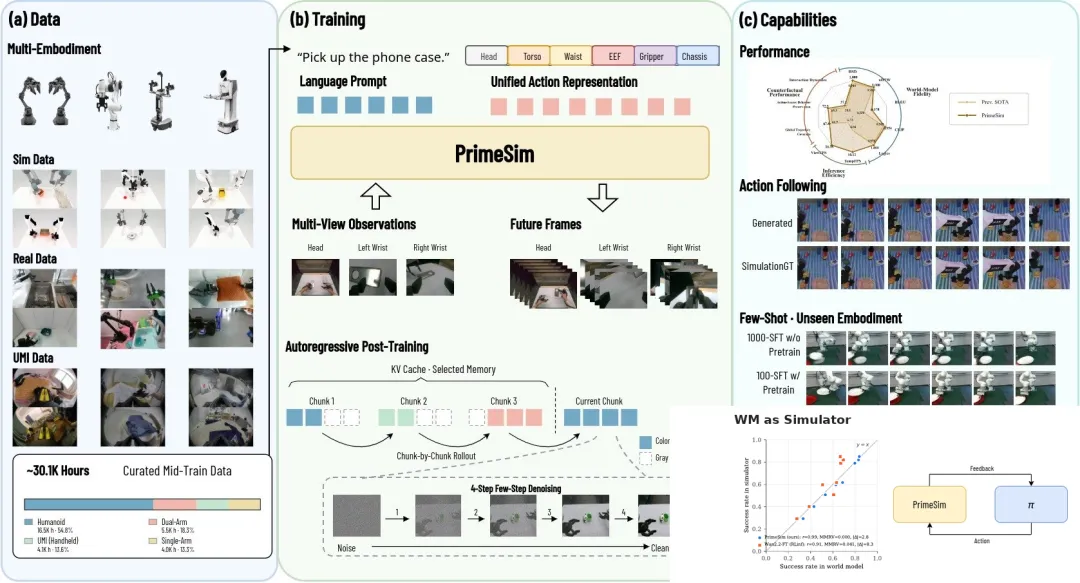
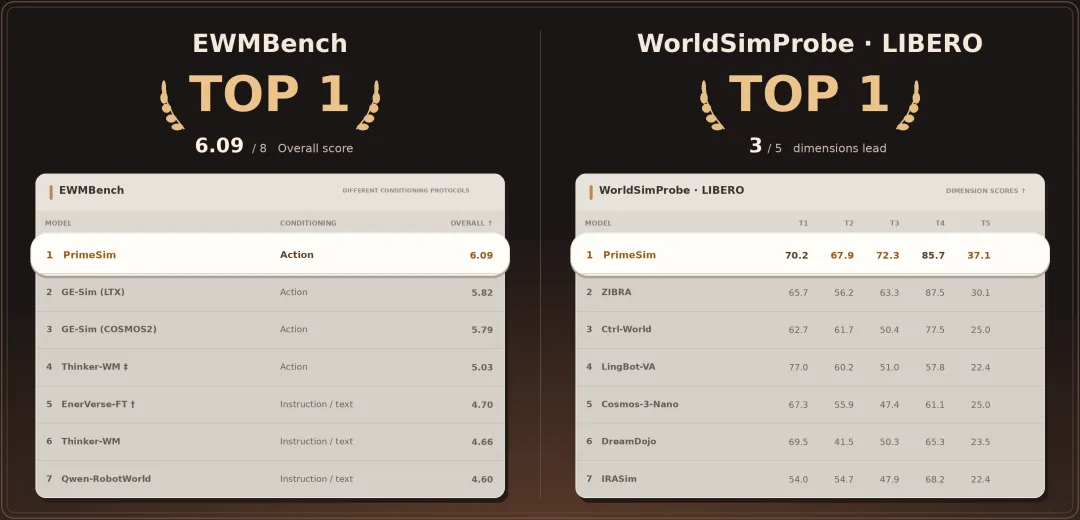
On the EWMBench scale, PrimeSim has an overall score of 6.09, topping the list; three of the five rating dimensions of WorldSimProbe have been awarded first places.

PrimeSim generated demos
Why do robots need "simulators from high school data"?
Ideal robot simulators should meet several core characteristics: be able to simultaneously schedule tens of thousands of trajectory rollouts, support accurate repositioning of scenes without hardware loss, without the need to customize large amounts of engineering for different scenarios, while narrowing the sim-to-real gap as much as possible.
But video-generated models are not enough to do this, and "visual realism" is far from enough. As the basis of simulation, it must simultaneously uphold three constraints:
strict adherence to policy outputs;
Geometric and semantic consistency between multiple camera viewpoints;
Keeping the state consistent in long-running iterations of context windows that are far longer than training.
In the team's view, most of the existing universal world models can only satisfy one or two of these, and it is difficult to accommodate all three.
Technical path: training before, training after
PrimeSim uses a two-stage transformation paradigm to gradually transform the native two-way video generation model into an interactive, self-rolling world model simulator.
Stage 1: Training from video generating models to robot world models
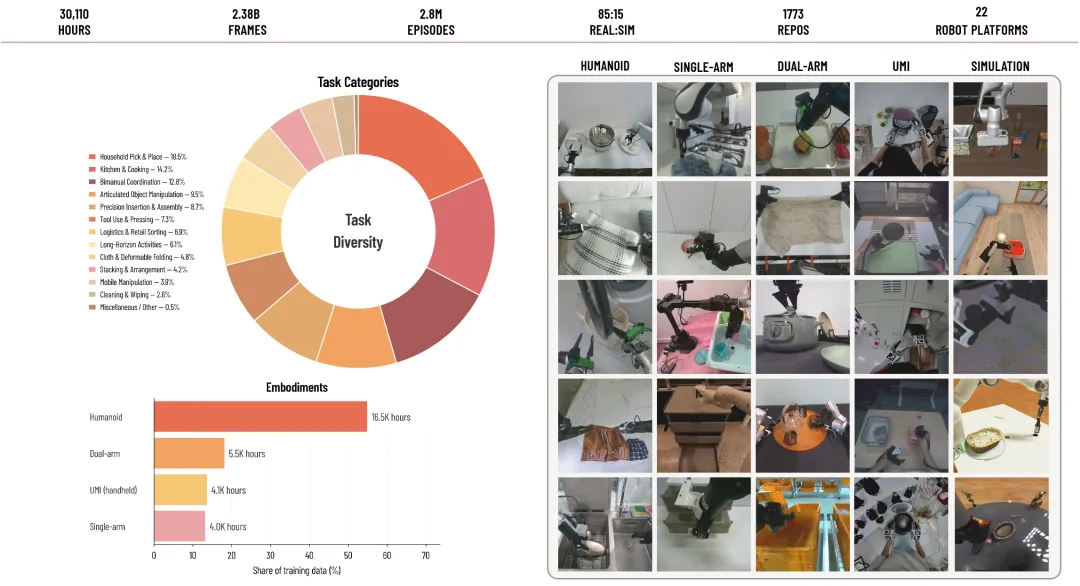
Model training is based on 30110 hours of selected robot demonstration data, covering 22 heterogeneous robot platforms such as humanoid, two-armed, single-armed, hand-held UMI devices, mixing real-world data collection with traditional simulation data; human robot samples accounted for 54.8% and real-world data for 84%.
Unified Action: encoding the control signals of the head, torso, waist, end executor, claw, bottom to the same movement vector to achieve cross-body compatibility;
Coordinated double path conditions injectedCombining timely alignment of attention mechanisms with direct action injections, strong binding control instructions and generating movements;
How to perceive the perception of distractionIntroducing an optical camera identifier that completes the interaction of information across viewpoints, ensuring consistency across multiple viewpoints, and avoiding the convergence of different viewpoints.
Stage two: post-training high-speed generation + long-term sequence memory
The difficulty of returning to the simulation is that the model needs to continue to run on the basis of its own inaccurate predictions of the next step, while the native video generation model is trained only in the context of fixed-length real values. The team specifically designed three mechanisms:
High-speed generating linksPartition factor adjustment + four-step consistency distillation, supporting continuous simulation of long sequences;
Self-conditional stability: Freeze the two-way teacher model as a reference and conduct Self-Rollout world model simulator training with asymmetrical distribution matching to mitigate error accumulation;
Layered chronological memoryKV Cache: In-line storage of initial scenes, rare long-range history, close-range movements, and support for long-range projections.
The system ultimately transformed the two-way generation model into a simulation of the world model of the Cause, Self-Rollout: it can still be steadily rolled out after more than a fixed training on the context window, supporting continuous rollout for more than two minutes at most.
In the RoboTwin 2.0 single-chip A100 environment, 50-step noise deceleration causes the back-to-back dissemination baseline speed of only 1.12 FPS, PSNR 26.15; the CD decreases the noise deceleration to 4 steps, increases the speed to 10.04 FPS, PSNR drops back to 24.40; after overlapping DMD, maintains 4-step noise deceleration, PSNR returns to 24.87, LPIPS is optimised from 0.193 to 0.176, which is about 9 times the overall acceleration of the 50-step instructor model.
The results of the experiment
EWMBench: Scoring first overall
PrimeSim received an overall score of 6.09 on the EWMBench, higher than GE-Sim, LTX, 5.82); GE-Sim, COSMOS, 2.5.79) and led the Thinker-WM, EnerVerse-FT, Qwen-RobotWorld, Sora2. In the segment, HSD, 1.000, nDTW, 1.000, BLEU, 0.570, CLIP, 0.954, and Logics, which took first place.
WorldSimProbe: Five indicators and three titles
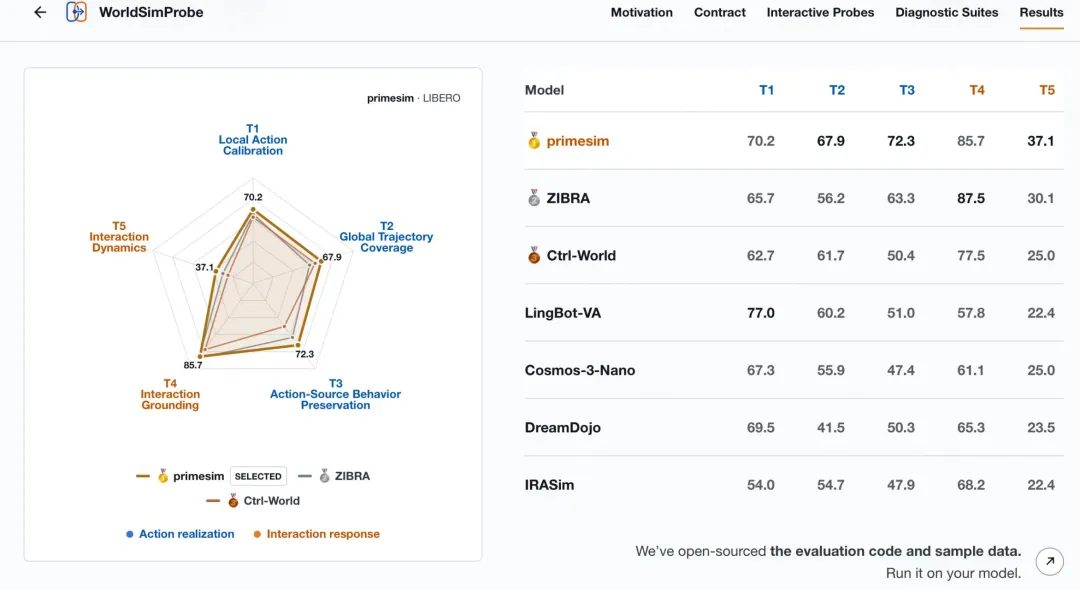
WorldSimProbe is based on LIBERO, with five assessment suites designed to intentionally strip visual perception, task success rate interference, and focus on dynamic reliability of the simulator itself. PrimeSim maintains three peaks in its global trajectory coverage (T2, 67.9).
As a strategic simulation base: highly aligned with traditional simulators
The experiment selected eight OpenVLA-OFT strategies, and the baseline simulator success rate ranged from 29.3% to 85.0%, with the PrimeSim and LIBERO native simulator success rate correlating coefficients r = 0.99, MMRV = 0.000, the average absolute error Δ = 2.8.
The team went even further, doing GRPO reinforcement studies on OpenVLA-OFT directly within PrimeSim, with 512 episodes per round of sampling, for a total of 200 rounds of updates. The strategy improved success rates on native simulators by 11.5%, and the rating indicators in PrimeSim by 11.8%. This demonstrates that the strategy gains in the neural simulator can effectively migrate to a traditional physical simulation environment.

counterfactual action following demos
Minor sample core migration: new core needs only 100 tonne 200 steps of subtraction
In the AgileX Piper's XVLA scene, the fabric, camera position, and scene are not present in the training kit: the densely-contacted fabric shape changes rapidly as the sample rolls; in the A100, less than 3 minutes, 200 steps later, the fabric changes according to the instructions, keeping the multi-angle state consistent.
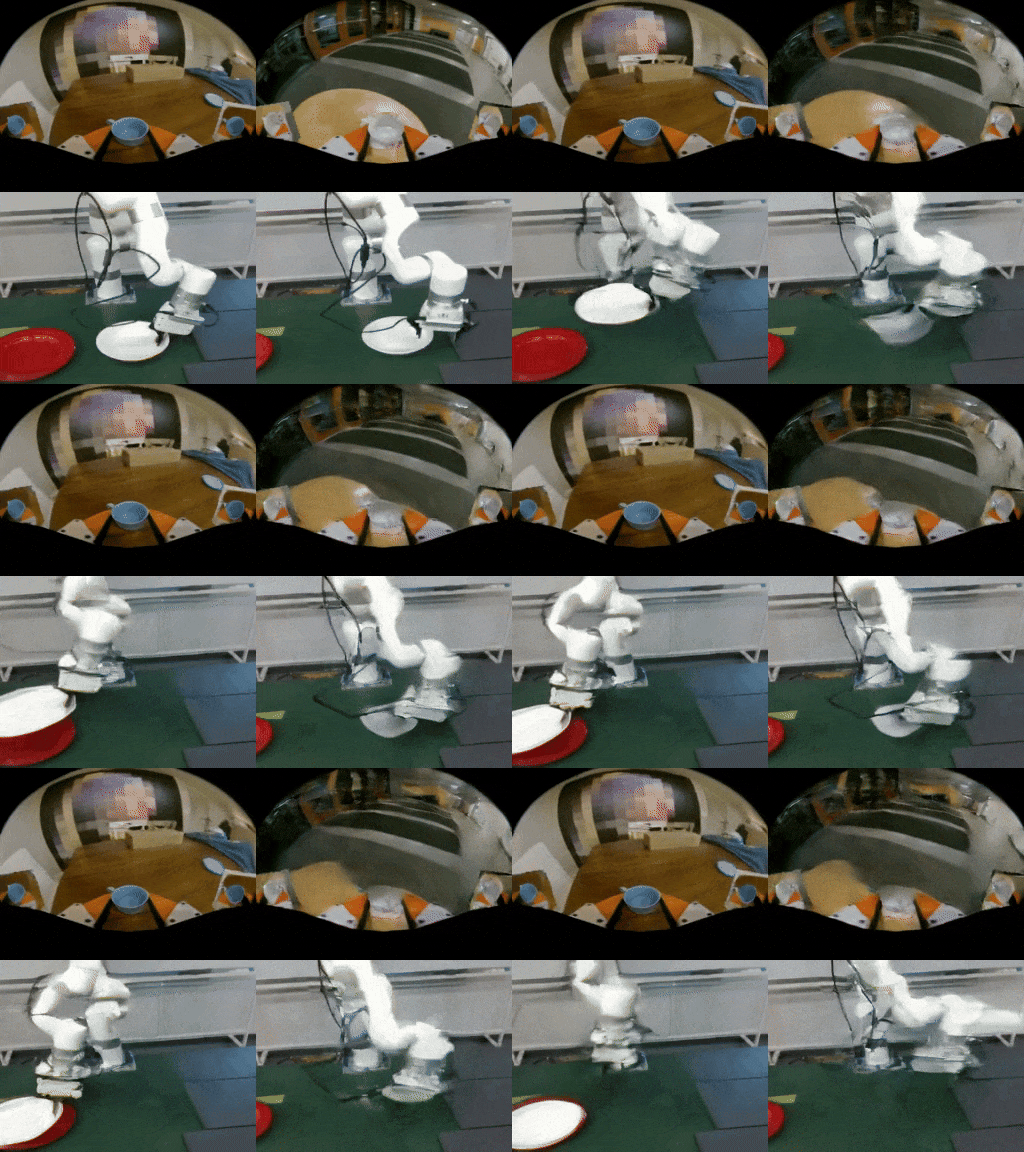
PrimeSim unseen embodiment few-shot demos. Left side is PrimeSim, right side is Wan2.2 5B
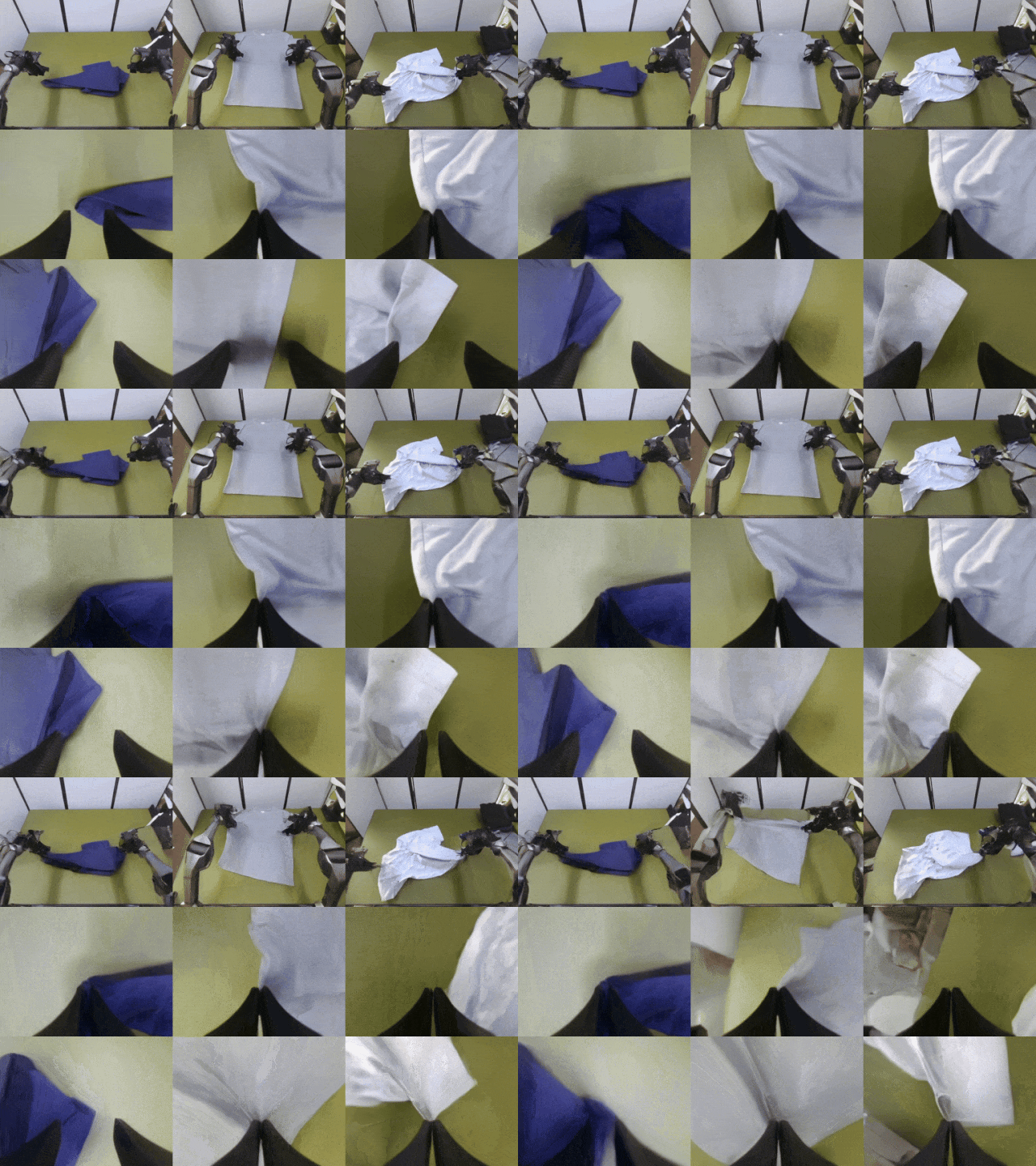
unseen camera and environment zero-shot demos
Reasoning performance: Single card A100 up to 10.12 FPS
A single-disc A100-80GB, three-dimensional, single-disc resolution 288×384, one-time prediction of 32 frames, four-step noise configuration, PrimeSim achieves 10.12 TempFPS, 30.35 ViewFPS; throughput is about 4.5 times that of GE-Sim 2.0 and 11.6 times that of Ctrl-World.
Melting Experiments: Clear Benefits of Modular Design
The PSNR was only 16.30 when the multi-point blending was done; the PSNR increased to 23.78 after the addition of the point of view token conditions; the LPIPS decreased from 0.58 to 0.15 after the superimposed point of view blending attention to 24.56.
The working knot
The team came to four key conclusions based on the experiment:
This is a recoverable engineering formula, not a single-point model."Middle-training + Post-training" is a progressive flow channel that converts general video generation models into interactive robot world model simulators.
The accuracy of movements can be learned through the scale of dataUnified motion characterization with dual path condition injection, achieving strong binding of control signals and motion generated on 22 isomers;
World models have the potential to replace traditional simulators: a success rate correlation with native simulation strategies of up to 0.99, and the benefits of reinforcement learning within the model can be migrated;
Accuracy and engineering practicality10.1 FPS reasoning speed, more than two minutes of sequence time, the new body needs only a hundred-degree step-stimulation.
As the machine understands, PrimeSim's weight, reasoning code, and training code are about to become open source.
© THE