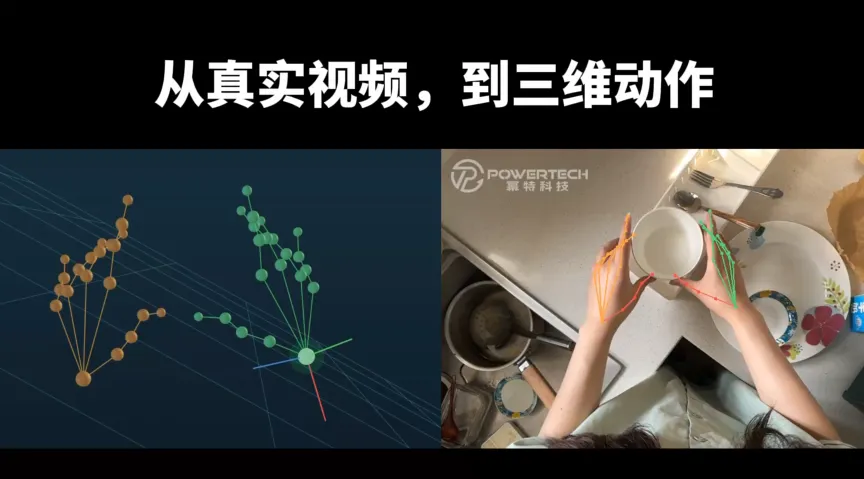
“ From the video, it restores 3D action and maps it as robot action.
The appearance of the GPT-6 Astra demonstrates general model advances in complex reasoning and multi-step task execution. According to Intel, as these capabilities extend into physical, accurate, and portable human action data, they will become an important foundation for connecting model capabilities to robot action. Ordinary cameras record rich human action; if reliable three-dimensional gestures and continuous trajectories can be restored from them, there will be an opportunity to transform more human experience into robot learning signals, expanding real scene data sources beyond the collection of real machines.
The focus is on this conversion link from ordinary single-dimensional RGB video to high-quality three-dimensional motion data: high-precision reconstruction of extraction movements, continuous verification and enhanced accuracy with autonomous real-value systems, supporting scalable processing by automated pipelines.
Recently, Pantheon Technology has demonstrated a technological breakthrough: using single-lens RGB video collected with the GoPro headset alone, it can accurately restore the three-dimensional motion of the human hand in real time and map it to the mechanical arm and dexterity of the hand to achieve precise real-time control.
This progress validates the key capabilities of data conversion links: in demonstration scenarios, recovering three-dimensional movements from video, and mapping them to robot movements. For robot training, a combination of intrinsic constraints, movement redirection and quality verification is also required to form available model-learning motion oversight, and to evaluate test effects through downstream models.
01.
From human video, extract robot-learable action information
For VLAs, world models, and other directions, human video provides a wealth of scenes, objects, and processes of operation. The three-dimensional gestures and spatial trajectories can further describe where the hand is, how it moves, and how the movements intersect over time, providing information for the model to establish a link between visual observation and physical movement.
ICL, In-Context Learning) is also used in the exploration of demonstrations: models refer to a given demonstration when performing new tasks without having to be retrained for the demonstration. It has been studied in RGB-D video conditions to extract task segments and hand trajectories from human demonstrations, using them as the context above, to guide robots to perform corresponding operations.
Human experiences have different use paths, from training-stage monitoring of movements to demonstration references to execution-stages. High-precision three-dimensional information is expected to provide a clearer description of these paths.
Over the past few years, big-language models have made a leap in capability through mass data training. Today, physical intelligence is also exploring its own Scaling Law. Single-lens RGB video relies on popular devices such as smartphones, motion cameras, low-cost, easy-to-access, wide-screen coverage, and provides an input to scale-up access to human motion data. However, single-lens vision still faces challenges such as depth and dimensional ambiguities, camouflage and trajectory drift.
From easy-to-access videos to accurate, continuous, and robotic-learning 3D motion information, there is a critical technical gap in the middle.
This is exactly the data compilation link that PintTech chose to focus on.
02.
Precision determines exactly how much robots can learn from humans.
From the point of view of Intel, the core challenge of Ego (first point of view) data processing is not just to reconstruct hand movements, but how to ensure that reconstructed results are accurate, continuous, and have a reliable three-dimensional spatial structure.
In robot-operated tasks, a small error in position can result in completely different execution results.
For example, in precise movements such as grappling, insertion, and rotation, deviations in the position of the tips of the fingers may directly affect the grappling points and contact relationships; while continuous drift of the camera's motion trajectory may disrupt the consistency of a long period of motion in three-dimensional space.
For robots, geometric accuracy is not just a visual reconstruction indicator, it is related to the quality of the motion monitoring signal.
To address this issue, Photonics continues to use core technologies such as 3D Hand Pose, SLAM, and environmentally generated reconstruction. The system rebuilds continuous three-dimensional hand motion information and camera space trajectories through single-track RGB video, and continuously optimizes dimensions such as movement accuracy, consistency, scenography generalization, and processing efficiency.
In the team's existing internal tests, MPJPE reconstructed in 3D arm posture was about 1 cm, and the PA-MPJPE reached the millimeter level after rigid alignment; single SLAM also achieved high-precision trajectory reconstructing results under specific test conditions.
Test results: The contrast between the 3D Hand Pose accuracy and the representational scheme tested on the Hot3D dataset
(All units are in mm, the lower the better)
Model name | It is absolutely MPJPE. (Camera-space) | Relative MPJPE of the wrist (Wrist-relative) | PA-MPJPE (Procrustes-Aligned) |
|---|---|---|---|
HaMeR | — | 57.96 | 10.26 |
WiLoR | — | 26.09 | 7.57 |
HaWoR | 68.11 | 16.71 | 7.64 |
Dyn-HaMR | 58.12 | — | — |
EgoForce | 43.90 | — | 6.60 |
V-JEPA Hand | — | 12.04 | 5.72 |
Ours | 14.27 | 8.47 | 4.40 |
Compared to simple video recognition, high-precision 3D structured data can provide more precise spatial motion monitoring, providing a geometric basis for the migration from human to robotic actions (Ego2Robot).
When these three-dimensional trajectories are further combined with the robot's intrinsic constraints, movement redirection, and quality verification, there is an opportunity to transform into motion monitoring data that is trained for robot strategies.
The long-term value of high-precision Ego data comes from understanding what humans are doing to learning how humans are doing their movements.
03.
Autonomous real-value systems that make accuracy verifiable and sustainable
There is also a problem that is easily overlooked behind the single rebuilding algorithm:
How do we know exactly how accurate the three-dimensional actions of the algorithm are?
In complex first-person scenarios, hand shading, rapid movement, changes in perspective and the inherent depth and dimensional ambiguity of single-eyed vision pose challenges to accuracy assessment. In the absence of reliable three-dimensional true values, algorithmic errors are difficult to measure accurately, making it more difficult to form a continuously improved closed loop.
To this end, Pantheon Technologies independently built a high-precision dynamic 3D real-values system with single-item Ego data. The system enables absolute three-dimensional position measurement under dynamic scenarios, providing a benchmark for hand gesture reconstruction, camera space trajectory and related algorithms.
The team uses the Marker hand-held unmarked point scheme, with an end-to-end true-value measurement system with a measurement accuracy of about 0.2 millimeters. The value of this capability is not only to obtain a more accurate set of test figures. It means that the team can build from real motion measurement, algorithmic error analysis, difficult scenario positioning to continuous model optimization, and provide the basis for subsequent high-quality training and evaluation data, as well as real-world and simulated joint assessments.
Especially for technological pathways such as one-way vision, reliable real-value systems can help teams continue to identify and improve reconstruction errors in complex scenarios, improving the accuracy and generalization of algorithms.
It is noteworthy that the high-precision real-value system is primarily used for algorithm research and verification, while the actual scale-processing data still comes from ordinary RGB camera equipment. The team was able to use high-precision measurement to continuously improve the algorithm, while retaining the overall advantage of single-shot video in cost and scale acquisition.
Autonomous real-value systems constitute a technological foundation for a long-term iteration of the algorithms that are supported, and this is one of the long-term technological barriers that Intel is building.
04.
From high-precision algorithms to the ability to process millions of hours of data
Whether a high-precision algorithm can become a data infrastructure depends on whether it can continue to run steadily in complex, vast amounts of real-world video.
Unlike standardised test sets, large-scale Ego data from different devices, perspectives and scenarios, lighting changes, motion blurring, shadowing and movement differences are normal. Faced with hundreds of thousands or even millions of hours of processing demand, stages of artificial inspection and repair are difficult to support long-term expansion, and high accuracy must be established in conjunction with scenographic generalization and automated processing capabilities.
In verified production scenarios, its automated data processing pipeline enables continuous, automated processing of video data, reduces artificial interference, and has the ability to process complex real-life scenario data with high shading, various types of gloves, dimming, and trans-exposure with stability and high precision.
These production practices enable teams to test the stability and processing efficiency of algorithms in real customer demands and gradually translate the laboratory's technical capabilities into data services that can be delivered at scale.
For large model customers, the real value of a data service is not just the one-hour processing cost, but how much high-quality, consistent standards and data can be accessed through the training process.
High accuracy determines the availability of the data, scenario generalization determines the coverage of the data, and automation determines the scale to which data production can be achieved.
As the demand for data with physical models grows, automation, stability and quality consistency of the data processing pipeline itself will gradually become an important infrastructure capability.
05.
MaaS platform to make high-precision Ego processing a standardized service
Based on core algorithms and automated processing pipelines, Pint recently launched the MaaS platform for single-use Ego data, further opening up high-precision data processing capabilities for standardized services.
Users can upload RGB video to the platform, call on the ability to reconstruct 3D hand gestures and spatial trajectories, and process the original video into three-dimensional structured data with more training value.
Users can also view the original video and 3D reconstruction results simultaneously in the browser, through playback and viewing switching, and intuitively observe hand movements. This makes the processed data more visible and easier to understand and check.
The platform is targeted at a variety of mainstream single-player RGB video sources, including the RGB video streams of devices such as iPhone, GoPro, and RealSense. Users do not need to rely on specific models of professional collection hardware to perform data processing tasks using common devices.
For robotics companies, model R&D teams and research institutions, the complex data processing processes that would have required a professional algorithm team to build are expected to be available in a lower threshold, more standardized way, and reduce the investment in rebuilding data processing capabilities.
The MaaS platform also enables the technological accumulation of Peugeot Technologies with replicable product carriers. From customized projects to standardized processing pipelines and online services, the company is transforming high-precision Ego data processing into infrastructure capabilities for sustainable expansion.
Its positioning is thus clearer: with widely available RGB video input, high-quality 3D animation and spatial structure output, connecting real human experience with the need for robot training. This level is not dependent on a specific data collection device, but can synchronize with different upstream data sources and downstream model training needs.
06.
Next Generation of Physical Data Infrastructure: Giving greater value to the human experience every hour
As physical intelligence moves towards more generalized robotics capabilities, an important trend is becoming clear: data size is important, but how much physical information can be learned is equally important.
Similarly, an hour of Ego video, with only original images, with data on precise three-dimensional gestures, spatial motion trajectories, and continuous motion structures, has different potential training values. The former records what happens in the physical world, while the latter goes further, transforming some physical processes into structured signals that models can use.
In order for this capability to truly serve physically intelligent scaling, the breadth of data sources, processing accuracy and scale production efficiency must also be taken into account.
Around this goal, Photonics is building a system of mutually-supporting capabilities: high-precision reconstruction to extract action information, autonomous real-value systems supporting quality assessment and continuous iteration, automated pipelines and MaaS platforms driving scale delivery.
In the future, as more complete object-interaction information is gradually complemented with cross-body motion mapping capabilities, broader human behavioural experiences are expected to be further transformed into data resources required for robotic pre- and post-training.
Pant Tech hopes to build a data compilation infrastructure that connects human physical experience with robotic learning to make real-world actions more accurate, more efficient as robot learning signals, and expand data space for the continued development of physical intelligence.
Currently, Pint Technology is continuing to work with high-precision Ego data processing teams aimed at large, physically intelligent models, VLAs, world models and robotics development teams.