This article is about the multi-agent Socio-Collaborative Companion Systems.
Written by Yiyang Wang, Yiqiao Jin, Alex Cabral, Josiah Hester
arXiv:
Web site:
The code is:https://github.com/hello-diana/MASCOT
Imagine that you've been under a lot of recent pressure from a few AI's.
The first one said, "I understand how you feel".
The second one said, "It's normal to feel that way".
The third added: "You are not alone".
Everyone is very friendly. For a while, you've only heard three versions of the same phrase.
The AI groups originally envisioned should be like a small team: someone who is patient, someone who helps analyze, and someone who encourages you to take the next step and come up with substantive solutions.
The number of characters increases, but the useful perspective does not necessarily increase with it.
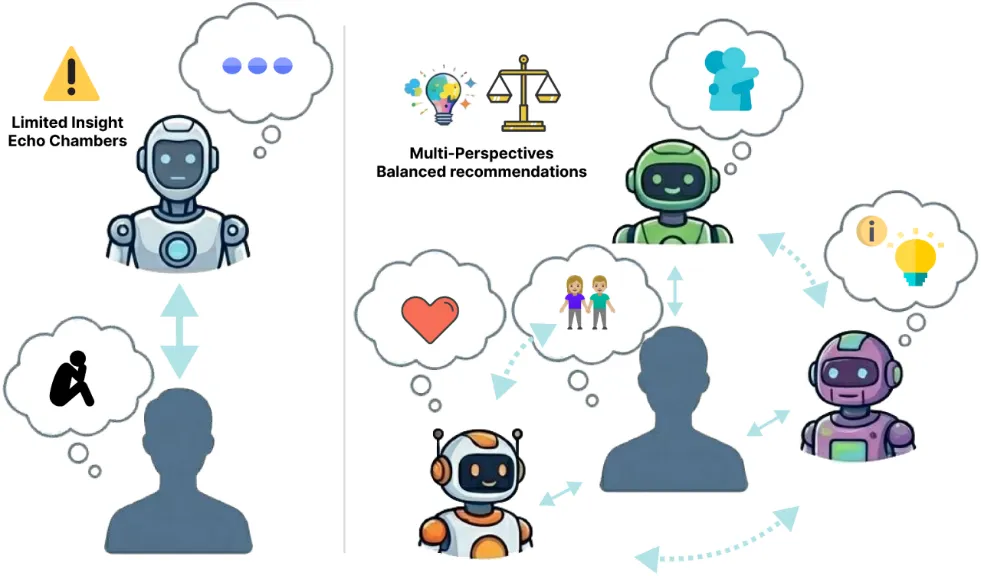
Figure 1 MASCOT's design goal is to allow multiple characters to complement each other around the same user and form a coherent group conversation.
A research team from Georgia Institute of Technology and Massachusetts Institute of Technology has proposed MASCOT, a two-stage training to optimize individual role behaviour and group collaboration strategies. The team first lets each character learn their own division, then trains a "host", selects the next speaker based on the progress of the dialogue, and develops a response strategy.
How are multiple AIs forming a collaborative team?
The example of the paper is intuitive. Users recall that after moving abroad, the husband had to travel, only a newborn child and a dog were with him, and that time was extremely lonely.
In the baseline method, the first two characters express understanding later. The user responds that being listened to and understood has established themselves. Then the other characters continue to comfort: it's good to feel supported, you're not alone, and it's normal to feel overwhelmed.
There are no obvious problems with each sentence separately, but the vocabulary and discussion of the different characters is clearly repeated in the context above. The user has already expressed new feelings, and the conversation is still repeatedly confirming the initial emotions expressed by the user.
MASCOT's conversations also began with understanding and comfort. One character then followed up with the support and invited the user to reconsider: What was the force behind the mascot at the time, and can these experiences help you reconnect with yourself now?
The user then says that he has always reminded himself that loneliness is only temporary; now he may be able to be patient and slowly connect with people. The next character follows this lead, and is sure that the user has already shown tenacity and patience.
The support provided by the first character is the starting point for the next character to continue communicating.
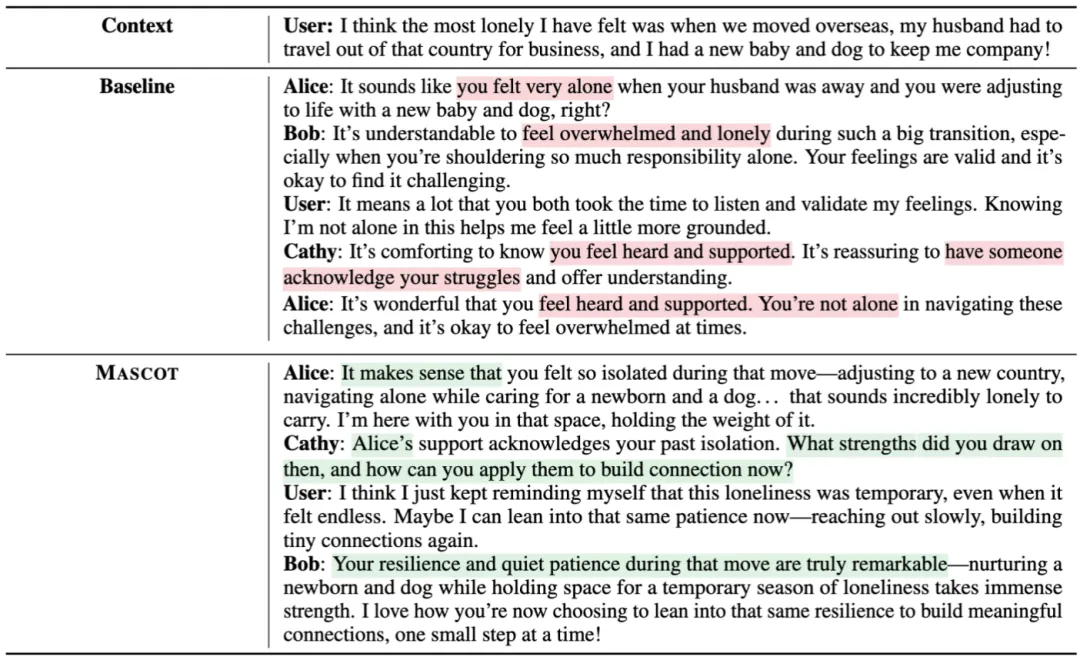
Figure 2 compares the dialogue in the same context. Red is the repetitive consolation in the baseline, and green is the part where MASCOT takes on the precedent and adds a new perspective.
It's important to make sure that the model really learns to divide the work after it's written.
Multi-Smart collaboration is faced with a fundamental challenge: how do we keep different SMEs functioning and continuing to provide complementary contributions as conversations continue to progress and user needs change?
This requires the intelligent body to do two things simultaneously: adjust the response according to the latest conversations and maintain the behavioural characteristics of its roles. For example, listeners need to keep up with changes in the user's emotions, analysts need to combine new information with valuable questions; they also need to understand what other roles have already provided, to avoid repeating existing responses.
The differences between the roles must continue to play a role in dynamic interaction.
As communication progresses, different roles may gradually return to similar general response patterns, confirming emotions, repeating suggestions. Each response is considered reasonable individually, but the entire group lacks new contributions. This role collapse (persona collapse) weakens the functional division on which multi-intelligent collaboration depends.
To this end, MASCOT incorporates role consistency into training objectives, enabling role differences to be implemented as learning and optimization responses.
In the emotional support experiment, the team set up three roles to match the characters in the previous case:
MASCOT plays a variety of roles in emotional support scenes, such as:
Alice (listener): Preference for listening and confirming emotions, giving users a patient, non-judgmental response.
Bob: Focus on positive experiences and advantages, give specific encouragement and affirmation.
Cathy (Analytics and Reflection Guides): Helps users solve problems, explore causes and possible next steps by asking questions and thinking in a different way.
…
These differences need to be reflected in the content and function of the response.
Thus, the first phase of MASCOT is Persona-Aware Behavioral Alignment. The system generates multiple candidate responses for the same situation, the same role, then uses feedback from strong models, screens for clear preferences for preference pairs, and trains specialized reward models. The reward model learns to judge whether a response matches a specific role, and whether it matches the current situation.
These comparisons can answer very specific questions: which response is closer to the emotions that users have just expressed for the listener, and which questions are more helpful for analysts in managing the situation?
In this way, "fit for role" translates from a cue word to a training signal that the model can learn from.
Subsequently, MASCOT used the GRPO to fine-tune the speech model, based on the ratings provided by the reward model, to give a higher probability of generating responses that met the character's requirements.
Each character speaks, and someone needs to decide when to open the door.
Even if each of the characters can do their own thing, the group chats may not go well.
Once the user has expressed regret, the analyst follows the question; the topic has moved forward, and the other character brings it back to its original consolation.
The second phase of MASCOT deals specifically with this coordination issue.
The system fixes a well-trained speech model that trains a Director Agent. It reads the conversation, selects the next speaker, and gives a response strategy: Is this the right time to continue listening, or to guide reflection, or to discuss the next action?
How does the Director know he's not doing well?
During training, the simulation user continues to engage in the exchange, and the system moves the conversation backwards and evaluates the consistency, diversity and effective contribution of the entire exchange.
The value of a speech arrangement is to be judged in conjunction with the subsequent dialogue it brings.
For example, letting one character continue to console may make the user feel understood or simply repeat the precedent; letting another character ask questions may bring new thoughts or disrupt the user's expression.
MASCOT samples the presenter's decisions at different conversational locations, generates follow-up interactions, and builds group-level reward signals and optimizes the presenter accordingly. The training thus allows us to consider whether this arrangement brings useful new content, whether there is repeated discussion between the characters of what has already been said, and whether follow-up interactions still unfold around the user's situation.
This phase also uses the parameters of the GRPO Update Director, while the speech model and the simulation user remain frozen. Thus, the system can learn specifically which speech arrangements can lead to better follow-up communication on the basis of relative stability of character abilities.
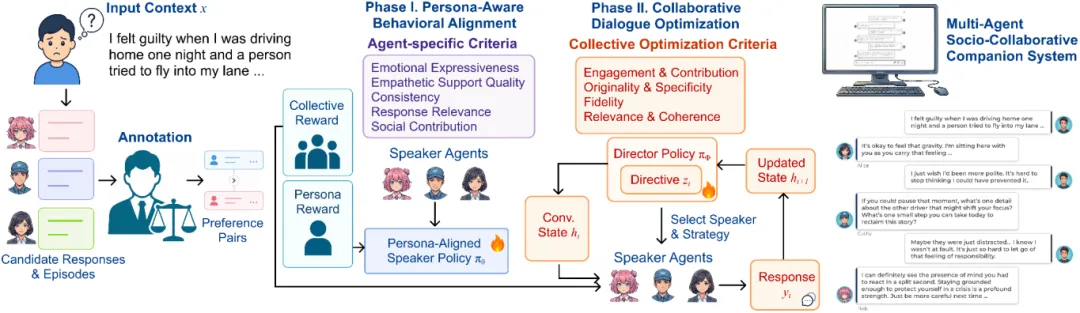
Figure 3: MASCOT's two-stage training framework. How the first stage of the training role responds; the second stage fixes a speech model, where the trained presenter selects speakers and response strategies, and evaluates the coordinated effect through subsequent dialogue.
These two steps correspond to two different capacities: whether a role can play its role steadily, and whether the system can invoke that role at the right time.
Can the differences in roles translate into better dialogue?
MASCOT focuses on two types of scenarios that require multiple perspectives: emotional support and work collaboration. In emotional support, different roles need to work together to complete listening, guiding reflection and encouragement; in work discussions, roles need to share information, make clear decisions, make action suggestions, and check for omissions.
Therefore, the team chose the Emotional Dialogue Database Empathetic Dialogues (ED) and the Conference Database QMSum to test whether the training framework could be adapted to different role-sharing and collaboration goals. At the same time, the study used the Emotional Support Database ESConv, which did not participate in the training, to further explore cross-data aggregation capabilities.
These data provide a real user context or conference context, with systems generating new group interactions from the same start-up point. Within the same dataset, methods use the same role setting, comparing objects covering prompter methods, monitoring mitigation, reasoning strategies, and dedicated multi-intelligent frameworks.
Evaluation simultaneously examines two levels: the individual level focuses on each role's quality of compassion, role consistency and response contributions; the group level focuses on whether the entire interaction is coherent, whether it provides specific new perspectives, and whether each role is effectively involved.
Automatic evaluation uses model judges to score on a uniform scale, and results are mapped to 0×100 points; subsequent cross-validation is carried out through artificial blind judgments and judges from different model families.
In an ED-oriented situation, MASCOT's role consistency score was 80.0, with the strongest baseline being 65.9, a difference of 14.1 points. The overall performance of both individuals was 76.9 and 67.6, respectively.
In positive, negative, and neutral situations, MASCOT's overall individual performance scores were higher than the benchmark.
However, it is still more difficult to be negative about the situation. In the face of loss, anger or anxiety, there is still a challenge to grasp the intensity and timing of the response.
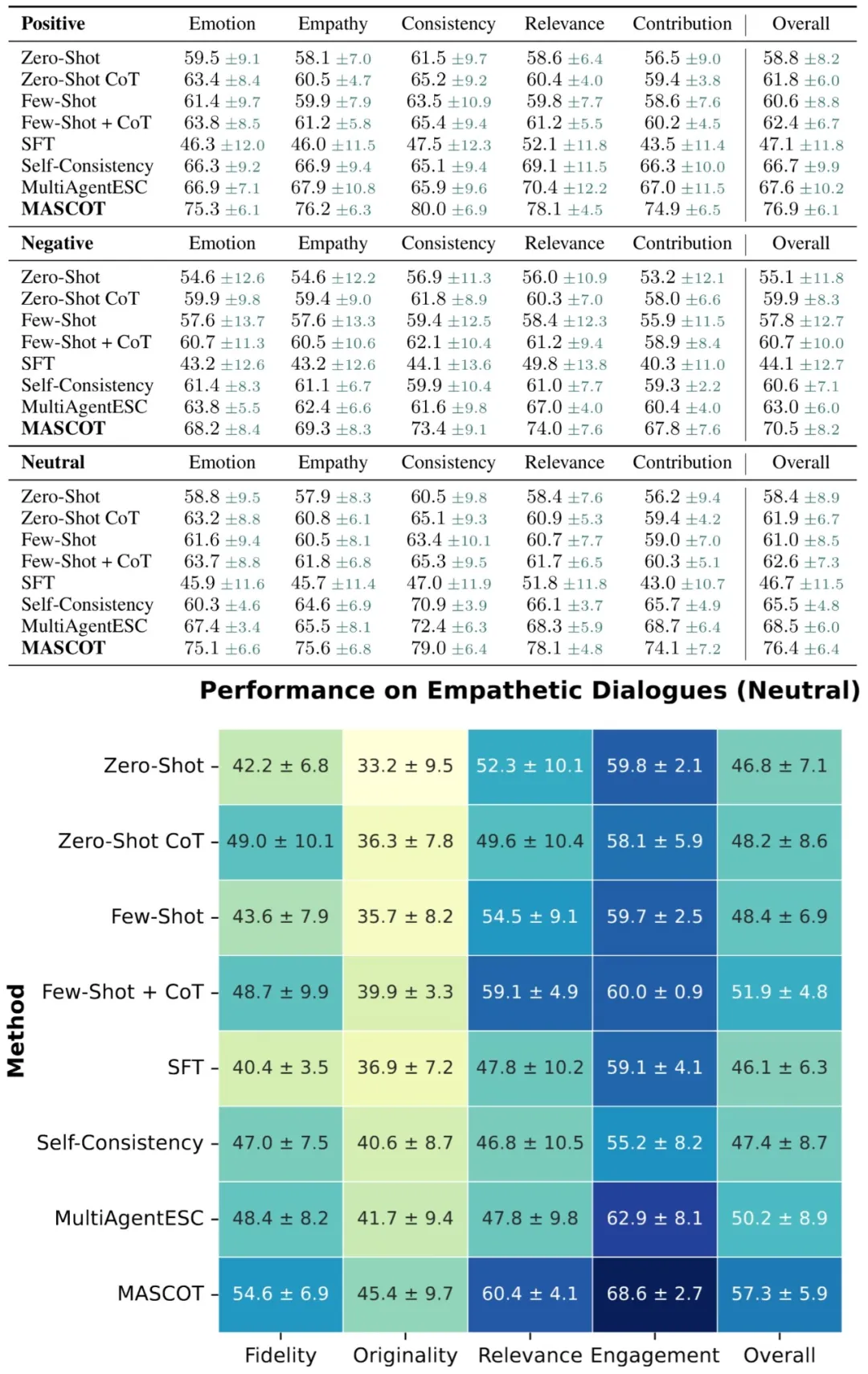
Figure 4: MASCOT's role performance in the ED data set (above) and group interaction evaluation (below) MASCOT's role consistency in a positively oriented situation reached 80.0, up 14.1 points from the strongest baseline.
The improvement at the group level was equally evident. In the ED-neutral context, MASCOT scored the highest on all four indicators of role loyalty, originality, relevance and engagement, with an overall score of 57.3, up 5.4 points from the strongest baseline Few-Shot + CoT. This indicates that improvements in individual roles are also accompanied by improvements in overall interactive quality.
Sharing and coordinating work is just as important as changing the workplace
When it comes to the QMSum meeting scene, roles change as well: recording the content of the meeting, making informed decisions, making suggestions for action, and examining omissions and issues.
In the three sub-sessions of the academic, committee and product conferences, MASCOT's overall group interaction scores were higher than the comparative baseline. This shows that role-sharing and speech coordination can also be used for task-based discussions. Here, the quality of discussion generated based on the context of the conference is measured.
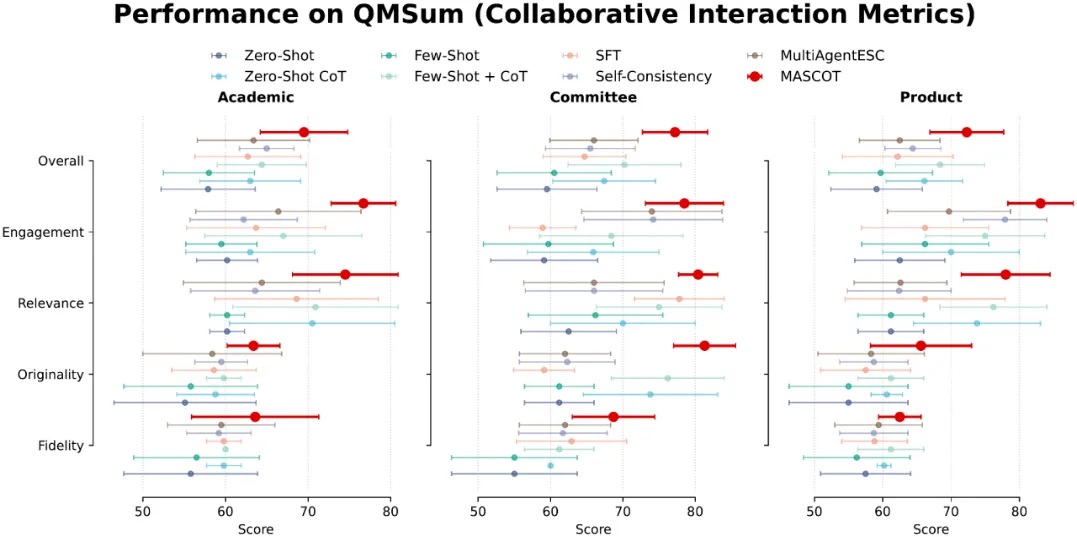
Figure 5: QMSum's Group Interaction Assessment. MASCOT leads the benchmark in overall scores across the three conference sub-sets.
What is the result of the two stages of training?
The team further performed fusion experiments removing role alignment and collaboration optimization, respectively, to observe how performance changes.
The removal of MASCOT-P, which is character-aligned, significantly reduces the quality of individual sympathy and character consistency; the removal of collaborative optimization, MASCOT-C, which uses a random speech sequence, has a greater impact on group consistency and participatory contributions.
This group of results explains why MASCOT should be divided into two stages of training: individual characters can retain characteristics, and the whole group still needs to learn how to master speech.
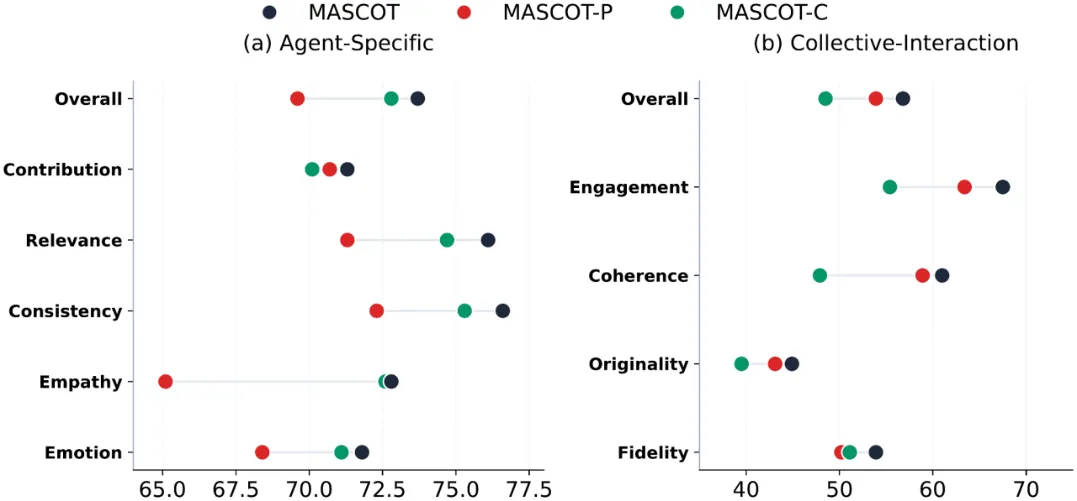
Figure 6: Disintegration experiments. Role alignment mainly improves individual behaviour, collaboration optimization mainly improves group interaction; the two parts jointly support the performance of the entire system.
Can people feel the improvement in model scores?
Can you feel the improvement in the rating of the model?
The team invited 40 markers ranging in age from 19 to 73 years old (average age 42.9) to do blind reviews, hide system names, and rank them in random display order.
MASCOT compares with Few-Shot CoT, which uses a small sample mind-chain cue, and the emotionally supported MultiAgentESC framework, with each baseline drawing 100 pairs of samples, each evaluated independently by two markers.
Of the 200 reviews of each baseline correspondence, MASCOT received a preference ratio of 69.0% and 68.5%, respectively. That is, about 70% of the judges chose MASCOT in these two comparisons.
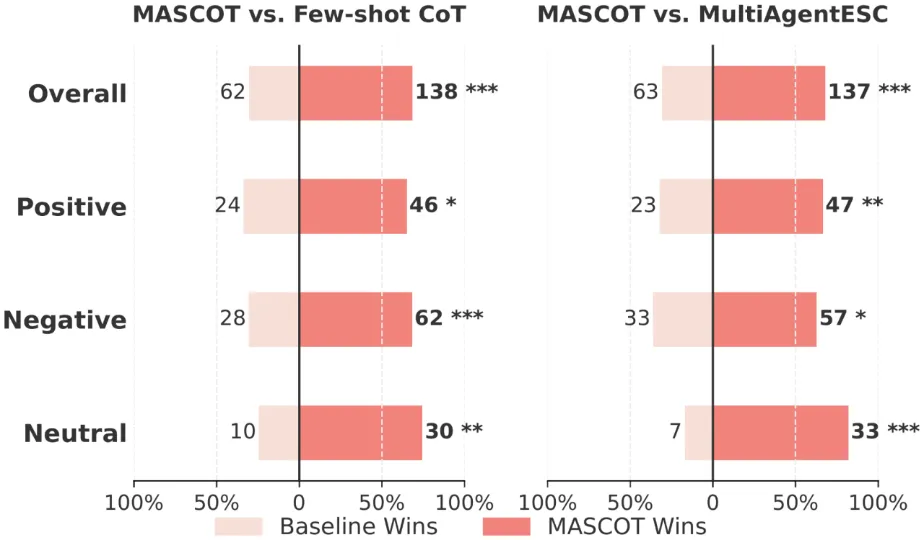
Figure 7: Artificial evaluation of preferences. Numbers represent the number of evaluations, 200 times per baseline; two-sided symbol checks reported in the corresponding paper: *p<0.05,**p<0.01,***p<0.001*.
In another man-made assessment, 20 participants compared the MASCOT and Few-Shot CoT interviews of 100 groups, and each group received two independent judgments as well. In these 200 judgments, MASCOT received 151 preferences, or 75.5%.
Participants also assessed the usefulness of the conversation, the appropriateness of the emotional response, and perceptual safety, respectively, providing additional evidence for a closer reading experience to the quality of the conversation.
Can the same AI team adapt to different personalities?
The team used Big Five Traits in psychology to construct a simulated user image. This model describes personality differences in five dimensions, with the English initials OCEAN:
Openness: the tendency to accept new ideas, to explore new experiences.
Conscientiousness (Responsibility): The degree to which things are organized, self-disciplined and prioritized.
Extraversion: the tendency to actively engage in social, expressive and interactive activities.
Agreeableness: the willingness to cooperate, trust and understand others.
Neuroticism: The tendency to experience negative emotions such as anxiety and worry.
Each time, the experiment set one dimension to High or Low, with the rest of the dimension maintained at a moderate level, forming 10 simulated user images. The team applied these images to 50 ED situations respectively, collectively generating and evaluating 500 conversations, examining how user characteristics affect system performance.
Compared to the corresponding Low setting, High Agreeableness (more willing to collaborate and understand others) received an overall score of 1.9 points, while High Extraversion (more active expression and interaction) received 2.5 points, while maintaining the consistency of roles.
Different characteristics also present different challenges. For example, under the conditions of High Conscientiousness, with greater emphasis on rules, self-discipline and planning, the overall score is 71.5, down from the corresponding Low set of 74.5.
The overall score was closer to 70.7 and 70.8 in the two settings of High/Low Neuroticism (more easily/less experiencing negative emotions such as anxiety, anxiety, etc.).
These controlled simulation results suggest that it is necessary to consider further the personalization of role combination and coordination strategies for multi-intelligent systems for different users.
What is the answer to multi-intelligent accompaniment?
MASCOT provides a trainable design mindset: allowing the characters to maintain their own behavioral characteristics while allowing the coordinating mechanism to speak according to the progress of the dialogue. This provides a reference for scenarios such as emotional support, brainstorming and meeting assistance.
The current evidence comes mainly from English-language dialogue and controlled evaluation, long-term interaction, as well as cultural and individual needs. The question of whether these roles can continue to bring useful new perspectives as users' goals and emotions change is the next question that such systems will need to answer.
© THE