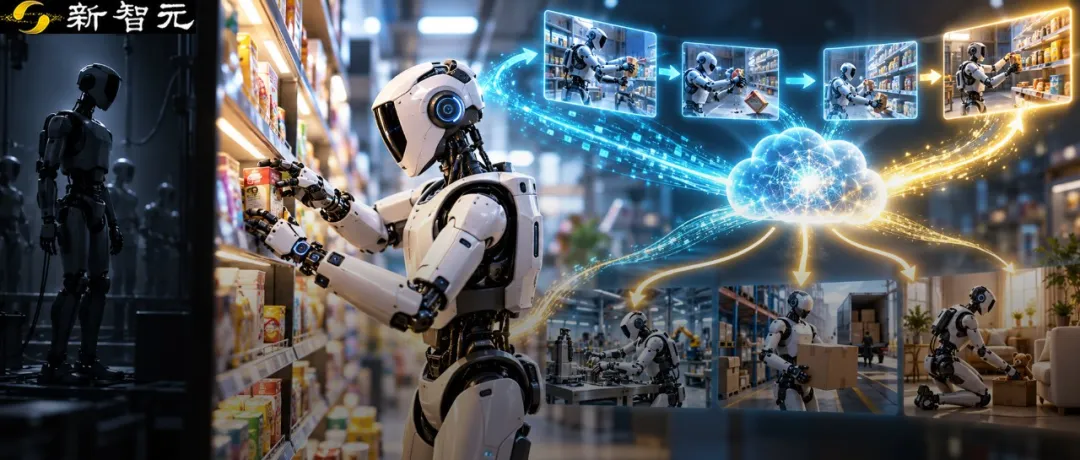
It's the first time in the history of the world.
In the last two days, Musk has fired again.
This is according to a forecast by market research firm Counterpoint: In five years, the demand for human robots for memory will skyrocket by about 20 times, and by 2030, each robot will have 39GB of memory.
After reading a sentence, Musk said, "Stupid analysis".
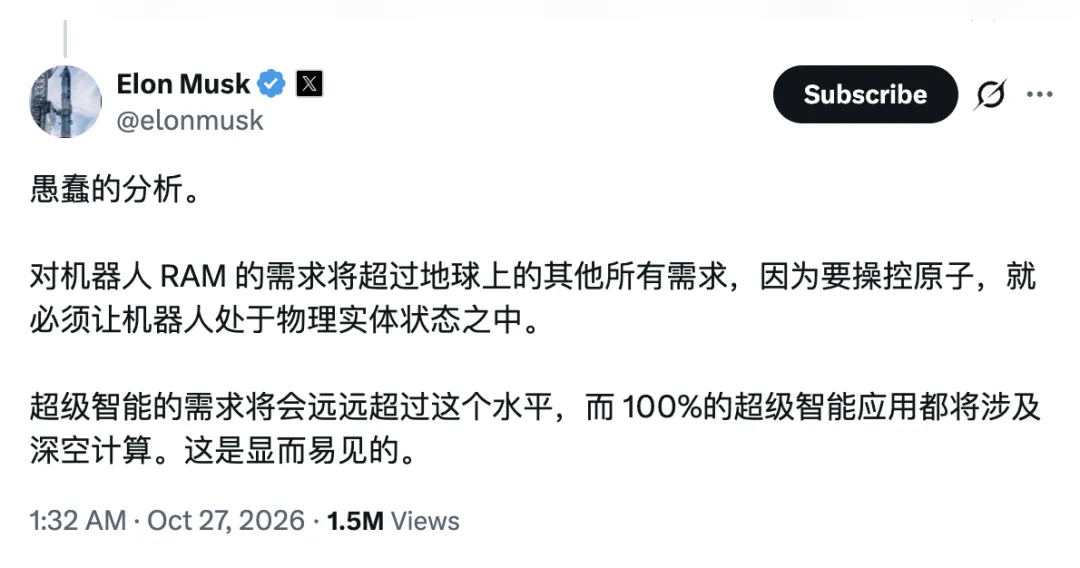
In his view, robots are going to "shape atoms" in the physical world, and in the future, they will eat more memory than the sum of everything else on Earth.
The market is also betting on real gold and silver. On October 28, the human-robot concept stock once surged more than 5 percent. On the same day, brokers reported that Optimus had begun prototype production.
However, in the heat of the moment, a problem emerged that gave robots such a large amount of memory that they would actually "long-term memory".
The answer is that most of robots on the market today will never eat a dime. The smartest day of their lives is when they leave the factory.
It "read the book" in the lab and walks into factories, shops and homes with a well-trained model. Day after day, it encounters an unprecedented situation in which most of its robots are "graduating at their peak".
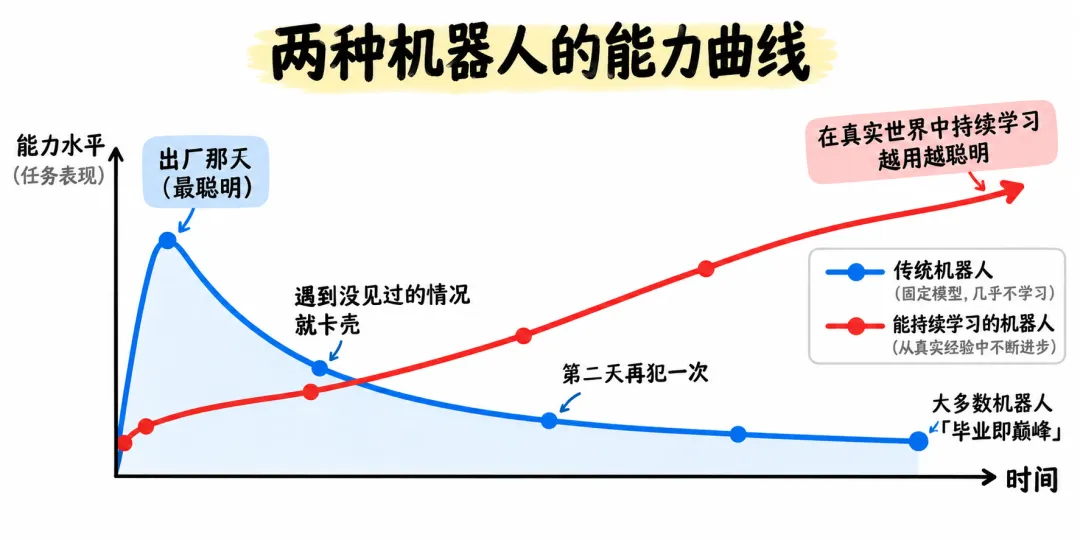
As Xiang pointed out at the conference, the theme of physical intelligence in 2026 is no longer "will not be demonstrated" but "can not be deployed".

On 29 October, Xi'an was officially released.GO-3 PreviewThe goal is to end the plague!
GO-3 Preview is a pre-training, post-training, post-deployment model for full-link scaling.It's time to get to the top of robots like RoboDojo, RoboTwin, and RoboColiseum!
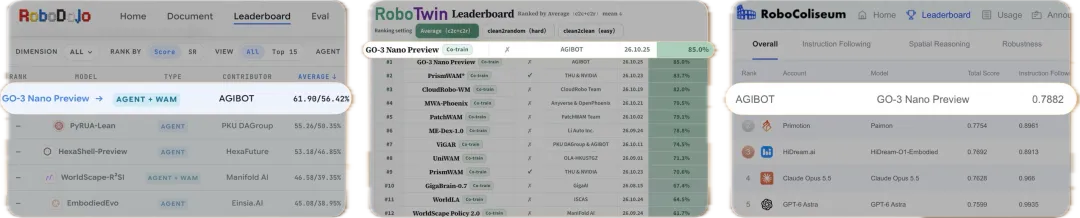
The GO-3 Preview is expected to be fully available by the end of the year.
From now on, robots are no longer trained to go to work.It's about working and getting stronger.。
From GO-1's first ViLLA architecture, to GO-2's first "action thinking chain", and to today's GO-3, Chiu extends the "power of scale" from the training phase to the real world.
The result is that robots can open up hundreds of tasks, some of which are difficult to operate at or above human levels, and continue to accumulate experience and self-evolution in real work.
Physical intelligence in 2026: Everyone is looking for their own "Scaling Law".Big language models run ChatGPT based on "stack data, stack parameters, stack computation".
In the face of the end of data depletion, the big language model circle has already begun to save itself.
Since humans can't write more, more high-quality content, it's based on reinforcement learning, self-hypnosis, testing...
As long as there is enough computing power, intelligence is like infinite scaling, it's hard to reach the limit.
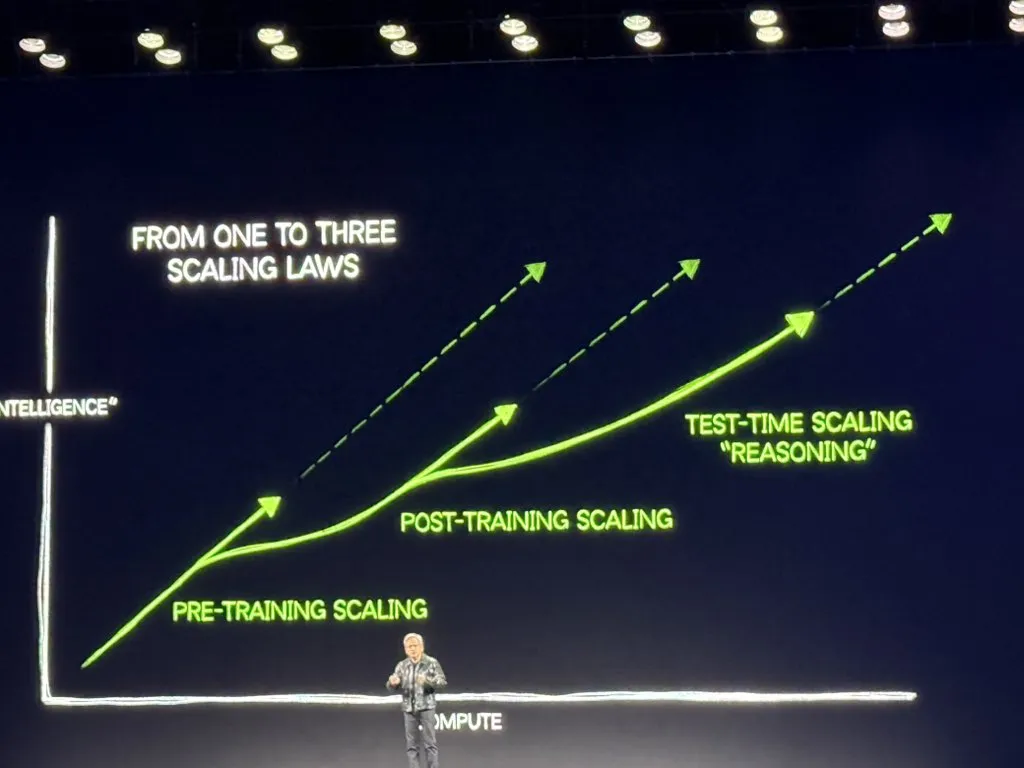
You look at all kinds of cutting-edge reasoning models, you look at all kinds of Agent Harness, language models are starting to evolve, RSI is starting to show up, and super-intelligent ASI indexes are on the way.
There is also a trend towards a body-smart model:
Pre-training began with measurable laws across data scales and the ability to "learn from a demonstration".
The focus of post-training has shifted from "exercising" to "practice saving".
After deployment, learning can be closed-looped on the real machine, but it is still not free of artificial intervention.
This year's most troubling issue in the world of physical intelligence, says UC Berkeley professor Sergey Levine, co-founder of Physical Intelligence:
"The key is not scaling, but finding something about scaling".
The GO-3 Preview option combines the three routes of "pre-training Scaling", "post-training Scaling", and "post-deployment Scaling".
Especially in the RoboDojo robotics arena, the GO-3 Preview pressurized large models such as the GPT-6 Astra.
The first is to build a solid foundation, where robots are highly dependent on the general ability to move.
Why not?
Because the real world is full of variables.
If a robot is stuck in a lab with only a few cups of clutter, and once it switches to a real convenience store and encounters unseen lights, backgrounds or new packaging, it will instantly crash the machine. Only with the general ability to interscene, inter-object, can a robot really leave the lab.
To achieve this universality, the GO-3 pre-training was simultaneously amplified around two dimensions:The dataandModels。
To support this path, and break the bottleneck of data depletion, Xiao has built an end-to-end loop from data to intelligence, officially launching the industry's first systematic, multi-million-scale machine data set, AGIBOT WORLD 2026, which covers the entire field of research.
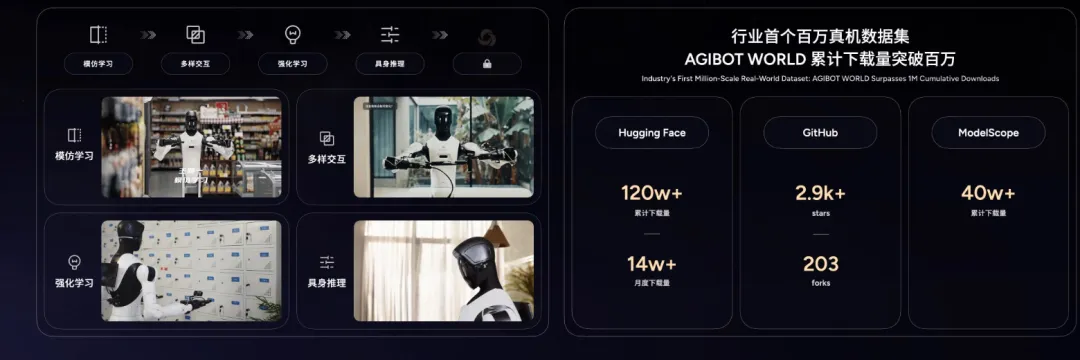
He designed the World Reasoning Action Model (WRAM) architecture specifically designed for pre-training Scaling.
Its biggest breakthrough was to unify the three things of "understanding mission-building and predicting future-building movements" into one line.
Specifically, the underlying logic of WRAM is supported by three core mechanisms:
(1) CoAE, a control-oriented visual encoder;
(2) Single-step visual planner SVP;
(3) Knowledge-based selective optimization of KASO.
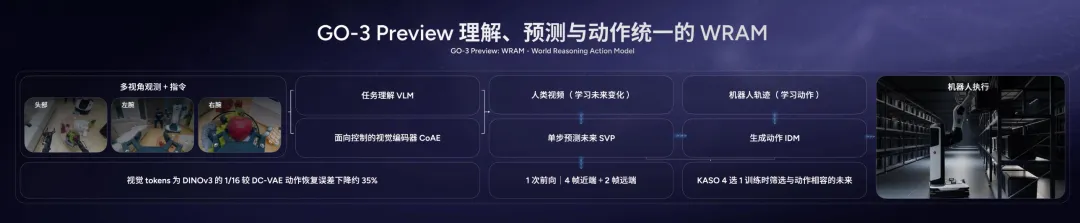
Not only do robots need to "see" objects, but they also need to know how to "control". CoAE is able to extract control-oriented visual representations to provide the basis for future predictions and motion generation.
It accurately captures the location, shape, and relationships of objects, closely linking "the world we see" to "how robots should behave".
SVP can "generate a complete future one step at a time", meaning that robots have learned to "think and go backwards".
The SVP predicts the next change step-by-step based on the current observation and mission instructions, then moves the generating module to learn how to get from the current state to the "prediction state".
In this way, mass-produced human videos provide the robot with a common-sense experience of "how the physical world changes", while the robot's actual trajectory data link these changes to specific actions.
In the real world, there are often multiple approaches to completing a task (e.g. left-handed grip and right-handed grip), which means that there are multiple reasonable "futures" in the same scenario.
The role of KASO is to select candidate outcomes that are more consistent with actual actions in training, to better align future predictions with the training goals generated by actions, and to prevent robot actions from being "averaged" by multiple possibilities.
Thanks to the strong underpinnings of WRAM, the explosion of pre-training capabilities is directly reflected in the actual combat performance:
In the face of the massive new mission, GO-3 is the main player.It's the first time that I've ever been able to do this.It's an unprecedented scene, it's an object, it doesn't have to be an open box; it can be used in the face of more subtle living things.Few-shot ((small sample fine operation)It's just a matter of seeing how many times you can get it.
For example, a fine-tuned GO-3 can accurately handle, position and insert Lego parts.

After crossing the body, the robot can also perform high-difficult complex operations such as opening two-handed doors, kneeling and picking up objects.
 After-training Scaling: Trials and Tribulations based on Genie Evolver's "Three Engines"
Read a thousand books and walk a thousand miles.
Pre-training gives robots common sense, but many of the finer physical contacts can only be learned through practice. The problem is that in the pure-physical world, trying to make mistakes is too expensive, and in traditional ordinary simulations, real physical contact feedback is not learned.
Xi'an's response was a powerful post-training infrastructure boom.Genie Evolver。
It has completely abandoned the confines of a single environment and has built up a system that is based on"Real machines, physical simulations, models of the world".After-training paradigm for the three mainline engines.
World model engineIt is responsible for providing the "imagination in the brain", launching a variety of possible motion branches and visual dynamics in the cloud, allowing robots to crawl back into their minds and "what would happen if they changed a move".
Physical simulation engineThe world model compensated for the lack of precision force, providing high-precision rigid, flexible contact feedback, and ensuring that the robot's movements were not only "looking right" but also "mechanically reasonable".
The real engineAs the ultimate test piece, the latest physical data collected in the real world will be fed back to two other engines in real time, ensuring that cloud practices are always aligned with the real physical world.
At the bottom of the algorithm, Qi introduced the "FERT experience retrieval mitigation of failed guides".
This algorithm is incredibly ingenious: when a robot fails to perform a task (such as plugging, assembling) it doesn't learn the actions of the failed one, but instead uses the situation before the failure as a "query word", goes to the pool of "successful experiences" shared by the entire machine community to retrieve the most relevant success trajectory segments, and dramatically raises the sampling priorities of those segments for monitoring training.
In other words, successful experiences provide "what action to imitate", while lessons learned from failure determine where robots currently need to "focus on reviewing".
In five real-world task tests of plugging, folding clothes, charging cell phones, mounting cabinets and packing cell phones, FERT increased the average success rate of robots from 81.0% at inception to a staggering 97.3% and relatively reduced the average failure rate to 86.0% without collecting any additional human expert samples at all.
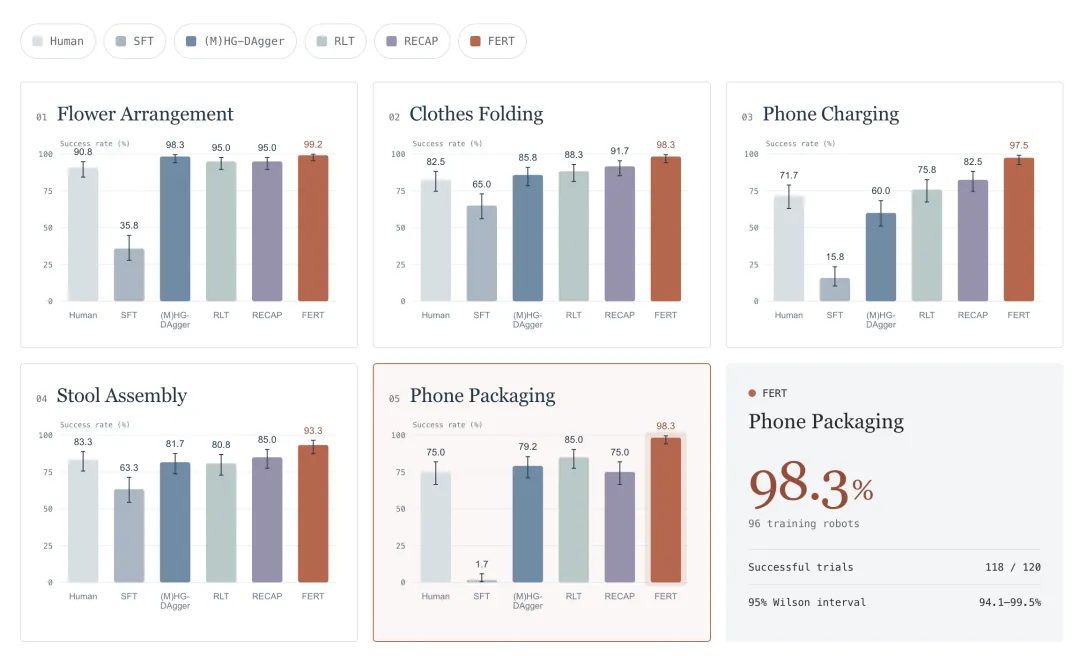
With the addition of CEL, the real-time machine environment Scaling expanded the group experience, allowing a surge in the reliability of complex tasks, such as phased-in multi-phase long-process task failures in mobile phones, significantly reduced by 92%, and the success rate of clothing-form controls increased from 85.8% to 98.3%.
Global Model Environment Scaling traces its roots back to the science of accelerated real-machine learning:
1. Experience tracing tree searchRather than wasting computational power to re-run the same start, concentrate the firepower to explore key intersections.
2. Assessment of tree structure valueIt is not necessary to add additional training to a complex value network, which can be used directly against the outcome of different branches under the same starting point.
3. Physical alignment during testingIn order to prevent robots from becoming "more abstract" in world models, the system uses the latest real-world data from robot manipulation to modify the physical dynamics of world models in real time using LoRA + DMD.
When robots can independently accumulate experience in deployments and duplicate the same set of capabilities, marginal costs will continue to decrease, which is a key prerequisite for physical intelligence to scale.
With the conversion of these three engines, the robot's training scale is no longer limited to the number of actual machines.
Whether it's "pulling blocks" that require fine-grained feedback, or "desk freezes" that require extremely strong hand sensing, robots can, with the help of the Genie Evolver, practice extremely high strategy reliability at extremely low cost, even improving their online performance for the first time in four hours over the human average, and pulling blocks achieves five consecutive pulls and stability.
After the deployment of Scaling, the real "no one rings" continued to evolve.If post-training is the "training" prior to addiction, the most distinctive part of GO-3 is Scaling after breaking the "graduation is peak" deployment.
On October 27, Xiao officially released the Agent Framework.Genie MasterIt solves an industry pain point: by following robots manually to change their code, retrieve data, and land only a few steps away; robots must learn to "advance, unlock new skills" in real-life business scenarios.
This is the first time the industry has jumped out of simulation environments and laboratories, running a closed loop in real-world business scenarios, verifying the Physical RSI.
To build a bridge from "discovering problems" to "solving problems", Genie Master has designed critical interfaces.EEP (Personally Enforced Protocol)。
The EEP gives the Agent a clear idea of what robots can do and how to do it, and fully integrates upper-level reasoning and lower-level execution.
In this framework, the robot learns to "eat a bite, eat a bite" through two complementary routes.

1.Harness the RSI (having experience repeatable)
In real-life convenience stores, the robot initially had a low success rate of hanging merchandise on the shelf. After a failed record, Agent tracked down the reason: the head camera's resolution was insufficient, and it was overshadowed by the label.
This non-artificial "follow-by-memoir" will weigh down failed lessons for long-term Prompt and memory rules.
2.Policy RSI (Capacity Learning into Parameters)
When outsourcing, the robot's claws are easily held up by white plastic bands. The agent guides the claws to be collected and retried. These real anomalies are captured and recovered data that, after processing, flows directly back to the bottom to be trained in the action strategy.
This means that this correction error is no longer just a hint of staying on the surface, but actually solidifies into a model-weighted muscle memory.
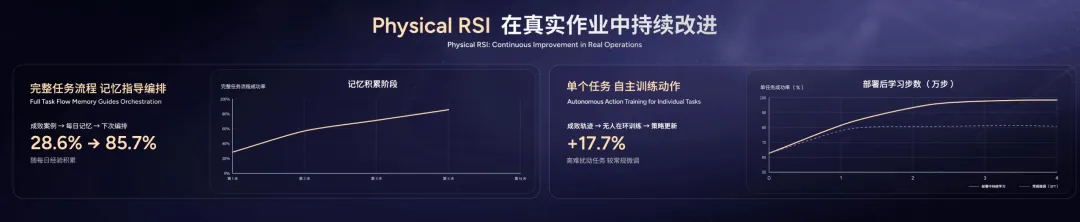
Thanks to the continuous improvement of the Physical RSI, real work experience after deployment can be replicated. Throughout the entire task process, thanks to memory-guided editing, the success rate has increased significantly from the initial 28.6% to 85.7%; while the single-task success rate has also increased by 17.7% under the no-person update strategy.
On 2 November, Xiao will launch a 24-hour convenience store live broadcast, with six G2 robots continuously taking "transfer checks" to test their true levels of resistance to stress, stress and continuous evolution in a no-man's-land.
What does GO-3 Preview mean for the industry?The difference is obvious when you put together some of the most representative players in the industry:
From this table, you can read the three-tiered industry implications of GO-3.
First, it pulls "Scaling" from a point into a line.
The ability to do so depends not only on how much data is coming out of the factory, but also on the entire link: from pre-training to rollback brainstorming to physical RSI in real life.
Second, it gave the world model a lighter, more landing-ready form of real warfare.
Combined with the Rollback's tracking mechanism, the World Model is no longer a mere "player", but a "simulator-driven engine" that is truly involved in strategic evolution.
Third, it rewrote the definition of "data".
In the past, physical intelligence was the most expensive in high-quality remote-operation demonstrations. In the system of Chiang Kai-shek, human video, failed trajectories, projections of world models, and even a water bottle knocked over in a convenience store are all data.
The most natural, continuous source of data is the real work after deployment.
For the domestic market, this is particularly important. China has the world's richest manufacturing, logistics and retail scene, the more robots are on the rise, the more backflow experiences, and the faster models evolve.
The age of "lifelong learning" for robotsIt brings together representative players from the industry to learn the far-reaching industry implications of the system.
Some people have achieved extremes at a certain point, while others have passed.GO-3 Preview (pre-training) Genie Evolver (post-training) Genie Master (after deployment)In addition to this, it is important to ensure that environmental co-operation is fully implemented in three ways:
Pre-trainingEstablish a cross-scenario basis for generic capabilities;
Post-trainingThe strategy's reliability has been dramatically improved through large-scale trials and errors on three engines: real machines, physical simulations, and world models.
After deploymentThrough the Agent framework, experience continues to be accumulated and reused in real-life work in a no-man's-land.
The ability to do so no longer depends on how much data comes out of the factory, but on how fast the entire link moves. In the past, high-quality remote-operation demonstrations were the most expensive; now, human video, the projection of world models, and even a water bottle in convenience stores are all evolutionary nutrients.
From GO-1, GO-2, to today's whole chain-scale chemistry studies, Chiu has come up with a clear enough and bold enough judgement.
The improvement of robotic abilities should not only happen during the training phase, but also in every real job.
Humanity never stops growing on graduation day. From now on, robots will not be needed.