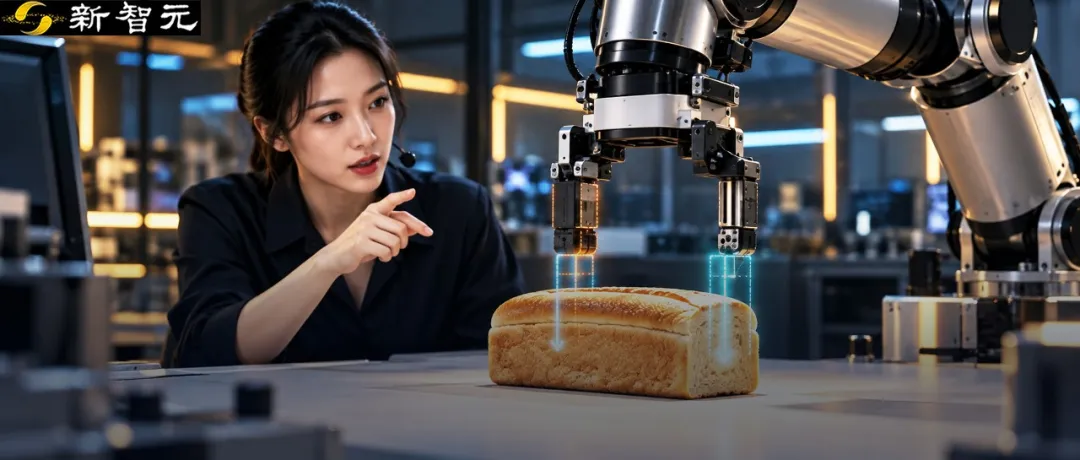
It's the first time in the history of the world.
A common piece of bread, changed posture, can often be difficult to knock down a "learned" robot!
When training, the bread is usually baked;
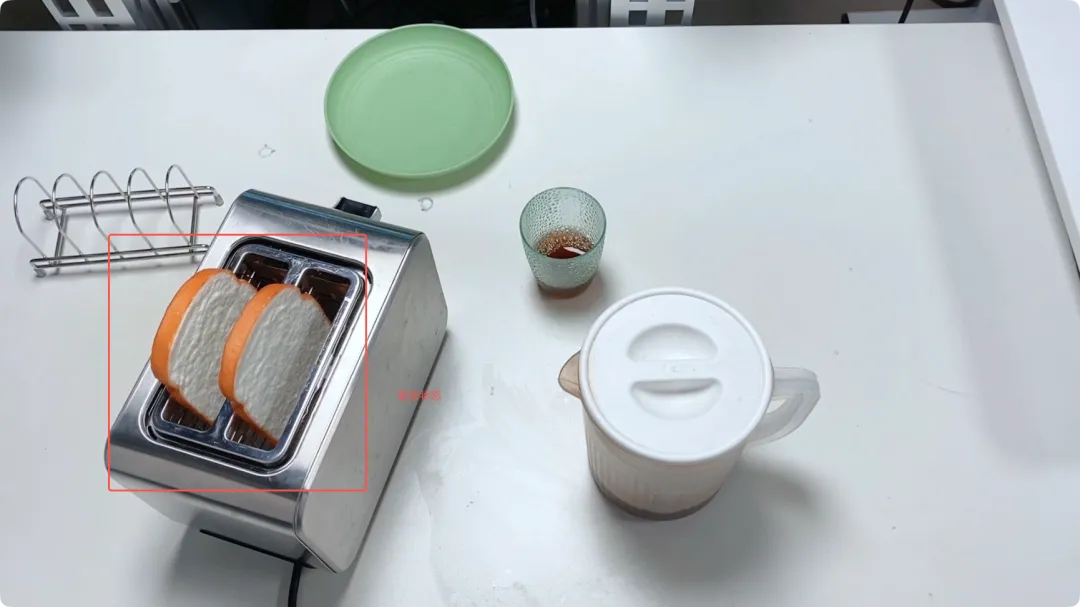
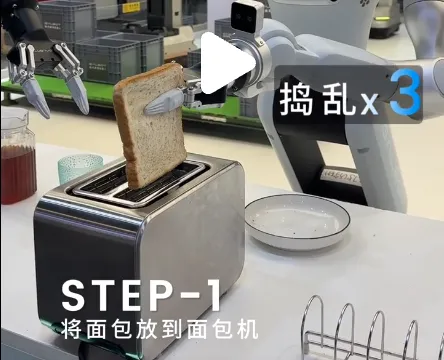
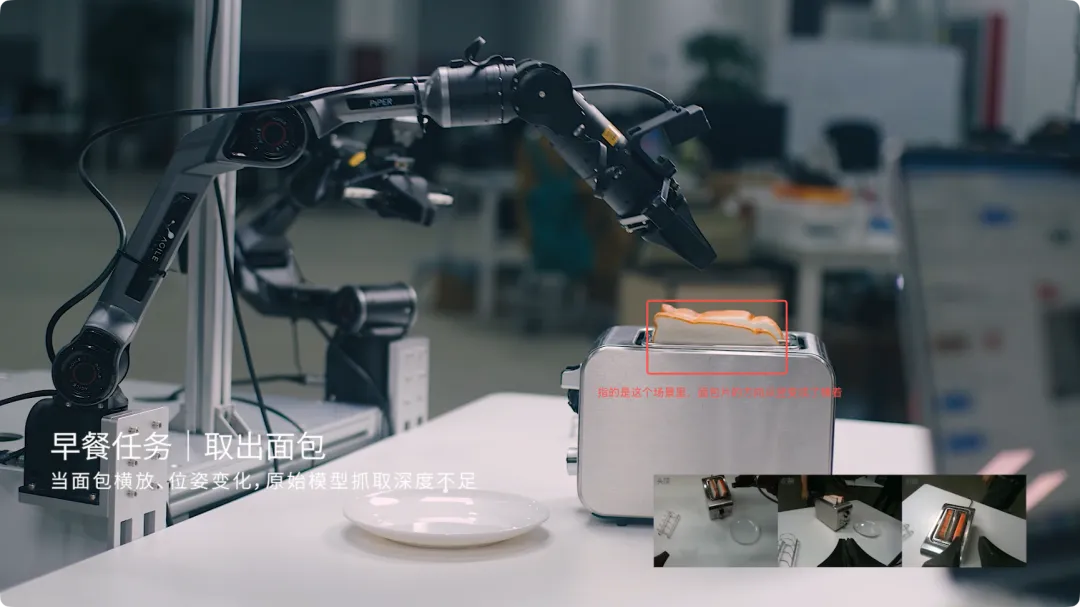
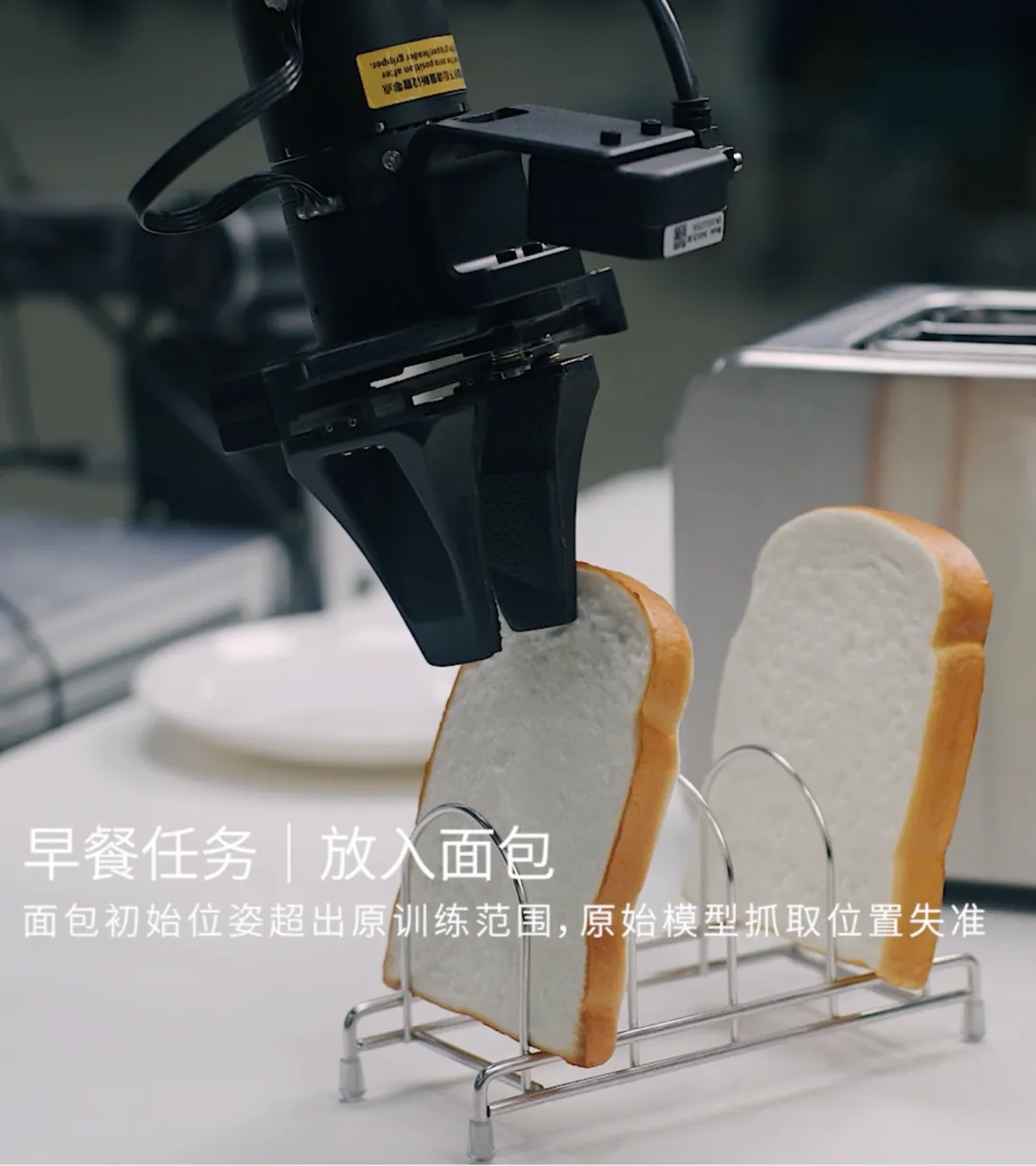
If the bread is passed, the mechanical arm can clearly recognize and grasp it, but it is always so far away that it is difficult to solve the problems that children in kindergarten can easily solve.
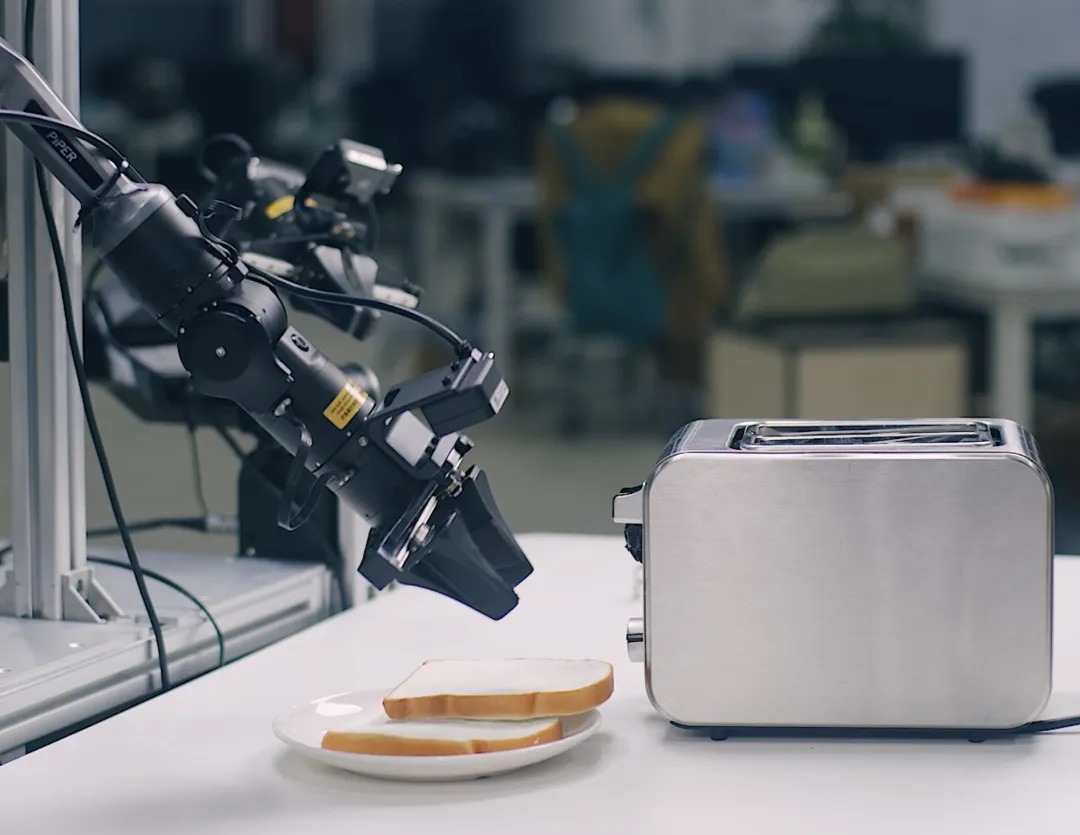
In this "side-bread" test setting, the original strategy model has only a 5% success rate.
It's not that it won't -- grab, move, place, all the skills are there, but this time the starting position has gone beyond the training distribution (OOD, Out-of-Distribution), causing it to "be biased".
Do you want to re-collect demonstration data, increase training? Not only does it require additional time to invest, but it is also a huge burden on computing skills.
What is even more troubling is that the "black box" characteristics of the end-to-end model make it difficult to really explain where the problem lies.
The good news is that the latest answer given by Geek+ with physical intelligence to the question of "you already have the ability to do a task, but you've taken a step forward".You don't have to go back to the boiler to fix the robot's local action bias!
Recently, AI has been launched under its Gravity Physical Intelligence framework.Gravity Control Causal Interference Models。
It goes deep inside the black box model and finds those characteristics that are really "holding the steering wheel", adjusted directly during the reasoning phase.
When faced with out-of-distributed tasks, the operator only needs to give a natural language cue (such as "go deeper when grabbing bread") and the robot can change the actions of the runner.
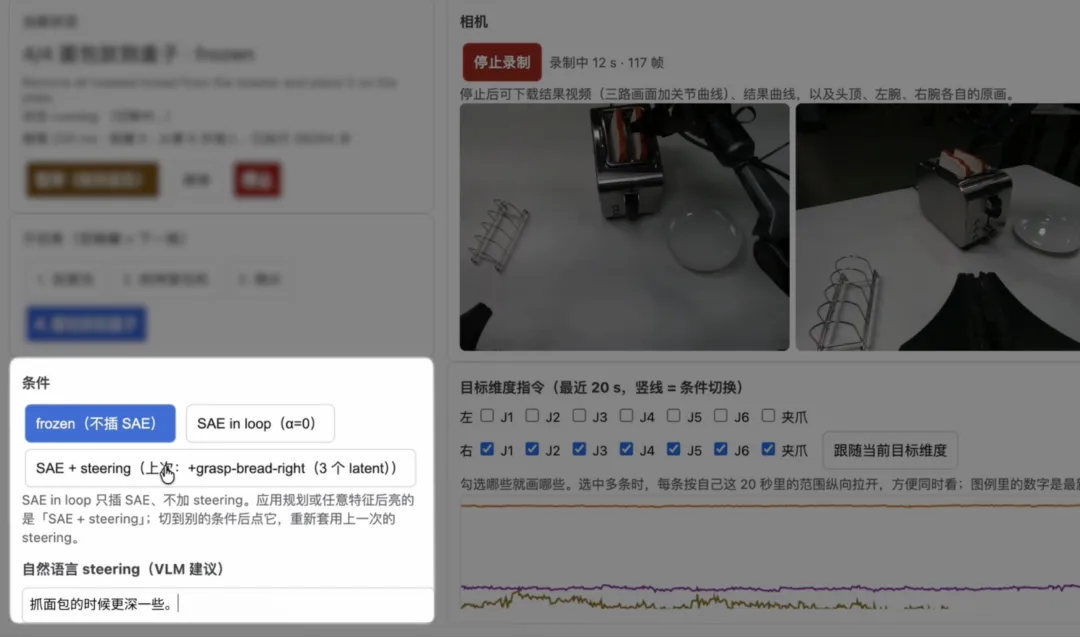
As a result, the overall success rate increased significantly from 17.5% to 87.5% in real out-of-distribution complex operational task tests, where the single OOD set of the horizontal bread was directly increased from 5% to 95%!
Behind this group of surprising numbers, there is a change that deserves industry-wide attention.
This is the first time a robot has corrected this error with an explanatory, verifiable, constrained runtime path!
"The last centimeter" is the "last centimeter".Over the past two years, progress has been made in body-intelligent models, but the real physical world has never come out of the box by training.
Many failures do not come from "absolutely not", but from "a little bit".
This kind of local bias is the most tormenting.
For the deployment side, it means: the site can't stop, the problem is unclear, only the data can be uploaded back and wait for the next version of the model.
So the question becomes: Is there a more direct, verifiable way to correct the deviation of execution within the model's already capable range?
The core findings are that the characteristics of "calling names" are not necessarily "commanding actions".In order to correct biases in reasoning, one basic question must be answered:Among the thousands of high-dimensional expressions hidden inside the model, who really controls the movement?
There is a common misconception in the academic community that if an expression can be decoded for semantic concepts such as "grabbing down", it must be guiding the behavior of robots.
But the findings of the team gave this intuition a bowl of cold water.Relativity is not equal to causality.
Studies have found that many expressions of the linguistic layer that are highly sensitive to objects or instructions, played by "interlocutors" in explaining how it moves to the mechanical arm, make little real contribution.
The "player" who really drives the end-user gesture, claws open and moves with the speed, is highly focused on the movement expert level deep in the chain of motion generation.
To clarify the path of action, the Poitiers team formalised a conceptual chain of attributes, a characteristic that must be linked in five ways:
Faithful (accuracy) → Motor Aligned (mobility alignment) → Verified (generalization verification) → Causal (causal control) → Safe (closed loop security)
The results of the experiments reveal a disruptive phenomenon: linguistic features are often disconnected from the transmission chain at the "movement alignment" or "generalization verification" link.
The name sounds like it has something to do with the sport, but the physical movements are not moving at all. Only the characteristics of the professional level of the sport can be fully integrated.
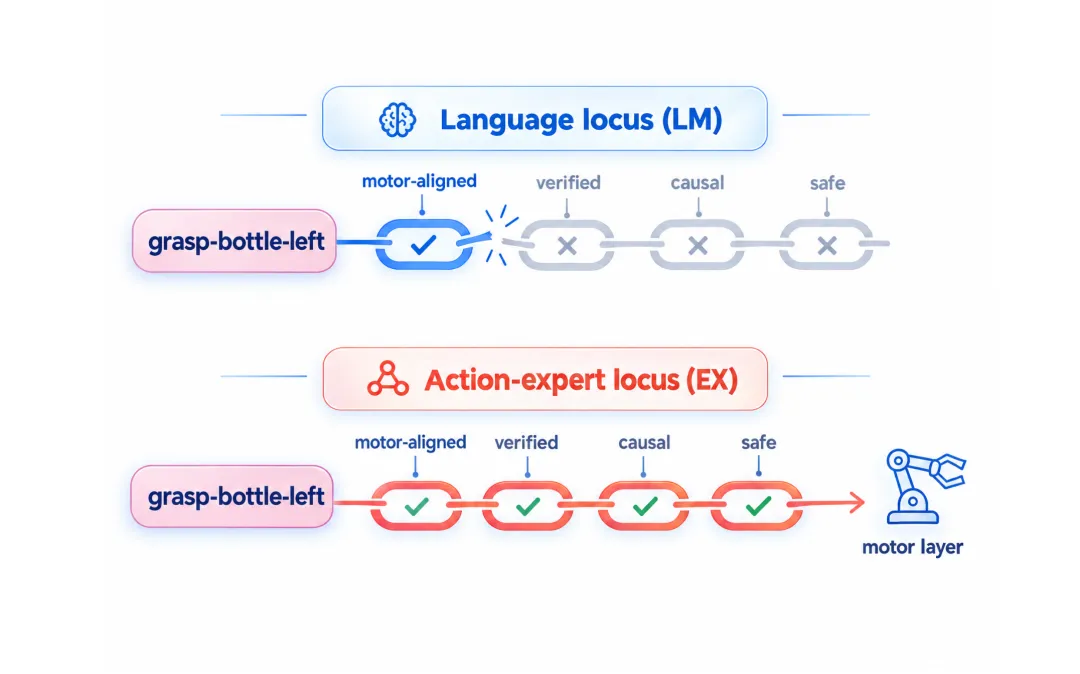
The breakdown of this discovery is that it completely separates "explicable" and "controllable".
A lot of explanatory work has been done on "naming features", while Gravity Control adheres to a stricter standard:If a feature has control, it should not be looked at what it's called, but rather whether the action after the intervention responds as expected.
Gravity Control: Accurately locking the "control handle" inside the modelBased on the above findings, Zhijia built a completely new Gravity Control model.
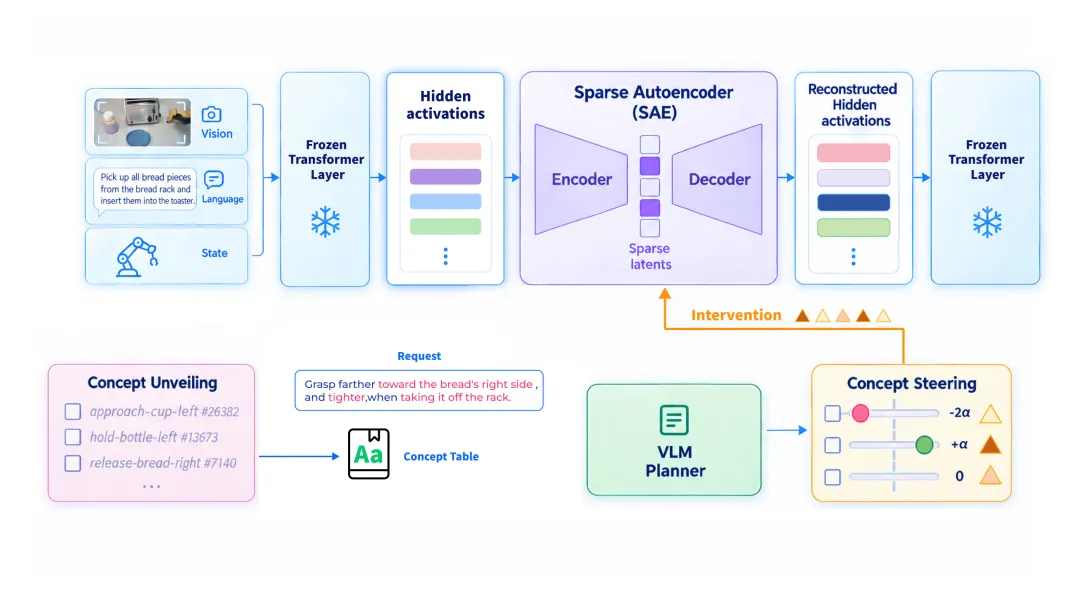
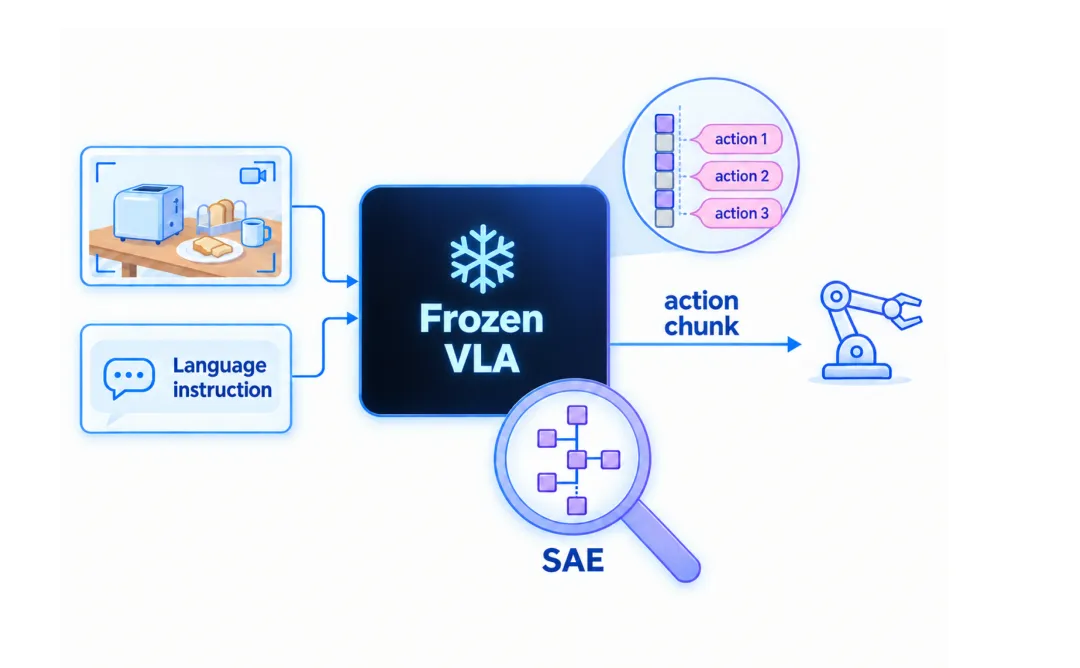
Overview of the model framework for Gravity Control
The way it works can be summarized in three subtle steps:
The first step is to remove the rare features found.Under the premise of freezing the original model skeleton, modules such as Top-K SAE (smaller than the encoder) were introduced into the residual flow, activating the high-dimensional hiding into a sparse decomposition to extract a human-interpreted Latent Feature.
The second step is to introduce a "causal-oriented" intervention.Real physical responses to the characteristics of the completed semantic marking by directed causal intervention (enlargement or suppression), followed by observation of position, rotation, claw-like movement channels.
The third step is the "specific evaluation".Introducing an intervention specificity assessment, only keeping the direction consistent, the dose response monotonous, the effect focused on the characteristics of the target movements.Control the handle。
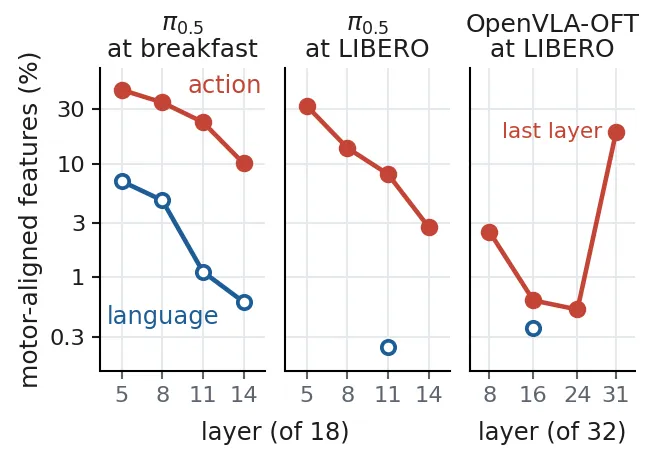
π0.5 differs from OpenVLA-OFT in proportion to the number of available features obtained after inserting the SAE in different layers
Compared to past industries where models can only be passively "read" via feature activation, Gravity Control has really opened up the full loop of Interpretability → Intervention → Control.
This is what causes interference by using white boxed, explainable thinking.
It's a simple, straightforward "microprocessor" move.After finding the control handle, there is a more engineering question: how do people use it most conveniently?
Of course, people talk!
Traditional end-to-end models only accept macro-mission-level instructions such as "putting bread in a plate".
However, macroscopic instructions do not naturally provide stable control over local movements such as grasping depth, wrist angles.
Gravity Control will build a language-guided action-adjustment link based on an established conceptual control table.
When the robot has deviations, the operator sends out a natural language cue that the external VLM planner does not need to reprogram the entire trajectory, but instead retrieves the characteristic vocabulary in the concept table and activates the online adjustment directly from within the original model.
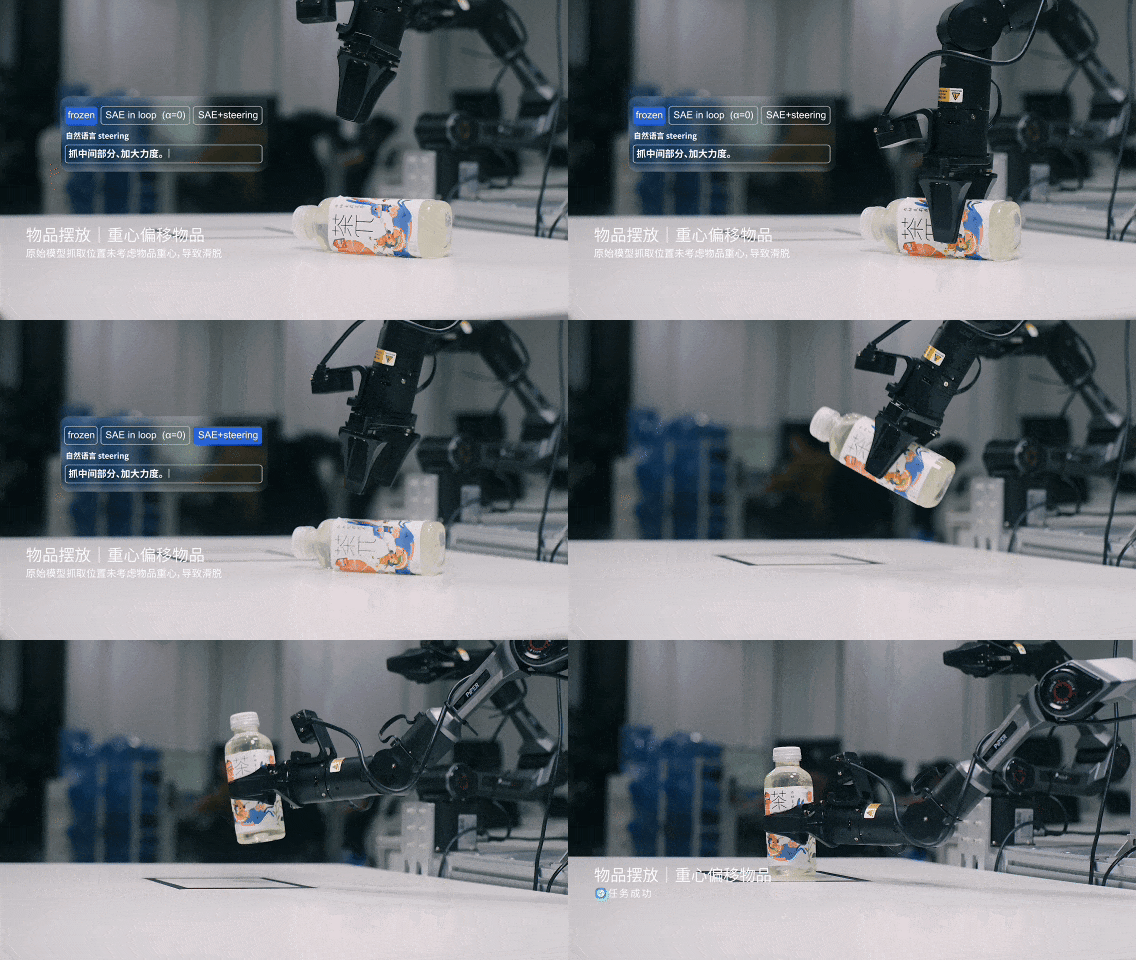
At the same time, the system introduced closed-loop controls, setting limits for the degree of intervention, to ensure that the regulation works only at specific geometric freedoms and does not cause catastrophic scattering movements due to "excessive force".
In other words, the adjustment of the previous step will not affect the next step that could have been completed exactly.
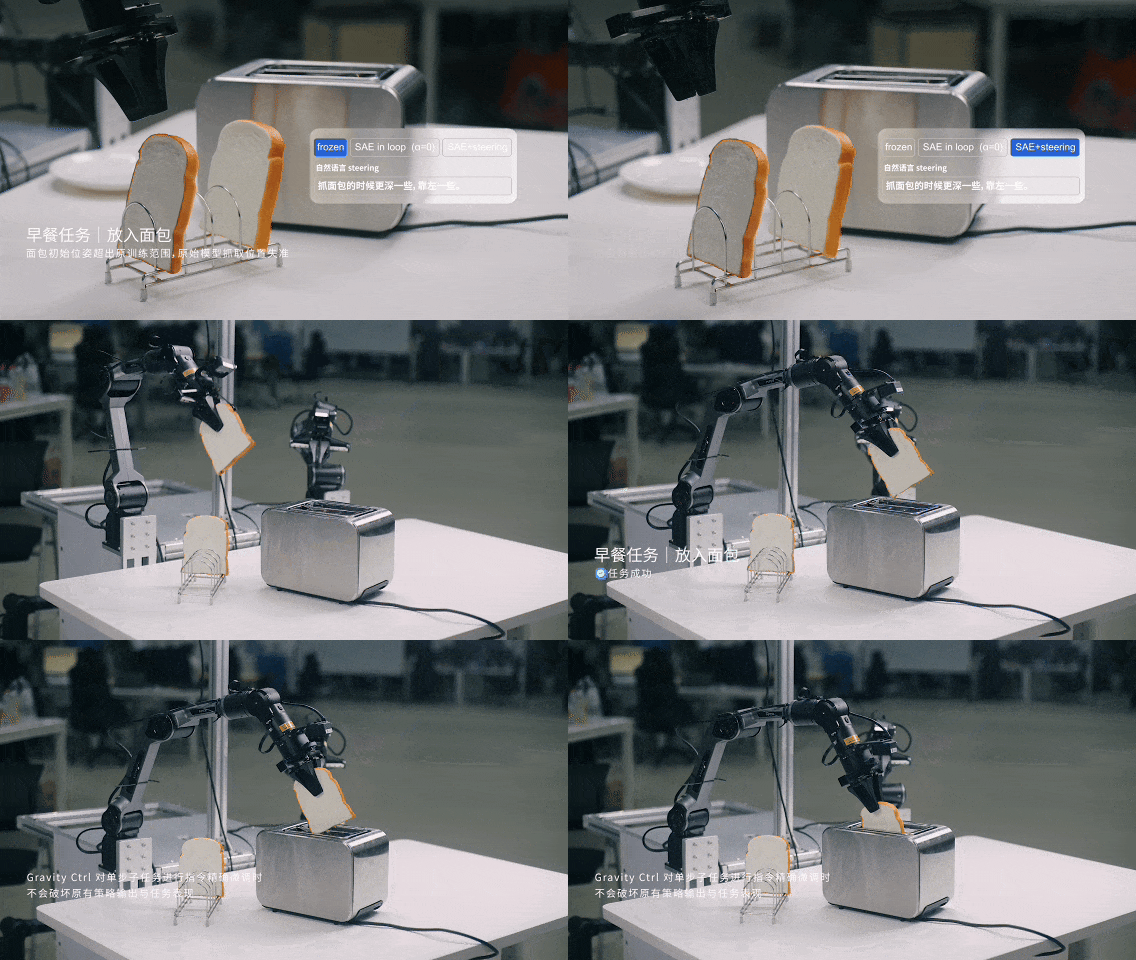
The ability of robots to execute tasks according to natural language instructions is already a feature of many VLA models.
The most critical advances in Gravity Control are: how to correct "grabbing a little deeper" when a robot already has the basic ability to complete a task, but a deviation occurs in its execution, and transform it into a validated, constrained set of movements within the model, correcting the deviation without updating the original strategic weight.
In addition to breaking the boundaries of capability, correcting bias is also crucial.If you take a look at the hundreds of competing global body-smart racetracks, you'll discover an interesting phenomenon.
The main battlefield for the vast majority of the main players is to "get more robots".
And "What's Happening Now" is still a hard bone that few people have attacked in the system.
Category 1: Ability to push the boundaries of what to do.
This group represents the mainstream narrative of the current model.
Figure AI launched Helix 02 in early 2026 and subsequently demonstrated the ability of robots to run eight-hour shifts continuously under full autonomous control; its Index pre-training will increase the success rate of zero samples from about 9% to 56%.
Google's DeepMind released Gemini Robotics 2 and the RT series, which feature full-body control and multi-machine collaboration.
Invidia has open-sourceed the 3 billion parameter Isaac GR00T to provide fine-tuning workflows for different robots;
Skild AI is aimed at "a brain that controls arbitrary robots".
These efforts together significantly broaden the boundaries of capability.
However, when local deviation occurs in specific deployments, the mainstream remedial method remains the "black box mode": back to the data, retuned to GR00T, the standard landing path itself being the "basic model + scene mitigation".
Category 2: Reliability of deployments using mass real-time
This group is most representative of the Tesla Optimus.
Musk admitted that Optimus hadn't done a really useful job in the factory, and that precise operation was still a problem until production increased recently.
They rely heavily on large human remote operations teams, and once they encounter poor performance in new environments, the practice is to retrain "stacks of data".
Similarly, Agility Robotics' Digit models data breastfeed through over 65,000 hours of cumulative operation.
Apptronik has set up a huge test site dedicated to collecting data.
This method is effective, but extremely expensive, to improve the reliability of aluminum in units of "month" and "thousand hours".
Category 3: Correction of Misconceptions exploring a new paradigm of "failure recovery"
This is the area closest to the Gravity Control vision.
Physical Intelligence's π0.6 proposes the RECAP method, which combines proofreading, expert correction and independent experience with reinforcement learning, as the benchmark for "learning from mistakes".
1X Technologies' NEO uses "Expert Mode": missions that are not encountered are taken over by remote human experts, VR, which is essentially "human-to-robot".
Academics (such as Stanford, Berkeley, and others) have begun attempts to directly direct robotic behavior through internal representations of VLAs, proving that "without changing weights, behavior can also be modulated" is technically feasible.
It's like this.The leadership and unique ecological status of UltraGravity Control is very clear.
It accomplishes four "do it at the same time" goals.
1. Zero weight updates and zero additional data:Instead of training the error correction cycle, the correction cycle will be compressed from "day/week" to "one sentence".
2. Complete system of verification of causes:Through a conceptual chain of attributes + peculiarity evaluation, the academic community's exploration of "power modulation" progresses to engineering landing standards that are "controllable and safe".
3. Natural language interface and closed door control:There is no need for the operator to wear VR hands-on demonstrations, while there is a dose limit to keep the safety limit.
4. Improving the quantity of real-machine OOD tasks:The single success rate jumped from 5% → 95%, which is extremely rare among intervention outcomes in publicly disclosed similar operations.
It's even more remarkable that the problem with this technology is that it's defined from real industrial work, not laboratory work.
At present, the company's business covers more than 40 countries, with more than 1700 projects, and faces extreme reliability requirements in high-frequency scenarios such as storage selection, multiple SKUs, lighting changes.
In the phase of moving from demo to productivity with physical intelligence, the Gravity framework is a solution to the puzzle of "the high cost of post-deployment generation".
Experimental testing: Success rate of 17.5% → 87.5%This set of techniques not only highlights the results, but more realistically, it does not bind to any particular underlying model at all.
At present, it has completed evaluations on representative VLA architectures such as π0.5, OpenVLA-OFT, LIBERO simulation benchmarks and physical robot platforms.
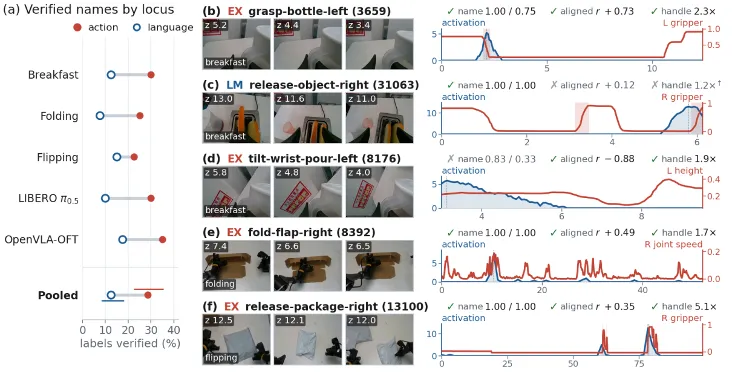
Naming and Control Come Apart phenomenon
If you look at the test data, you'll see how much this improves in real-life physical robot OOD tasks, where the overall success rate for non-distributed tasks such as bread rolling jumps from 17.5% to 87.5% without completely updating the original strategy weights or adding new demonstration data.
In particular, the above-mentioned "sliding bread" test, the success rate increased from 5% to 95%.
Using natural language online to correct the entire workflow of virtual robots
If the same improvement were to be achieved by using complementary data-minimization methods, how much more training and conversion time would be required?
Of course, it must also be seen objectively that this scheme is not a "non-biological" magic. Its positioning is clear: it is a "correction" rather than an "enlightenment".
The premise is that the robot itself must have this basic skill, just because a slight change in the scene (such as something being twisted) causes the movement to go off, it can turn the deviated movement to "pull back".
It is unrealistic to expect a whole new technique to be used directly to teach a robot.
But if you've done real commercial deployments on the front line, you'll see that it's precisely this tiny bias of "you're going to do it, but you're not going to do it in any other way" that's the most human-consuming hole on the ground every day.
If we can solve this problem at a low cost, we have solved most of the landing problems.
From righting mistakes to Skill: Making righting mistakes the starting point of evolutionReturning to a real flexible manufacturing or storage site, the value of Gravity Control will be infinitely greater.
A workstation faces hundreds of thousands of SKUs every day, randomly arranged and packaged. Even if only 1% of the moves go wrong, thousands of times a day are grabbed, and dozens of artificial interventions are performed. For customers, the real cost is every day after deployment.
Gravity Control points to two layers of longer-lasting system value:
The first layer is automatically corrected.
In the future, Gravity Control can access the upper-level Agent or AI native system suite. The system directly acts as a "monitor", detecting the state of the task in real time, detecting the state of the task, diagnosing the deviation of the motion, and actively calling Gravity Control, correcting it.
The second layer is the experience of immersion and reuse.
A successful correction is by no means "read-and-burn". The system can record the task phase, the scene state, the Control Handle being called and the intervention dose, so that it can be deployed as a replicable Skill.
From error-correcting to Skill, to evolutionary silicon gravity control to self-contained error-correcting systems and ability to accumulate, it provides a clear engineering path.
Written at the endNow, the ability curve of physical intelligence is still rising rapidly, but the real world doesn't just reward "will do", it gives you a trickier question: "What's wrong?"
Gravity Control's answer is that once a model has the basic capabilities, it doesn't have to go back to expensive data factories every time.
As long as the internal characteristics of real control are found, precisely regulated in a natural language during the reasoning phase, the closed-loop control can be used to guard the security boundary, and every successful correction of the bias can be turned into an experience.
For researchers, this proves that "concepts can be interpreted ≠ behaviors can be controlled"; and for industry, it means a real account: the cost of running and minimizing robots after being deployed in the field is finally hopefully coming down.
The success rate of distributing complex operational tasks has risen from 5% to 95%, possibly just a stepping stone. What's really exciting is that what used to be extremely expensive and time-consuming, like opening a blind box, for a robot to "correct" has finally become an ability to understand, handle, and accumulate.
How to turn a smart Demo from a cool demo into a really useful productivity tool?