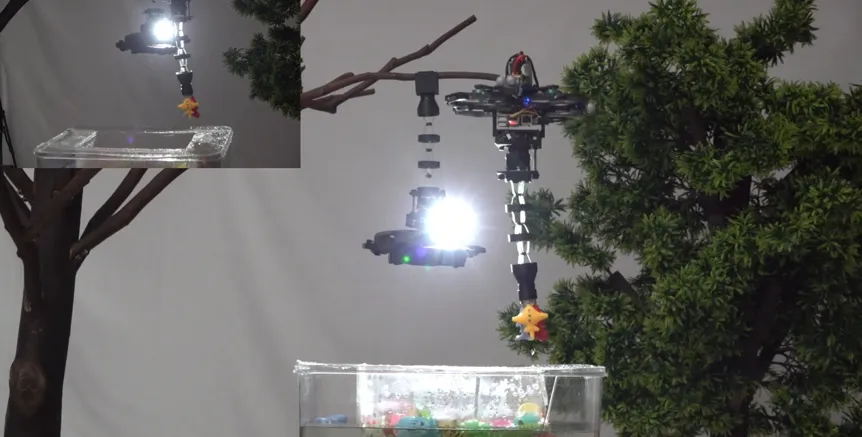
“ The problem of solving the old problem of unstable flying robots.
Quad flying robots can fly and shoot, but in the long run they don't want to be hard on the environment.
Aerial photography, sightseeing, and delivery of supplies are the basic tasks it has already completed. In these scenarios, it only needs to suspend, move, photograph, and maintain distance from the outside world. The real difficulty lies in the active and environmental biological interaction, such as chasing moving targets, hanging on walls, breaking ice sheets, and digging into water to grab objects.
These missions look very different, but the roots of the cartridge are the same. The quad is based on a non-driving system that is constantly tuned to maintain balance.
In other words, for flying robots, power and steady suspension are a natural contradiction.
The team at the Shanghai Autonomous Intelligent Systems Science Center in Shanghai changed their approach. They didn't let the hard drive come as a surprise, breaking up the entire operation into two separate tasks. The non-symmetrical dual-steady-state pulse modules were responsible for rapidly hitting the crankshaft, and the series of flexible arms were responsible for digesting the crankshaft before disrupting the transmission to the body.

The simulation of the study, which mimics a raccoon hunting tactic in which the torso remains stationary, with the four limbs momentarily locking prey. The platform itself is still a quad flying robot.

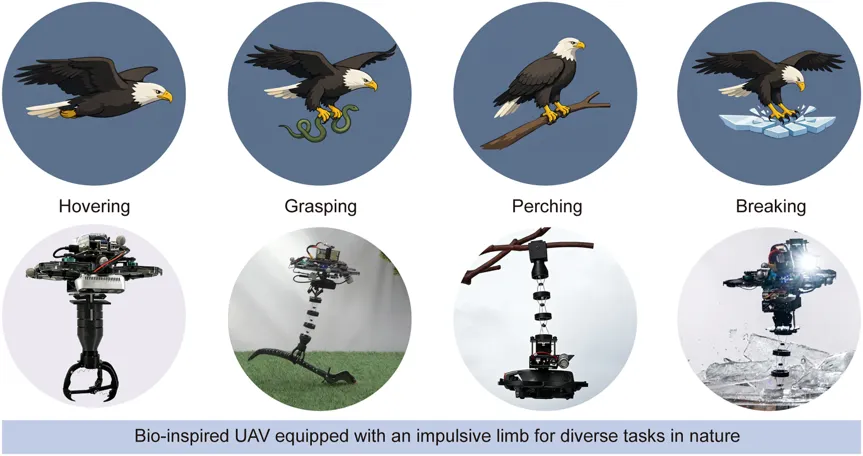
Simulative flying robots are equipped with pulsed limbs, which can achieve dynamic air interaction form buffers.
01.
Storage of energy booms + flexible loading power, dissolving air interaction
Existing aerial operating arms are difficult to match explosive force and stability. The rigid arm positioning accuracy is good, but the impact of high-speed contact is transmitted directly to the body, which is very easy to break the suspension posture; the flexible arm has its own vibration-reducing characteristics, but the response speed does not match the requirements of dynamic grabbing, ice breaking and other tasks.
Flight control seeks stability, interactions require instantaneous bursts, and two sets of demands are difficult to coexist in the same set of institutions. The team's solution is to dismantle functions, allowing different structures to do their jobs. Pulse modules are dedicated to storing energy, carrying out shots and strikes, chain-linked flexible arms are responsible for scattering shocks, and flight control is no longer rigid and sudden disruption, focusing only on positioning, targeting and triggering judgments.
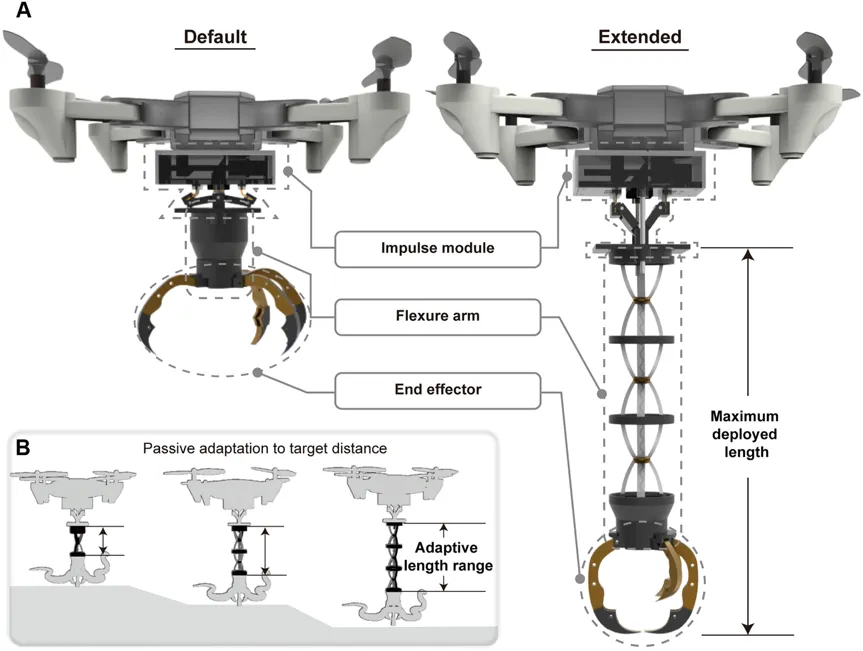
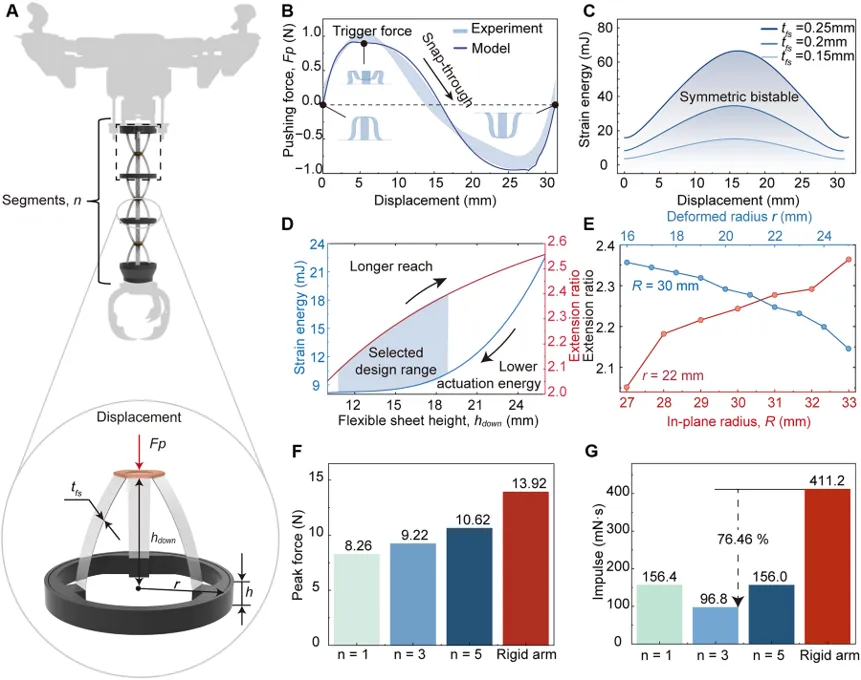
The core of the pulse module is a polyamide flexible beam with a thickness of 0.7 mm (0.9 mm), which usually stops at an unstable state and accumulates resilient energy. The motor slowly propels the slide to a continuous energy storage, and once it crosses the critical bend, the structure instantly jumps and releases energy, causing the entire arm to bounce quickly out.
Non-symmetrical dual stability is the key to this design. The higher the storage capacity of traditional symmetrical dual stability structures, the greater the triggering force required, and the more difficult it is to drive the small motor in the aircraft; the non-symmetrical configuration will limit the storage capacity and trigger the barrier, then accompanies the geometrical pre-loading, bringing the initial state of the structure closer to the critical point, reducing the trigger resistance.
When the beam thickness increases from 0.7 mm to 0.9 mm, the peak trigger power rises from 20 N to over 45 N, releasing energy increases by about 2.5 times, and engineering design needs to find a balance between energy storage needs and motor load.
The flexible arm is composed of a rigid, ring-shaped bracket and a pair of stable PET thin films with a thickness of 0.15 mm (0.25 mm). The rigid bracket transmits the bullet radiation energy, achieving a domino-shaped progression; the PET thin film changes shape and dissipates shock when it touches the target, and the paper defines it as a cylindrical mechanical shock filter tube.
At the end of the claw is a self-driving instruction, which is directly locked by the contact force. The arm restraint is based on SMA-shaped memory alloy springs, rather than a motor, and can be completed at 7.4 V voltage, 0.5 s pulse heating.
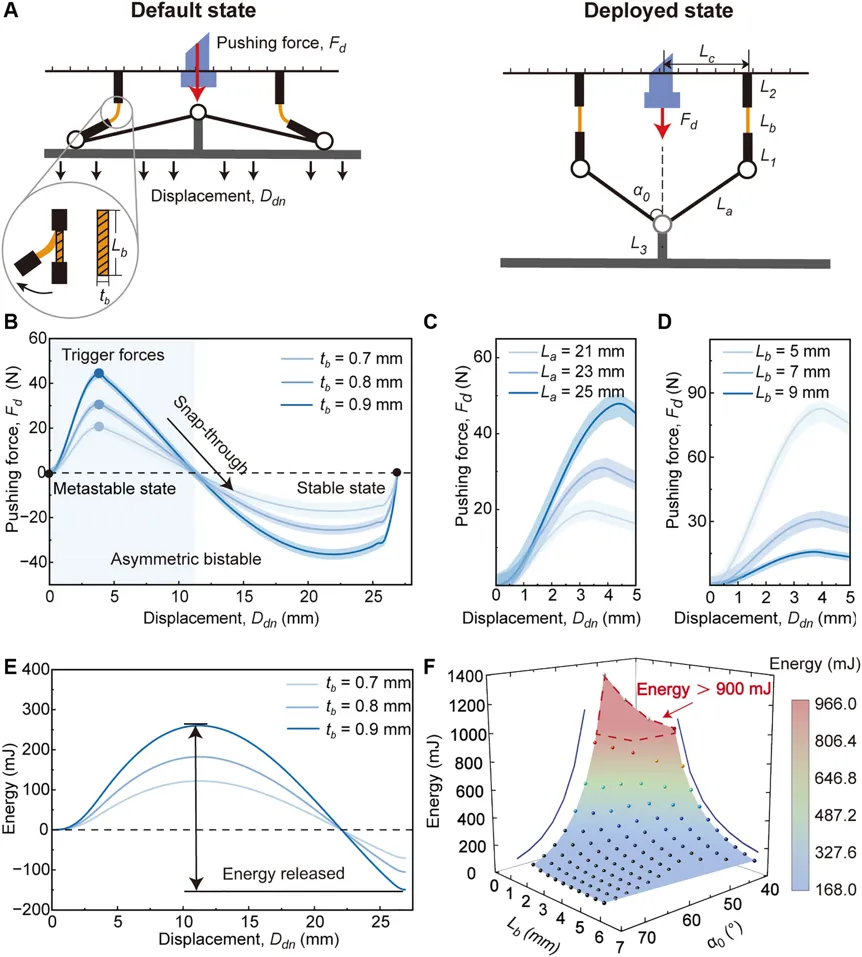
The mechanical structure and geometry of pulse modules.
02.
70 milliseconds of impact, achieving 76.46% of impact decline
Under the test configuration, the arm extends from the 71 mm enclosure state to 166 mm, extending about 2.3 times, with a total length of only 70 ms, and a peak speed of 2.1 m/s at the end; replacement requires 440 ms, striking much faster than receiving.
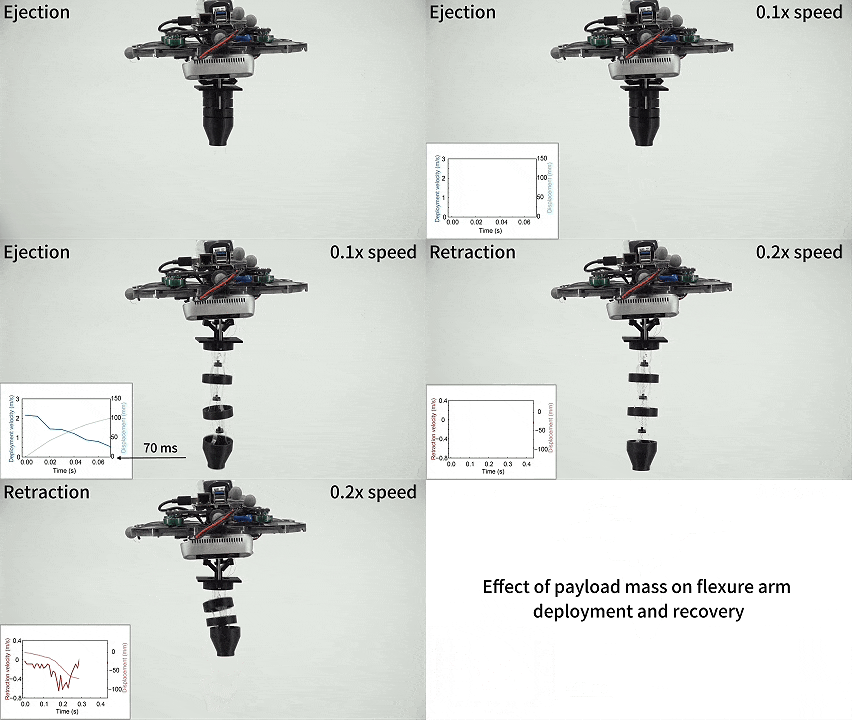
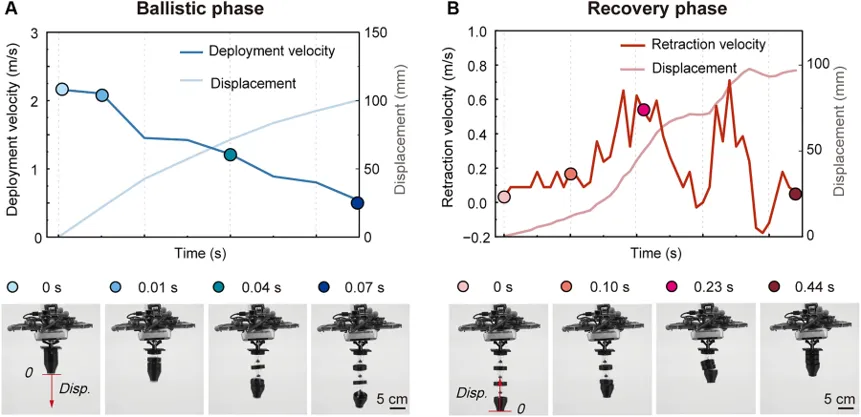
The kinetic characteristics of the pulse-driven cycle. A) The ballistic unfolding phase. At the trigger of the pulse module, the test's flexible arm is fully stretched in 70 milliseconds, with a peak speed of 2.1 m/s. B) The thermal recovery phase driven by the shape-memory alloy (SMA). An embedded SMA catalyst shrinks the flexible arm back to a tight state in 440 milliseconds.
Shock data is the central highlight of this work. Under the same contact conditions, 3 knots of flexible arm versus rigid arm: peak recoil force decreased from 13.92 N to 9.22 N, a decrease of 33.76%; initial 100 ms of thrust decreased from 411.20 to 96.80 mN s, a decrease of 76.46%; body peak decreased by 74.57%.
76.46% corresponds to the impact score in the first 100 milliseconds, i.e. the total impact, rather than the instantaneous peak impact force. The rigid arm transmits all the impact directly to the body, while the flexible arm dissipates most of the disruption in advance, reducing the total impact load by almost three-quarters.
Another set of experiments further demonstrated the value of shape intelligence. In fixed platform tests, the 7-point flexible arm reaches 277 mm in the passive adjustment range, accounting for 70% of the total length of 395 mm. After the blast is triggered, the control system no longer calculates the arm length in real time, and the arm continues to stretch forward until reaching the target, depending on the structure to achieve the distance of self-adaptation.
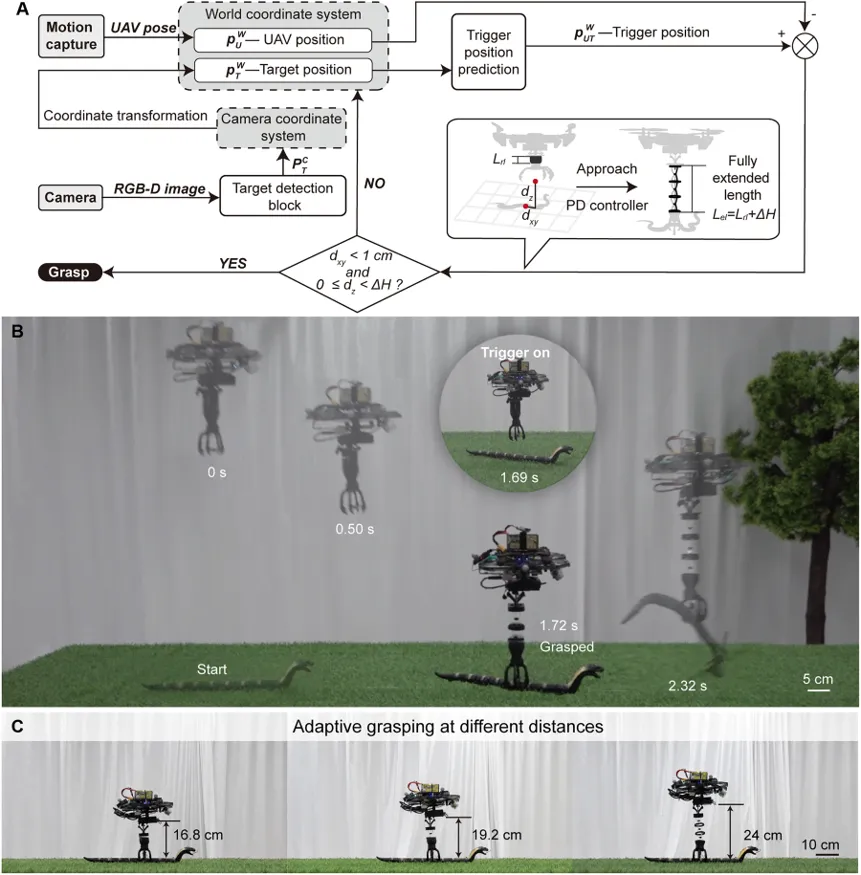
Autonomous target interception with passive arm adaptability.
03.
There are four types of real flight: catch, stop, break, catch.
The research team made four types of real-life flight scenarios, ranging from small to large.
Dynamic grabbing with 3 knot arms, all effective contact at a vertical distance of 16.8 cm, 19.2 cm, 24.0 cm in three sets. On-board YOLOv5n identification target, depth camera output position; level error less than 1 cm when launching the launch, the remaining vertical error is digested by the passive dynamic difference of the arm, and the test target is a serpent-shaped moving model.
Fixed-point suspension uses an upwardly extended configuration, depending on the geometric spacing to fit the height, without the need for high-precision position locking; after the fixation is completed, the drive motor can stop and save power, suitable for long-term fixed-point monitoring.
The ice breaking scene is the home of the pulse module, which relies on instant ballistic shock to hit the ice sheet, and the flexible arm simultaneously absorbs the instantaneous load of the collision, reducing the load transmitted to the body.
Cross-medium crawling is divided into two working conditions. Air-to-water crawling, armor penetrating the surface of the liquid, body suspended above the surface of the water; gel-medium crawling, contact length controlled within 0.2 s, rapid retraction according to SMA, reducing the risk of adhesive drag of the sticky medium.

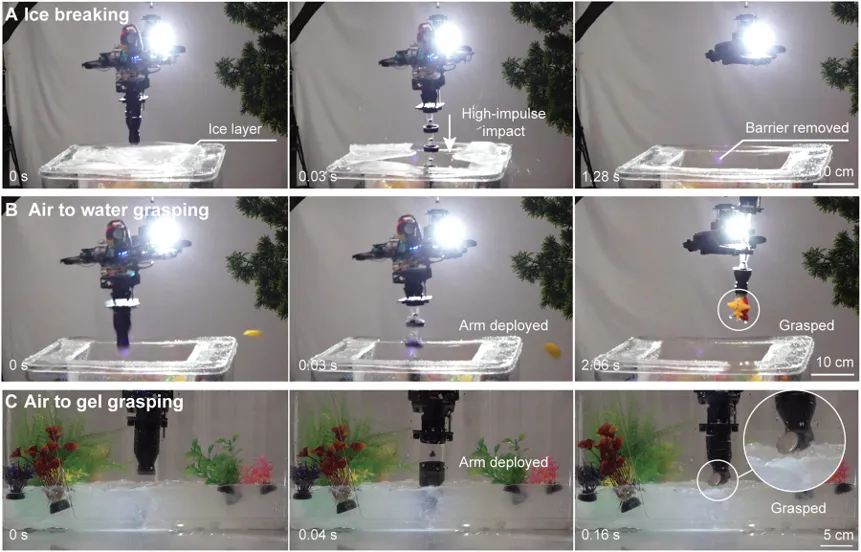
Pulse-driven and form buffers achieve multi-functional air-to-air physical interaction. A) use pulse modules to break ice. Immediate impact forces can shatter the ice layer, while flexible arms play the role of mechanical impact filters, reducing the impact load transmitted to the flight platform. B) cross-medium recycling (air-to-water retrieval).
The paper is also frankly limited in that experiments can still observe the interference caused by the airflow washing under the wheels, and the current system can only rely on long-distance attenuation effects, which cannot be completely eliminated.
04.
Give some of the control to the structure
Traditional high-speed air interaction requires continuous closed-loop control altitude to ensure the endpoint's accuracy in touching the target. This design changed its mind: after a bounce is triggered, abandoned real-time control of arm length, and the final working length is defined by the contact event.
In terms of flight control, there is less of a control variable that requires high frequency regulation; in terms of the mechanical body itself, it carries a layer of passive error capability. The paper's summary is refined, form-buffered, which transfers the fluidity of the physical interaction in the air from the control of the algorithm to the mechanical design of the body.
Modularity is another aspect of the design. Modular architecture supports increased range of arm adjustment, but the number of sections is a double-edged sword: longer courses will simultaneously raise the need for blasting energy, structural self-weighting and disruptive torque. Thin film thickness increases from 0.15 mm to 0.25 mm, energy strength increases from 10 mJ to 65 mJ, structural rigidity increases, and trigger thresholds also increase, and the parameters require comprehensive weighting.
This set of pulses does not transform the quad into a flying bird. It draws on the divisive logic of raccoon hunting, the body stays stationary, the limbs instantly strike, and the collision is disrupted by the limbs themselves.
For the entire mobile robotics industry, this is a noteworthy signal. The industry's long-standing habit of using stronger computing power and more tight circuitry to counter environmental disruption, while formal intelligence provides another route to submerge some of the perception, tolerance, and dynamic regulation capabilities of the institution itself.
For platforms with highly limited calculation, load and duration for aerial operations, mobile grappling, the structure is often more pragmatic than the performance of unlimited stacks of controllers.