The positioning accuracy of mainstream industrial robots has remained at 0.01mm for a long time, and there is still a significant gap in performance in the face of micro-level operation requirements in scenarios such as semiconductors, panels, and precision electronics.
The power control capability of industrial robots on the market is not entirely empty, but the power control accuracy is rough, difficult to support flexible, precise operation, and the lack of integration of precision power control systems.
Traditional joints are based on single-spinning freedoms, in the presence of tight work spaces, complex postures, and deformed workpieces.
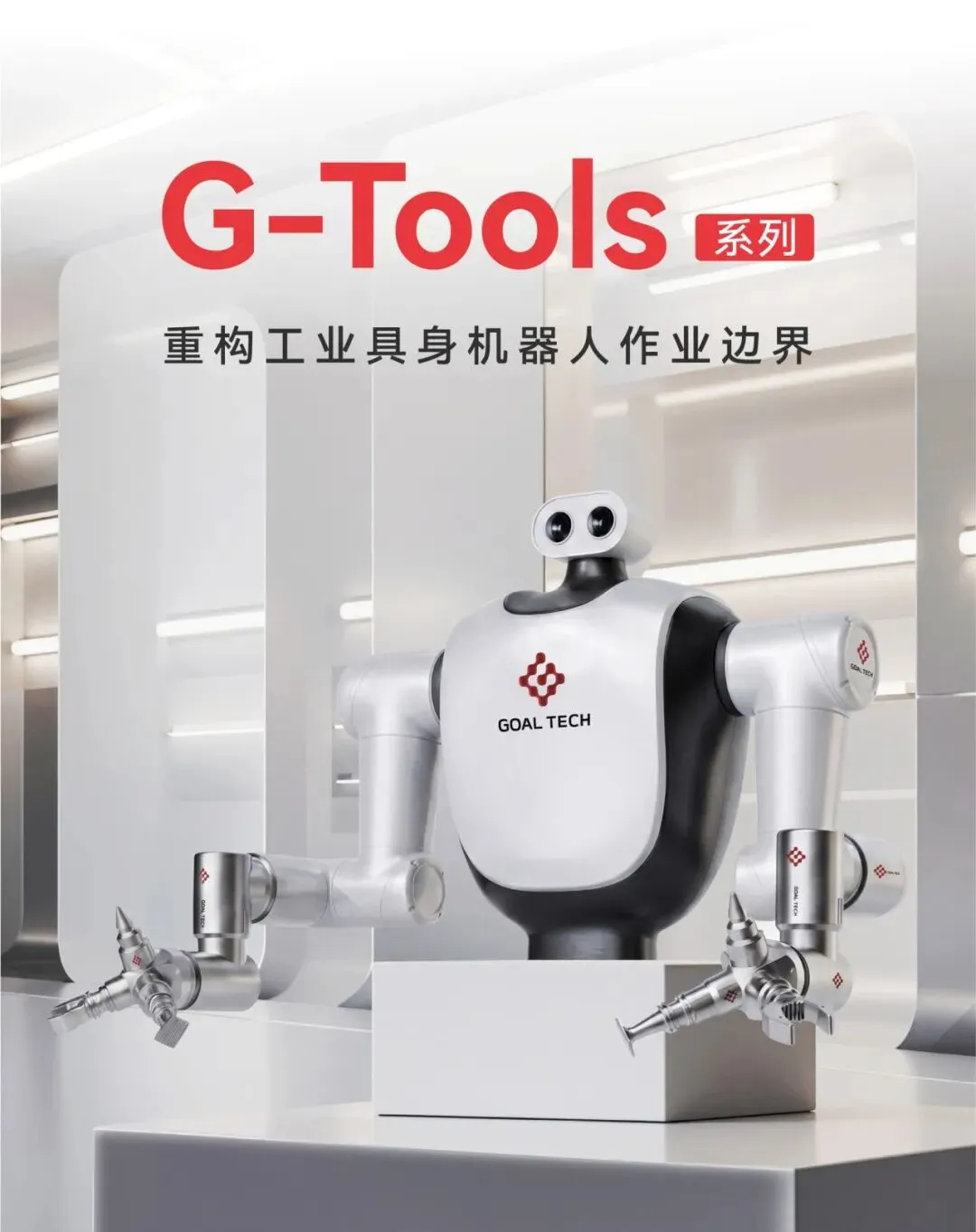
These three overlays directly resulted in a large number of high-value precision workstations that are still difficult to cover by robots. It was based on this judgment that GOO Tech launched the G-Tools series of products and from the beginning cleared the direction: leading precision-controlled industrial-grade body robots, cutting into a new generation of flexible production lines.
Around this direction, G-Tools is planned in four major product formats, all of which support multifunction end-user acceleration:
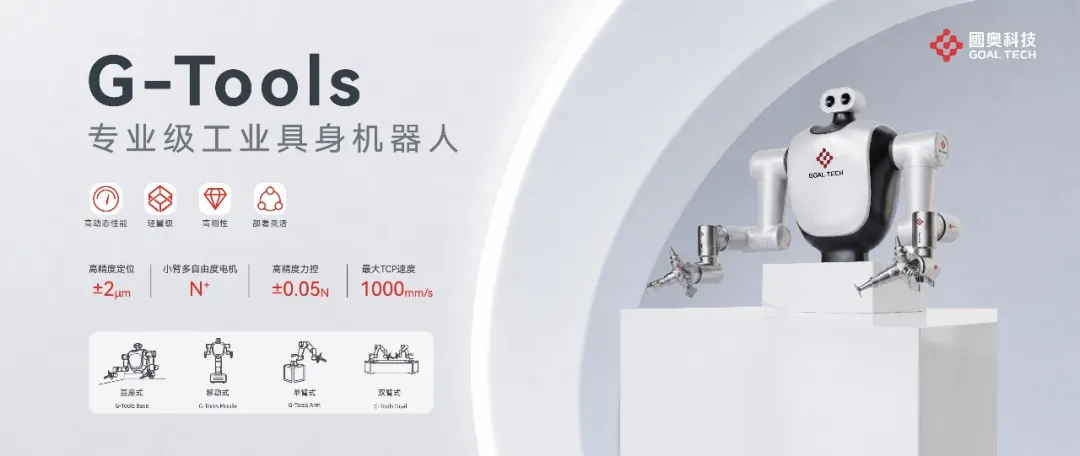
G-Tools Base (G-Tools Base) is fixed to the workplace, oriented towards semiconductors, panel displays, precision electronics, and other precision requirements for the most demanding point-to-point, high-precision, high-speed operating scenarios.
Mobile G-Tools Mobile (G-Tools Mobile) superimposes on the physical capability of the mobile substrate, which is oriented towards multi-process flow; flexible production lines that require flexible cross-location scheduling, allowing the high-precision operating unit itself to be mobile.
The single-arm G-Tools Arm is highly compact and adaptable, capable of rapidly completing integrated landings, and is suitable for precision workstations conversion and equipment embedded integration deployment scenarios.
G-Tools Dual relies on the ability of two-arms synchronous operation to accommodate complex operations that require two-arms collaboration.
Self-development and underlying technology empowerment
How G-Tools Broke the Barrier to Precision Manufacturing
The transition from components to integrated circuits has been made possible by the long-term overlap in the underlying technology, especially in high-frequency precision motor technology.
Established in 2018, National Otechnology has a clear technological path from the engine to the integrated engine: the integrated straight-line rotary engine from academic achievements in 2018 to autonomous intellectual property product trends; the completion of product industrialization in 2020 officially enters the customer line; the mass production in 2021 and enters the international first-line customer supply chain; the expansion of capacity in 2023, the refinement of the product line; the release of ZT double-axis precision transformer, FDS heat pump tightening system in 2025; the release of G-Tools industrial machine body robot in 2026.
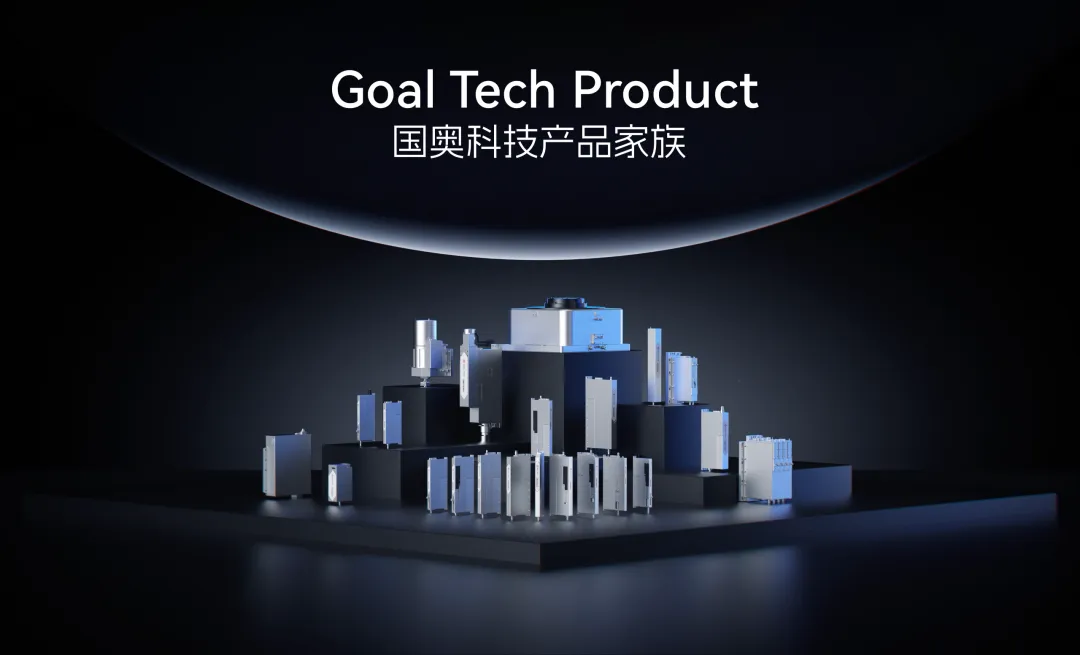
G-Tools industrial robot is not an alternative to the boiler, and the state-owned technology has chosen to use the underlying core technologies such as positioning, power control, alongside a synchronous source technology system for precision motors.
The technology has previously achieved high positioning accuracy, soft landing and precise power control on two-frequency straight-line rotary motors, but is more widely used in semiconductor equipment and other precision automation equipment.
G-Tools' core strengths are reflected in the following:
Dual-frequency joints, eliminating multi-level transmission errors: based on self-development technology innovation integrates dual-frequency joints, a single joint can simultaneously complete straight-line and rotational complex movements, saving redundant intermediate transmission links. Compared to the multi-level transmission structure of conventional steam engines + gearbox, the accumulated physical sources of errors are directly eliminated, thus achieving an improved cross-quantity level of accuracy. According to state-of-the-art technology published, G-Tools repeat positioning accuracy reaches ± 2 μm, while having high precision maintenance power at ± 0.05N level, as well as high rigidity, quick response and high flexibility.
The 9+2 tonne frequency structure combines macro-micro-complex motion to adapt to complex working conditions: for example, the G-Tools-based robot, which uses a single-arm 9+2 tonne frequency design, coupled with a macro-micro-complex motion strategy, fully improves the ability to avoid obstacles, the abundance of end posture, the smoothness of the trajectory and the adaptability of deformed workpieces, which can be adapted to small spaces and complex assembly postures.
Deep self-development of the entire chain, mastery of performance definition rights: as an integrated product, the self-development of the state-owned technology does not stop at the motor. From the drive to the algorithm, the core links of G-Tools are deep self-development. For example, the overall structure, the heat dissipation and the transmission layout are completely redesigned, the motor, sensors, the drive is highly integrated miniaturized; the power control response is reconfigured, the multi-axis synchronous control algorithm is re-optimized, preserving the advantages of flexibility control and adapting to the needs of continuous operation.
This means that the ability to define precision, power control and response characteristics is fully in their hands, without the need to relocate parts, as well as greater space for synergy optimization, scenario adaptation and customized response at the integrated level. This is where the transformation route of the state-owned technology is different: its competitiveness is not in the ability to install the motor into the integrated system, but in the ability to redefine the integrated system with underlying technology.
From insight into needs to strategic leaps
Synchronous closure of silicon parts + integrated silicon
Whether or not a product can stand still needs to be tested at the end of the market.
It is understood that by visiting a large number of integrators and terminal factories, the system solved the real pain points of the high-end manufacturing site, discovering the automation gaps caused by inaccuracies, tightness of force control, restrictions on joint freedom, are a common bottleneck that exists across industries.
On the demand side, this gap is continuing to widen, and the production lines in industries such as 3C electronics, panel displays, semiconductors, and new energy are moving towards smaller gaps and more frequent shifts.
G-Tools, which has been working in these industries for many years, has gained insight into these needs, and the design and product definition of industrial robotics is based on these needs.
From a strategic point of view, entering the industrial robotics track is a natural extension of the technological capabilities of the state-owned technology, the goal is to seize the core equipment for intelligent manufacturing, create a second growth curve, and fully enhance the competitiveness of enterprises.
The self-development of the core components provided the integrated system with a robust walled city, the integrated system in the high-end production line with a continuous reversal of the actual working conditions, the two business lines are mutually supportive and jointly construct unique technological barriers. At the same time, the business model of GOO TECH has also been upgraded: from the supply of components to equipment manufacturers, to the direct delivery of integrated solutions to the terminal production line, and further expanded to the field of AI and industrial vision.
Along this path, the focus on investing in the future of GTOC has been clear: continuing the core technology offensive, capacity expansion and product system upgrading, accelerating the deployment of new energy vehicle lightweight installations, industrial robots and other emerging scenarios, pushing enterprises to jump from single-piece suppliers to precision-controlled innovation enterprises with the capability to deliver automated solutions.
Who owns the underlying technology, who defines the limits
The competitive focus of industrial robots is shifting from the overall shape of the machine back to the basics of motors, drives, algorithms, and joints.
When the task requires advancing from millimeters to microns, from position control to precision force control, any upper-level optimization cannot bypass the physical limits of the joint structure itself. That is, whoever has mastered the underlying motion control technology defines the limits of the capabilities of this generation of industrial robots.
Similarly, from the motor to the integrated system, the state-owned technology has chosen to construct barriers to competition on the basis of the original technology. This is both the inevitable result of its many years of accumulation of technology, and it is one of the most divisive underpinnings in the industrialization of professional-level industrial robots.