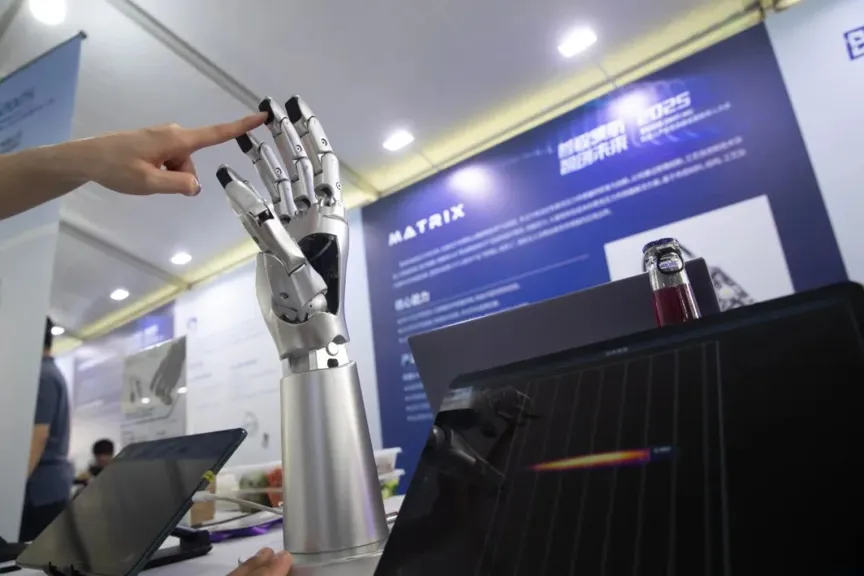
“ After the launch of Utrecht, the focus shifted to the first-ever controlled robot version.
At a time when the market was still investing in how many robots to measure the color of an industry's robots, the top players had already moved their chips elsewhere.
This was the case with the first holding company. It was a minority that made a huge return on its assets.
By the end of 2025, through its Beijing Robotics Industry Development Investment Fund, the first round of investments in the global robotics industry chain has exceeded 2 billion yuan, with a portfolio valuation growth of about 4 times, and a book float of more than 8 billion yuan.
According to the simplest capital inertia, the rational choice is to continue coding in the proven direction after a quantitative performance has been verified on a scale.
I'm not sure if I'm going to be able to do that.
However, the initial holdings did not do so, on the contrary, after the launch of the Utrecht, it began to concentrate on the upstream of computing.
01.
From the physical list to the arithmetic list
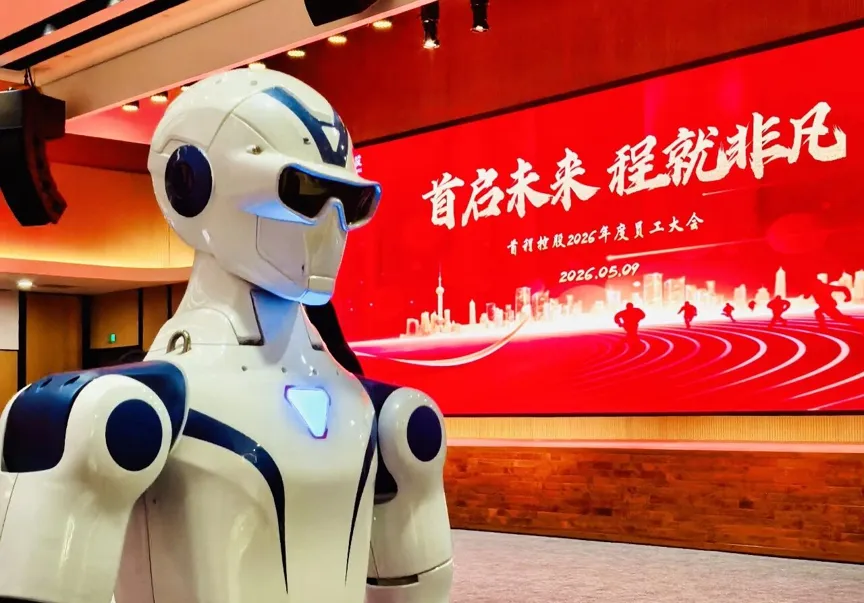
Initial holdings have a rare practice in industrial capital, where almost all investments are distributed to the market through voluntary announcements at port exchanges. This undoubtedly provides an observational sample, stretching the timeline of their announcements, to see the cognitive migration of industrial capital.
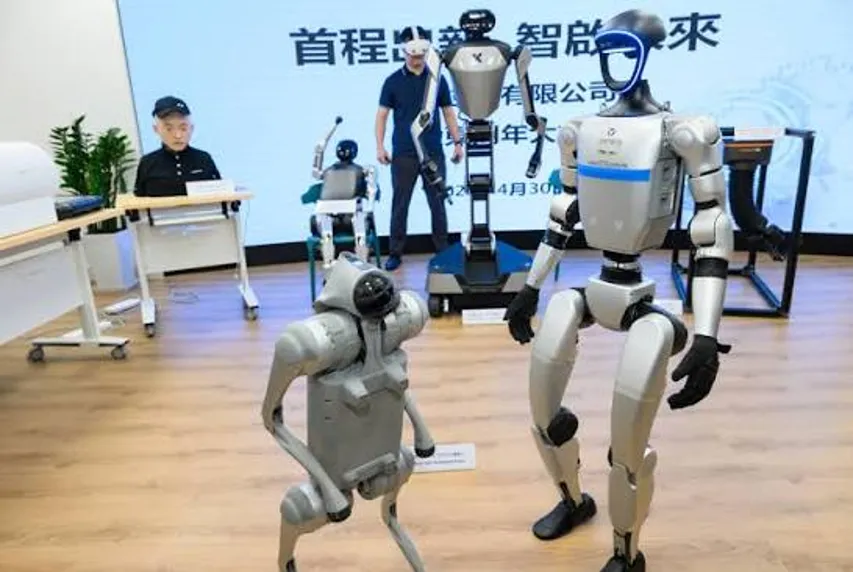
In 2025, the company will be one of the hardest-working buyers in the physical-intelligence-class market - including U-skill technology, cloud deepness, Beijing humanoids, stellar age, stellar charts, galaxy generalization, slow motion, accelerated evolution, micro-intelligence, and so on.
The industrial chain is on the rise, with Kwon Weibo integrating joint modules, and Meizu Tech making flexible touch sensors. The scene ends are lined up with clean robots with cloud computing intelligence, flexible operations with Wan Wei Tech, and medical robots with Rosenbot.
From quadrupeds to human figures, from body to model, parts, scenes, the full-body layout of a textbook-sized book. This list is still luxurious today.
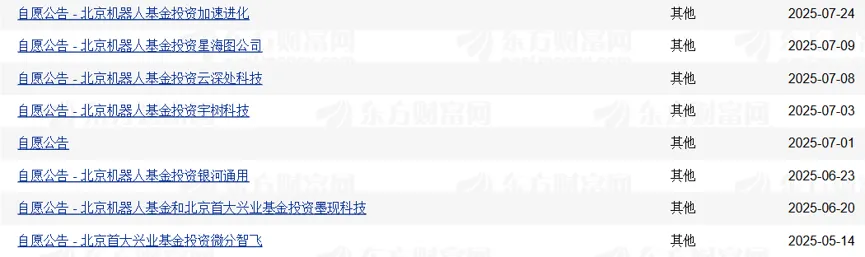
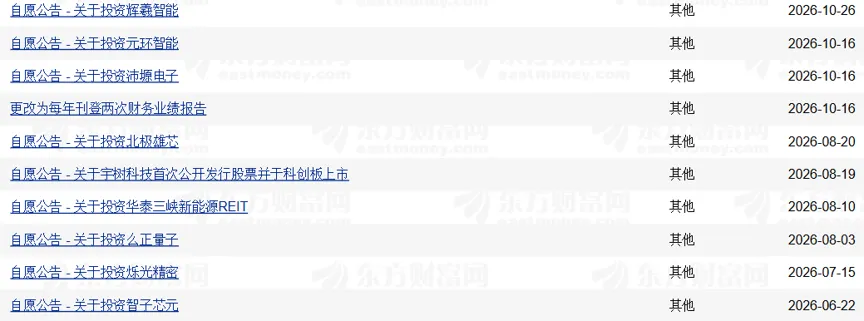
However, in the last six months, the initial investment movement in holding shares has changed significantly.
On June 22, the start-up capital jointly acquires Intel's Core Angel + Wheel, tens of millions of yuan, in the direction of "AI for Computing", which breaks the domestic chip computing puzzle; on July 15, invests in fluorescent precision, cutting into AI-algorithmic optical interconnection upstream; on August, invests in a new round of financing in North Korea's Core Core, Cardit Chiplet High Performance Computing, which the company has been consolidated by the team of Silicon Institute of Technology; on October 16, the same day, the company announces investments in silicon electronics and ring intelligence, the former being the high power density power source module, the latter being the AI module; and on October 26, announces investments in Core Intel, in the direction of intelligent high performance computing chips.
These investments all point in the same direction: the underlying infrastructure of physical AI.
So the question is, why would an industry that has just bought almost half of its smart racetrack go out of its way to become a mobile robot?
02.
The body itself is no longer a scarce entrance, and computing is a hard constraint.
The answer lies in the darkness of the entire robotic capital market.
First of all, the scarcity of physical tracks is being re-priced. For the past two years, capital has been competing against physical tracks, because physical tracks are almost the only entrance to the narrative. It is difficult for LP to explain what the robotic era is without a walking humanoid robot.
But by now, the pattern is clear. Companies valued at over $10 billion are also counting on their hands and feet, the prices of the head companies are being pushed to the top, and the excess earnings of early cards are shrinking. Capital is always flowing into a scarcity that has not yet been priced, and this scarcity is moving up along the industrial chain. Most upstream brands are still stuck in the seed wheel, the angel, and tens of millions of yuan level can cling to a key link.
Second, the Scaling Law of physical intelligence pushes the bottleneck into computing. When model parameters and the size of training data increase exponentially, underlying computing becomes the most established rigid constraint in the industry. Whether it's the construction of a simulation environment, the processing of multimodal data, or the training of end-to-end model reasoning, each node is absorbing a sea of GPU resources.
After all, having a stable, efficient and low-cost supply of computing is the equivalent of holding the throat of companies that have evolved intelligently.
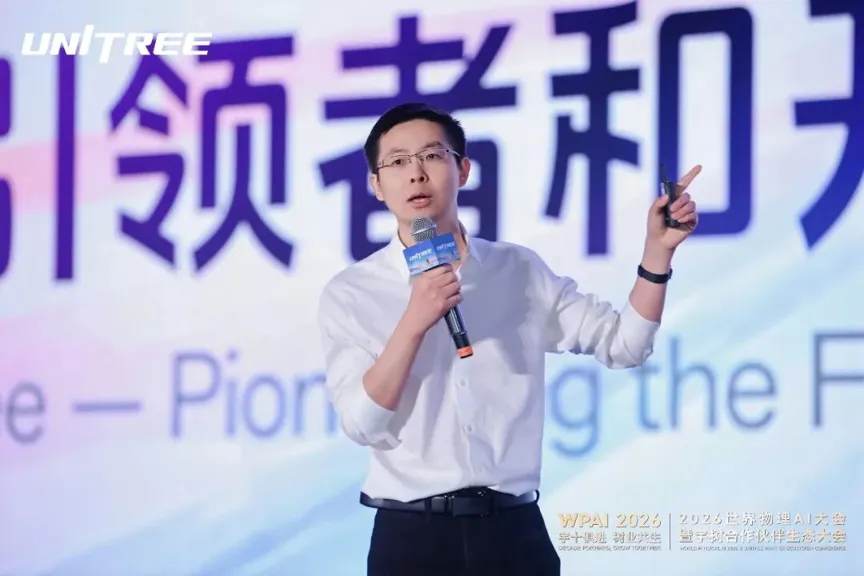
A recent speech by Wang Xing also released this signal. It said that physical AI has seen its crop cut, with a window period of about one to three years, among the key capabilities he listed, supermassive computing servers and computing and storage chip manufacturing capabilities are at the forefront.
Capital has just as keenly captured the transition of this value chain. Instead of stifling itself in the crowded Red Sea, it is better to stretch upwards and lock down the infrastructure that provides hydrogen fuel tanks for smart people.
In an interview with the media, Kang Huang, managing director of the Department of Capital Markets, spoke frankly about the way the company invests, explaining how we first invest in the hardware and model end of the chain of companies, and then along the demand of the chain of companies to the upstream industry.
Initially, the holding company has dual status as the executor of the Beijing Robotics Industry Development Investment Fund, which is the capital of the government's industrial will; as a publicly traded company, it also exchanges investment returns with shareholders.
The first time I did it, I bought both tickets in advance.
03.
The self-declaration itself is a narrative.
There is also a question that is rarely asked seriously, why should almost every investment be initiated in the first place?
A publicly traded company throws an angel round, but at the tens of millions of yuan level, the volume of transactions from the port of exchange has a considerable distance from the threshold to disclose the transaction.
But it opts for each of them to be voluntarily made public, which means it wants the market to see, to see the market to see itself as the organizer of the physical AI infrastructure.
The first level is to compete for pricing rights. The initial market capitalization is about 10 billion hong kongs, while the overall robotic portfolio has surpassed 8 billion yuan. The market sees it as a parked asset operator, or a lucky financial investor, and physical AI asset packs are hardly priced separately. Assets are inflated under the ice, and market values end up on the ice, which is the most dangerous valuation error. The meaning of voluntary announcements is to turn a black card into a trademark, forcing the secondary market to re-establish its price reference.
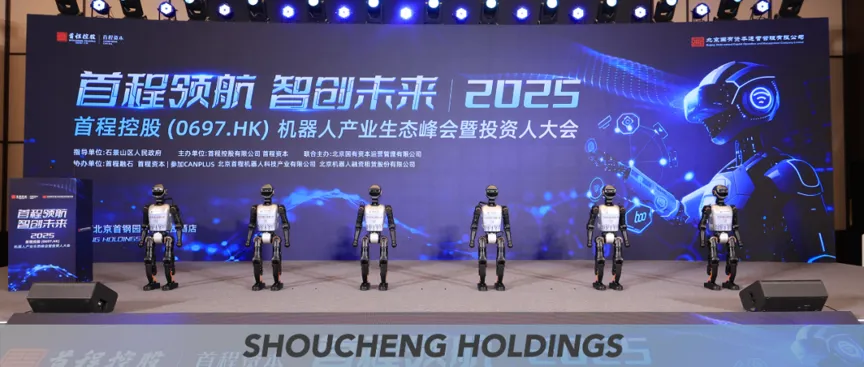
The second layer is building ecosystems. A public company announcement is one of the hardest public credentials for startups, and one of the most divisive in the next round of financing negotiations. The more disclosures, the stronger the impact of the first wave of hard-tech start-ups; on the other hand, it can get shares that no one else can grab at lower costs, better terms.
The third layer is the management narrative. The timing of the publication of the information is the text of the strategy, and every month, step by step, it moves upwards. To date, the first phase has been completed with dozens of announcements.
04.
The best hunters
The best hunters do not chase after the shadow of the prey, where it awaits the prey and is always the gateway through which the prey must pass.
The current collective anxiety of the robotics racetrack is essentially a disconnect between the narrative of valuation and the narrative of the industry. The long-term picture of a trillion-dollar market cap is priced at the corporate level, but the real bottleneck at the industrial level cannot be answered by the corporate level alone.
The first option is to use the cash flows of publicly traded companies as the bottom of the chain of custody, using scenarios and channels to meet demand, using upstream materials and chips to trap the throat of the industrial chain, and then using funds to define the direction of the chain owner.
The return cycle of this approach is longer than pure financial investment, but it is also deeper, and it aims to build a value loop that can cross the cycle.
As physical intelligence moves from lab to factory, from concept to land, infrastructure that was once considered a heavy asset burden will eventually turn into a stable source of cash flow and an irreplaceable bidding chip.
At that time, hunters no longer had to chase their prey, as the entire hunting ground was already in its drawing.