The ship delivery deadline for our newly signed orders has been set for 2030.
The main focus of his speech was not to get the order bowl to the hand softener, but to find a delivery solution.
The shipbuilding industry is known for its large, complex, multi-variety, non-specified coatings. A ship from steel plate to assembly, welding through and through, is often the most difficult to automate: ship groups build workpieces of many types, often without drawings, with very high requirements for welding stability and accuracy; at the same time, narrow closed bodies, ultra-large deformed components, cross-site machining, etc. complex working conditions, allowing fixed traditional welding equipment to be tracked, machine arm stretches, specialised assembly constraints, difficult to fit.
For the aforementioned pain points, Hunan Vision Bit Robot Co., Ltd. (abbreviated as "Hunan Vision Bit Robot") at the 2026 China Marine Economy Exhibition, showcased a number of intelligent robotics workstations in the shipbuilding field and a simulation platform in the industry, covering key processes such as group welding, corrugated flexible grinding, steel defect detection, residual scanning and reprocessing, visual sensing, robot operation and industrial simulation, and digital transformation pathways for producing landings for ship repairs.
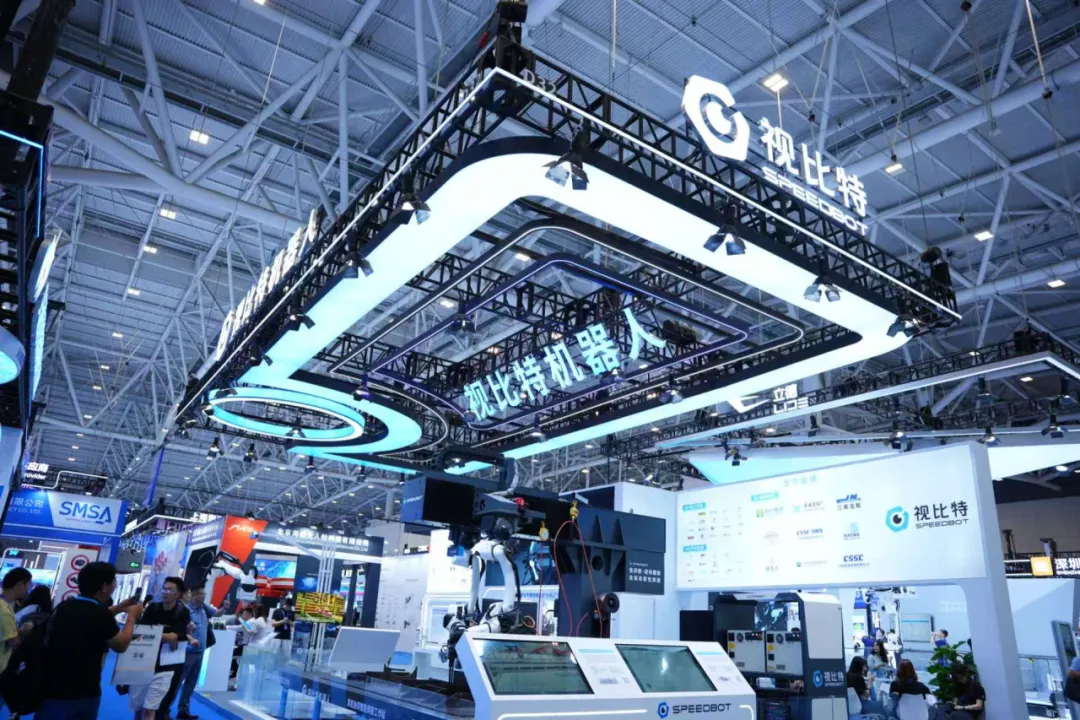
Dr. Liu Wenping, Chairman and CEO of BitrobotThe focus is on the layout of physical AI in view of the bit.It's hard to believe, it's hard to believe, it's hard to believe.The scene.
One of the main exhibits at the Expo in Haifa is the twin-engine synchronous welding workstation, which responds to the variable difficulty of welding vessels with the use of aluminum-free welding. The two mechanical arms share the same set of external axle control systems, aiming at the two-way curve welding at the same position, while achieving intelligent avoidance, while significantly improving the welding pulse and quality.
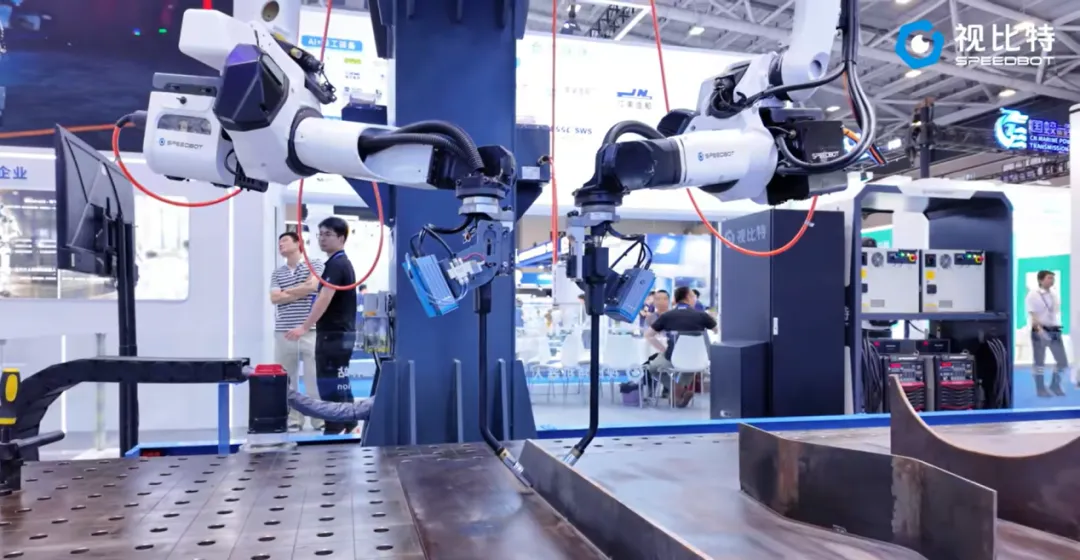
The dual-machine collaborative smart welding workstation deeply integrates 3D vision, AI algorithm engines, self-developed smart welding control system with VBits, and a rigorously precise design-free, demonstration-free, and program-free flexible welding.
SpeedWeld intelligent welding control system is the integrated adult in the field of welding technology. In addition to traditional standard 3D models or CAD drawings import, the system supports reverse modeling after scanning with 3D structural photographic cameras, without drawings tools can also automatically generate welding trajectories, without the need for professional programmers, and ordinary welding craftsmen can easily operate to complete single-key welding scanning, welding processes, etc.
With the support of the SpeedWeld system, the dual-machine collaborative smart welding workstations can also perform multi-layer welding processes on the ship's thickness, with visualized auxiliary modeling tools, which can easily adjust trajectory gesture verification according to the previous molding situation, improve modeling efficiency, and reduce the discharge time from a few hours to a few tens of minutes.
The latest updated version of SpeedWeld 2.9 supports multiple flexible operating modes such as dual-machine synchronization, asymmetric welding, independent welding, while continuously updating many practical functions such as interrupt welding, full process welding processes and parametric traceability, shipyard model adaptation, and focusing on the continuous optimization, upgrading, and refinement of intelligent welding capabilities of robots.
SpeedWeld's core is a deep understanding of industrial hardware intelligence, and ultimately solves the problem by letting robots know how to weld themselves.
In addition, VBIT also brought a humanoid welding robot sampling machine in the field, capable of performing autonomous scanning welding and quality testing of T-shaped workpiece pads through multi-mode perception and self-developed size brains. Human welding robots are pioneers in targeting small batches, decomposition, and flexible welding pain points in the shipbuilding industry, and this humanoid welding robot sampling is currently continuing to evolve in multiple customer sites and lab environments.
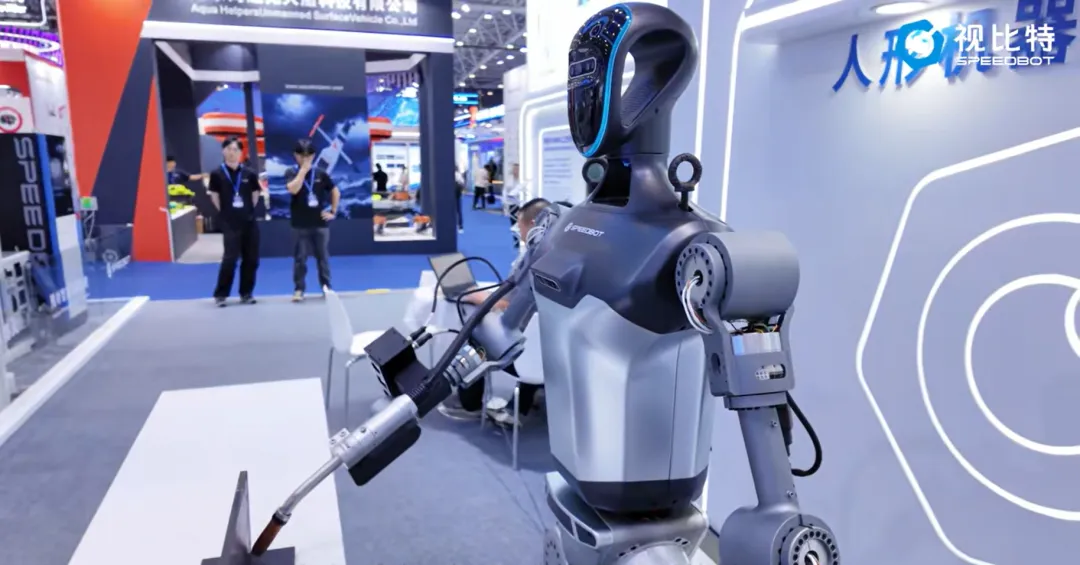
In addition to welding, full welding capability breaks shipbuilding process card points
The seamlessness of a complex industrial scene is just one of the puzzles in the intelligent manufacturing chain of ships.
In heavy-duty machinery and shipbuilding, the first bit robots were seen in the early 1900s.Steel plate cutting materialSelectionThe link achieves single-point breakthroughs, automating the entire process of charging, cutting, sorting and assembling of steel panels through unique visual guidance technology and production line planning capabilities, replacing traditional man-made hanging methods, significantly improving assembly efficiency, and creating benchmarks for some of the engineering machinery industry's leading enterprises.
In recent years, with in-depth collaboration with several of the world's leading shipbuilding companies, the Vee Bit robot has been successful in launching such projects as:Substrate sorting, slope cutting, flexible grinding, non-specific welding, quality testing, etc.It's the process of making the process smarter, digitizing.
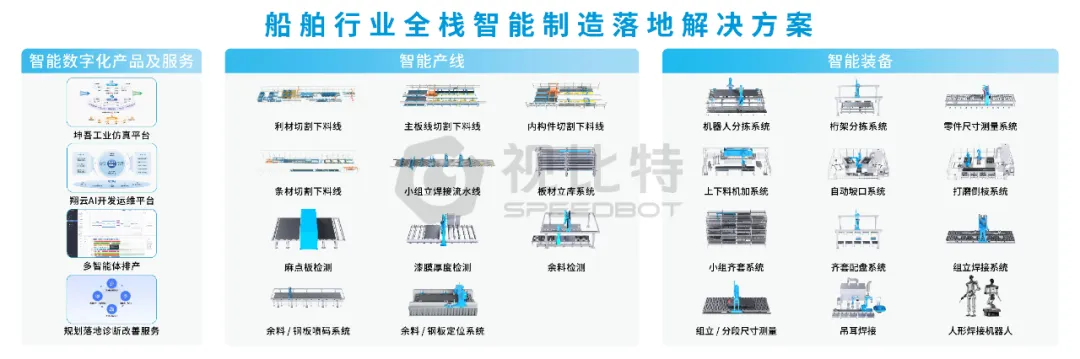
Earlier this year, VBIT took orders in the shipping sector for nearly 200 million yuan, relying not only on the excellent performance of a single plant, but also on its deep understanding of the upgrades to shipbuilding processes as a whole.
In the shipbuilding industry, several production pain points continue to plague shipbuilding efficiency:
1. the cracking process in the shipbuilding industry, the failure of workshops to form standardized data flows and low automated penetration;
2) Low utilization of steel, heavy waste of materials and high cost of raw materials;
3 - Milling, sloping and welding jobs are man-made and have a high risk of being used;
4. One-point equipment is fragmented, data cannot be transmitted throughout the plant, and systematic upgrades are difficult.
Through in-depth observation of the production line and on-site grinding, VBIT creatively developed solutions in collaboration with shipyard customers, achieving two major process breakthroughs in the shipping industry from 0 to 1 tonne of high reliability operations.
The first innovation was the 3D detection system for stainless steel surfaces. The system effectively identifies the density, size and depth of stainless steel surfaces generated during material rotation, avoids man-made detection errors, improves ship's service life and productivity, and further guarantees delivery times and pass rates.
The second is the intelligent scanning system, which targets neglected aluminum ore deposits in shipbuilding. Steel accounts for about 30% of the total cost of shipbuilding and up to 95% of the steel utilization in many international shipyards. The system can automatically identify the transactional direction of cutting, achieve reuse of the value of the residual materials, and help shipyards save on expenses.
Intelligent scanning of bits and piecesBased on multiple 3D linear cameras and visual algorithm engines, it is able to automatically complete scanning, classification and storage of residual materials and guide the residual material to secondary cutting, greatly leveraging the residual value of steel plates, improving the utilization of steel, practicing the concept of low-carbon shipbuilding, adapting shipbuilding, steel structures, and the steel industry to the scenery of waste processing.
To make the industry physically intelligent and go towards generalisation
In the eyes of many practitioners, the ultimate dream of humanoid robots is to become universal, a robot with all-knowing, all-performing generalization capabilities.
Can we use the same set of intelligent technologies to cut materials, cut slopes, grind, weld, test quality?
In the eyes of Bitt,The core area of industrial physical intelligence is whether or not it has the ability to understand physical rules, and whether or not it can be adapted to non-standard working conditions.
From single-point processing to up-and-down station welding, from understanding production line know-how to attacking cost-efficiency bottlenecks, VBIT is pushing industrial hardware intelligence into deeper manufacturing landscapes:Getting rid of the rigidity of traditional non-standard equipment, smart robots have both a decision-making brain that understands the complexity of processes and a small brain that perceives the physical world and is moving towards generalization in flexible production.
The KUNWU industrial simulation platform and the KWorld industrial world base model, which is self-developed, provide a suite of intelligent evolutionary closed-loop tools that encompass simulation training, mutation optimization, and machine deployment.
The platform combines functions such as digital generation, industrial models, virtual reality interaction, covers the entire production line design - programming, modeling, simulation and simulation, and integrates five pre-trained models such as production line automation, low-code automation, visual quality testing, and intelligent output, enabling production line workers to complete production line development from 0 to 1 in the form of packed blocks.
China Industrial Simulation Platforms - Automated Production Lines
In addition to a complete tool chain, cross-industry process experience is essential, and the platform incorporates 30+ industry scenario templates, 10+ professional process packages, rich algorithm models and industrial equipment repositories that can be used across multiple industries such as heavy construction, shipping, and automotive to achieve migration reuse.
After completion, the platform will also be able to verify the operation of the entire process online, avoiding the cumbersome steps of replacing traditional production lines before and after assembly.
The virtual reality scheduling of the Yuyu platform, the reasoning decision-making of the Wuyu world model, combined with the flexible execution of the intelligent robot workstation, and the real-time operation and detection of the Xi'an Cloud AI operating the intelligent body platform, the VBIT robot has succeeded in making the physical AI deeply connected to industrial equipment, production environments, robot workstations, achieving a closed loop of sensing - execution - decision-making - operation and intelligent operation of the four layers of industrial equipment.
With the eyes of the industry, the hands of the industry, and the integrated technologies of the industry's brain, Visual Bit is closely integrating products with cross-industry processes such as engineering machinery, automotive manufacturing, shipbuilding, and marine engineering, bringing physical AI from the laboratory into the real manufacturing landscape to realize the visual operation and scale-up of industrial devices.
He wrote at the end:
Returning to the site of the Expo, many exhibits focus on the same pain point: how to solve the problem of shipbuilding?
From fixed workplace automation pumps to flexible smart pumps, at the Shanghai Expo, Vibet robots were featured in the dual-machine synchronous welding workstations, bi-legged welding robots, residual intelligent scanning systems, steel plate blister detection and industrial simulation platforms.
The answer to this group of exhibits is simple: using visual quantification instead of sensory experience, allowing robots to self-diagnose, filter out the debris, pinch the strength of the debris, and use a ring-linked smart base to make intelligent, autonomous decisions.
After serving 300+ domestic and international customers in the accumulation process and building a model base for AI models in the physical world, Viber Bit has become one of the few smart enterprises in the industry with a self-developed industrial base with large models, real industrial status data, and the ability to deploy full-frame systems engineering.
In a flexible manufacturing scenario with a high barrier, upgrading intelligence has never been a struggle. Full-frame technology-armed viewing bits have been able to navigate the digital intellectual leap from one direction to another in a real-world pathway that can be replicated.