“ From almost billions of dollars to hundreds of millions of dollars in funding in just over a year, the funding trajectory of China's Koeijing is itself the process of activated robots being revalued by capital.
In a shoe-making workshop at a leading shoe company, robots are being examined by the second. In a related process test, a shoe's bottom seal takes 7 seconds and a pair of shoes takes 18 seconds. According to current project projections, the program's annual return on investment is about 50% to 70%, and the investment recycling cycle is expected to be within two years.
In this year's human-made robot industry, there are not many accounts that can be calculated. 2026 has been called the year of mass production, shipments have increased significantly, and production lines have been connected. China's Kohqing founder and chairman Zhang Zhengqiang gave an estimate in a recent media interview. In this year's robot shipments, data collection, education and business demonstrations together account for about seven to eighty percent of the potential to actually land on industrial sites. Many robots have been built, but have not yet found a long-term viable scenario.
Recently, China's Beijing-based Kowheeling Robotics Technology Ltd. announced the completion of the RMB 100 million A++ round of financing. The last round was the almost billion A round of BlueTech's acquisition, more than a year ago. Discussions about cooling down financing in the industry have not spread, and the company, founded in 2023, has increased its single-cycle financing from almost RMB 100 million to RMB 100 million.
01.
After hundreds of millions of dollars of financing, investors changed their feet
The round is being jointly invested by knowledge-based, venture-backed, venture-backed, venture-backed, and venture-backed institutions such as National Science and Technology Co., Ltd. and Running Investments, including marketed equity-backed investment institutions, specialist parent funds and industrial investment platforms focused on artificial intelligence, hard technology and advanced manufacturing.
Speaking of the outside world's voice about the cooling down of the financing of the physically intelligent industry, Zhang Chang, China's head of corporate capital operations, has changed his perspective. His view is that in the process of robotics companies moving from the first-tier capital market to the second-tier capital market, who is doing what, wherever the value is on the screen, everyone's idea of the end of the industry is also returning to reality.
Zhang Zhengjian divided this year's volume into two parts. The first, a relatively rough one, with social expectations, policy support and demand for data collection pushing shipments up, the number of demands may be halved. This is a process by which technological accumulation cannot be avoided.
According to this rhythm, Zhang Liu has positioned the A++ cycle as a turning point for the company. The first phase was mainly on offensive technology, finding scenarios, and now the business of brain schemes, shoe manufacturing, mining wells and robotic bands have entered a critical stage of commercialization. The money is divided into three parts: physical brain generation in key scenarios, production delivery and market pioneering.
Speaking about this round of financing, Zhang Zhengqian believes that physical intelligence has value, and that in the end, to put it to the test in the real world, industrialization is a long-term system engineering. The company has been using complex sites such as factories, mines since its inception as a place to grind products and accumulate data.
02.
And then the beat goes back to the book, and the robot goes through the shoe factory and closes.
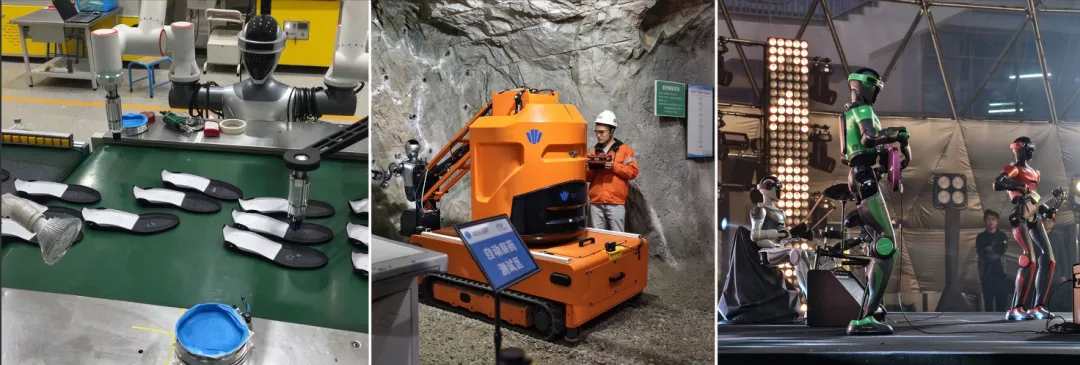
At its core, it is a full-fledged self-development system. The robot body, body, brain and dexterity are all self-developed, with design capabilities ranging from end-user executors to integrated systems. Current products include full-size humanoid robot CASBOT 02, round-arm robot CASBOT W2, half-size humanoid robot CASBOT Mini and CASBOT BAND robotic bands, adapted to industrial flexible operations, mining high-risk processes, as well as commercial services, entertainment and educational research.
On the data side, the team uses a self-developed XR remote operating system that continuously accumulates robot operations and real-world interaction data to support model training and strategy optimization. The algorithm is based on a visual language multimodal large model (VLM) that combines world models, reinforcement learning, physical agents and physical RSI, an overall architecture dividing the brain, small brain, and core three layers. At its core is the self-developed large model CAS-brain.
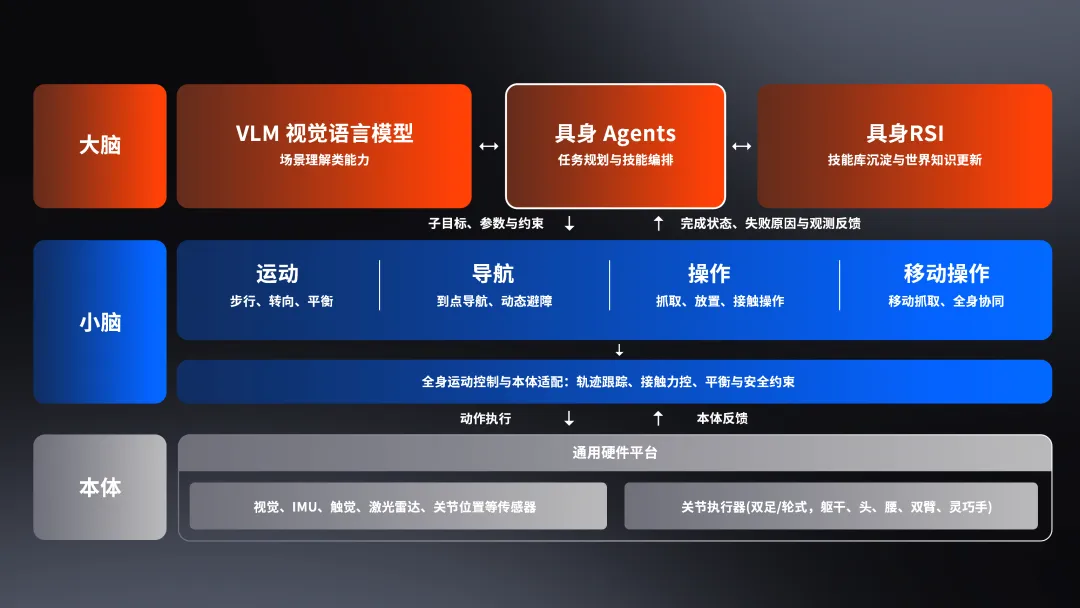
Note: In China, Koei-ling's body, brain, brain, and small brain, body, and brain architecture diagram.
The system was first tested in shoe factories. According to Zhang Zhengqiang, in the last decade, traditional industrial robots have taken on a large number of models in small batches, large batches of standard procedures, leaving people with small batches, many varieties of long tails. Shoe clothing is typical, the fabric is soft, the water will swell, the style changes to work, fixed programming is difficult to cope with. When he first entered the world-renowned branded shoe factory, he saw workers cutting, attaching, brushing around the workbenches, recalling the handmade shoes he saw as a child.
In August 2025, the first shoe-making robot entered a factory in a leading shoe-making enterprise, taking the shoe seal process into the production line POC, verifying process adaptation and continuous operational capability. In 2026, the company surpassed 400 million US dollars in total orders for handheld shoe-making robots, continuing to advance body-smart into shoe production.
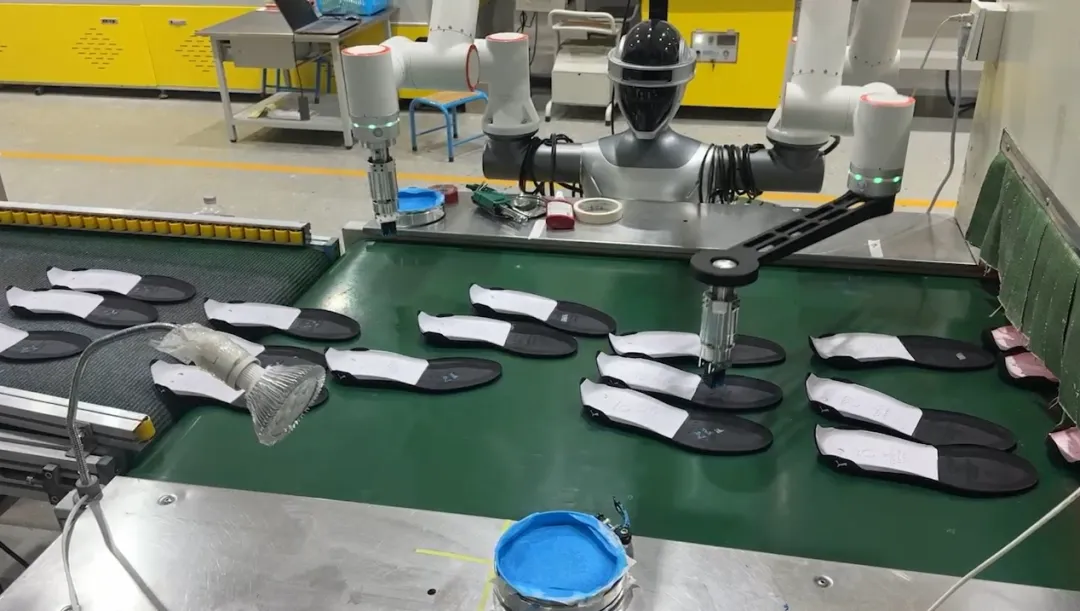
NOTE: China's Kohqing CASBOT PA detects application validation of action models in shoe manufacturing plants
Recent advances have come from the lightweight CASBOT PA model. PA is an acronym for Perception-to-Action, which stands for direct perception to action. The link has been opened to look at materials, generate movements, do kinesiology calculations, drive mechanical arm execution. It is now used as an executive arm for verification in real shoe manufacturing locations in leading shoe companies and to continuously modify strategies and execution effects based on real production tasks.
To understand why it's so light, we need to look at the hidden costs of moving into a factory with a physical intelligence, which I call a payload tax. Traditional industrial robots go straight on their predefined trajectories, walk along arcs, are faster and more accurate, but a change of model requires reprogramming.
Traditional industrial vision automation dismantles tasks into positioning, planning, execution, and other modules, link lengths, and changes in products may require re-taking of data, re-adaptation. General large model effects of 5B, 10B scale may be good, but the reasoning is sluggish and does not follow the scene. CASBOT PA parameters are smaller, directly generating movements from the visual, a consumer-grade display card can complete training, and the threshold for plant deployment and adjustment also decreases.
The production line does not receive a robot, but also to see if it loses hands. Returning to work and man-made interventions are too much, and speed is no longer needed. Zhao Ming said that the team is exploring two routes based on the world model and based on the real machine based on reinforcement training to improve the success rate.
The pace of the pace is up, the success rate is guaranteed, and the account can only stand at the beginning. More proportionate than measuring the numbers, is another thing Zhang Yi revealed, shoe manufacturing has had multiple procedures to buy back customers. It is not difficult to understand, buy back can explain the problem more than a single indicator.
The company also admits that this is not easy. Zhang Yi said that the same type of task is to change a production line, change a light, model performance can fluctuate, and the data collected can not be used directly to train. Speaking of the data source, Zhang Yi's answer is true.
03.
It's a good way to get to the bottom of the well and get to the top of the stairs.
The mine's business line is linked to Zhang Zhengqian's origins. He was born in a remote Shandong fire station, where the local gold industry is concentrated, and several generations of families mine. Geological changes, flooding, falling rocks, and the risk of wells are difficult to fully predict. He said that the probability of an accident, even one in ten thousand, falling on a family head may be irreversible.
In June 2025, China Ko-Hiling and Shandong Mining Group, Shandong Shandong Mining Group, jointly formed Shandong Shandong Mining Corp., Shandong Mining Corp., Shandong Mining Corp., Shandong Mining Corp., Shandong Mining Corp., Shandong Mining Corp., Shandong Mining Corp., Shandong Mining Corp., Shandong Mining Corp., Shandong Mining Corp., Shandong Mining Corp., Shandong Mining Corp., Shandong Mining Corp., Shandong Mining Corp., Shandong Mining Corp., Shandong Mining Corp., Shandong Mining Corp., Shandong Mining Corp., Shandong Mining Corp., Shandong Mining Corp., Shandong Mining Corp., Shandong Mining Corp., Shandong Mining Corp., Shandong Mining Corp., Shandong Mining Corp., Shandong Mining Corp., Shandong Mining Corp., Shandong Mining Corp., Shandong Mining Corp., Shandong Mining Corp., Shandong Mining Corp., Shandong Mining Corp., Shandong Mining Corp., Shandong Mining Corp., Shandong Mining Corp., Shandong Mining Corp.
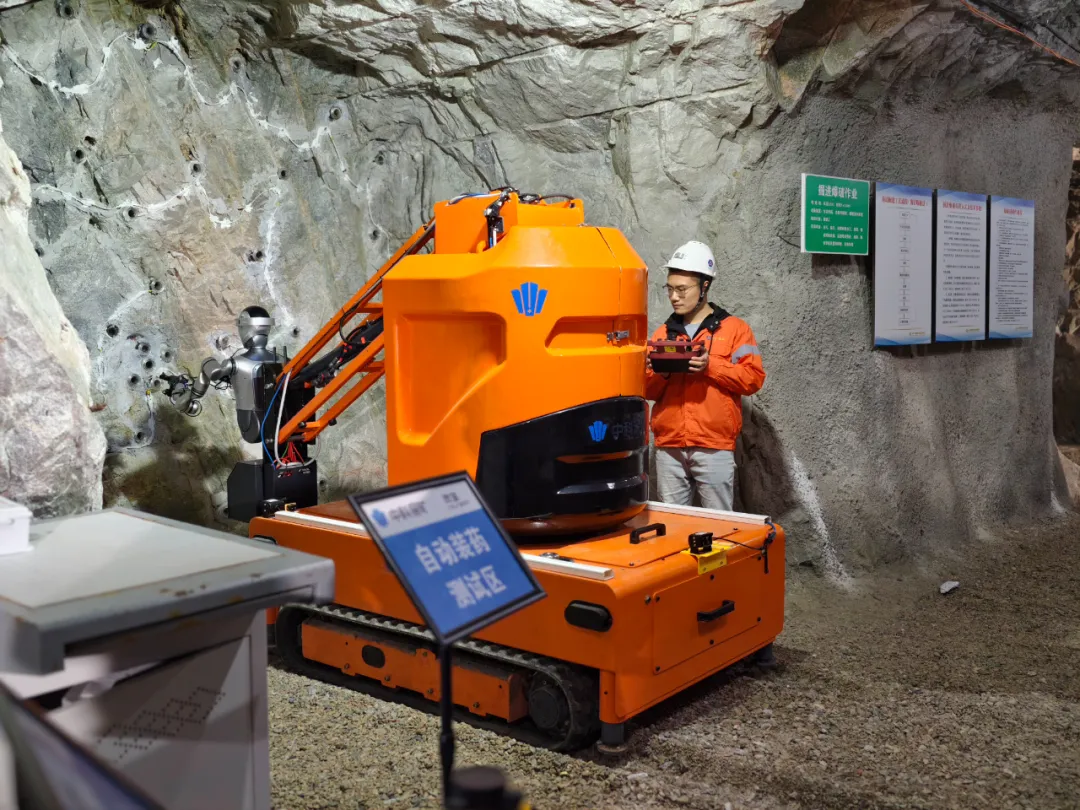
NOTE: China explores the application of body-smart technology in mining scenes
The difficulties at the bottom of the well are mostly in engineering details. Some mines are close to the seabed, the humidity is high, the equipment has to be protective. Batteries have to meet the essential safety requirements. The equipment occurs abnormally, but also to ensure the safety of operation.
In February this year, the band appeared in Beijing's springtime CASBOT BAND, the company's latest product from a general audience. The four CASBOT 02s, playing guitar, bass, keyboards and drums respectively, are real instruments, and play real rhythms and melodies.
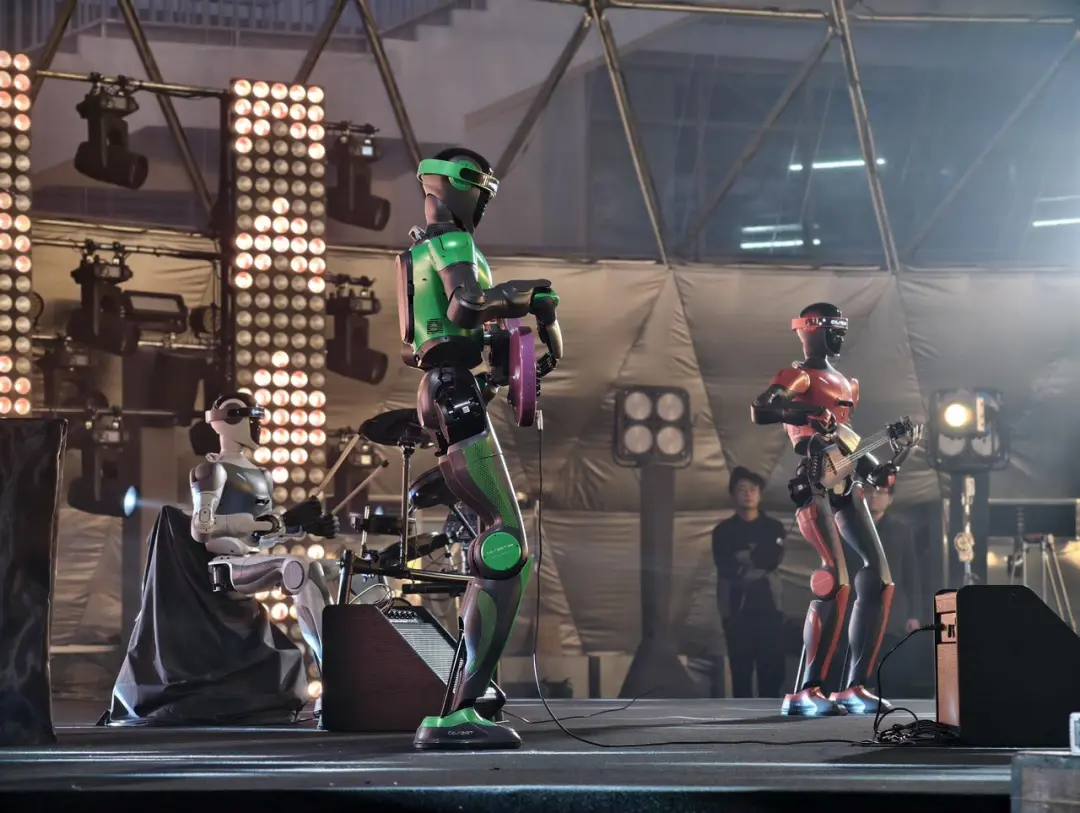
Note: China's Kohiling Robot Band will debut at Beijing TV in the spring of 2026
In Zhang's view, the band and the robot dance are two things. The dance mainly shows the ability to move, the band has to interact with the real physical world, to be accurate, to play well, and several machines have to be aligned at millisecond tempo. This is precisely the precise operation and multi-machine collaboration required in the industrial scene.
The band's commercialization progress made the team somewhat unexpected. Zhang Liu said that initially as a band, they mainly wanted to make robots' operational and motion control capabilities into products, and the commercial feedback after the launch was more positive than originally imagined. Currently, the company sells both an entire band and sells a single robot. Some bars do not require an entire band, only adding a robot drummer and a real guitar player in the store.
04.
After hundreds of millions of yuan, the program can be copied to large-scale delivery
According to the plan, the next phase of the project will involve the transformation of products and models along industrial, commercial, special and base lines. Light workplaces will be delivered from functional to replicable engineering. The special scenario will extend from mining to electricity and transportation. The overseas market will be cut off from science and entertainment, gradually expanding into the Middle East, Europe, Southeast Asia and North America, while building a system of tunnel cooperation, overseas certification and localization services.
He observed that companies that do well are often very focused. To achieve a success rate of more than 99% in a vertical scenario, data, brains, tools and customer collaboration are essential. Logistics is not rushed in for a while, where efficiency demands are high, gross margins are low, and a link error affects a large subsequent package.
A recent trip to Silicon Valley also gave him a glimpse of the space outside. He learned that the annual labor cost of folding the yuan for some ordinary jobs in the United States could be as high as $5,600,000, or even $7,800,000. Applications such as hairdressing, hotel services, and towel folding do not have to be budgeted domestically, but could be founded in the United States. He believes that China and foreign technology routes are not as big as imagined, followed by the speed, China's advantage in the size of engineers, industrial chain support and real-world scenario data. He also noted that Silicon Valley companies demonstrate that folding clothes can achieve a 99.5% success rate, not go wrong for three consecutive days and be fully commercialised, but very rarely.
He believes that the team has both scientific research innovation and engineering industry practice experience, and that its own commercialization path in industrial manufacturing and mining energy is clear that it will play an important role in the ecosystem resources of the AI industry, providing support in production, technology, customers and quantity.
He believes that mining and footwear are the areas where demand is clear, returns are quantifiable, and China is struggling to let industry demand drive research and development, and accumulated industry experience and data form differentiated advantages. He also wants companies and other invested enterprises in the physical industrial chain to collaborate more.
Looking back at the industry, capital is re-evaluating a way to model by job requirements, define products according to this cycle, first fix one thing, then talk about scale. Deliveries can bring heat, repurchases can explain value. From the shoe workplace, down the mine to the stage in the commercial space, China wants robots to take on more risk, eat more energy and be able to reproduce, while serving the physical economy, making people more creative.