This is a milestone in global AI.
Claude's parent company has finally come out of the closet, with an AI epic IPO.
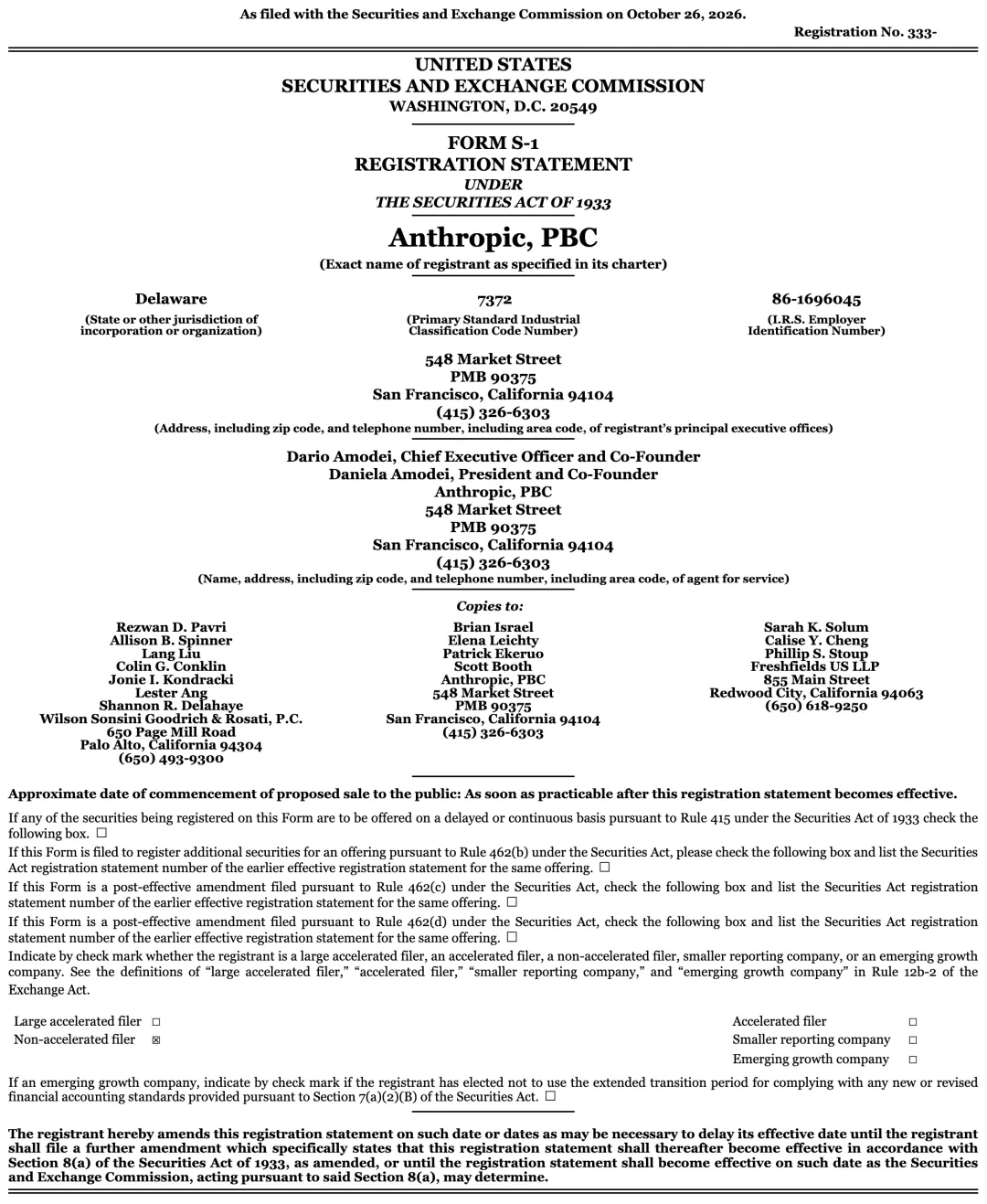
On the evening of October 26, Beijing time, Anthropic officially submitted an S-1 bid to the U.S. Securities and Exchange Commission (SEC) for listing on NASDAQ under the stock code ANT. This could be one of the world's largest tech IPOs and a key test of the generated AI business model in the open capital market.
This is not a secret filing, and Anthropic has filed an S-1 filing with the SEC, officially entering the IPO preparation stage, and plans to be listed on NASDAQ, stock code ANT, and leased by Goldman Sachs and Morgan Stanley.
The document laid the groundwork for the launch of Anthropic in November. Its funding is expected to exceed SpaceX's record for the largest global IPO of $86 billion, which it just created in June, a step ahead of its direct competitor OpenAI.
And because of the public submission, everyone can now see the power of the world's leading AI companies through their 335-page book of bids, and the market can accurately measure their business performance with public financial data.
While Anthropic has been "pre-heating" for a long time, there are a number of shocking figures after looking at the financial data:
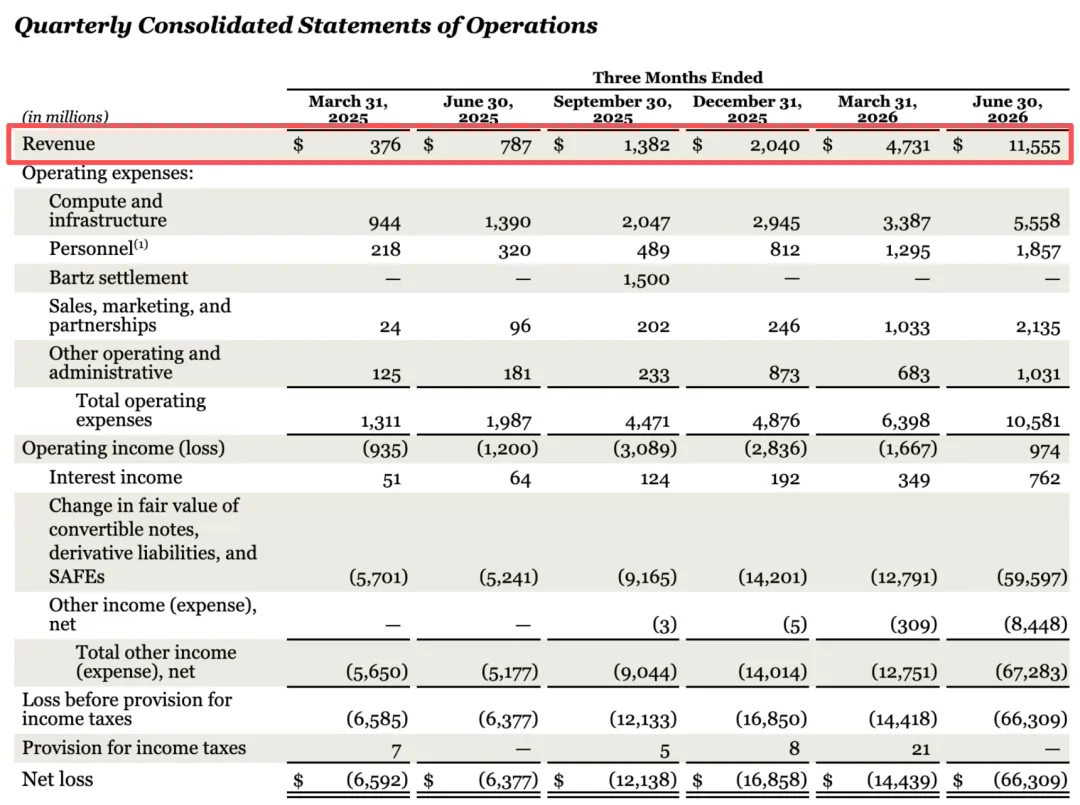
Revenue of $162.9 billion in the first half of the year, about 13 times that of the storm;
The company reported a net loss of $80.75 billion for the first half of the year, a staggering amount of account losses.
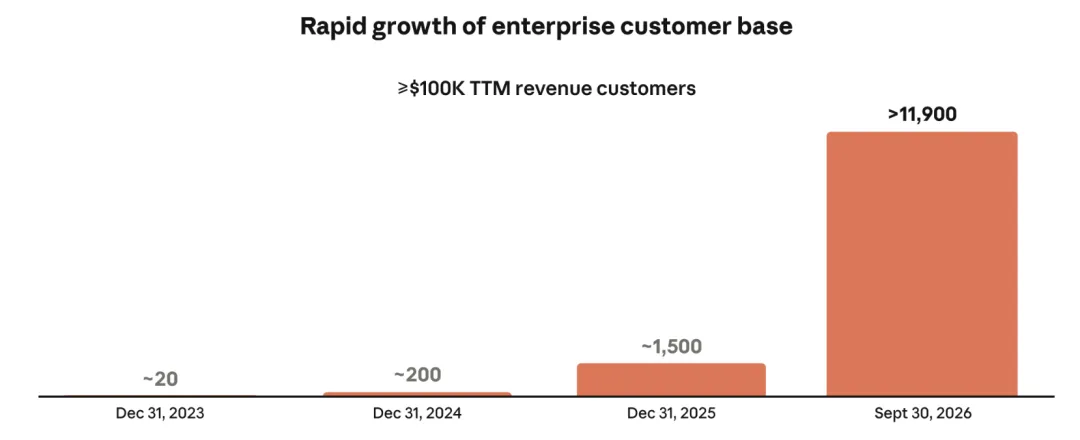
More than 119,000 high-value customers with annual contributions of $100,000;
Long-term computing spending promises to exceed $50 billion, putting almost the entire AI era at stake.
More exaggerated is the valuation. According to various foreign media reports, the market-driven Anthropic has reached a market valuation of between $15 trillion and $2 trillion, with potential financing of $10 billion.
Anthropic, founded just five years ago, is trying to establish itself as the world's most valuable technology company.
There's a crazy income on the one hand, and there's an astronomical number of losses and calculation bills on the other.
The answer is finally revealed.
The printer's on?
Half-year increase in revenue 13 times
Everyone agrees with Claude's high IQ, and Anthropic's revenue is rising rapidly. According to the IPO, it earned $386 million in 2024, $4.6 billion in 2025, and $1.63 billion in the first half of 2026, 14 times the year before.
The mainstream industry started making money. In the second quarter, the company made a $1 billion operating profit, with a profit rate of 8% and a loss of $1.2 billion in the same quarter a year ago. The change was mainly due to computational costs: In the first quarter of 2025, computational spending was 2.5 times the revenue; by the second quarter of 2026, it had dropped to 48% of revenue.
The cost structure of Anthropic's money is changing, which is 13 times more worthy of attention than the revenue surge.
In the first half of 2025, Anthropic will need to spend about $2.01 on computing and infrastructure costs for every $1 earned in the first half of 2025. By the first half of 2026, that number will have dropped to about $0.55.
Who is sending crazy money to Claude?
As of the end of September 2026, Anthropic had more than 1,1900 customers who contributed at least $100,000 in revenue over the past 12 months, including more than 1,900 who contributed $1 million in annual revenue.
What's even more exaggerated is that about 250 customers contributed more than $10 million over the past 12 months.
Anthropic's net revenue retention rate (NRR) reached a staggering 900% by the end of September 2026.
According to the statistical calibre of Anthropic, the same number of eligible customers who generated revenue a year ago contributed revenue in the third quarter of 2026, about nine times that of the same period in 2025.
This indicator does not include individual subscribers for Claude Pro and Max.
In other words, Anthropic is not only continuously attracting new customers, but also expanding the scale of AI use.
Behind this is a shift in business models. Claude is no longer just an AI chatbot aimed at ordinary users, but is a key source of revenue for businesses and developers.
In the first half of 2026, about $1.31 billion of Anthropic's $1.3 billion in revenue came from pay-as-you-go, accounting for as much as 80 percent, while subscription revenue was about $3.2 billion, accounting for 20 percent.
Businesses use the API to call on Claude's model, and the more they use and pay for the use of the model, the more money they spend. Especially with Claude Code and AI Agent entering the software development, corporate office, and other scenes, Claude is transforming from a question-and-answer tool to a productivity system that can participate directly in the work.
This also explains why Anthropic's revenue can explode in a short period of time. As more and more businesses embed AI into their core business processes, model calls are no longer a one-time consumption, but an opportunity to become an ongoing production cost.
For Anthropic, this means a more stable use demand and the possibility of further expanding revenue.
Of course, it will take time to verify whether these customers can stay long-term and continue to expand their spending. But at least for now, the five-year-old AI company has grown from a cutting-edge model lab to an enterprise AI platform with hundreds of tens of millions of dollars of customers.
While the second quarter of operations was profitable, Anthropic's net loss for the first half of the year was $80.748 million.
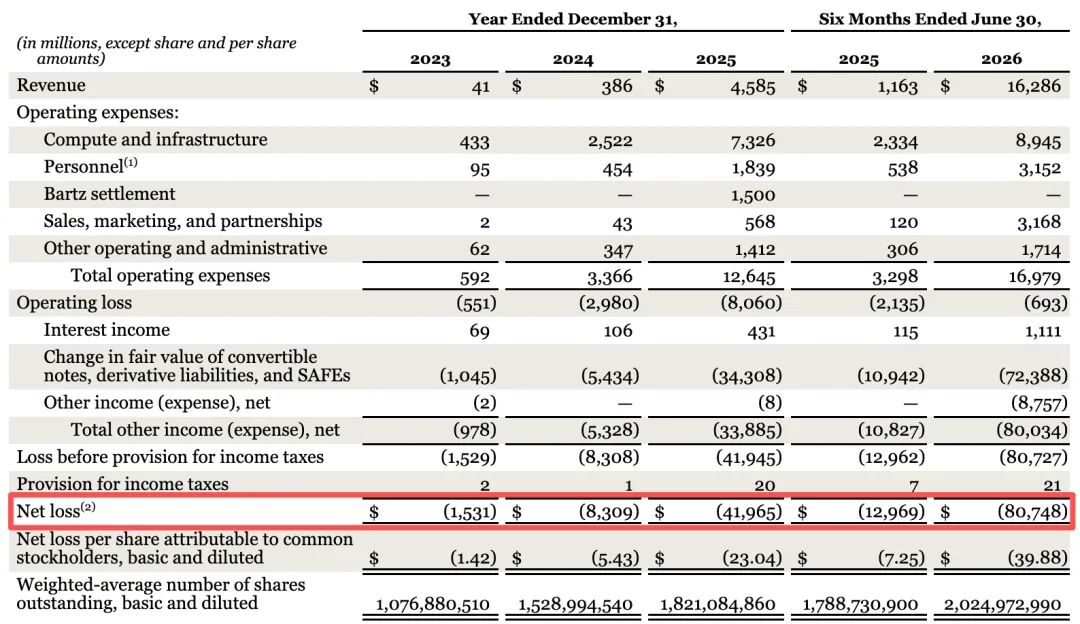
The answer lies mainly in the accounting process.
In the first half of the year, about $72.388 billion in net losses came from changes in the fair value of transferable securities, derivatives and financial instruments such as SAFEs. Anthropic explains that this is mainly due to the company's own valuations rising, pushing up the fair value of some of the unpaid convertible securities.
Simply put, the higher the company's valuation, the higher the corresponding account liabilities of some convertible financial instruments, which can lead to huge accounting losses.
But that's mostly non-cash losses, which doesn't mean that Anthropic actually burned $80.7 billion in cash in six months.
In fact, the company's cash reserves are still quite robust. As of the end of June, Anthropic had raised $14.11 billion in capital, $11.2 billion in cash and cash equivalents, and $1.3 billion in short-term investments, totaling about $13.17 billion.
However, how much is it going to cost to support the continuous operation of this AI printer? The answer may be even more surprising than the $80.7 billion in account losses.
The real big boss.
Infrastructure costs
Claude's money went to the people who bought the coconuts.
The book-by-book lists several major contracts: Anthropic leases TPU equipment to Broadcom, for about $161.2 billion; SpaceX's SpaceXAI, for example, purchases U.S. GPUs, for a maximum of $12.5 billion; Google for at least $1.14 billion; Amazon for at least $11 billion; Microsoft for at least $44.9 billion; Nscale for at least $44.6 billion; Lambda for about $41.3 billion; AMD for unfixed funds, the first batch is expected to exceed $20 billion.
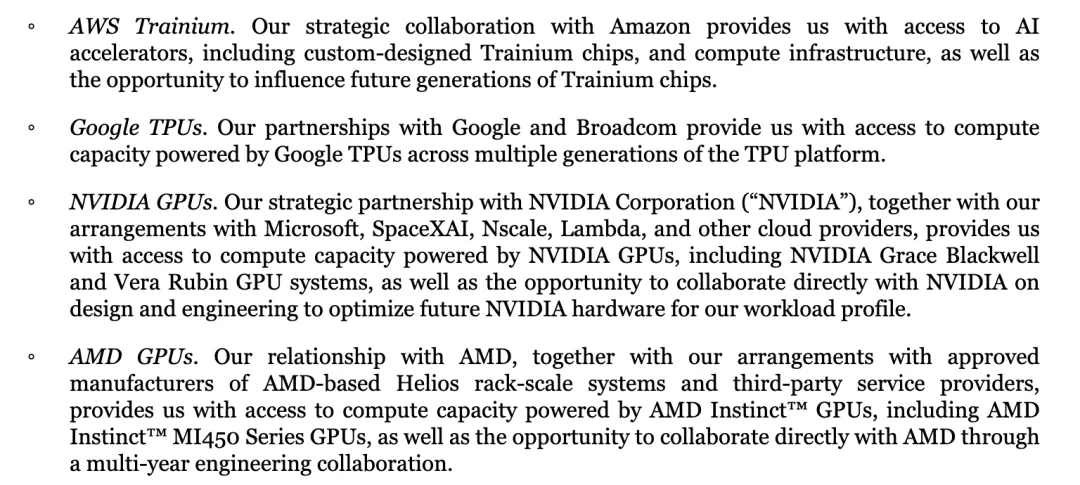
These add up to more than $600 billion, but this total is added by accounts such as Kobeissi Letter itself, where the total amount of the book of bids is still empty. The book of bids further states that the new contracts signed and modified after June 30, the minimum payment is about $245 billion; another batch of TPUs will be purchased from 2028 to 2031, expected to be $125 billion to $15 billion.
Sales channels are similarly dependent on cloud providers: 47% of revenue in 2025 and 48% in the first half of 2026 were sold out through cloud providers' application markets.
Seven founders hold 50.1% of the vote
Not giving up control of the market
In addition to the financial data, there is a very special design in the Anthropic equity structure. After the IPO, the founding team will retain control of the company.
The tender shows that seven co-founders, including CEO Dario Amodei and president Daniela Amodei, will hold special Class F shares through a specially established entity. This arrangement will give the founding team 50.1% shareholder voting rights.
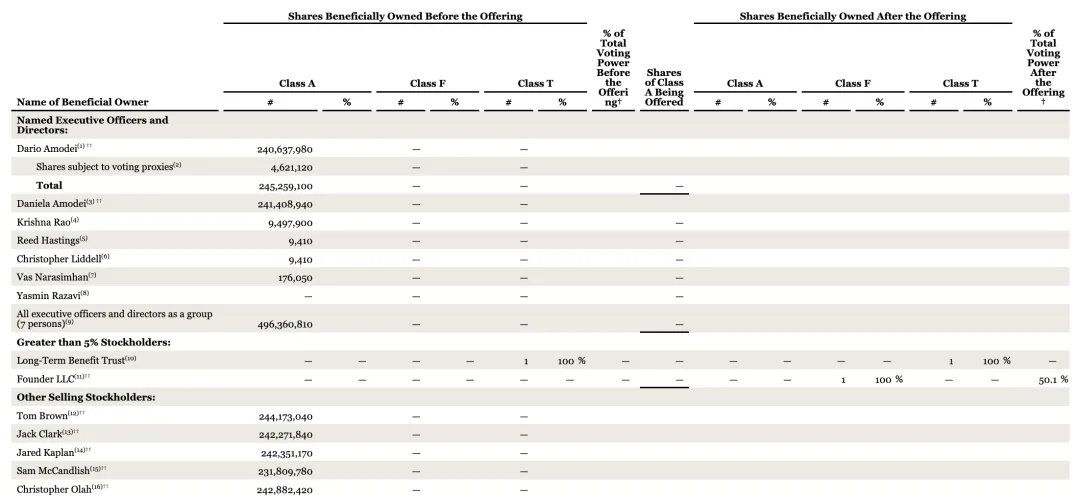
According to the relevant financing and transfer arrangements disclosed in the tender, Amazon's partial transferable shares are limited to a holding percentage of 12% and Google's distribution of shares in the 2026 financing agreement is limited to a percentage of 14.99%. The two companies mainly hold Class N shares with no general voting rights.
At the same time, the Long-Term Benefit Trust of Anthropic will also gain the power of a majority of the elected board members through a special governance mechanism.
This means that even if investors buy Anthropic shares through an IPO, it does not mean that they can make major decisions about the company based on the proportion of shares they hold.
This design is closely related to the concept of AI security that Anthropic has always emphasized. Anthropic is a public benefit corporation whose mission is not only to pursue shareholder returns, but also to promote the development of secure, controllable advanced AI.
However, this also generates an interesting contradiction: ordinary investors take the risk of stock price fluctuations, but it can be difficult to influence the strategic direction of the company.
Even in the risk disclosure of the IPO, Anthropic explicitly discusses the catastrophic risks that advanced AI could pose and even the risks to human survival.
For example, the document discusses the unpredictability of autonomous agents, information security issues, regulatory and copyright litigation, and extreme accidents that may exceed insurance coverage.
This is not to say that these consequences have already occurred, but rather that as AI Agents gain greater autonomy, their legal and security risks are becoming commercial risks that need to be formally measured.
A company that has publicly suggested that its technology could be extremely risky is now preparing to go public with a trillion-dollar valuation. This may be a special proposition that the AI capital market has never faced before.
Valued at up to US$2 trillion
What exactly is Wall Street buying?
According to media outlets such as The Associated Press, Anthropic's potential IPO valuation could be as high as $1.5 trillion to $2 trillion.
If the first half of 2026 were to simplify the yearly revenue, Anthropic's annual revenue would be about $32.6 billion.
It is valued at $1.5 trillion, corresponding to about 46 times annual revenue.
It is valued at US$2 trillion, corresponding to about 61 times annual revenue.
This is not a valuation based on future earnings forecasts, but simply an annualization of previously disclosed half-yearly earnings. Such a high valuation multiple means investors need to believe that Anthropic can continue to grow strongly in the coming years and significantly improve profitability.
It seems that what Wall Street is buying is not just Claude, but that it is betting that AI models can become the infrastructure of the next generation of digital economy. If AI Agent really enters the field of corporate office, software development, financial services, and research, future Token calls may continue to grow. At that point, Anthropic may become the basic model platform behind corporate AI applications.
However, in turn, the fierce competition between models, the advancement of open source models, and the continued decline in reasoning costs may also undermine the platform's long-term pricing capabilities.
Anthropic's IPO meant much more than creating a trillion-dollar AI public company.
It could also be the first large-scale, publicly priced business model for a flagship base model company on Wall Street.
Over the past few years, the global AI industry has been answering the question of how much value big models can create, and now the question is who can continue to make money from AI?
With six-monthly revenues of $162.9 billion, Anthropic demonstrates that companies are willing to pay for advanced AI capabilities; with rapidly improving operational data, it shows the potential for profitability to scale.
But it also made more than $50 billion in long-term commitments to accounting, revealing the staggering capital demand behind the business.
On the other hand, OpenAI, Google, and many other open-source model camps are continuing to advance model capabilities and price competition.
The AI giant of the future may not only be the company with the most modeling capabilities, but it must be the company that knows best how to turn modeling capabilities into revenue, turn revenue into profits.
Anthropic has released its first open-ended answer to the capital market. Next, let's see how much Wall Street is willing to pay for it.
According to the SEC's official rules, IPO companies using a non-public disclosure procedure must open a public offering book at least 15 days before the official launch date. Anthropic's public filing date is October 26, which means that the initial public offering date is November 10 at the earliest.
The full list of bids is as follows:
The full text of the booklet:
© THE