When we talk about smart glasses, many people's first reaction is: Can it take pictures, play songs, navigate, or is it just like a headphone jack?
But with the rapid development of egocentric vision, multimodal models, human-machine interaction, and physical intelligence, the smart lens is evolving even more profoundly: it is no longer just an accessory responsible for collecting or displaying information, but is becoming the first intelligent platform to connect human perception, continuous memory, and digital/physical action.
Recently, a team of researchers from Zhejiang University's APRIL Lab created a systematic research framework for this rapid development in their review From Seeing to Acting: Smart Glasses as First-Person Intelligence Platforms, in which they organized and discussed relevant concepts, methods, resources, assessments and future directions.
From seeing to acting: Smart glasses as first-person intelligence platforms
Address of the paper:https://arxiv.org/abs/2608.24877
Project warehouse:
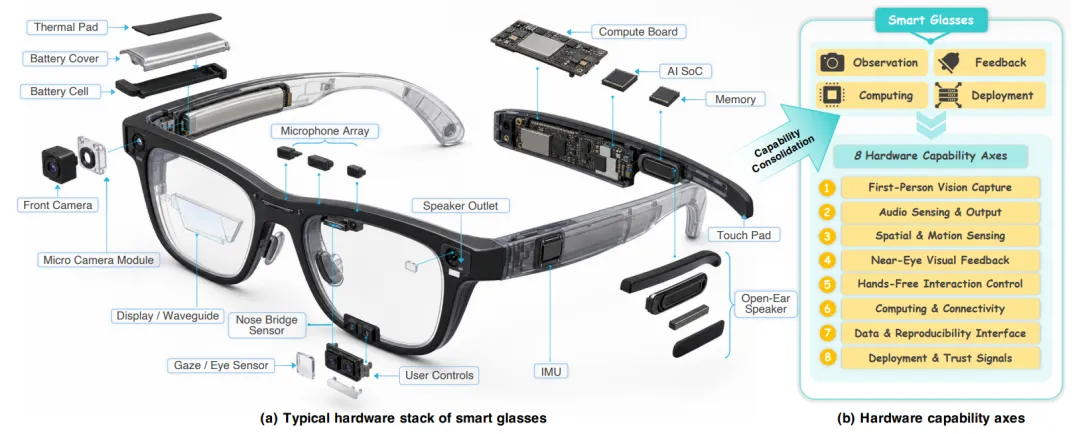
From Hardware Specifications to Verifiable Axis
A set of smart glasses, which are received at any given time by a group of first-time observers: the images you see, the sounds you hear, your movements and positions, your attention and gestures, your apparent interactions, and the state of the device and the privacy strategy. These signals are not isolated sensor readings, but a timely structured flow.
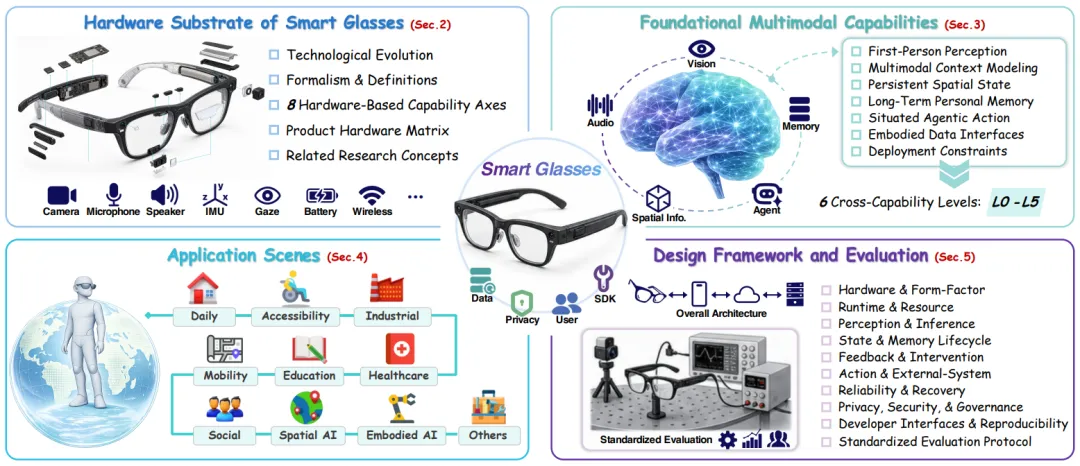
The paper is based on the first-person data stream, which divides device/platform hardware into eight verifiable axes: visual acquisition, audio perception and output, space and motion state perception, near-sighted visual feedback, hands-free interaction control, computing and connectivity architecture, data and replicable interfaces, deployment of engagement and trust signals.
These eight hardware capability axes determine what research claims are supported by different lens routes, respectively, and translate vague product labels such as AI lens lenses into systemic conditions that can be evaluated and replicated. The paper also gives a matrix of smart lens product hardware, mapping representative devices to these capability axes, and points out that capability progress is neither a single-mode function of the number of sensors nor a comparison of the complexity of the display, with each route being made differently on a limited budget.
Seven basic capabilities and the L0-L5 framework
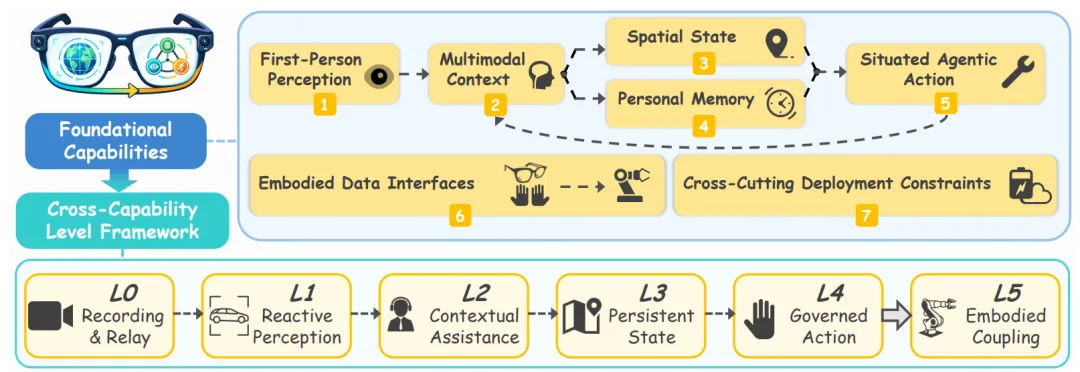
On the hardware side, the paper abstracts seven interdependent basic capabilities: first-person perception, multimodal context, persistent spatial states, auditable personal memory, contextualized intelligent body actions, physical data interfaces, and deployment constraints across all nodes.
These capabilities are not simple linear flow lines superimposed, with first-person perception providing evidence base, multimodal contextual integration of heteromorphic observations, spatial states maintaining geography across locations and object-level contexts, personal memory extending systemic states over events and time, situational actions closing the perception cycle, state-of-the-art movements. Physical data interfaces extend outwards, with first-person observations transforming into robotic learning and transpersonal migration resources.
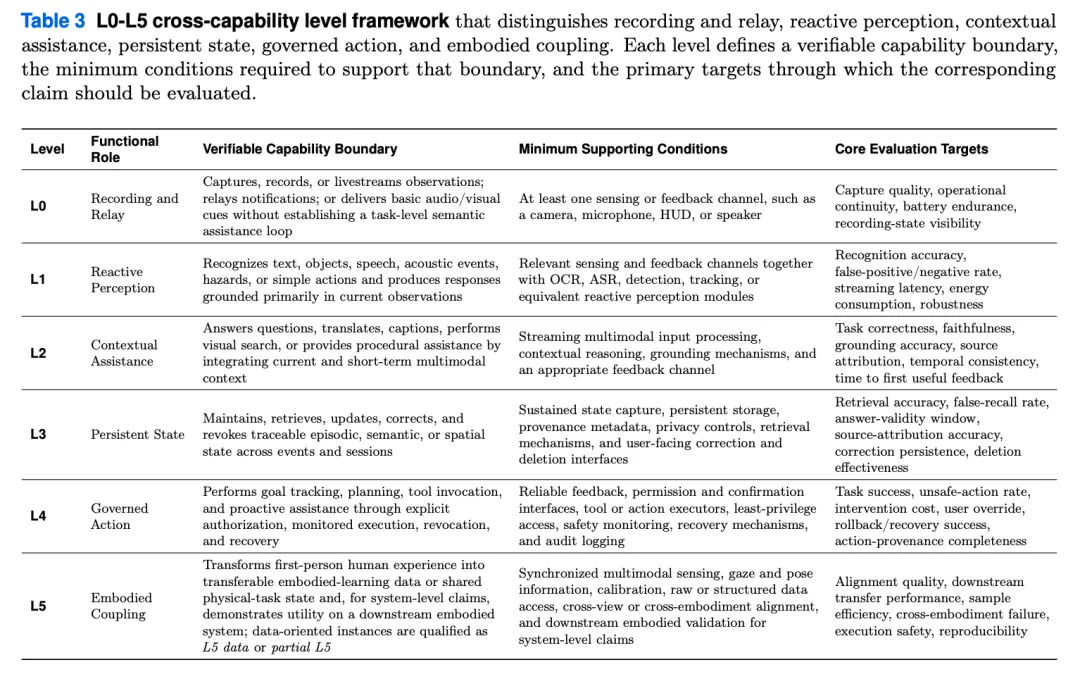
Based on these capabilities, the paper proposes an L0-L5 cross-capacity-level framework: L0: recording and transmitting, L1: instant reactive perception, L2: contextual contextual assistance in situation, L3: persistent state, L4: controlled action, L5: physical alignment. This L0-L5 framework does not serve as a product ranking, but as a boundary of capabilities for specific tasks and evidence.
Application scenarios and deployment frameworks
The review further examines the work and hardware platforms in nine real-world scenarios: daily assistance, unimpeded assistance, industrial processes, medical and care, education and skills training, mobility and traffic safety, social collaboration, spatial intelligence, and physical intelligence. Each scenario connects the required capability cycles, representative datasets and benchmarks, research systems, product inputs, affected parties, failure outcomes, and lack of validation evidence.
Different application scenarios also imply different functions and responsibilities, so the paper proposes a nine-dimensional deployment framework covering hardware, running time, perception and reasoning, state and memory lifecycle, feedback and intervention, action and external systems, reliability and recovery, privacy security and governance, developer interfaces and replicability. Based on this, the paper gives a proposed conditional evaluation protocol, a deployment checklist, and an alternate step-by-step evidence of deployment from documentation, laboratory measurement, benchmarking testing, device input relay, fault detection to terminal research, alongside deployment to privacy security auditing.
What is the meaning of this verse?
The paper concludes with eight open challenges and six roadmap directions for a credible first-person intelligent system. The authors hope that this review will drive the conversion of smart glasses into comparable, deployable, and reproducible objects of research, providing guidance for future research and applications, and providing a clear field map for the community.
Information from the author
This paper was completed by the APRIL Laboratory team at Zhejiang University, the first author and communicator is Zhang Jiangnin, a researcher in Zhejiang University's Hundred Project, and the first co-author is Chen Liu, a graduate student at the APRIL Laboratory at Zhejiang University.

© THE