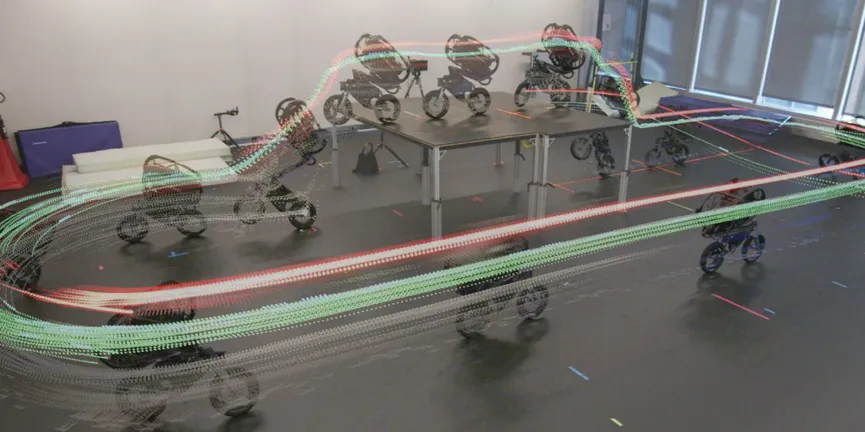
“ It's been a long time since I've been on a plane, and I've crashed a dozen times and flipped half a second before.
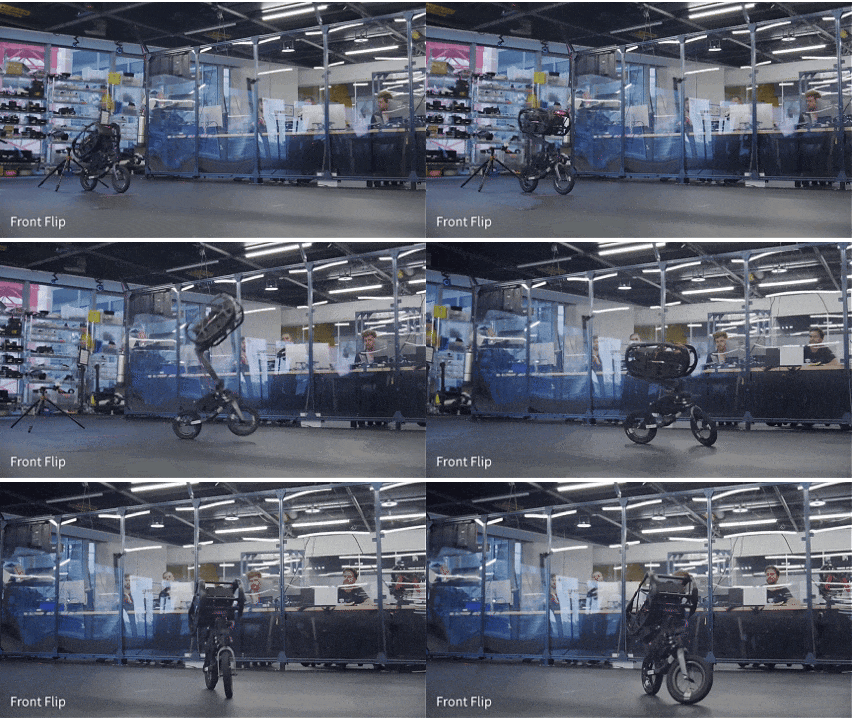
In a half-second, five motors -- a bicycle robot without a rider -- completed a frontal overturn.
It has no propellers, no springs, no control rotor, and no mechanical devices specifically designed to maintain balance. The entire robot has only five degrees of driving freedom, less than half of a quadruped robot (usually twelve).
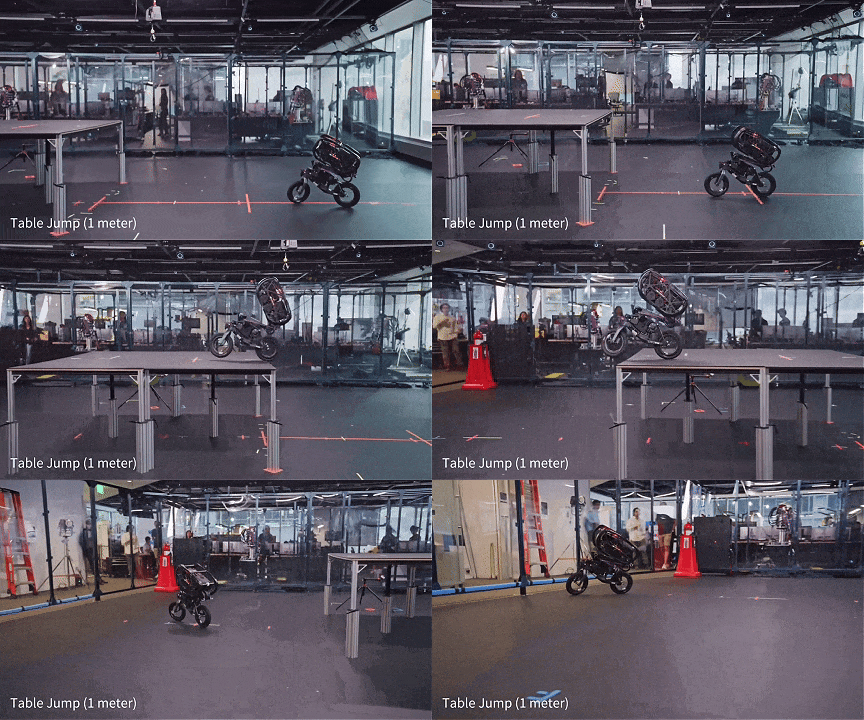
Based on these five engines, it jumped to a 1 m high platform, reaching a top speed of 8 m/s, and was able to jump with one leg behind the wheel, drive with the head, and balance locally. All the exercise strategies were completed in a simulation environment, deployed directly to physical robots, zero-sample migration, no on-site modulation, and secondary training.
This is the UMV (Ultra Mobility Vehicle, Supermobile Vehicle) robot published by the RAI Institute in the United States in the journal Science Robotics.
01.
A child's bicycle with a 23.5-kilogram head
The UMV looks well-described. A bicycle, but its position is occupied by a huge rubber skull. The entire robot weighs 23.5 kg and is only 0.8 meters high when fully rolled. The skeleton is a specially sold Specialized Hotwalk Carbon children's carbon fiber balanced vehicle.
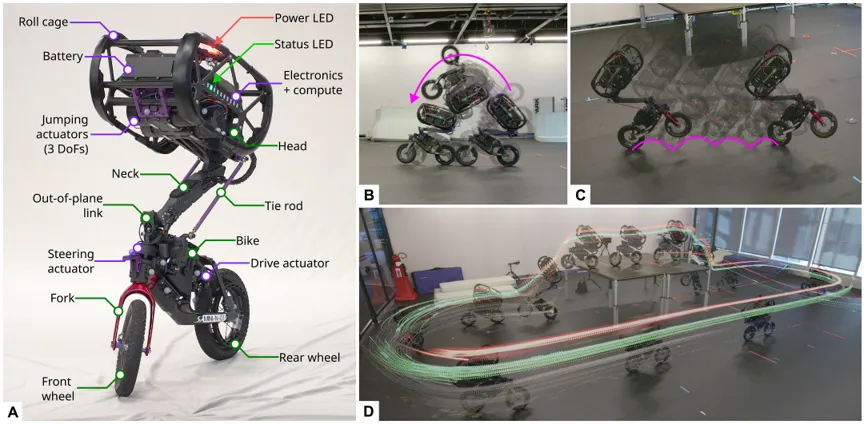
The head is equipped with batteries, calculating units and a jumping motor. The design logic is simple: to make the robot jump high, fold fast, balance well, the most effective way is to concentrate most of the mass on the connector at the top.
According to Newton's third law, when the head accelerates rapidly upwards through the clutch, it imposes downward counteraction on the clutch, causing the rear wheel to hit the ground and the entire robot to be pushed up.
Balance is also the same logic. If the robot turns left and the head turns left, producing a right-to-left counteraction torque, pulling the centre of gravity back to its equilibrium position, the principle is the same as for humans in single-wheeled vehicles.
It's more clever to flip ahead. When you jump up, you pick up your head, turn the inertia smaller, turn the speed faster; when you land fast, stretch your head out, turn the inertia larger, slow the buffer, and land smoothly.
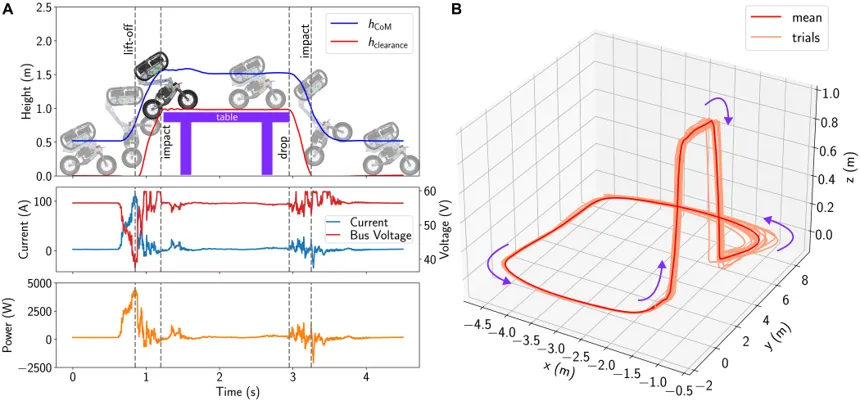
When jumping up to 1 m high, the motor's power peak reached 4.5 kW, lasting 0.25 seconds. What is the concept of this figure? A 23.5 kg robot jumps at the instantaneous power density, approaching the motor of a small electric car.
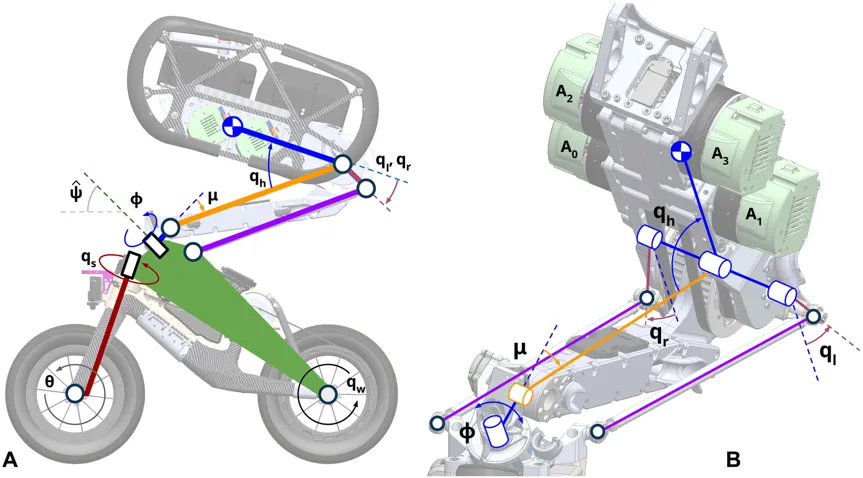
UMV's design philosophy can be summed up in one sentence: cut off all auxiliary stabilizers and leave the problem to the algorithm.
There are no springs, no counter-rotating wheels, no control rotor, no single-track narrow body, no multi-track wide supporting surface. Stability, energy storage, buffering, all of these functions were originally assumed by the mechanics, all of which were transferred to reinforcement learning strategies.
02.
Algorithms themselves invented the skills of human drivers.
Supplementing Hardware Shortcuts is a set of restrictive reinforcement learning frameworks, the core of which is the PPO (near-end strategy optimization) algorithm.
The team used this algorithm to train four main strategies: driving, jumping, flipping, and jumping. The entire training was done in the NVIDIA Isaac Lab simulation environment, with the mindset and teaching children how to ride a bike like falling back and doing the right thing to reward.
The team didn't give the robot any action scripts for cheering, cheering, and cheering, and they didn't specify the exact timing of the contact.
The first is to design a reward function that tells the robot what a good worm is.
There are three categories of rewards: task rewards with the highest weight, such as tracking the target speed, jumping to the target position; style rewards that encourage posture stability; normalisation rewards that punish torque overload, movement overload, and impact overload.
Secondly, soft punishments are replaced by hard punishments, which simulate real hardware damage.
Once landing speeds exceed, power overloads, joint impact limits, physical contact, the current training cycle immediately ends and restarts. The initial training constraints are relaxed and, as the strategy progresses, gradually tightened, allowing the AI to learn the core movements first, and then to learn to move within the hardware security boundaries.
Third, the randomization of the whole area, the rudeness of the strategy.
In training, they randomly modify almost all the parameters: body weight, tire friction, core position, engine power, controller gain, drive delay. Sensor readings add noise, and occasionally push random force to the robot. The strategy is learned to accomplish tasks in a variety of imperfect rolling scenarios, rather than only with a set of precise parameters.
In the end, a well-trained strategy can be used to directly copy to a real machine, without any on-site mitigation, with additional training to achieve zero sample migration.
What's even more interesting is that the two autonomous moves, which were not designed by the engineers at all, were created by AI itself in the reward space.
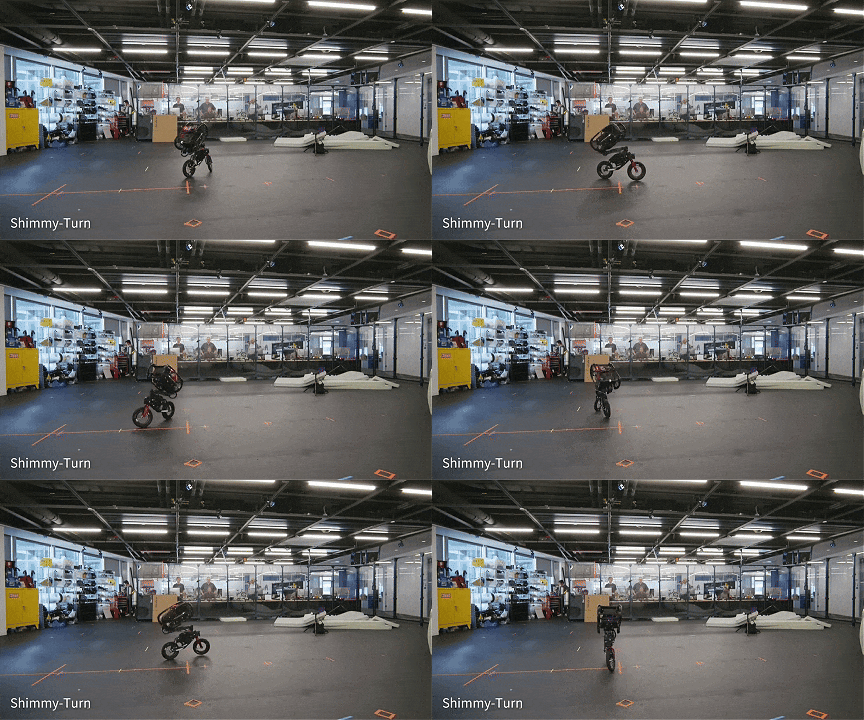
One is to swing in the original position. Lift the front wheel, swing quickly around the head, drive the front wheel to swing back and forth, and turn the rear wheel to achieve the original deviation.
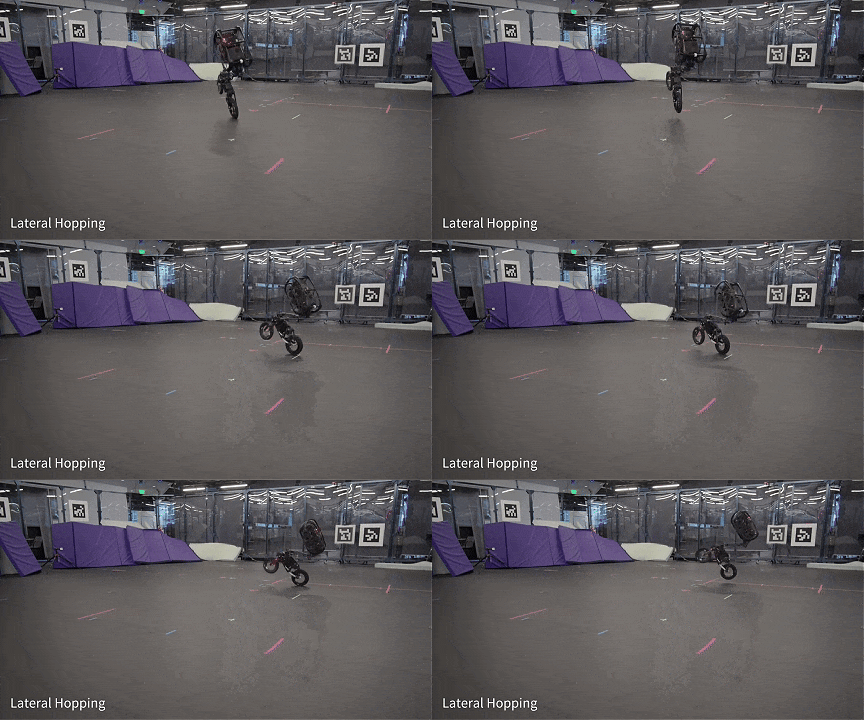
The second is the rear-wheel jump rolling balance. When the rear-wheel single-point jump touches the ground, it rolls a little backwards and forward with force, rolling back and forth to maintain balance, and the skills of single-wheel riders are highly similar.
These two moves are difficult to manually encode using traditional control methods.
03.
Seven months, dozens of crashes and a half-second flyover
The experimental data in the paper brings the robot's capabilities to a very intuitive level.
Maximum cruising speed: 8 m/s (about 28.8 km/h), which exceeds the steady cruising speed of conventional quadruped robots;
The height of the barrier: 1 m, reaching 130% of its vertical height;
Continuous reliability: 15 autonomous jump stage tests, high overlap of the jump stage trajectory, fluctuations occurring only during the landing shock stage.
The most difficult moves are the overturning, which is also the most expensive part of the project.
The UMV is lightweight and can easily be damaged by the impact of heavy debris upon landing. Dr. Kim Jong-un specialized in tackling this problem during his RAI internship.
His method is called iterative motion mimicry (IMI), and the central idea is that he creates a rough, even physically impractical, reversal of the trajectory when sketching a plot, and that reinforcement learning strategies mimic it, optimizing a bit at a time each iteration, gradually narrowing it down to actions that can be executed safely by the machine.
The process was very brutal. In two semesters of internship, the samples broke down dozens of times, and every time they broke down, the hardware team had to dismantle and repair them. It took nearly five months to make the safe landing without damaging the hardware; it took two months to make the smooth transition to running after landing.
Seven months in the making, dozens of hardware failures, and less than a half-second of steady overturning.
In an interview, RAI researcher Shamel Fahmi said that it is now a visitor demonstration project in the laboratory, very reliable and has never failed.
04.
It's not a leg replacement, it's a new design space.
The UMV is not going to replace four-legged, two-legged robots. The advantages of terrain adaptability, load capacity, static stability, and leg-like robots remain irreplaceable.
The value of the UMV is confirmed by a new line boring machinery for reduction, calculation and addition.
In the past, it has been the industry's default to make robots more agile, with more joints, more powerful executors, and more precise movements. UMV demonstrates that in dynamic motion scenarios, learning to control powerful, minimal mechanical structures can accomplish many of the things that only complex leg robots could do in the past.
Of course, its limitations are also clear. Current laboratory testing also relies on Optitrack's motion capture system assistive status estimates that there is still a distance from fully autonomous outdoor operation on the aircraft; the gap between simulation and reality remains the core challenge of this method. The team is testing laser radar inertial mileage, detachment of targets, and fully autonomous operation.
But the most crucial point of this paper is to put forward a new design proposition: when computation is cheap enough, when simulation is accurate enough, when reinforcement is robust enough, will the first question of robotic design go from what I need to build to what I need to teach the algorithm?
If this path is taken, the cost of the next generation of mobile robots may come not from cheaper hardware, but from smarter brains.