Last month, Jev burned through the AI community.
An intelligent body that does not produce long text at all, its main job is to make judgments. It is simple and insignificant, but it is fast enough, practical enough, and has been adopted by many developers into the workflow of Agent.
The ability to achieve complete autonomy in the MC to defeat the Dragon from scratch to the end.
The redness of Jev reflects a change that is taking place this year: the ability to care is becoming more practical. After all, making AI work is much more complicated than solving problems.
The tasks at work are often complex and long-lasting. Let the AI complete independently, it has to find information, analyze information, find problems, and then decide not to go back and modify the add-on. Once it goes in the wrong direction, it can be corrected in time. The longer the task lasts, the more likely it is to make mistakes and run away.
But the big model that really broke this hard-boned one is still outnumbered. Today, major players in the open source model field are starting to push in this direction as well.
Ling-3.1-flash was released on September 30, and officially became open-source on October 15. The upgrade focuses on complex tasks and long-range execution.
Once we've got the model, we want to test it out: how far can it go if we don't break down the task into step-by-step instructions and give it to AI?
So we prepared several different types of tasks to make Ling-3.1-flash work itself out.
Architecture, performance, cost, three cards from the Ling-3.1-flash
Let's just look at the basics of Ling-3.1-flash.
The total parameters of the model are about 560B, but for each processing of a Token, only about 25B parameters are activated.
Architecturally, the Ling-3.1-flash is a continuation of Bentley's previous hybrid linear attention design: each seven-layer KDA is equipped with a 1-layer Gated MLA, and each Token activates eight routing experts and one sharing expert.
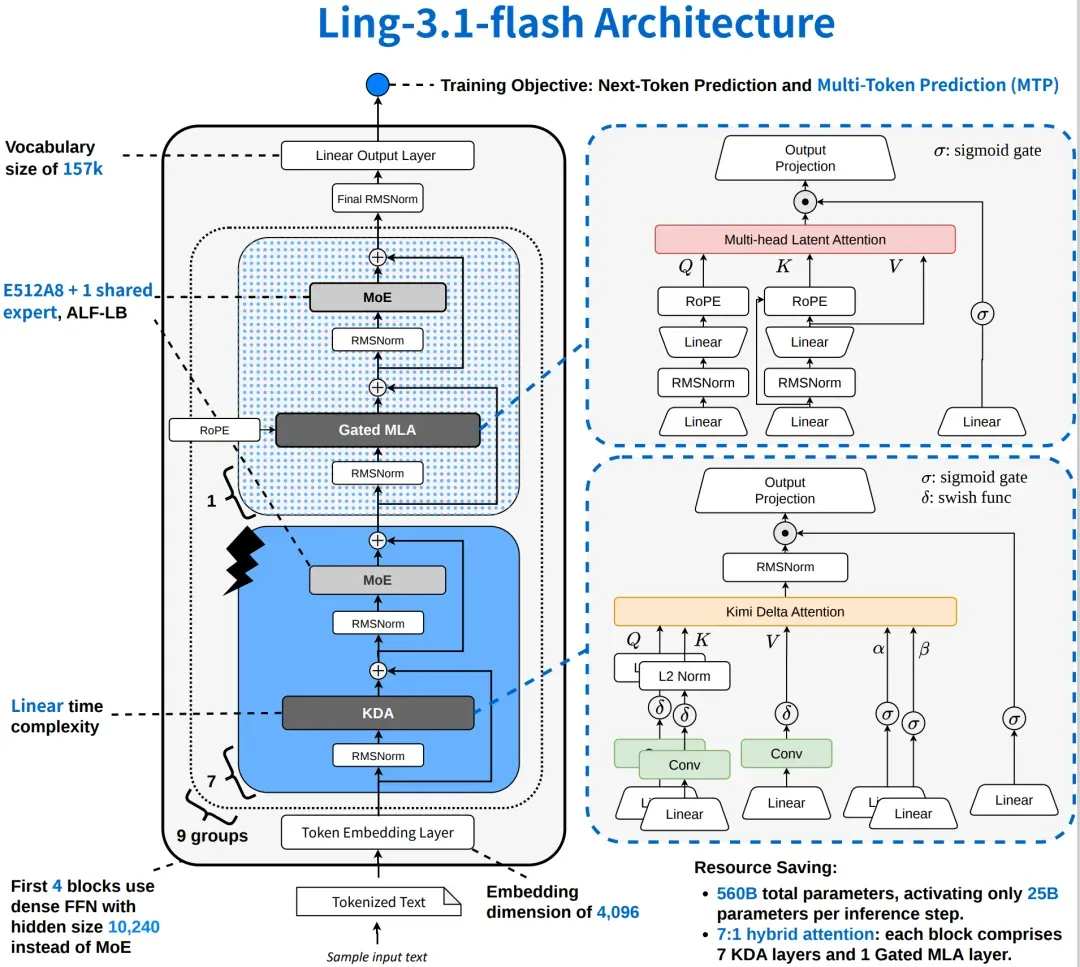
Simply put, both to get the model loaded with enough information and to control the computational costs of handling the long context.
In this case, KDA uses a linear complexity design, where computational expenses do not expand as fast as traditional full attention as the context evolves. Gated MLA, which is retained every eight layers, provides the model with a channel for global information interaction to help it capture key associations when processing long sequences.
Such a combination is particularly suitable for complex tasks that require repeated reading of data, maintaining large libraries of code, and continuously calling tools.
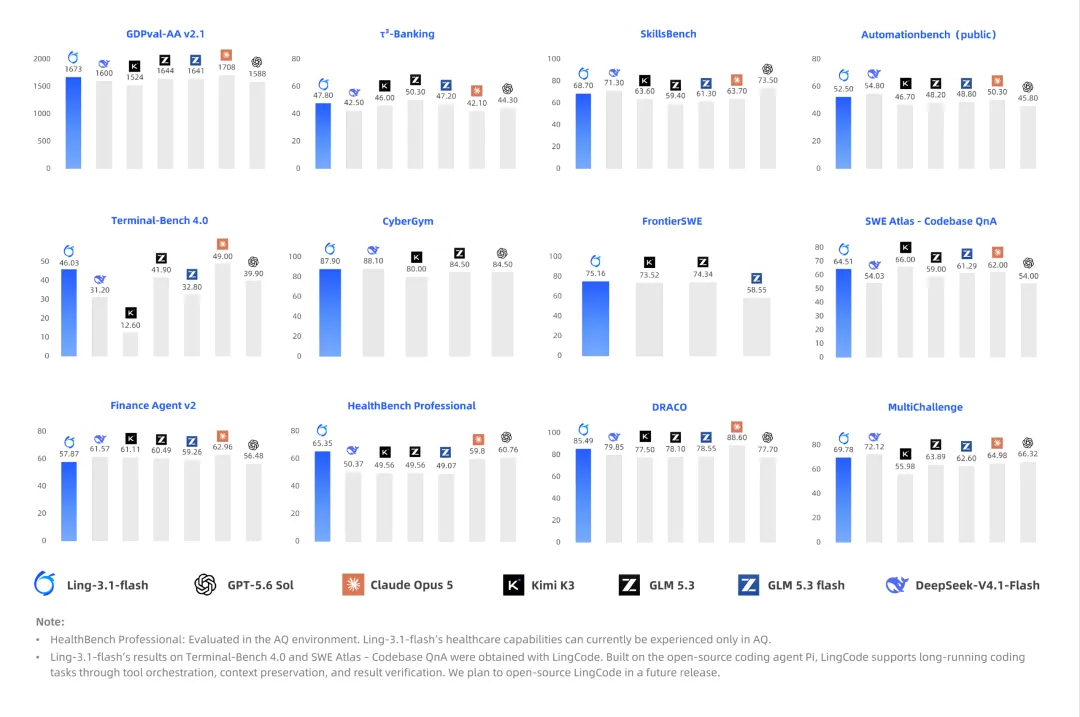
From a public standpoint, the Ling-3.1-flash has demonstrated its competitiveness in multiple benchmark tests involving real-world missions.
For example, GDPR Val-AA V2.1 focuses on integrated task handling capabilities in everyday office scenarios; FrontierSWE and Terminal-Bench 4.0, respectively, test models to solve complex software engineering problems; and the ability to complete tasks using terminal tools; and HealthBench Professional focuses on professional information understanding and communication in medical scenarios.
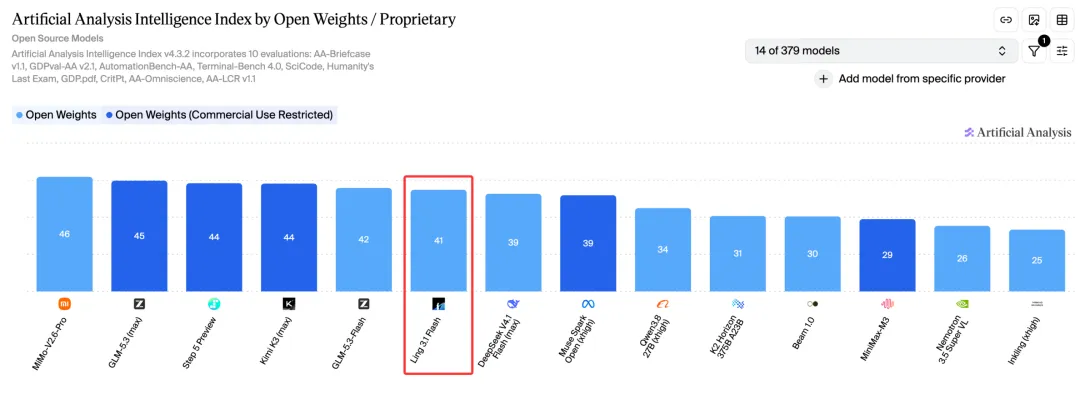
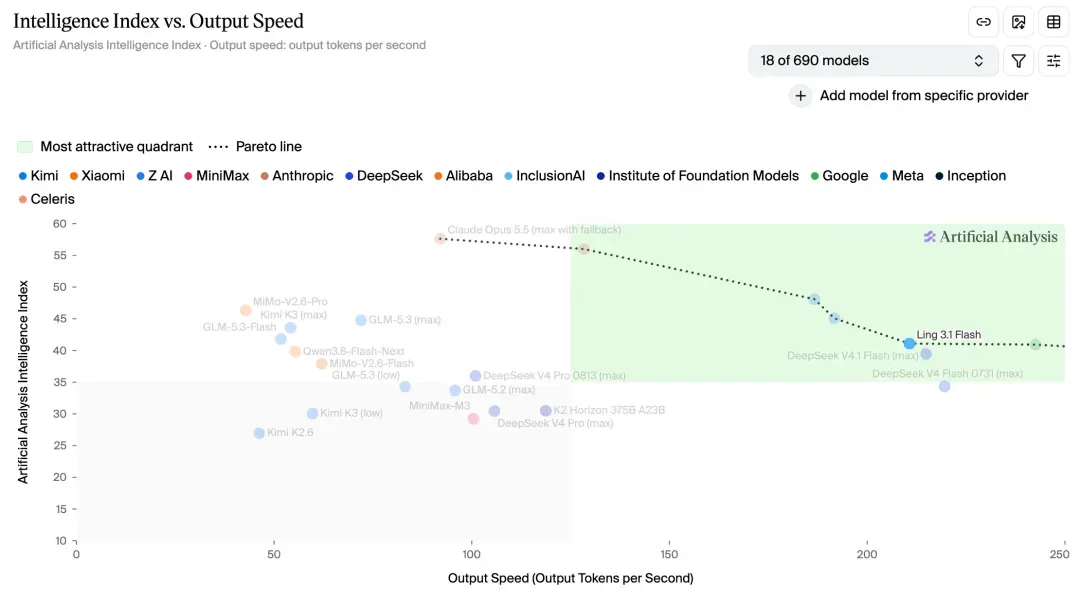
Ling-3.1-flash scored 41 on the Artificial Analysis Intelligence Index, which is a pretty good score in the open source model.
In this version, Baring emphasizes a word: "intelligence comparison".
In other words, it's about completing the same task, exactly how much computing power, how much time, and how much money the model will consume.
According to a public assessment by Artificial Analysis, the Ling-3.1-flash has a smart index of 41, output speeds of about 210 Token/s, and a mixed call price of about $0.19 per million Token, making it competitive in both speed and price.
In order to further squeeze the cost, Boeing is also reducing the deployment level. By quantifying MXFP4 to routing experts while maintaining the Dense layer at block-FP8 accuracy, model weight occupancy has been squeezed from about 534GB to 292GB, and deployment needs have been reduced from 8 to 4GB.
After looking at the basics, we tested it directly.
Let AI edit once in a while
Our daily routine is to extract valuable information from a huge amount of industry information each day, find original sources to confirm the facts, complement the technical background and industry context, and finally form a choice of ideas that can be discussed by the team. From finding a clue to forming available research materials, the middle usually requires multiple searches, repeated comparisons, and continuous judgments.
We tested the Ling-3.1-flash on the scene at the "Hotspot Reconnaissance Station" in Berlin.
The instructions are simple: search for the last 24 hours' worth of AI industry news, select news that is worth reporting, give news summaries, release dates, original sources and reasons for recommendations.
After the model began to work, it was first called upon to retrieve the recent dynamics of the network search tools. Here it is necessary to distinguish that the search capabilities come from platform access tools, and the model itself is responsible for information screening and value judgement.
In the end, the model gave eight candidate news stories, covering everything from the progress of Microsoft's Big Model, Meta, to Anthropic's security assessment, AI industry regulation, corporate revenue and industry policy.

(Note) Selected news selection
In order to make it easier to read, we asked for the model to be presented in a web-based form.


As a result, the model has a more comprehensive coverage of the dynamics of the leading industries, and the boundaries of some key facts in the news have also been noted, such as the distinction between model completion of pre-training and official release, enterprise self-assessment data and independent verification results.
For us, the main efficiency bottleneck lies in judging. Even as powerful as the GPT-6 Astra, it is not possible to improve the efficiency of our work in selective judgments.
So how does the Ling-3.1-flash perform in selection judgments?
It ranks Microsoft's MAI-Base-2, Meta Muse Spark Open, and Anthropic's open access to METR as the top three news priorities, in the three areas of big model training, open power ecology, and AI security governance respectively. Interestingly, these three news stories are all featured in our real-life selection data today.
Returning to the real office scene, this test has shown considerable practical value. For editors who deal with large amounts of information on a daily basis, this means that there is already room for new efficiency improvements in subject preparation.
And this is exactly what we want to see in the capacity of the model, which enables it to get into the day-to-day workflow, take on specific tasks and produce really useful results.
Let's make it a city from scratch.
In the second test, we further improved the difficulty and examined the long-range coding capabilities of the model.
By 2026, making large models write code is nothing new. While mainstream models generally have excellent code generation capabilities, there are still many challenges to undertaking a complete software engineering task independently.
Real software development often lasts for hours or even longer. Models need to constantly write code, run tests, analyze errors, fix problems, and always master the state of the entire project. As functionality increases, the dependencies between modules become more complex, and modification of one code can lead to abnormalities in other functions.
Whether a model can maintain a stable engineering capability in long-term development has become an important question for coding agents.
In this regard, the Burlington authorities have demonstrated a number of representative cases of bribery.
An extremely challenging task, for example, was to rewrite a C-language image library with Rust while maintaining C API compatibility, pixel output consistency, and introducing parallel processing and SIMD optimization.
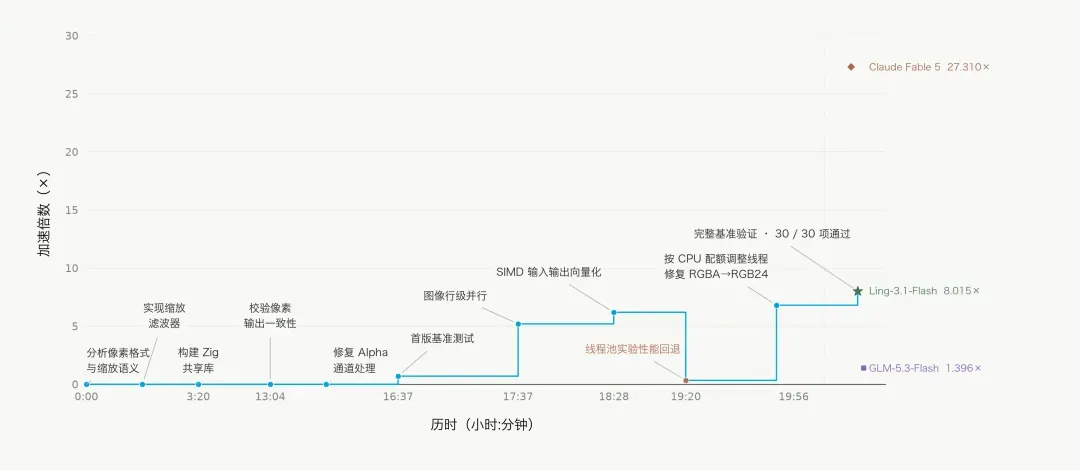
We challenged the long-range complex task capability of Ling-3.1-flash: allowing AI to develop the most complete city-building game possible from scratch.
The advantage of urban simulation is that the systems involved are very diverse, with a complex interdependence between road networks, building sites, vehicle search routes, population changes, economic cycles, and city management mechanisms.
This means that the model must continue to deal with the dependencies between the different modules during the development process and gradually complete the entire project through repeated testing and modification.
During testing, we tried to minimize human intervention, handing over the main development work to Ling-3.1-flash, observing how it plans development sequences, coordinates different modules, and independently finds solutions when faced with problems.
The entire test is divided into three phases.
The first stage was prototype development. After receiving the mission, Ling-3.1-flash completed the first version of the city-building game, which included the main menu, demonstration cities, and the basic building and operating system, in only about 26 minutes.


Prototypes of buildings are simple, repeatable cubes, and urban layout is dense.
The second phase is long-term optimization. For issues such as the replication of the original building design, urban layout density, we have added visual upgrades. The model has been in centralized development for about six hours, redesigning the building, planning the city layout, and continuously modifying and modulating the rendering system, so that the overall feel of the game is significantly improved.

Optimization includes redesigning the appearance of buildings and planning urban layout.
We actually went into the game, inspected buildings, roads and transportation systems, and discovered further issues such as vehicle appearance, road markings, overlapping relationships, and vehicle generation logic, so we asked the model to complete the final round of modifications based on preserving existing results.
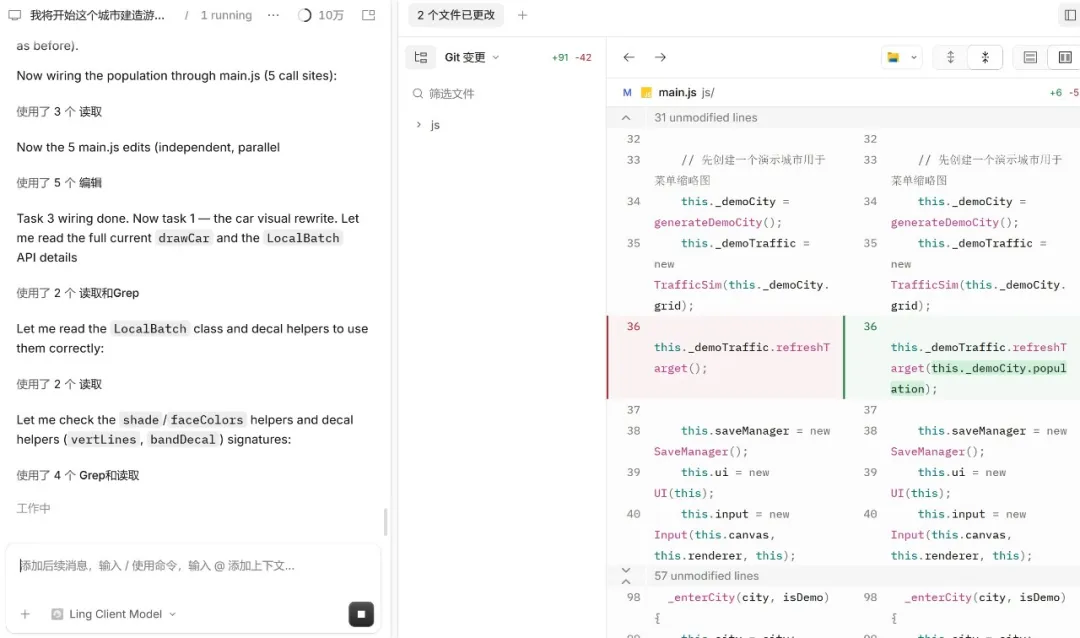
Ling-3.1-flash continues to modify game code in OpenCode, accesses demographic data to traffic systems, and independently checks associated mapping functions to prepare for subsequent vehicle visual optimization.
Autonomously performs game functionality regression testing, checks economic systems, archive read-write and traffic logic. It detects that some use cases have not been passed in the test, and continues to screen out problems, verifies the corrected results.

The appearance of vehicles, road signs and traffic logic have also been further improved.
From rapid delivery prototypes, to continuous optimization, and to refining feedback based on real-life details, Ling-3.1-flash underwent a complete round of software development and iteration processes in the same project.
In a nutshell, learn the Fermat Principle.
The third test was inspired by a new trend recently discussed by the developer community.
At the beginning of October, Andrej Karpathy came up with an interesting idea on social media: As AI's programming capabilities improve, future learning tools may be generated on demand.
Users can directly revolve around their own problems, allowing AI to instantly generate an interactive learning application. Both dynamic charts, physical simulators, and visualization tools that can freely adjust parameters can be customized according to specific needs.
This method of learning is attractive, but it also places higher demands on the model's comprehensive capabilities. It requires both accurate understanding of expertise, the design of rational teaching logic, and the transformation of abstract concepts into intuitive forms of interaction, ultimately achieving a functioning application.
We decided to validate this idea with Ling-3.1-flash.
In the novel, the FEMA Principle is a physics concept with important narrative significance. Simply put, when light propagates between two points, it moves along a path that allows the propagation of time to take place; in common refractive scenarios, this path corresponds to the shortest path of propagation of time.
This principle seems simple, but there is still a barrier if understood only by formulas and text. Why does light change direction when it enters another medium and how does it "select" the path of transmission?
We made a rather brief request to the model: "I'm interested in the FEMA Principle. Please create a beautiful, intuitive, practical interactive teaching web page to help me really understand the concept".
The pages begin with reflections of light, gradually introducing reflection phenomena and the FEMA principle, and visualizing abstract physical processes through dynamic light path demonstrations.
The most central part is a light path angle simulator that can be freely dragged. The user can adjust the position of the light through the intersection of the two mediums, observing the length of the light path in real time, the time of propagation and the changes in the corresponding numerical values.
From practical experience, the generated web pages perform well in visual design, instructional logic and interactive completeness.
This means that the model has been able to combine expertise, interactive design and code to deliver a learning tool with practical use value.
Looking for answers in the real world
From producing a result to delivering a complete work, the model also needs to cross multiple thresholds of reliability, stability and professionalism.
This is also the direction that Pepperdine has been exploring.
In a series of interviews in September, Zhou Jun, the head of the Big Bang model, cited a ruling: "Byring doesn't run the risk of finding the answer to AGI in the real world".
This is evident in the Ling-3.1-flash. It has begun to put more energy into complex tasks, long-range execution and actual deployment efficiencies, so that the model can continue to play a role in real work.
In the medical field, LingSante focuses on medical knowledge reasoning, evidence-based retrieval and standardization of medical processes, and accumulates feedback through application scenarios such as AFO, Bold and Bold; in the financial field, LingFin focuses on the need for professional investment research to explore ways to improve analytical efficiency and reduce the risks of model hallucinations.
These explorations point to the same question: how to transform the ability of generic models into reliable, available productivity in real industries.
Along this path, the direction of the next spin is becoming increasingly clear.
On the one hand, continuing to improve the reasoning, planning and long-term execution capabilities of the baseline model, enabling AI to undertake more complex tasks; on the other hand, improving "intelligence efficiency" through architectural optimization and engineering innovation, reducing the cost of deploying and using the model.
Returning to our observations, the Ling-3.1-flash has been able to independently advance complex tasks that in the past required continuous human involvement. It will still go wrong, need testing, verification and correction, but the scope of work it can handle is expanding.
For large models, benchmark scores are still important, providing a unified scale for measuring technological progress. However, when the model becomes truly involved, the evaluation criteria must be more specific: how much of the task is completed, whether the results are reliable, how much resources are consumed, and how much time is saved for the user.
After all, the ultimate value of technological breakthroughs depends on how many problems they can solve in the real world.
© THE