Two days ago, co-founder and CEO of technology media Every, Dan Shipper, released a lengthy in-depth report on How Codex Happened, which fully restores the entire process of Codex, the OpenAI programming intelligence body, from the bottom of the valley to the bottom over the past year.
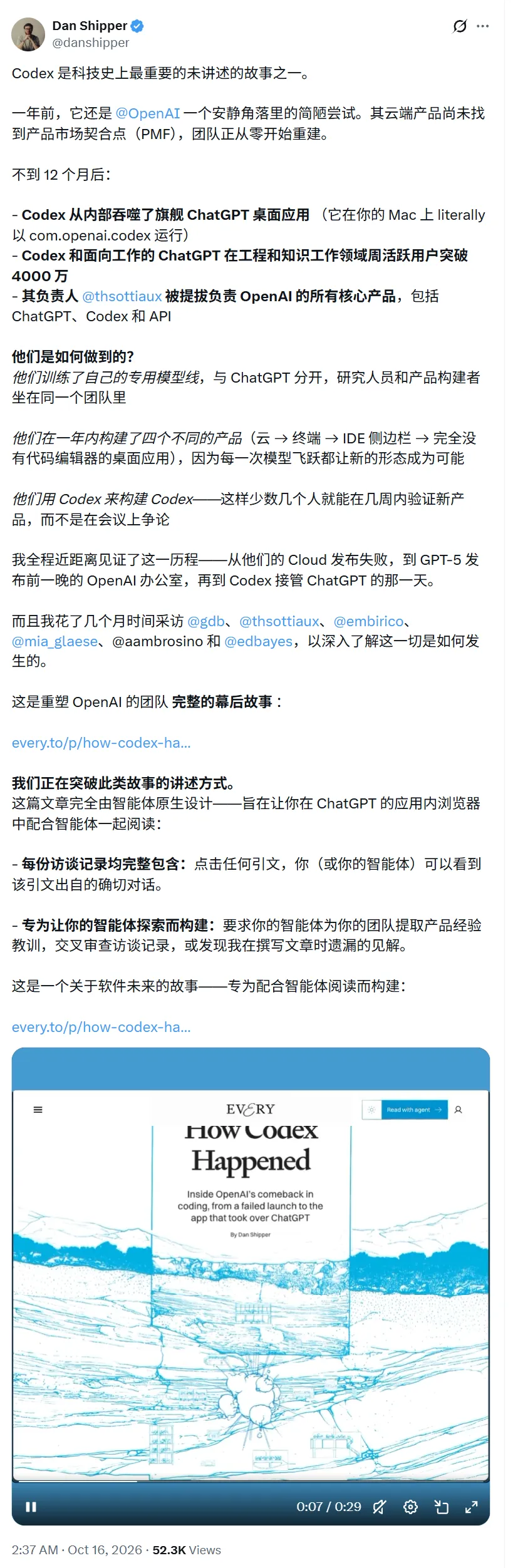 Scroll down and see
For the manuscript, Shipper interviewed six core Codex participants for several months:
Greg Brockman, President and Co-Founder of OpenAI
The Codex is headed by Thibault Sottiaux, or Tibo.
Alexander Embiricos, former head of Codex products
I'm not sure what I'm talking about.
Designed and engineered by Andrew Ambrosino
Designed by Ed Bayes
Shipper himself is also a veteran: Every was granted testing permission and released a "Vibe Check" rating long before the release of the new model, and on the eve of the release of GPT-5, he sat in the OpenAI office.
The form of the report is also special. Shipper calls the "agent-native" manuscript: the full texts of the six interviews are all with text, clicking on any quotation can jump into the original dialogue, and readers can cross-reference their intellectual body to the text, refine product experience, and even dig up missing author insights. According to Every, the report itself was completed with the help of the Codex.
Today's ChatGPT desktop application, which is still called com.openai.codex on Mac systems, codex is "swallowing" ChatGPT from within. The outside world thinks that having an independent model line is a vision of a high-level patch, but Tibo says there is no such decision at all.
Over the course of a year, the team developed four product formats: a cloud, a terminal, an editor sidebar, and finally a desktop application with no code editor at all. In order to verify the failure of the "don't let anyone change the code", Embiricos was asked daily in the office by colleagues: "Do you use it as your main tool today?"
The results were surprising. According to Every, over 5 million copies of Codex were made available in June this year; in July, the Codex desktop application became the new version of ChatGPT desktop application; today, over 40 million copies of Codex and ChatGPT for Work combined, Tibo has also been appointed as the head of all core OpenAI products and platforms, overseeing ChatGPT, Codex and API.
Below, we'll explore the story along the lines of Shipper's narrative.
Address of the article:
The night before the release of GPT-5
A bit of an embarrassing conversation
The story begins in the summer of 2025. Every gets GPT-5 a month early, but he's happy with the day-to-day use, but he writes the code in the Codex, and the reaction is flat: it's fast, smart, but it always stops prematurely, like he doesn't dare to cross the permissible boundaries, more like a partner to programming.
At the time, Every had changed the way it worked: using Claude Code, it handed over the entire task to Opus 4, and then left, waiting for a complete function or even the entire application to return.
In the conference room of the OpenAI Mission Bay office, Shipper told Embiricos: "You can let it go crazy with Claude Code, but GPT-5 is cowardly". He said, "We don't really see the code anymore".
When he left that night, Shipper had a thought: OpenAI may be building the perfect tool for a dying workflow.
It all started with "Thinking"...
To understand the overlap of the Codex, Shipper traces the birth of the reasoning model back in time.
Early big models, like improv actors, could only think one word at a time. In September 2024, OpenAI launched an o1 preview, which trained "step-by-step reasoning and answering" into the model itself: the same model, think for a moment, can do better on difficult problems.
Programming is the biggest beneficiary. Writing code is naturally a closed loop: change, run, know what's wrong in a few seconds, the model can test itself, correct itself. In theory, as long as you think long enough, the reasoning model can complete any programming task independently.
The name Codex itself has also had several "beginnings": the earliest Codex was a 2021 model based on the GPT-3 tweak that supported the early version of GitHub Copilot. O1 was followed by several teams within OpenAI to pursue the dream again in different directions.
Two dark lines
One "feeling AGI" and one "self-lifting".
A line from Embiricos. He joined OpenAI in 2024 with the acquisition of his co-founded programming collaboration tool Multi, and later tried human collaboration on ChatGPT desktop applications and Atlas browsers, but the model read the screen slowly and slowly.
The other line is from Tibo, who now owns the core product of OpenAI.
Shipper interviewed him in an OpenAI employee's dining room. In Shipper's note, Tibo had a bright brown face pointed to the side, with a thin metallic-framed pair of glasses and an architect's nose beam over the nose beam; the nose beam below looked exactly like a programmer: a brown bearded face, a deep brown tie-hat of "Research and Deployment Co". and a fancy sausage pizza in his hand.

Much more important than his appearance is his resume. Tibo has spent most of his career building infrastructure for researchers, first at DeepMind, then at OpenAI. The so-called research infrastructure is the shared code that AI researchers rely on to run, evaluate, reproduce and deploy experiments.
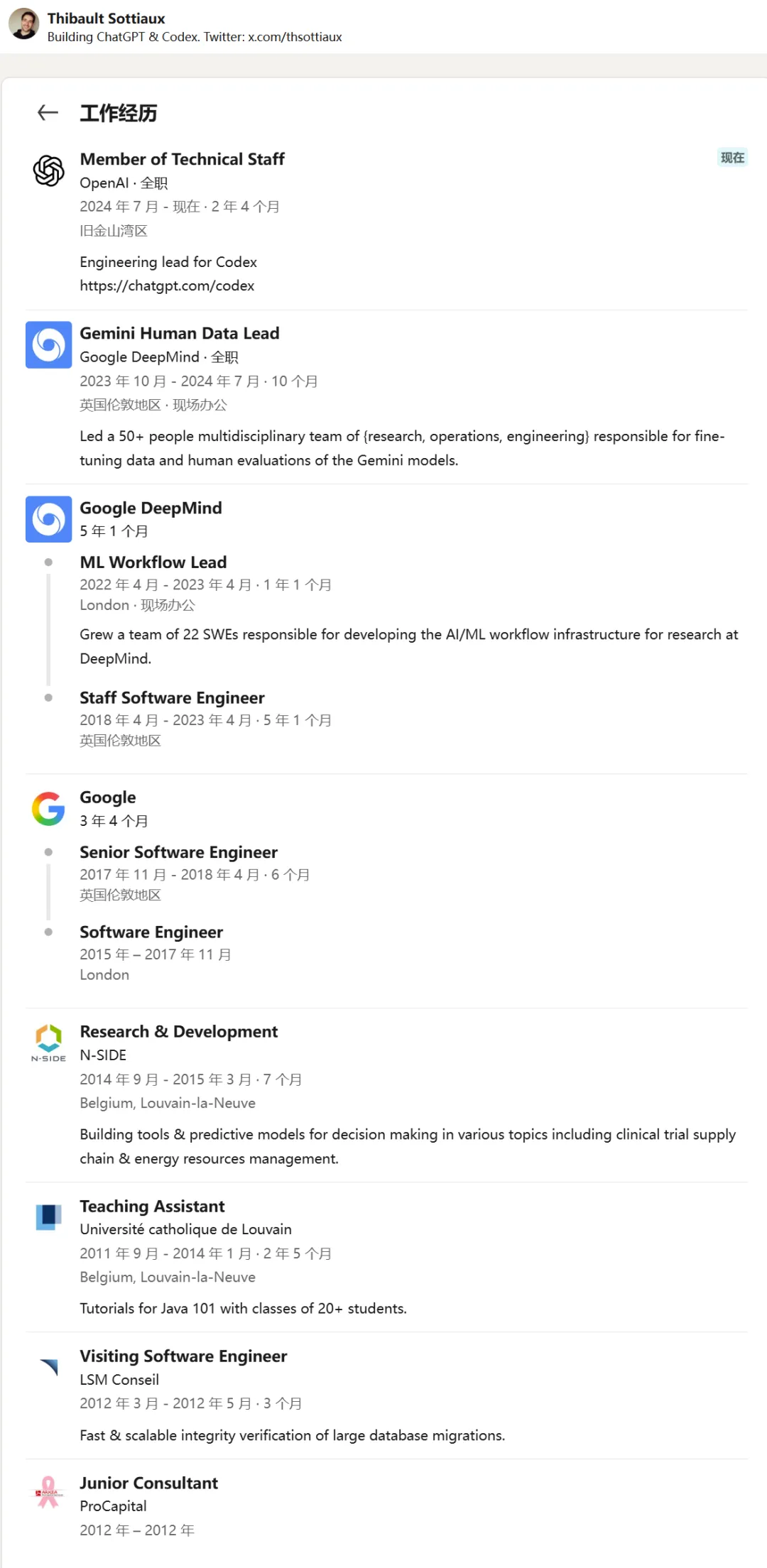 Scroll down and see
In many people's minds, infrastructure is like a water pipe in the world of technology, and no one cares how far it leaks; it seems a bit unexpected to come from someone who later ran the Codex. But in the field of AI, research into infrastructure is precisely where many key advances are taking place: shortening the time of an experiment, running multiple experiments, and getting better models sooner.
In December 2024, Tibo began working as a programmer to help OpenAI write infrastructure faster and do research. His team trained in-house programming at OpenAI's single code warehouse, Monorepo, where researchers were using it every day.
When asked by Shipper, "How did you decide to dismantle the model line?" Tibo calmly replied, "No such decision, at first it was just a research exploration to improve your speed". The researchers experimented with these models to create stronger models and then to do better experiments, which engineers called "bootstrapping".
A group of "internal startups" in the company.
By the end of 2024, programming became OpenAI's corporate goal, with several teams tackling the same issue. Brockman said the real issue was "product form": should the smart body be on the terminal, editor, or a cloud belonging to its own computer?
Sam Altman has said that OpenAI is in some sense a bet on a series of startups, but they are all within the company. This parallel exploration seems confusing and wasteful to some insiders, but Shipper believes it is almost necessary in the ever-moving field of AI at the forefront: a model that can replenish a whole line of code for automated replenishment, a model that can think for 30 seconds for side-by-side questions, and an hour of work for a whole new form.
The teams then began to merge, and according to Brockman, it was "to merge two, then merge two". The new Codex team put together product types like Embiricos, engineers like Tibo and researchers like Glaese, and the product manager suggested "how good a model can do this", and the researchers turned it into a reality.
The cloud version was released in September.
And its failures.
In February 2025, Anthropic released a preview of the Claude Code research. It runs directly on your computer's terminal, can be disconnected at any time with your existing files and tools, and is quickly accepted by developers.
The Codex team took about seven weeks to build the Codex Cloud, which went live on May 16, 2025. In ChatGPT, the codex describes the task of changing the code, running the test on an isolated cloud machine, and returning a PR submission button.
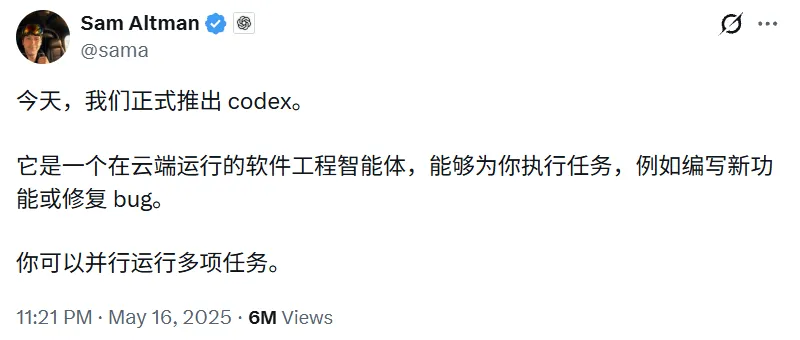
It was successful inside OpenAI, but outside it was not. Developers had to spend several hours rebuilding software, permissions and configurations on their computers in the cloud; the task could not be corrected in the middle, and even a single question required launching a new cloud computer. OpenAI's internal standardized development environment concealed how high these requirements were for ordinary users. Embiricos acknowledged that the model was not smart enough at the time; Glaese's reflection was that the team had a vision for the future without "going where the user is", their laptops.
In fact, the team didn't skip the terminal route, and Tibo revealed that they had built a prototype of the terminal internally, which they abandoned a month later, instead of focusing on the cloud. In OpenAI, the ideal form of the intelligent body has always been considered to be in the cloud for you to work autonomously, and you don't stop on your laptop.
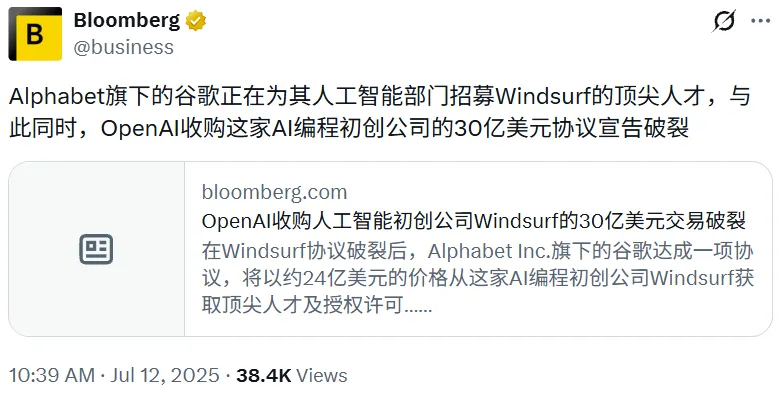
The reality is that the team's engineering manager jumped to Cursor, and OpenAI reportedly announced its $3 billion acquisition of Windsurf in July.
It's backwards like a rational model.
The strength of the reasoning model lies in retrospectivity: discovering the wrong path, reviewing the hypothesis, and changing the path.
At the time, Codex was described by designer Bayes as "the biased corner" of OpenAI, and as a bright designer, you should go to ChatGPT.
Instead of rushing to give CLI a stack of functionality, he used Rust to rewrite the smartphone itself, breaking down the underlying mechanisms for reading files, running commands, and terminal interfaces so that it could run in the future on editors, desktop applications, clouds, and even ChatGPT.
On the model side, Michelle Pokrass's team makes GPT-5 better at real-world programming. Brockman's metaphor is that an OpenAI model can score high in a programming competition but has never seen a messy code library. Pokrass's team sits next to a programmer and observes and turns where the model goes wrong into a training task.
This also explains Shipper's "cowardice" that night: OpenAI, which was handled by a cloud version, was done by a cautious co-author, which was exactly what most engineers wanted at the time. VS Code and Cursor, which were introduced after the release of GPT-5, expanded to over tenfold usage by October.
A programming application that can't write code
As usual, the CLI and the editor were then expanded. The codex team placed the next largest investment in the native desktop application.
Tibo sees that the tasks that the model can accomplish are getting longer, that people will soon be running multiple smart bodies at the same time, staying with them all day, and then managing everything with a pure-text window from the 1970s, which is ridiculous. Embiricos sees the workflow that the cloud version has not achieved: first working closely with the smart body, then as with new colleagues, gradually figuring out which tasks to let go.
After Ambrosino joined, the four-person team drew inspiration from chat apps rather than VS Code, and made the most adventurous decision: not to incorporate a code editor, but to change any code. He argued that once users are allowed to tap the code, everyone expects to withdraw everything from the editor, search, and shortcuts.
Embiricos went round the table every day asking, "Are you using it mainly?" and the initial answer was no. Some colleagues complained that they had to write a specific tip in order to replace a sentence; Ambrosino himself admitted that "not editing files" was his most suspicious decision. When Google launched Antigravity, an integrated full editor, in November, the team members faced each other:
The model is also a bottleneck. Ambrosino believes that due to the quality of the model in November, applications can't be released. The transceiver connection arrived: GPT-5.1 Codex Max on November 19 could write code for hours on end. GPT-5.2 Codex on December 18 was even better at modifying in large code libraries. Since the Codex model line is independent of ChatGPT, the team can quickly iterate without having to worry about affecting 800 million ChatGPT users.
By January, the entire team had switched to the Codex application; by February, well-known researcher Noam Brown said he had "completely switched", and that old users of Brockman's terminal and Emacs had switched, describing it back to the old workflow as "back to the past". Altman later called it OpenAI's most beloved product ever.
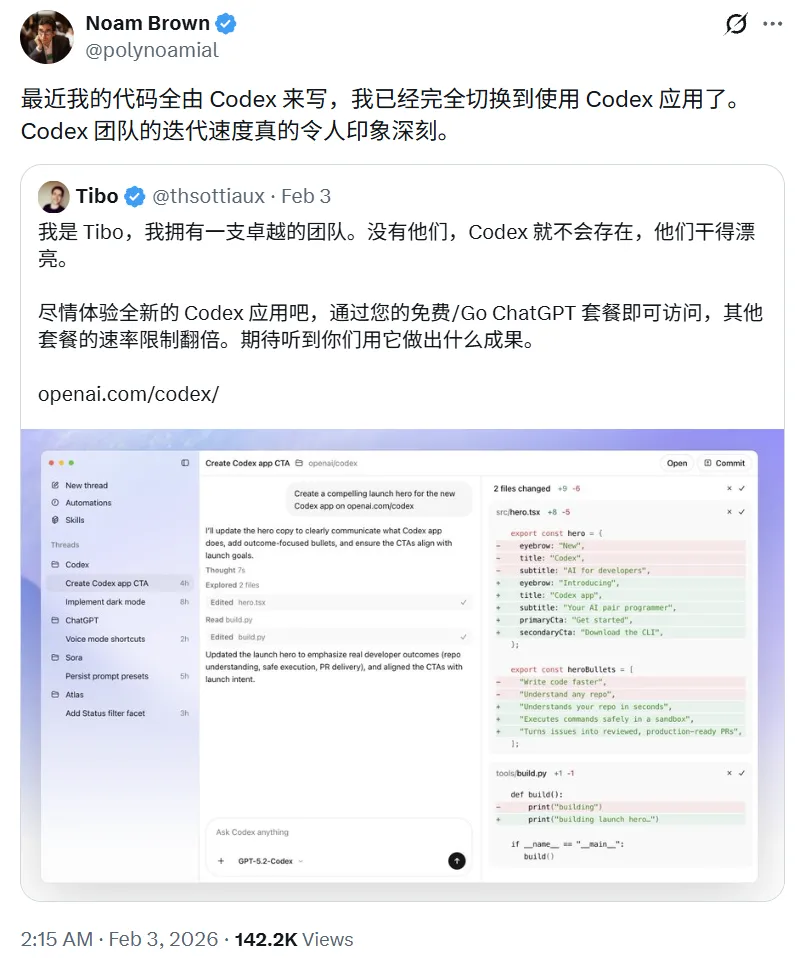
Today, ChatGPT runs on Codex.
The cloud version is also popular internally, but will it be different this time?
On February 2, 2026, the codex macOS desktop application was released. You can have one smart bug fixer, another develop a new feature, each working on a separate copy of the code. Shipper frankly, these features are not pioneering, and Claude's desktop application has been able to do this for a long time, but in his opinion, Claude's application is a bit of a puzzle, from chat to code to Cowork.
The GPT-5.3 Codex, released a few days later, was another turning point: according to Glaese, the Codex model line began for the first time to move beyond specialized programming training to broader knowledge work. Shipper himself switched from almost exclusively using Claude to extensive use of Codex; with the arrival of GPT-5.4 in early March, the Codex became his main tool.
Since then, the digital path has skyrocketed: it surpassed 2 million on March 19th; it added a built-in browser to view documents, slides and spreadsheets in April; it surpassed 5 million in June, with about a fifth being knowledge workers; and on July 9th, the Codex desktop application officially became the new ChatGPT desktop application.
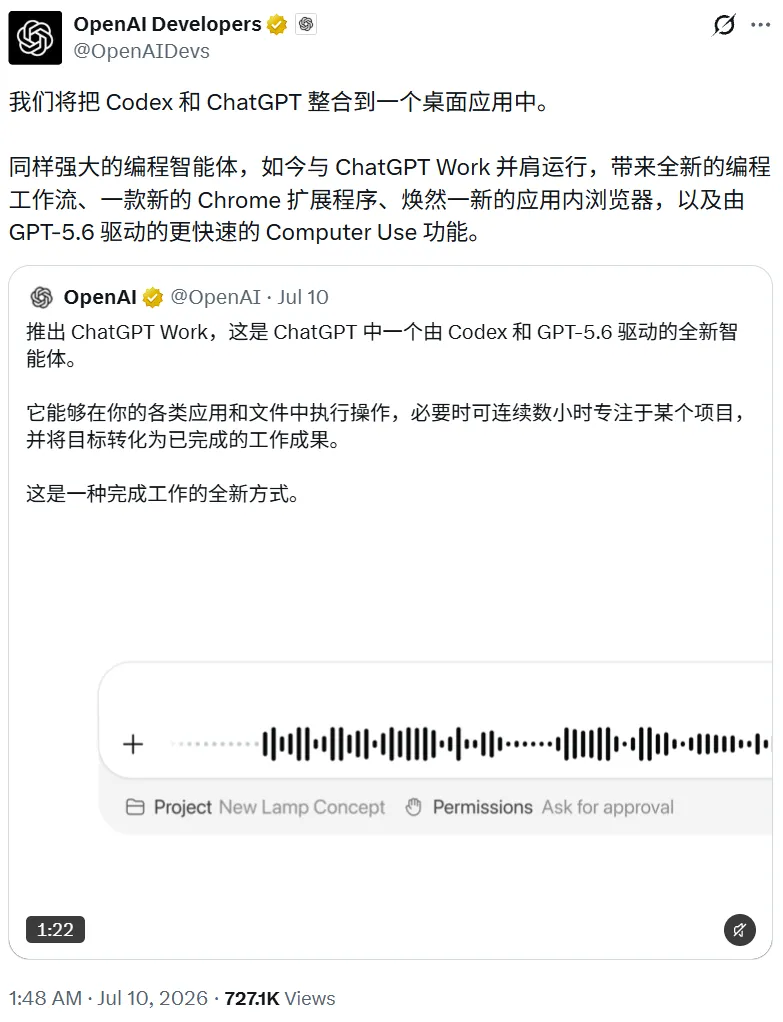
At first, the Codex Cloud was just a tag page in ChatGPT; now, ChatGPT runs on top of the Codex. Bayes recalled, when he walked out of the general assembly to announce the merger, he realized that "a few people in the corner" had become "ChatGPT's future".
Curve on whiteboard
A notebook with a notebook
The report concludes that Shipper returned to another meeting with Embiricos in Manhattan in June of this year, which has since taken over as Head of Enterprise Product at OpenAI.
Embiricos painted the growth curve of Codex on the whiteboard: the cloud version flattened quickly after a brief rise; the CLI after GPT-5 was shorter; the editor expanded higher; and finally the 5.3 Codex and desktop application, making the front curve look like a claw. The first, already a scratch at the bottom of the whiteboard.
Shipper felt this was like a diagram of the dilemma that plagued Clayton Christensen's pioneering innovator: Hardware advances pushed computing from supercomputers to personal computers to mobile phones, each leap resulting in a simpler format, a larger market.
The diagram was first proposed by Clayton Christensen in a 1995 article in the Harvard Business Review to illustrate the dynamics of disruptive innovation. It compares continuous innovation to disruptive innovation, which is initially small in scale but will eventually disrupt the market.
According to Christensen's theory, the team that won the previous curve could hardly win the next one. Shipper believed that Codex avoided this fate, firstly because OpenAI was deliberately organized into a parallel set, giving Codex the space to evolve independently outside the ChatGPT body mass; secondly, Codex was used to construct a Codex that changed the "physical laws of product development so that people could try out new forms in a matter of weeks".
There's a final curve on the whiteboard. Millions of people have trusted the smart body to run on their computers, and the next step is to get back to the vision that once failed: a smart body that continues to work after you're gone.
Shipper noted that this time, Embiricos' laptop was placed on the conference table and the lid was tightly sealed.

© THE