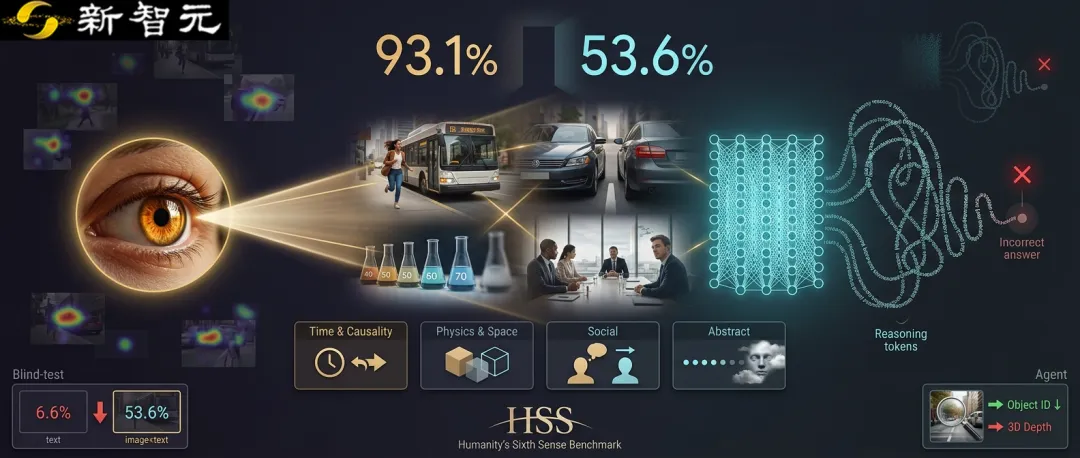
It's the first time in the history of the world.
AI can read graphs, make racetracks, identify obscure texts, and even use tens of thousands of tokens to analyze a visual theme. But it may not see why a woman chasing a bus is suddenly slowing down; why she can't fit another one between two cars; who's the most distracted in the conference room; how much of that unseen label is in a row of cups.Humanity's sixth sense (HSS, human sixth sense)The results were pretty eye-catching: 20 human participants took part.93.1%The GPT-6-astra, which is currently ranked at the top of the list, even when it is open to the maximum intensity of reasoning, is only available for the first time.53.6%The average of 25 models is only30.9%。
 HSS paper: Labs officially introduces:
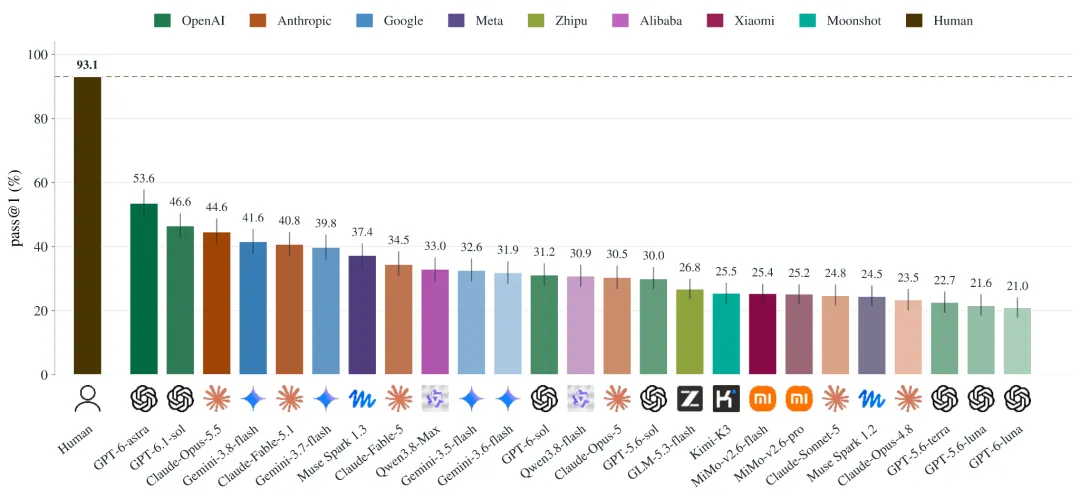 The first list of HSS: 25 multi-modal models, all significantly lagging behind humans.
AI has visionBut there's still no "eye to see".
What HSS calls the "sixth sense" is not a supernatural ability, but one that humans use every day.Intuitive visual reasoningSeeing a picture or a few seconds of video, we not only recognize "what's in the picture", but also automatically fill in information that doesn't show up directly: what happened before, what could happen next, whether an object can pass through a gap, who knows what, who obeys who, and what rules are hidden behind a scene. This ability is amazing. Cognitive science studies show that humans can classify natural scenes in about 150 milliseconds and simultaneously extract physical dynamics, behavioral intentions, and social structures.It is difficult to explain the process without the use of a formula, but it is possible to get an answer with a visual intuition.The HSS officially converted this blank into scores.522 questions, specifically examining what the picture doesn't say clearlyHSS included522 open missionsThe series consists of 288 images and 234 videos with a total duration of 17.6 hours. Subjects are divided into four main categories and 11 sub-domains:Time and Cause Dynamics.The model should be pushed back from the current image to judge the physical mechanism at work, or predict what the next step will be. For example, a woman in the video moves the rotor from right to left, which changes the direction of the track.Physics and spatial logic.Models are designed to judge objects that are obscured, their quality and their invisibility, and to answer "can't put it down", "what a different perspective will see", and "someone can't get enough".Social understanding.For example, a woman chasing a bus, running and running, suddenly slows down because the bus stops waiting for her, and she doesn't have to rush anymore.Abstract and situational inference.The model sought to find the hidden rules that give meaning to the scene, including the consequences of the change, the rules in the sequence, and the imaginary illusion of "seeing faces in objects" (pareidolia). For example, a row of cups labeled 40, 50, 60, 70, and the last blurred label.
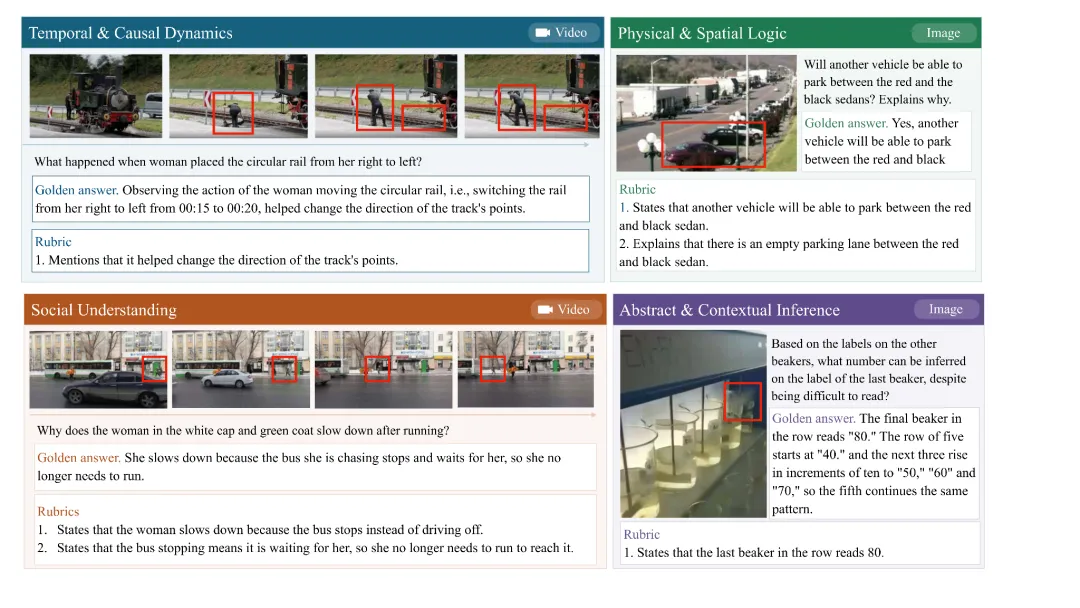 The four main task domains of HSS. Each question contains images/video, questions, reference answers and scoring criteria.The most critical design is:The answer can't be found directly in a pixel.High-resolution enlargement can see the answers, elimination; questions that require expertise, elimination; questions that humans cannot form consistent judgments, nor can they enter the formal test set. The labeling team wrote a total of 3,466 candidate questions, after three rounds of independent review, leaving only 522 paths, with an acceptance rate of only 15.1%. Only the first round eliminated 2,302 paths, the main reason being that "the answer is already in the picture" or "humans cannot unanimously recognize the correct answer".
25 model collective failuresLess than 60% of the world's populationThe team tested 25 multi-modal models from eight manufacturers. GPT-6-astra came in first with 53.6%, followed by GPT-6.1-sol (46.6%), Claude-Opus-5.5 (44.6%), Gemini-3.8-flash (41.6%) and Claude-Fable-5.1 (40.8%). The rest of the models were all under 40%, while humans were 93.1%.6.6%The evidence for determining the answer is indeed in the visual realm. Video is especially difficult. 23 of the 25 models performed worse on video tasks, averaging a 7.3 percentage point drop. Social understanding is the weakest area: 21 models scored the lowest on this one, with an average accuracy of only 24.4%, while the other three areas averaged 34.1%.[3]
The model is not unreasonable.But I don't understand.In order to find the root cause of the failure, the team attributed 8,573 failures to the model on a case-by-case basis. The conclusion was almost the opposite of the intuition that "models need stronger logical reasoning skills":94% of failures come from perceptual or potential information inferences, and true logical reasoning errors account for only a small fraction.The most common mistakes are missing the key clue to deciding the answer: 21.3%; followed by misidentification of objects, people or characters: 19.9%; subsequent misjudgements of size, distance and capacity: 12.2%; viewing in the direction of 12.0%; and mistaking two-dimensional shadows as a three-dimensional alignment: 9.1%.
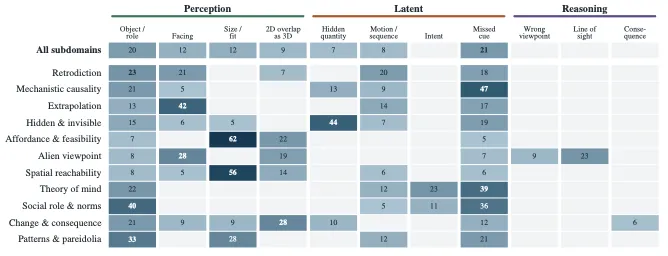 Failure in different sub-domains is highly concentrated in "looking wrong" and "not reading implied information from the image".And these mistakes are not random errors. In topics where at least five models make mistakes at the same time, up to 80% of the median models will fail for the same reason. This means that different manufacturers, models with different architectures, may share similar visual blind spots. They can generate a long chain of thought, but may miss the key facts at first glance: acknowledge the wrong person, look the other way, blur the wrong relationship; then spend thousands of tokens, and a false premise is advanced more and more completely.Adding an Agent to the model can make up for it, but it doesn't make up for the real sense of spaceIn a subset of 388 questions, Claude-Opus-5 increased from 30.8% to 51.3%, Claude-Fable-5.1 increased from 41.2% to 57.7%; GPT-6-astra increased from 54.4% to 59.3% in the Codex, becoming the highest score in Agent's setup.The agent can reduce multiple types of errors by re-examining the image, but it is almost impossible to judge depth in three dimensions.However, a number exposes the boundary: misjudging the two-dimensional overlap as a three-dimensional alignment error, dropping from 102 to 101 times, with little change. This type of failure is not "graph not magnified", but the model lacks stable three-dimensional representation. Agents can pick up magnifying mirrors, but cannot grow human space intuition in space. More remarkably, a few logical errors in Agent settings instead increase.
The next wall of multi-modal AIOver the past few years, advances in multi-mode models have often been shown to read more text, solve more difficult questions, and handle longer videos. HSS has proposed another coordinate axis: whether a model has real-world intuition. This axis is particularly critical for real-world AI agents. Domestic robots need to notice that a child is moving up the stairs before they fall down the stairs; automated driving systems need to determine whether vehicles can pass, rather than just identifying "two cars in front"; office assistants need to read who is in command, who doesn't understand, and real-world intentions after a set of sentences.To describe the world is not to understand the world; to reason is not to have intuition.Between 93.1% of humans and 53.6% of models, the next one is not a more difficult test question, but a look that must be completed before machines actually enter the real world.
RoboInd editorial channelResearch, robotics companies and market intelligence for cross-border sourcing.Explore the channel ↗
Share this
End of editorialExplore more from Global Robotics News ↗