It's the first time in the history of the world.
It took him 16 days to turn Prince Charming into a playable 3D drama game.
On October 13, developer Sac published his work on X.
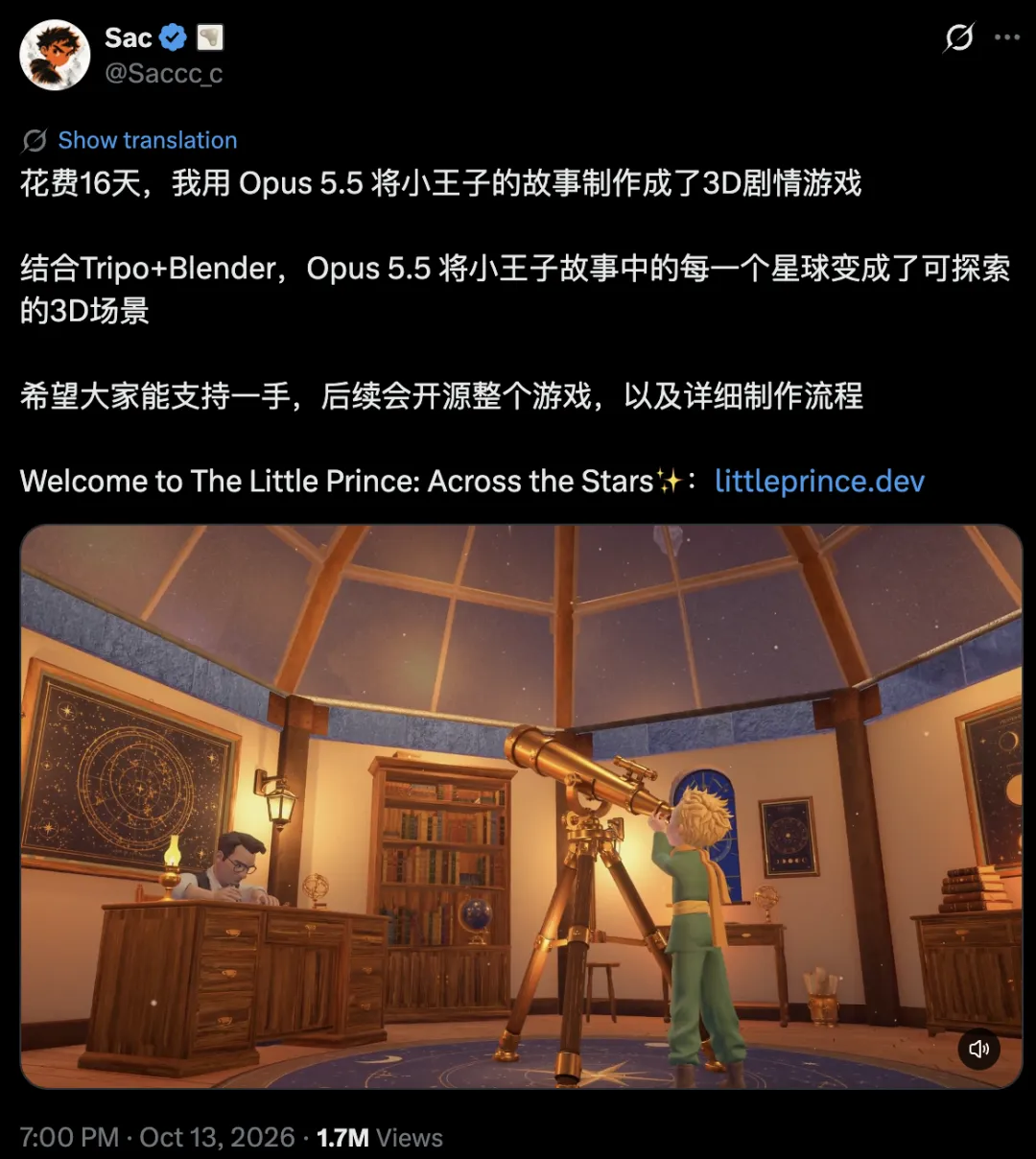
According to Sac, he used Opus 5.5, a combination of the 3D modeling tool Tripo and the 3D modeling software Blender, to turn every planet in the story into an explorable 3D scene.
The game is titled The Little Prince: Across the Stars and currently has an independent website.
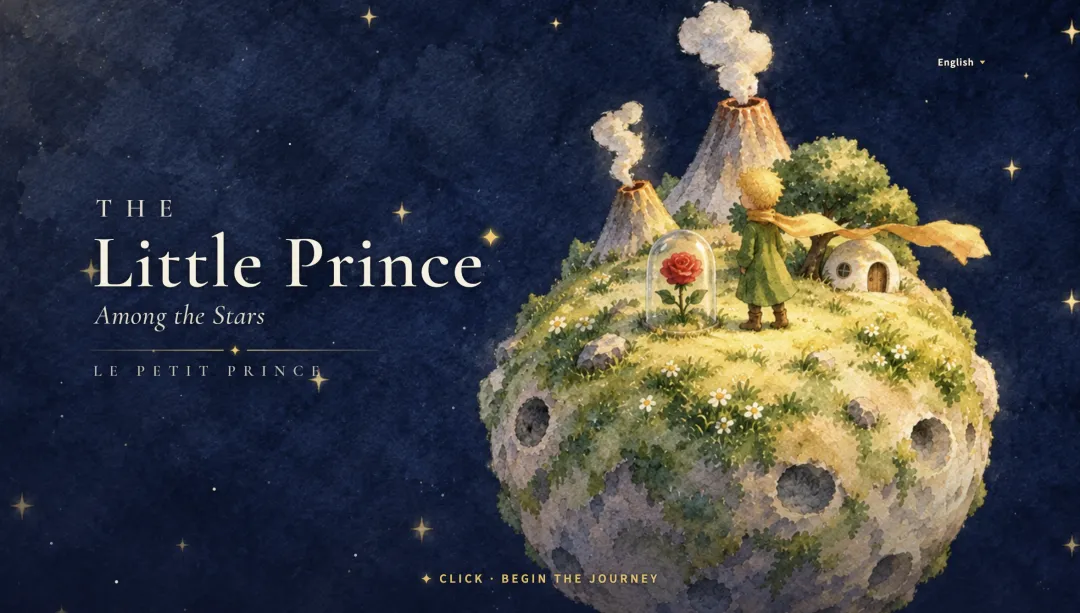
For the fans of this book, it's heartwarming to be able to personally walk into places they've ever imagined.
Planet of the Little PrinceYou can cook it yourself.It's the first time I've seen a demonstration by the author.
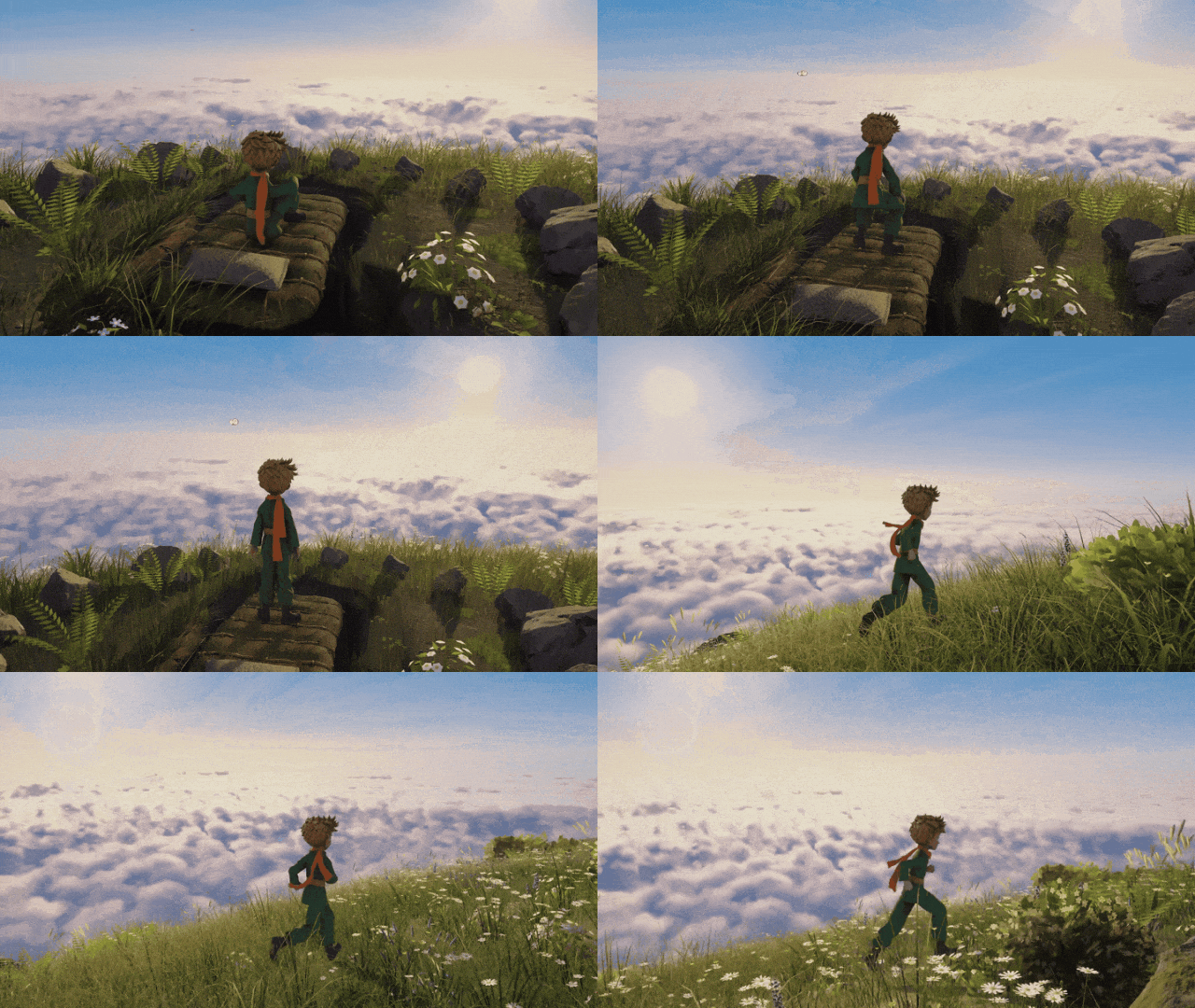
And the little prince with golden hair stood between the grass and the rock, and the sea of clouds was stretched out.
The camera moved into the room, under a wooden roof, with a map hanging on the wall and bookshelves on both sides.

In another scene, the little prince runs on the sand and the shadows follow in his footsteps.
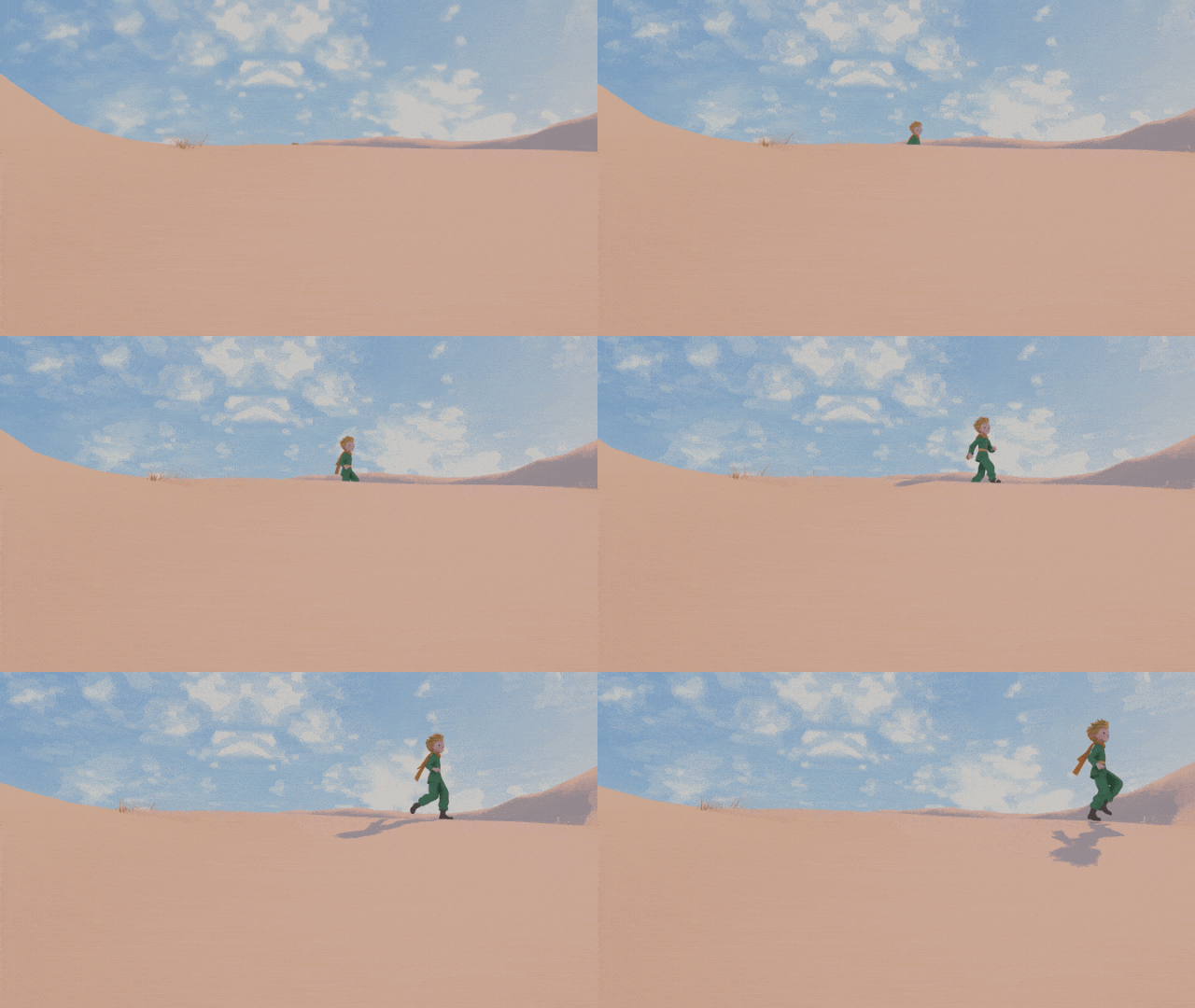
From the sea of clouds to the room, and then to the desert, the characters and environments in the book have specific shapes, shadows and spaces.
For those of you who have read Little Prince's novel, this adaptation is easy to pick up the curiosity:
What will the fairy tale world in memory look like when it becomes a game?
When we read, we follow the text and imagine that world in our minds.
After entering the game, we can take the form of a little prince and explore in 3D scenes: where to go, where to stop, which corner to look at, it's up to us.
It's a familiar story, so there's more of a way to participate personally.
However, there is a more interesting challenge after putting these scenes together:
How to turn the memorable story into an interactive experience that touches the player?
One action, one encounter, or even more than one moment in a place can affect the way the game tells the story.
The official website currently lists eight language options in Chinese, English and Japanese, allowing readers of different languages to access and explore the world.
The most curious thing is how did he make this 3D game in 16 days?
Making a story into a 3D game with characters and scenes on the screen is far from enough:
The characters have to be able to move, the footage has to keep up;
A person goes to a specific location to trigger a scene;
The player completes an action, and the game must give feedback accordingly...
Sac's publicly trademarked combination of tools is Opus 5.5, Tripo and Blender.
Among them, Tripo can generate 3D models based on text or images, helping creators transform ideas such as characters, objects, and more into physical material.
Blender is a set of 3D production software that can be used for modeling, materials, animation, and rendering.
Sac combined Opus 5.5 with these tools to create this open-source game project.
In addition, there is a difficulty in game-making that can be easily overlooked: the characters, scenes, action, and plot must be combined to keep the game running smoothly.
A character looks beautiful, and when placed into a scene, the size and style may not be in harmony. A character's movements look natural in isolation, accompanying the footage, and may make the player feel different.
These problems need to be discovered and corrected repeatedly after the work has been run.
The complete game is also gradually shaped in the process of solving a specific problem.
This case is the biggest inspiration for individual creators:
With the help of large models and 3D tools, one can gradually turn ideas into energy experiences.
First, create a scene, let the characters move in, and then connect more scenes and storylines.
By breaking up a huge production task into a small goal, alongside side-testing, side-adjustment, the work can be shaped a little bit.
Players have begun to flowerBegan writing Bugs.After the game went online, Sac quickly received feedback from players.
It's hard to imagine that a 3D game with such a high level of completeness could be made in just 16 days.
However, he also discovered a small bug: after completing the flowering task, the front and back directions of the W, S keys and the left and right directions of the A, D keys were reversed, but he did not determine the specific trigger conditions.
If the player is good, problems that were not detected during production may arise. Different search routes, keystrokes and task sequences may reveal new bugs.
More importantly, if the images are attractive, if the operation and the plot can keep people, they should be handed over to the player.
The official website also notes that the current version requires a browser that supports this graphics technology, WebGPU. If you want to try it, you need to first verify that your browsing environment meets the requirements.
After the game was released, adapting different devices and browsers to allow more people to play smoothly was the work the creators needed to continue to do.
After the open sourceThe 16-day process is worth watching.In the original post, Sac stated that the sequel would open up the entire game and reveal the detailed production process.
For those who want to play 3D games, the following information may be useful:
How to build planets, how to adjust character models, how to make characters work, and how to eliminate bugs.
If you can explain which links need to be tried repeatedly, which details must be judged by yourself, and publicly disclose the cost of the tools and the time spent on each link, then you can more clearly estimate how much time, energy and money you need to invest.
One of the most exciting parts of the project is that with the help of AI and 3D tools, a person can turn familiar fairy tales into a game that others can experience for themselves.
If the follow-up to Open Source is successful, the 16 days of experience could help more creators take the first step.
Some want to build a planet, some want to restore a small town, and some want to write their own long stories and become a world to go into.
If so, what kind of game would you prefer to play with AI?