The coal industry is still the main battlefield for smart landings
At a time when many intelligent robots were still performing in showrooms, a number of industrial equipment products were being moved and assembled in factory production lines every day.
This is the site of the 2026 China Expo, the most controversial and realistic scene in the smart industry.
It is no doubt that saving-card robots are an example of a physically intelligent landscape, and at the site of the trade fair, the company is looking at the future of the technology."Generalisation is the future".The theme is:The world premiere of the JAKA Zu50 large-load collaboration robot, and the JAKA Kargo 50 heavy-duty wheeled humanoid robot, two new products.AroundCollaborate with Intelligent, Physical Scenic and Data FlyersThe three main lines, live, show real-world images of AI deep into the entire chain of industry.
01.
Industrial landings
JAKA EVO changed from "Demonstration" to "Active"
In contrast to the "special modeling" of some exhibitions, the JAKA Kargo material handling application, which was moved from the factory site of one of the world's leading automotive parts enterprises, has been realized through the R&D team's on-site modeling optimization.From 105 seconds to 28 seconds of single-box operation in a month, meeting project-stage acceptance standards; from 12 expansions to 78 expansions; from 12 months to 57 days, the deployment cycle of all new scenarios of the same kind is squeezed.
Today, the upgraded version of the JAKA Kargo 50 rechargeable wheeled humanoid robot series debuts, which will expand the factory-verified mature mobile capability to higher-loaded industrial scenarios; the simultaneous debut of the larger JAKA Zu 50 rechargeable collaborative robot, further improving the entire scene product layout from lightweight to overloaded.
Robot-stabilized autonomous operations, built on real-life long-range operating experience of industrial physics AI systems.JAKA EVO with a physical and intelligent operating systemAdoptedA layered architecture of intelligent agentsLarge cloud models are responsible for visual perception, task planning, skill selection and abnormal decision-making; edge models combine rule engines, are responsible for action planning and force control execution, and deploy vertical skills, atomic skills and process experience as replicable assets; the bottom uses mature motion control algorithms to ensure stable execution at 1 kHz response. Thus, the upper model continues to upgrade, while avoiding model delusions affecting the bottom security control.
In addition,JAKA EVO systems convert complex long-range tasks into executable short-range tasks through SkillFor example, in the case of container movements, intelligent agents can perform tasks such as target identification, picking points, avoiding obstacles, holding flexibility, controlling force, positioning and self-checking.Implementation of skills in the integration of industrial processesThe system plans to adapt to real-world processing needs• Advanced skills can be summoned directly, lack of skills can be quickly generated through data collection training, and engineers can customize skills, arrange task processes according to field requirements.
In the field, the JAKA EVO system enables the JAKA Kargo to implement single-engine ECU intelligent installation, server light module dual-engine synchronous outputs, new energy motors multi-engine synchronous assembly differentiation industrial scene; the JAKA S3 mobile operating robot, coupled with the JAKA AL series robot, completes the space structural part lock screws, fully presenting the JAKA EVO system that gives the robot the ability to move.
Currently, JAKA EVO has accompanied 12 benchmark projects in the family of card body products to conduct scenario verification in automotive and 3C electronics manufacturing to meet the demanding requirements of industrial sites for rhythm, safety, accuracy, stable delivery. In long-range multi-step operational testing, removal, changing hands, precision assembly, about 2 minutes of continuous tasks, only about 200 training data, and long-range mission success rate of more than 85%.
02.
Collaboration is smarter
How to get 100,000 robots to know what they need
Collaborative robots, or the earliest and largest landform with physical intelligence. Over the past decade, saving-card robots have driven the collaboration boom, and today, saving-card robots want to make tens of thousands of collaborative smart make-ups on the global production line, from re-implemented tools, to high-value partners who understand the needs of first-line workers.
On-site, the JAKA Zu50 robot, with a card slot clutch process package, quickly sets the size of the box, the size of the tray and the clutch style, automatically completes the clutch, electrical wiring can be switched on quickly, and 3Modeling and conversion in 0 minutes。
It incorporates the AI capabilities of JAKA Studio Pro, which extends the scope of application from the original project's pre-production simulation to the mid-deployment and later replacement of the project's entire lifecycle.
JAKA Studio Pro is a simulation tool that is highly consistent with machine control logic and supports full-dimensional testing of applications on virtual modeling platforms, deployment of laboratories, and risk prevention.Second, the integration of AI-powered mission understanding and workflow automation into the smartphone platform released this year will also significantly reduce the use and development thresholds for collaborative robots. The smartphone platform enables fast path planning based on scenario model concepts, combined with the powerful post-processing capabilities of the original JAKA Studio Pro, and the ability to directly migrate trajectory, tempo, and logical data in a simulated environment to the real product line, forming a high-security digital hub.In this way, robots can directly understand the process description, further reducing the preparation time cost of line replacement.
At the same time, saving card robots are also on the rise.Continue to encapsulate process experience as a skill assetThe parameters of traditional process packaging storage, such as a specific box type, a specific tray type, are highlighted in the example parameters and calls under applicable conditions, allowing for rapid change of type when replacing SKUs, simultaneously improving operational efficiency and reducing the cost of line replacement.The resulting Skills can continue to be used repeatedly for each subsequent deployment, and are continually improved in the process, allowing the skill wheel to rotate, the more used, the more deployed, the faster the next deployment.
In addition, saving-card robots are continuing to integrate more than a decade of scene-know-how experience with AI capabilities, driving the improvement in the intelligence of mature industrial applications to showcase real-world experiences.Smart installation and detection of traffic lightsFor example, the JAKA S5 power-controlled robot uses six-dimensional power-control and 2D vision to complete electronic components with flexible assembly, dynamic vision synchronization, adaptive adjustment to compensate for installation errors; the JAKA A5L intelligent vision-sensing robot, using 2D vision, air pressure sensing and multi-angle photography, dynamic simulation of vehicle scenes, coverage of lighting, optical type, atmospheric density, and more than 10 tests.Three-fold improvement in detection efficiency, 99 percent accuracy in AI fusion detection, and less than 2 percent misjudgment.Production capacity is stable, and mixed-line production needs are met.
03.
Flight data
Let's continue to evolve our physical intelligence
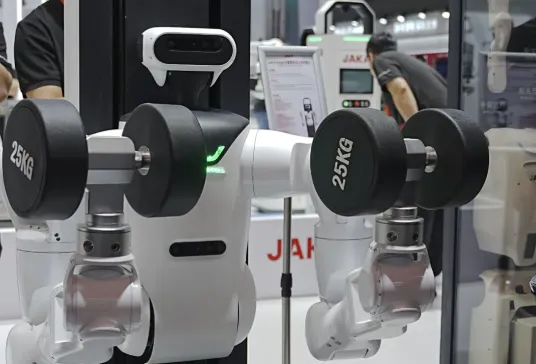
The long-term barriers to a physically intelligent landing are still the deployment of backflow data.At this trade fair site, the Saving Card Robot demonstrated the number of twin-armed humanoid robots in the JAKA K series, fully demonstrating the continuous collection of process data from real-world physical interaction, flowing back to the underlying JAKA EVO iterative skills model, opening.Field work - Data collection - Modelling updates - Re-deployment of pumpsThe data flyer,The problem of solving single-point scenarios is difficult to replicate, and it is difficult to scale up the cost of landing.
The JAKA K-series robot, which uses a self-developed APEX-series integrated joint module covering the entire process of data collection, model training and task execution, is the production material for high-quality data.Currently, lots of products have been supplied by manufacturers of smart devices and research institutes, which are transitioning from the laboratory to the production line through data training to achieve flexible plugging of cable inserts.
Data should be a value-added asset, independent of standardized collection, cleaning, labeling, quality inspection and entire lifecycle management.
JAKA-OTA Cloud Center combines and collaborates with JAKA AiHub to drive high-speed data flight.The OTA Cloud Center opens an end-to-end cloud bi-directional channel: responsible for mission planning, multi-modal data security collection uploads, and grayscale deployment of intelligent skills, remote operation and retransmission of operating results; AiHub as a platform for shaping models and skills: focused data governance, automated markup, distributed training, simulation and machine assessing, industrial skills packaging.
One take, one take, and one take, forming the complete flywheel closure of the locally-assembled aluminum - platform forging - deployment - running back-flow - generation upgrades of aluminum.The entire process can be traced back to a controlled, effectively compressed industrial smart landing cycle, continuous deposition of high-value enterprise digital assets.
For more than a decade, saving cards have deployed physical interaction data with process labels accumulated on production lines by tens of thousands of general-purpose intelligent robots around the world.Data such as torque shifting curves on the process experience layer, feed batch information on the workpiece layer, environmental parameters, etc. will further empower the skill pool within the JAKA EVO system, standardize process operations in real product line deployments and solidify them into reusable digital assets.
Deployment generates data, data refines skills, skills to replenish new tasks, new tasks bring new deployments.Each of the data collected from the JAKA K series on the ground is a continuation of this cycle, continuously elevating the starting point of a general intelligent robot.
04.
General is the future, landing right now
In addition to the industrial landscape, Smart Cards are expanding into more areas.
On-site, JAKA π (pipe) Application landings extend to public and entertainment scenes where both pipe and audience can interact intimately, connecting the two JAKA Lumi robot systems to complete robotic procurement, automated decomposition tasks, parallel scheduling production, selection and distribution processes, the same platform covering business over and drink shops dual mode; there are also booths where the pipe with flexible and lively body movements can be disconnected at any time.
From automotive, electronics, precision manufacturing, to retail supermarkets, science and research education, biochemistry, exhibition hall guides and entertainment scenes, smart robots with smart cards have always existed.Defining products using real-world scenarios, ensuring stable delivery with engineering capabilities, bridging boundaries, allowing people's imagination to go further into the future, demonstrates the core competitiveness of a physically intelligent landing.