It's the first time in the history of the world.
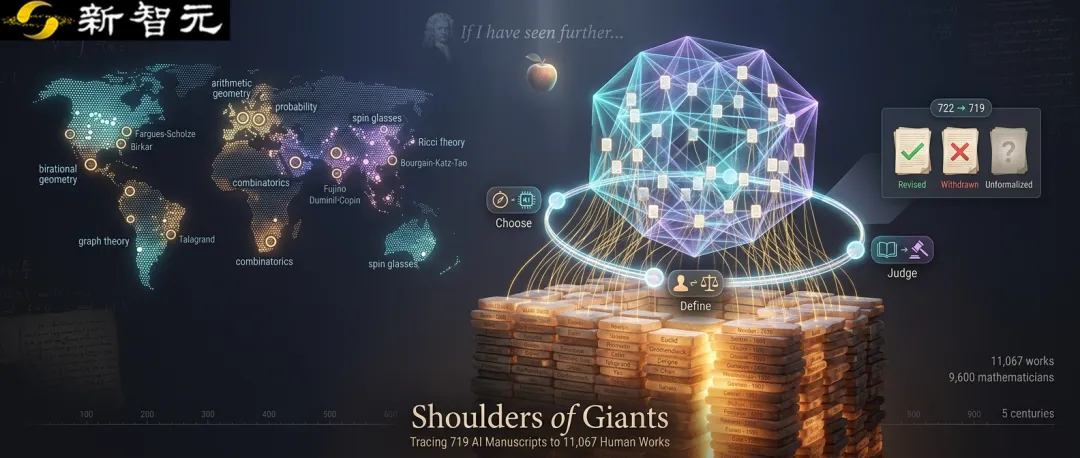
After OpenAI released 722 mathematical and theoretical computer manuscripts written by AI, the Open Source project On Whose Shoulders Are the Shoulders of Giants, launched by Qiongxiu Li, AI Security Laboratory at the University of Oldenburg, Denmark, carried out a step-by-step verification and systematic traceability analysis of all relevant documents.
The result: over five centuries, 11,067 human works, about 9,600 mathematicians, 114 of whom have won the Fields Prize, the Abel Prize or the Wolf Prize.
This type of work is often written as "AI solves a problem".
It's actually only half the sentence, and the other half is: AI is based on what work is solved.
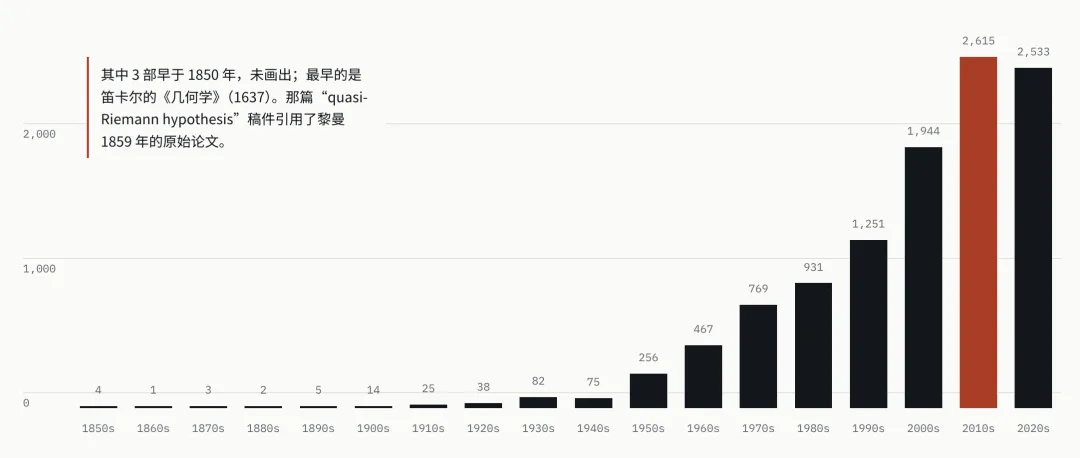
Most authors are not names in history books, but mathematicians and theoretical computer scientists still active today.
From the very beginning, AI manuscripts were intended to be used as tools for these scientists' findings:
In arithmetic geometry, a manuscript "by [Fargues et al. Scholze 2024]" matches some vector et al. with the internal local system p, the work of Laurent Fargues and Schultz.
In binary logic, some of the manuscripts follow Caucher Birkar's recent strategy with one of his collaborators, some apply Birkar's theorem of complementarity; others build on Osamu Fujino's theory of attribution, and on the work of Omprokash Das, Christopher Hacon, and Mihai Păun.
In probability theory, the manuscript relies on Hugo Duminil-Copin and others to estimate the critical crossing of random tree models, as well as the "mating of trees" theorems of Bertrand Duplantier, Jason Miller and Scott Sheffield.
One graphological counterexample uses the graph boundary sampling constructions of Lovas and Balázs Szegedy; a combined counterexample uses the aggregation method of Bulgan, Nets Katz and Taurus.
A manuscript on rotating glass uses Michel Talagrand's vacuum method.
A Ricci flow argument uses Perelman's 2002 synchronicity; a Hodge theoretical argument uses Deline's semiconductor argument.
The results of each area of AI depend on a group of people:
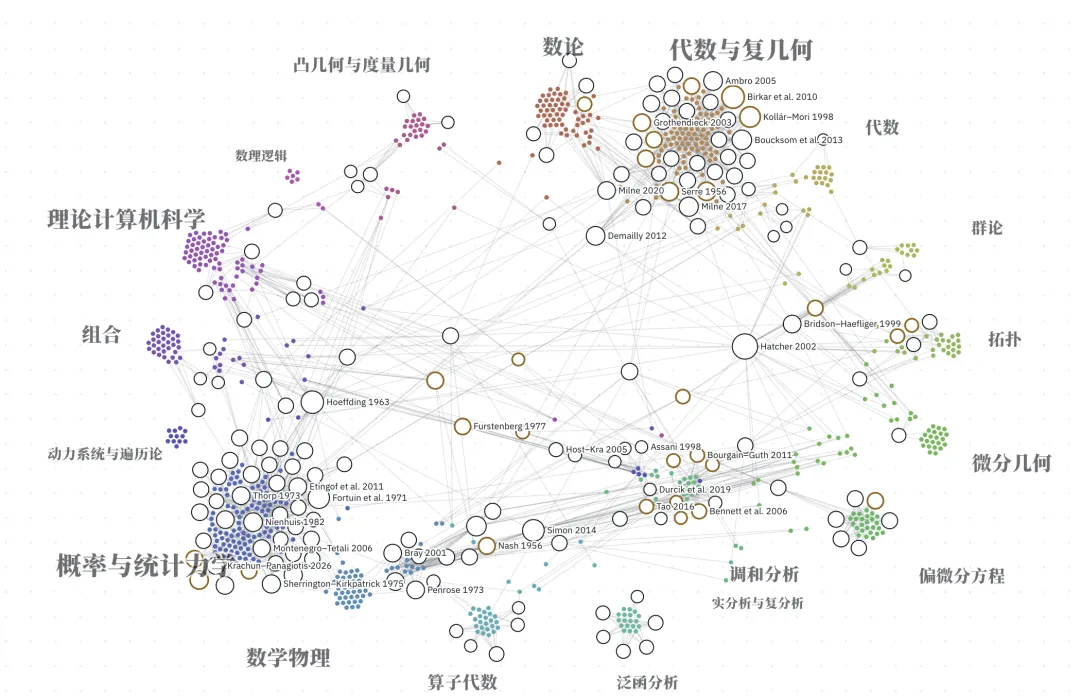

Each small dot is an AI pre-printed book, grouped into "continents" by discipline; the big dot of the circle is a human paper cited by multiple pre-printed papers, the size indicating the number of citations, and the position between the papers cited.

The Giant's Shoulder Project:seafill.info/Shoulders
Sources of data:github.com/openai/math
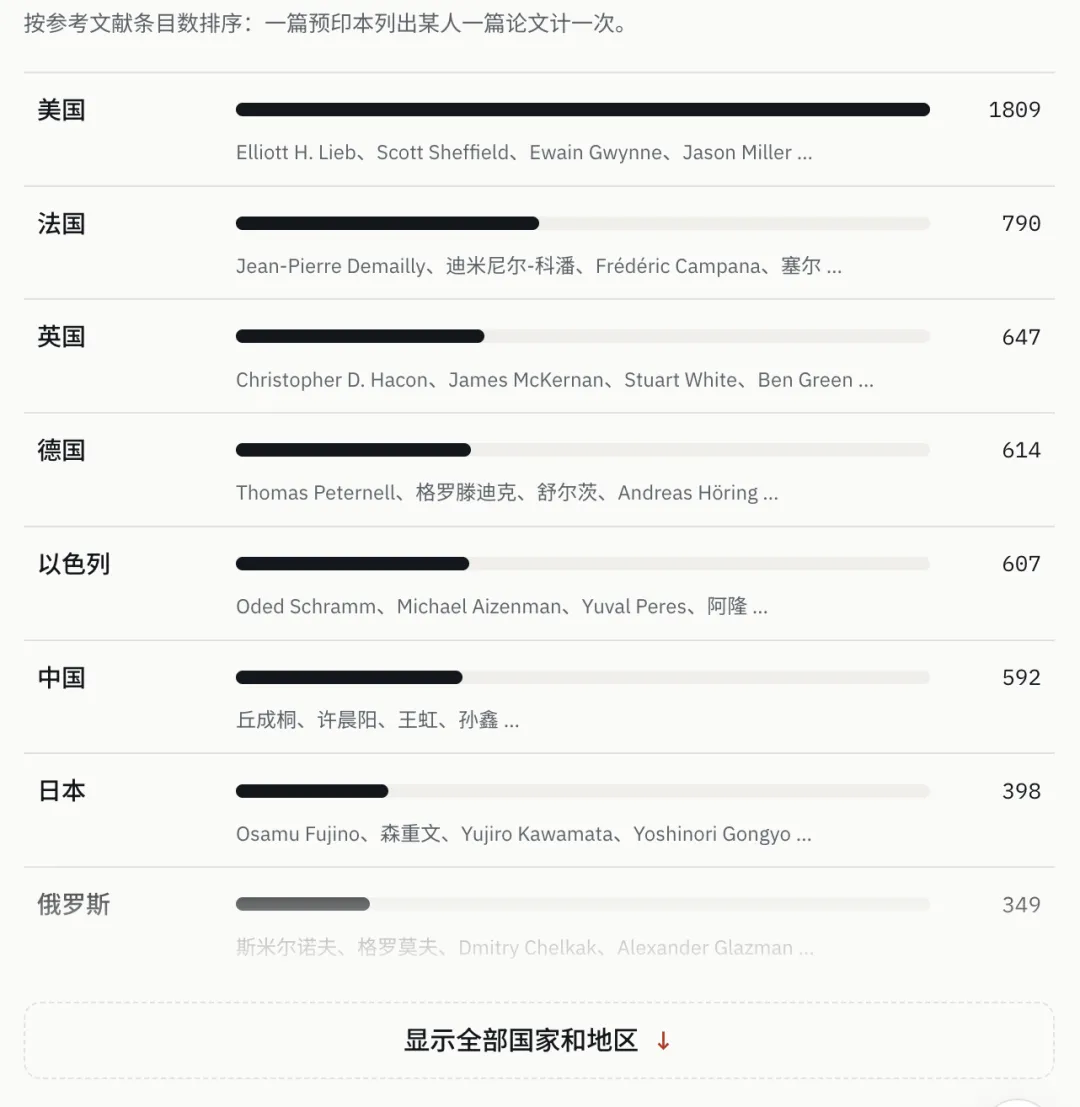
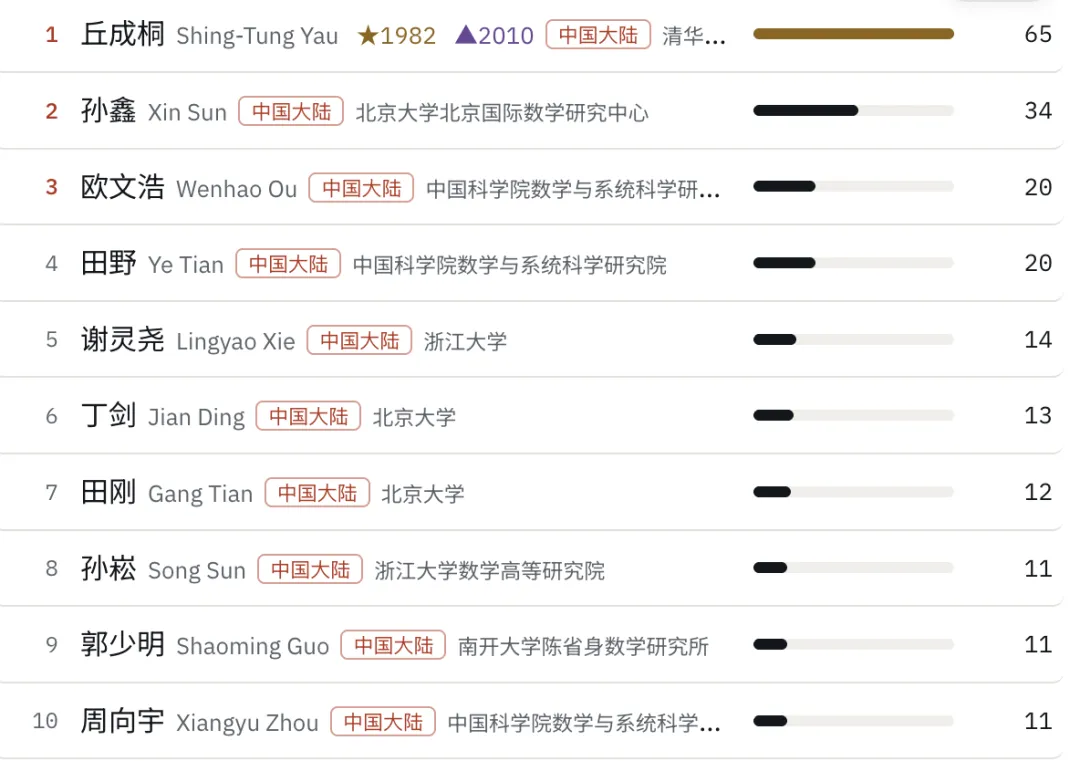
Number of cited works by mathematicians active in mainland China
OpenAI has repeatedly used works such as Chu Cheng Cheng, Sun Liu, Owen Liu, Fielding, Shering Liu, Ding Sword, Tarang, Sun Liu, Guo Tao Ming, Zhu Wang Yu, and others.
Chinese mathematicians in this thread:
In 1976, Chu's work demonstrated the caribbean conjecture and was cited in more than 10 manuscripts.
Chen Province's 1944 proof of the fallacy of the Gaussian formula, and his 1974 form of Chen Simons with James Simons, were used in three papers, one of which wrote, "We use the Chen Simons transverse generalization".
In a recent heated reconciliation analysis, OpenAI's four-dimensional Kakeya manuscript is based on proofs of the three-dimensional Kakeya Hanging Valley conjecture of Wang Neon and Joshua Zahl in 2025, and the Bourgain conditions in the proof also refer to the work of Wang Neon, Guang Neon, Zhang Rissing in 2024.
A manuscript on abundance speculation, based on the leaf-shaped structure of Sun Chen-yang and Lei Zhang; a manuscript on the hard-ball gas, introducing the hypothesis that Zaher Hani and Xiao Ma derived Boltzmann's equations from particle dynamics.
His work with John Morgan on the Ricci flow and Pongaly conjectures, Ding Sword and Allan Sly, and Nick Sun's proof of satisfactory sexual conjecture, as well as his 1957 paper on hard-ball glass gases by Zheng Ning and Lee Siang, and Huang Seung, are also in reference.
The above situation also applies to other scientific discoveries. OpenAI's Navi-Stokes equation paper is based on an equation proposed by Eula in 1757, and then reviews the weakening proposed by Leray in 1934, as well as partial theorems of Caffarelli, Kohn, and Nirenberg. Google AlphaFold trains the structure of proteins based on decades of analysis by structural biologists; its premise dates back to Anfinsen's 1973 publication that the sequence of proteins determines their shape.
Engineers Build MachinesScientists give it what it can learn
For a model that has made scientific breakthroughs (GPT, Claude, etc.)Engineers build machines: architecture, training codes, data pipelines, computing power. Scientists provide high-quality content that can be learned and determine where it goes. Pre-training.
One AI manuscript states: "The splitting theorem of vector angles on a linear projection shadow, E is the linearity of the linear angles". This fact was not discovered by the model.
In 1957, Gröndike gave it its classical form, and since then mathematicians have repeatedly written about it in papers, textbooks and lectures.
The intuition of a scientist is to know which reasoning to use next; the intuition of a model is to learn from tens of millions of human writings.「The next step」The probability is estimated.Models learn "how to solve a problem step by step" through a series of selected logic chains. Some of these logic chains are written by humans and some are synthesized by models; but the synthesized ones are also based on human titles and instructions, and are decided by human-designed tests.
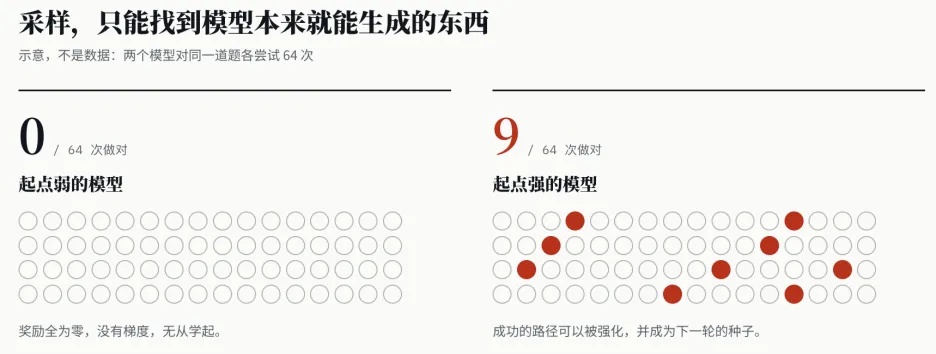
Finally, in reinforcement learning and reasoning, sampling can only reinforce or find what the model would have been able to sample.
This is based on sampling: if the model almost never writes the correct proof, the reward is zero and there is no beginning to learn.
Making "doing the right thing" hardly ever becomes an occasional occurrence, largely due to the quality of previously trained data. Simply put: engineers make learning possible, and much of what can be learned comes from scientists in different fields.
Scientists provide high-quality learning signals
Pre-training and supervision of fine tuning give models a way to intuit and reason, but the new results at the forefront are based on large-scale sampling: training reinforcement learning, reasoning search, and agents. Their common goal is to have the model rollout a problem multiple times and then determine which calculations are determined by the verifier.
Successful trajectories can also be the next round of training data. But the key to making this "test-test" cycle truly translate into improved model capabilities lies in the quality of the signal.
Much of the strong signals come from scientists: rigorous proofs that make training a clear next step; selecting the right subjects that give the rewards that are not all zero or all one; precise verifiers that ensure the signals point in the right direction.
(1) Selection issues.Training on the "just enough" problem is the most efficient, and reasoning is the most worthwhile to spend on such a problem. Good questions leave good seeds for the next round of model training, and flat topics leave only flat seeds.To answer such a question, we need what scientists say is taste.For example, the list of Elders, Chu, and Hilbert's problems is exactly what they're doing.
(2) Defining what is right.When training, the verifier decides the reward; when reasoning, it decides which one is left behind in many attempts.The standard of validation is easy to write, and model training can be tricky. Mathematics first became an experimental field because mathematicians have long been trying to solve problems.「Evidence」Defined very accurately。
(3) The judging results.On October 7, OpenAI withdrew three manuscripts after discovering a symbol error and revised 14 others. Their inventory notes also stated that some of the unformalised results "may be problematic".
So AI is stronger, and it needs drivers. It's like drilling for oil: drilling machines are stronger, and geologists have to decide where to drill to see if oil is coming up.
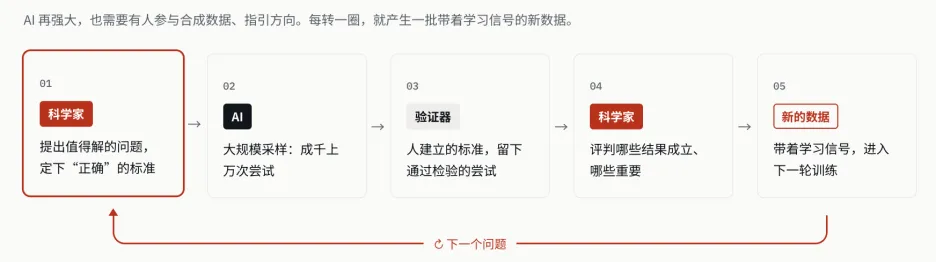
Scientists select problems, define them correctly, judge their outcomes; AI tries them on a scale that humans cannot handle.
Scientists take a step backThe gradient signal will weaken.
What would happen if scientists really took a step back?
The model will still sample, and will still try. But it will be pointed at increasingly narrow questions, screening the answers with increasingly loose verifiers, and shaping its own samples with increasingly single data. Without good instruments, samples cannot touch new knowledge. More troublingly, in the absence of external testing, a model that relies mainly on its own output will gradually deteriorate.
Studies have found that if models are repeatedly trained with data generated by models, they lose rare parts of the distribution and gradually degrade. New problems, new ideas, new experimental data, and the instruments to test them, still require the involvement of scientists today: asking questions, designing experiments, judging results. In the future, some of the new data may come from the closed loop between AI and the physical world, such as automated labs; but what experiments to do, measuring irregularities, what results mean, still require the involvement of field scientists.
So the phrase, "AI can solve everything, scientists are no longer needed", is not just about scientists. It affects where social motivation flows, but also whether young people are willing to engage in science.Both of these things will eventually return to the model: fewer people like this, fewer new problems, fewer verifiers, and naturally weaker gradient signals.
Finally.
For thousands of years, humans have been the only intelligent life to engage in scientific research, and many discoveries are the result of lifelong efforts by scientists.
Today, superintelligence is reaching the forefront of science, and it can only prove, discover, and predict more and more.
But every breakthrough is built on those bright spots: the highest wisdom of man, the deepest solitude, the longest endeavor.
Scientists are the bridge that connects human knowledge to AI. It is important to pay tribute to the scientists of the AI era and to build on the results of their work.
The SeaFill AI team is working on a project on the shoulder shadow of giants, initiated by Qiongxiu Li, assistant professor at the AI Security Laboratory at the University of Oldenburg, Denmark.