On September 11, 2026, a joint statement shocked the academic community.
The 28 co-signatories of the Fields Prize published a note that AI is a serious misconception in mathematics, with its wording rarely sharp. The statement noted that AI companies use solving mathematical problems as a benchmark for measuring their own abilities, a practice that "is harmful to the mathematical sciences and mathematics community".
Solving problems is merely a means and a proxy indicator, and mathematical research really seeks conceptual understanding and insight. When AI is mass-producing "yes/wrong" at an increasingly fast rate, it may destroy the very soil that gives birth to new ideas.
At the end of September 2026, the SAIR Foundation, co-founded by Tao Te Ching, announced the results of the second phase of the Mathematics Distillation Challenge.
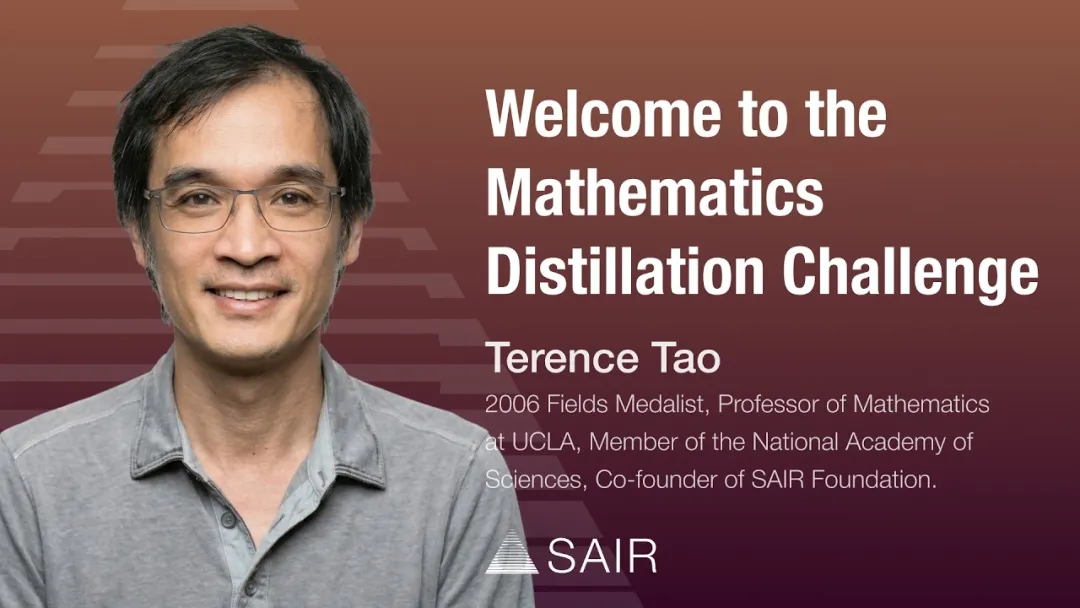
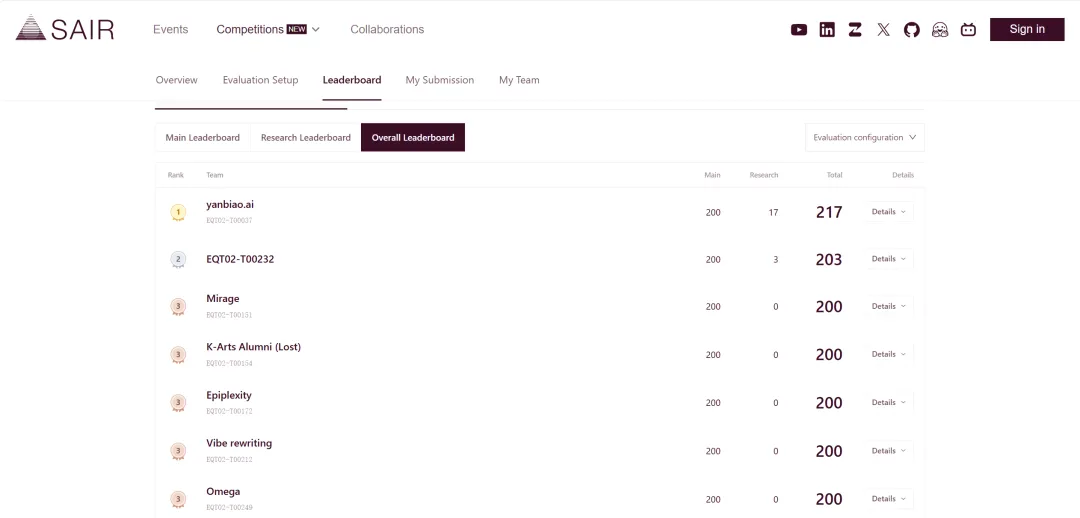
In 294 entries, Yanbiao.ai received 200 points in all four races, scoring a total of 221 points, significantly ahead of the other contestants, the only title it deserves.
While taking part in criticizing the practice of AI companies using mathematical brushstrokes, he personally organized a mathematical contest that required AI to provide verifiable proof.
He was always opposed to the path of "only pursuing answers, not caring about understanding", rather than AI doing mathematics itself.
A mathematical game called Guess or Don't
The second stage of the competition involves the implications of the theory of focus equations, and the core rules of the competition are as follows:
If applicable, the entry system must submit a formalised proof of Lean 4;
In case of non-establishment, an anti-case must be submitted (an algebraic structure that satisfies the premises but violates the conclusions);
All tests submitted by a Lean verifier of certainty are one-by-one, and verification is not subject to classification.
In other words, the judging criteria of the competition were changed from "response rate" to "verifiability".
The competition itself demanded formalized validation, and it has already demonstrated the position of Taoist philosopher. In his vision, the key is how to extract core knowledge from a large number of mathematical proofs and compress it into a hint word. When these highly constricted knowledge can help models solve new mathematical problems, knowledge is transformed in some sense into intelligence.
The second phase of the Mathematical Distillation Challenge has four racetracks, divided into two dimensions.
Solo racetracks deal with one problem at a time, with a fixed single-issue budget; Marathon racetracks deal with 100 issues at a time, with a shared overall budget. The two models focus on different capabilities, Solo focuses on single-issue approaches and Marathon focuses on resource allocation and overall strategy.
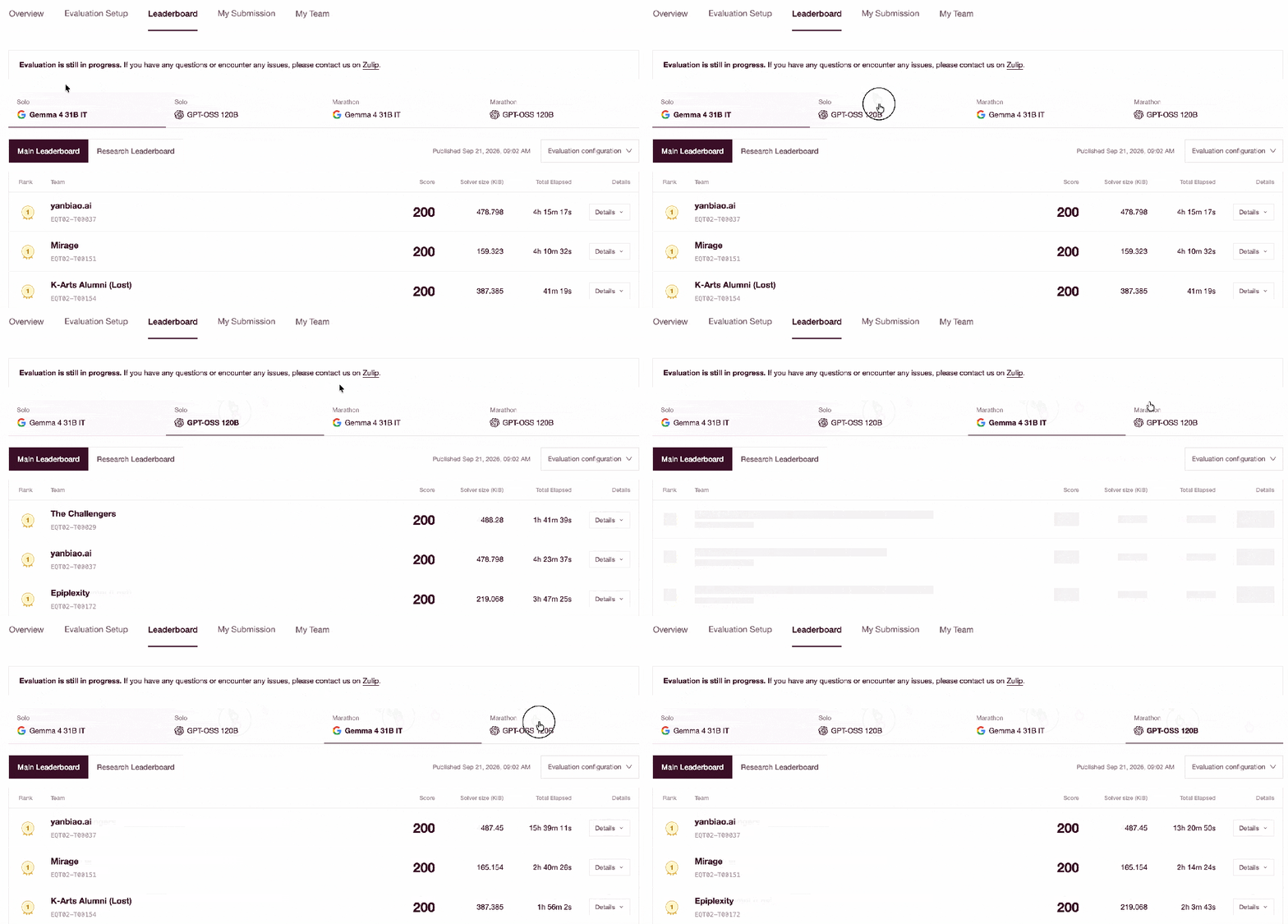
In all four races, the nine-polar solvers completed all the evaluation topics, all ranking first in the main rankings with a total of 200 points.
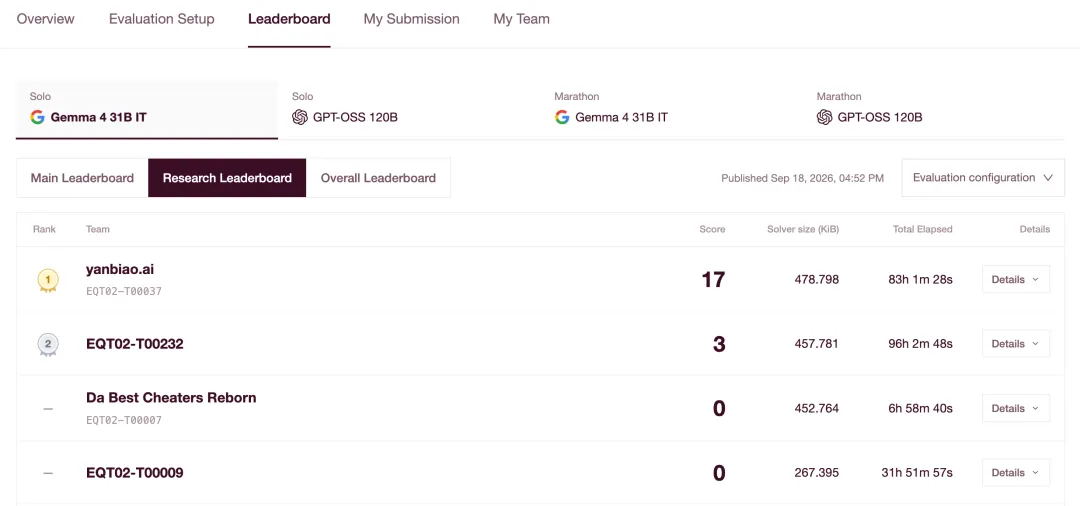
In addition to the main list, the competition also set up a Research Leaderboard.
According to the official evaluation framework of the tournament, the competition was divided into four levels of difficulty, Normal, Hard, Extra Hard and Order 5, where the Order 5 (fifth level) equation deals with approximately 62,000 rules, covering a large number of open questions that are still unresolved. Research Leaderboard selected the most difficult parts from these five levels and scored them separately.
Of all the participating teams, only two teams received scores greater than zero: Nine-Chapter Cloud led by 17 cliffs, second by only three points, and all the others by zero points.
It's worth noting that the teams used the same set of intelligences and methods on multiple racetracks. In the course of the RSI iteration, the team found that they didn't need to design the intelligences and algorithm tools separately, constructed a proof-of-concept map containing billions of Lean codes and then compressed them into the 500 KB Python code required by the competition.
This time, 28 open questions have new answers.
In the tournament, the nine-point cloud led to an astonishing result. This time, the new results of the tournament will be compiled into a paper on the difficulty of the Austin rules in the challenge.
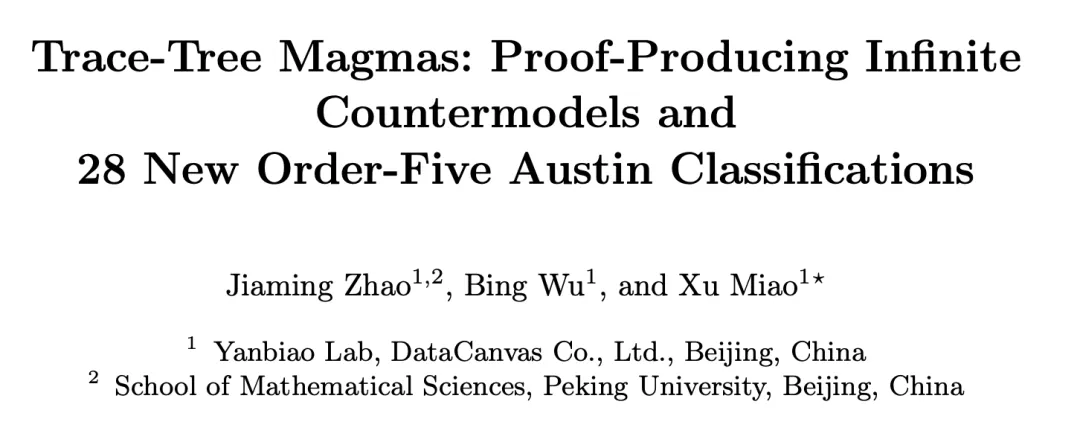
The title of the paper is Track-Tree Magmas: Proof-Producing Infinite Countermodels and 28 New Order-Five Austin Classifications.
Link to the paper:https://arxiv.org/abs/2609.05690
What is Austin's law? Intuitively it can be understood this way. In a world of algebraic structures (magma, i.e. a set with a binary operation), most equation laws either find interesting examples in finite structures or do not exist at all. But Austin's law is different. It defines a special kind of equation: all finite algebraic structures that satisfy it are ordinary (only one element) but there are indeed extraordinary infinite structures that satisfy it.
The paper's core contribution can be understood from three levels.
First, method innovation. The paper proposes a new construct of "rank-decreasing sparse trace-tree magma". Simply put, the team devised a method to rewrite a finite line rule to define a truly infinite algebraic structure on an infinite construct tree. This idea of "limited presentation infinity" bypasses the fundamental limitations of finite model search engines.
Second, a new mathematical finding. In 96 five-step candidate equations locked in the ETP, the paper first constructed an unusual infinite model for 28 of those equations that had not previously been publicly classified, establishing 28 new Austin classifications that fall into 14 paired categories. A single search generated a total of 636 Lean 4 certificates, all accepted by event verifiers.
Third, verifiability always passes through. Each reported model is accompanied by a self-contained Lean 4 proof. The paper team called this mechanism a "trust boundary" design, and the search and generation processes themselves are not trusted, and any candidate results must be calculated through Lean core validation.
The paper's main contributors come from the Speech Language Laboratory, an AI4S research institute owned by Nine Inch Nails. Nine Inch Nails, a provider of artificial intelligence infrastructure and cloud computing.
A champion born in the clouds of wisdom
Following the championship, Machine Heart held an in-depth interview with Dr. Liu, the chief scientist at Nine Polar AI.
This combination looks a bit unexpected. AI infrastructure and cloud computing companies are doing mathematical reasoning competitions? But think carefully, it makes sense.
We know that the age of AGI has arrived, and that RSI is an extremely important topic. AI for Science is a pioneering scenario for RSI, and mathematical reasoning with the ability to formalize verification has naturally become the first stop. Liu recalled in an interview, "We want an open source entity, all of us as a community, to come together to solve problems".
He proposed the vision that "knowledge can be converted into intelligence through compression", and that the Nine Clouds wanted to further expand this idea. He said: "Nine chapters are RSI, and the two sides want to evolve together: not only evolve the model itself, but also evolve human knowledge".
For the nine-chapter cloud pole, the game has a layer of significance: the AI4S load, which is formally verified as the core, poses different requirements to the algorithm base for scheduling efficiency and long-term stability, which is precisely the direction of the long-term accumulation of the nine-chapter cloud.
Automated mathematical reasoning is a very special kind of computational burden. It requires a continuous iteration of the "search proof → formalized verification → feedback adjustment strategy" cycle, which involves large-scale parallel searches, long-running and efficient resource scheduling, and is very similar to the engineering challenges of reinforcement learning training.
In the challenge of taking the lead, the need for infrastructure is hampered, which happens to be the traditional strength of the nine-point cloud. Dr. Liu directly put this first in an interview: "As a smart computing new cloud manufacturer, we must first strengthen the underlying infrastructure.
He gave a concrete example of a competition in which a few of the themes of Lean proved to take up to an hour to run, and the team did a lot of optimization on the Lean system to make the system load faster, to be able to run a large number of Lean processes in parallel, and to scale up the RSI experiment.
"By playing a competition, doing a research project to test whether the nine-point cloud-based engineering capabilities can support this work", said Liu, one of the goals of the competition itself.
Specifically, the training plant supports large-scale pre-training, micro-modulation and reinforcement learning on heterogeneous computing, while the Token plant carries high-throughput propulsion tasks, both of which constitute a complete engineering base from the training to the completion of the installation. The company has over 29000 PFLOPS of controllable power, and first proposed DCU's single unit of computing power, which drives power like hydropower.
"Sometimes computing resources are used more efficiently, and things can actually be done faster". This is a simple truth.
Reliable AI4S capabilities
AI for Science is undergoing a paradigm shift from "accelerated computing" to "participatory discovery".
In the mathematical field, the model has been able to work with mathematicians, and the capability has already reached the research level. Recently, OpenAI announced that its AI system has produced 722 mathematical discoveries, sparking widespread attention. However, mathematicians soon discovered that some results were erroneous or could not be independently replicated, and several results even had a symbolic error that was withdrawn after review.
Are the scientific conclusions of AI reliable?
At the 2026 AI4S Congress, Dr. Liu also spoke about this in his invitation to the AI4S Fundamental Theory Parallel Conference. He believes that a bottle of AI4S is a "deficit of confidence" in the conclusions that researchers make about AI.
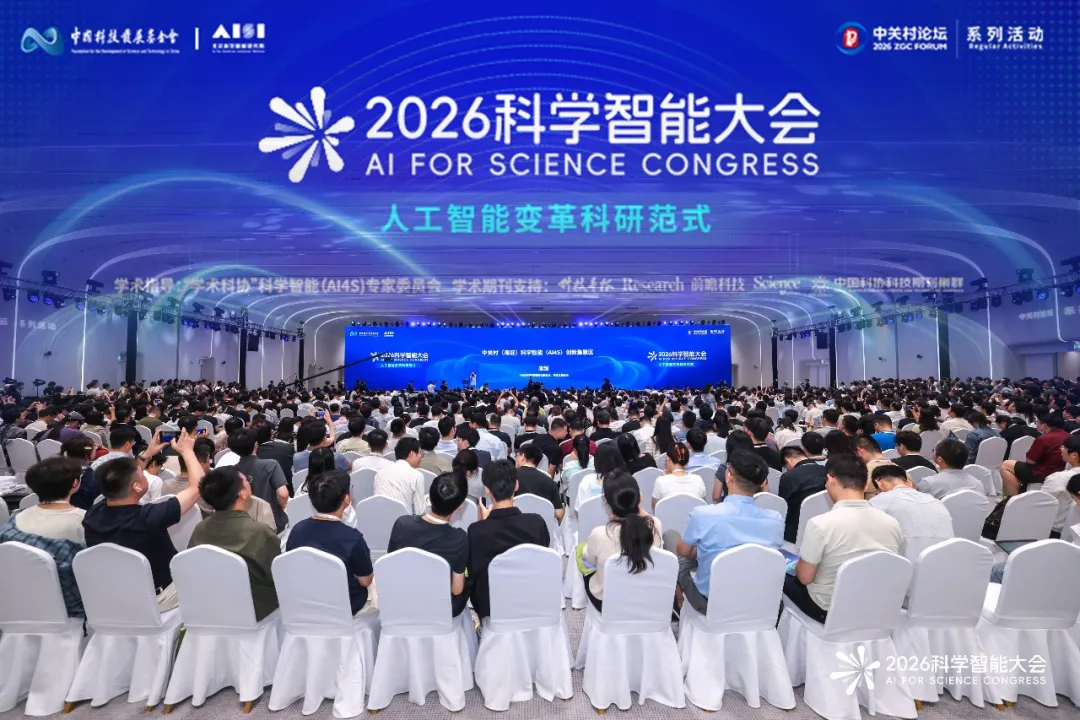
The probability generation mechanism of large language models naturally carries the risk of "illusion". In everyday conversations, occasional fact biases can be tolerated; in scientific reasoning, a neglected premise, a implicitly substituted definition, a small error accumulated in a long chain of reasoning can lead to inferences being invalid.
This is the strategic position of "verifiability" in AI4S. The latest version of the AI Security Governance Framework 2.0 released in March 2026 incorporates the reliability and verifiability of model output into the governance system, explicitly requiring the strengthening of "traceable, auditable" technical capabilities in high-risk decision-making scenarios.
The response path of the nine polar clouds is a combination of neural symbol verification and reinforcement learning, with the goal of making every scientific discovery of AI verifiable and traceable. The RSI path should not be entirely a model's own iteration, "it is likely to evolve alongside formal verification and knowledge bases".
Mathematics naturally has the capacity for formalized verification, and in the near future, AI4S systems will definitely start in the mathematical field and expand into experimental science.
Dr. Liu revealed that in the future, "we want to expand this set of mathematics, a system based on formal verification, to other experimental disciplines. If it can be combined with experimental disciplines, I think it's something that's really valuable that can really make a big difference to the progress of human science".
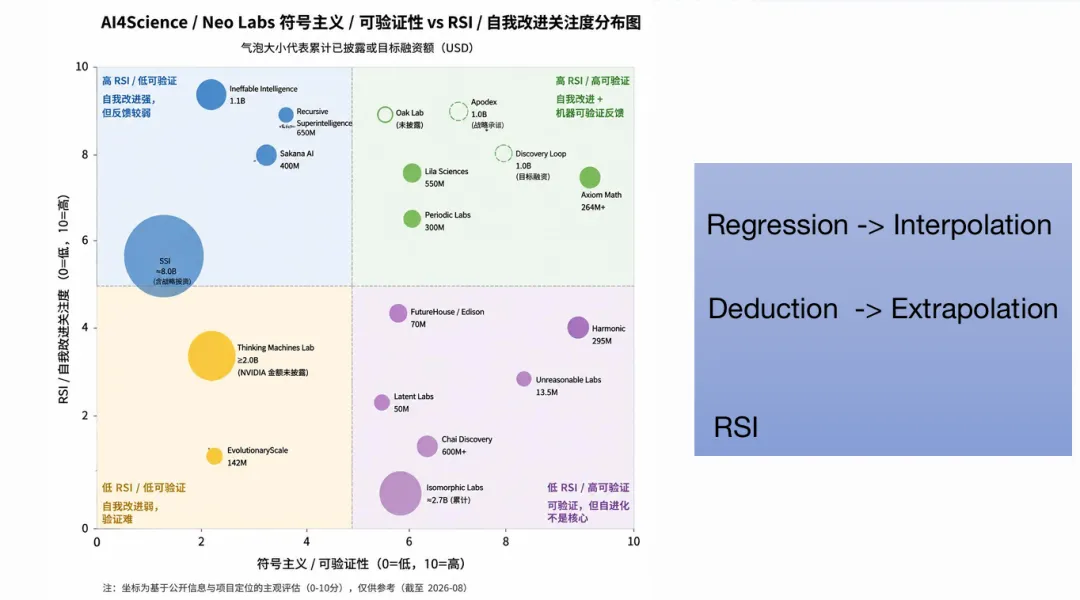
However, from mathematics to experimental sciences such as physics, chemistry, and biology, there is a huge "trust deficit". These fields lack a formal verification system. Many scientific hypotheses end up having to be verified by real experiments, which are often time-consuming and costly.
Even AI systems that have made major breakthroughs like AlphaFold can't fully cross this threshold. Models can quickly predict a large amount of protein structure, but really get into the experimental linkage, many of which may not be possible and still need to be screened and validated by researchers one by one.
The team's idea was to build a formalized knowledge base in disciplines such as physics, chemistry, and materials, gradually incorporating the relevant theoretical systems into verifiable, reasoned systems. Before actually conducting experiments, theoretical reasoning eliminates obviously unreasonable assumptions, identifies contradictions between different theories, and selects more verifiable directions for research.
AI has the opportunity to serve as a bridge between the two. On the one hand, through formalized reasoning and validation, theories guide experiments more directly; on the other hand, through experimental feedback, continuous modification and enrichment of theoretical knowledge, thus promoting the continued evolution of AI systems.
This is a tremendous amount of work, and if this cycle can be established, the value of the RSI will extend from mathematical proof to a broader scientific discovery process.
Building a new foundation for broader science
Chapter 9 The AI4S layout of the Cloud Pole itself is a new node in an ever-expanding scientific network.
Deep collaboration with Peking University is an important part of this connection. The two sides co-founded the "Northern Big Nine Cloud Multi-Intelligent Joint Laboratory", the lab focused on the Agentic RL direction, the "mathematical Intelligences and Complex Reasoning" in the four research directions directly related to the results of this competition and paper. It is worth mentioning that the laboratory has achieved "bi-directional collaboration in which scientific research has algorithms, algorithms have scenario outcomes, North Korea provides original algorithm ideas and high-end scientific talent, the P-class isomorphic computing group, the full-spectrum intelligent cloud, and the financial, manufacturing, scientific real-world industry scene".

The depth of participation in cutting edge research is also increasing. As a supporter of core arithmetic and an ecological co-building partner, Dr. Liu is deeply involved in the research and development of the "World Narrative Model" (WNM) team at Shanghai Transport University, providing a foundation for high-performance arithmetic for complex multi-modal training and physical simulation.
In addition, it has completed the validation of the adaptation with the Bose quantum Kaiwu SDK, an AI factory-wide hyperfusion technology chain, demonstrating the engineering practical capabilities of the multi-intelligent body reinforcement learning framework in quantum computing direction.
From mathematical reasoning to the evolution of intelligent agents, to narrative models of the world, quantum computing, the nine-polar study layout is extensive, with a clear technical underpinning behind it.
"The main line is actually around reinforcement learning", Liu gave a clear answer in the interview.
For reinforcement learning, Liu has a much longer vision: "We want to create a more universal methodology that turns it into an infrastructure and hands it over to professionals to do things professionally".
It also highlights the idea of a nine-point cloud: that reinforcement learning should be a replicable infrastructure to support professional research in different fields. As AI for Science moves from mathematics to broader experimental science, this infrastructure is also expected to be an important foundation for driving AI's deep involvement in scientific research.
Conclusion: Let AI explore the wider unknown
At the end of the interview, Dr. Liu mentioned a scene that impressed him. After attending the AI Congress, he was told that many young mathematicians feel frustrated that their industry is being disrupted by AI.
"But I don't think so", Liu said, "AI should help people discover more of the unknown, instead of taking all of the oxygen we know and leaving us without oxygen to breathe".
The more things that people know, the more unknown they will be. "If people only steal existing inventories, they are only machines, and sooner or later they will be replaced. But if there is an increase, it is a very big change in the world".
This is reminiscent of the original intent of the game: he wanted AI to help mathematicians understand more, discover more, rather than replace mathematics itself.
A good AI for Science should lead people to explore the wider unknown.