Recently, the world's leading AI laboratories are intensively releasing a signal: AI is moving from helping humans complete tasks to engaging in their own R&D and improvement.
In September, OpenAI announced that it had achieved the phased goal of "Automation AI Research Interns" and plans to create a real "Automation AI researcher" by March 2028.[3] OpenAI chief scientist Jakub Pachocki also published a lengthy paper discussing the prospects for recursive self-improvement (RSI).[4] On September 21, OpenAI added further automation of AI researchers and continuous improvement of AI research and development capabilities as an important strategic direction for the next phase.
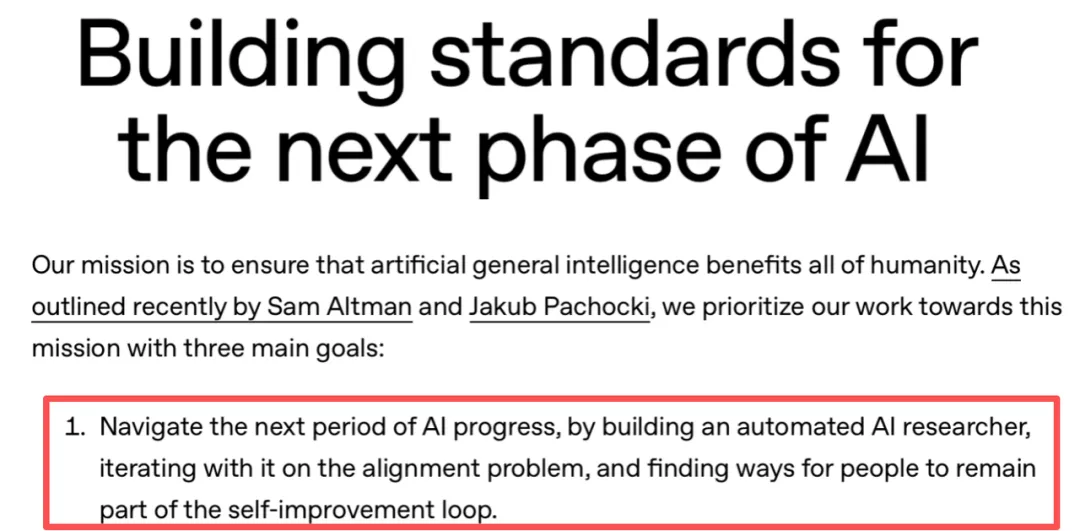
OpenAI issued an official strategic statement on September 21, 2026, listing automation of AI researchers and recurring self-improvement as important targets for the next phase.
On the other hand, Anthropic also released a remarkable set of data: as of August this year, Claude has taken the lead role in about 26% of internal AI R&D work, and more and more R&D tasks that were originally done by researchers have started to be carried out by AI under human supervision.
From OpenAI to Anthropic, RSI is moving from a far-reaching technological vision into the core R&D agenda of the world's leading laboratories. AI is no longer just a tool for solving external problems, but is also becoming involved in the development of its own capabilities.
But the key to this path of continuous evolution, at its core, is:
How can AI make past explorations and trials truly the foundation for the next step, instead of starting from scratch every time it faces a new task?
Memory is a key foundation for supporting the Agent's continuous self-improvement. It allows not only the results of the mission to be left behind each exploration, but also the experience of being able to be inherited and replicated by subsequent missions, allowing the Agent to enhance the ability to transcend single missions and continue to evolve in continuous accumulation.
From experience to continuous evolution:
How memory supports the RSI
The key to continuously improving the ability of the Agent in continuous execution is to enable the experience to transcend single-tasks: from past explorations to effective approaches, accurate calls in new tasks, and continuous modification and optimization based on execution results.
Memory writing requires identifying effective methods from complex execution trajectories, failing conclusions and their applicable conditions, so that past tasks truly leave repeatable experiences behind; memory retrieval requires accurately finding appropriate historical methods and critical evidence, depending on the needs of new tasks, to avoid experience omissions and error migrations.
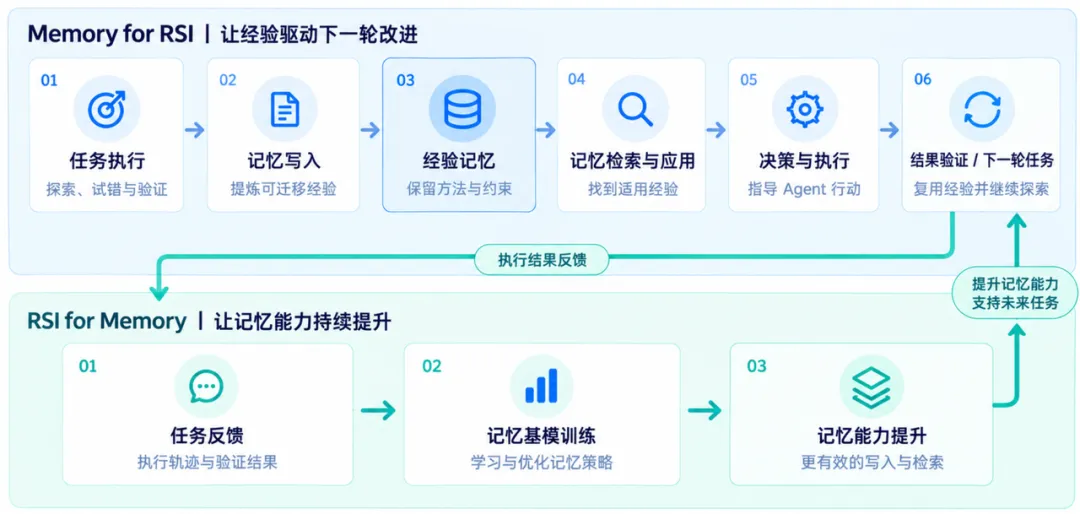
Furthermore, mission feedback can in turn test the actual value of experience. By continuously updating the memory content and using effective feedback to train basic memory models, boosting the ability of memory itself, forming a process of experience accumulation and enhancing each other by the Agent.
It's about learning and evolving memory.
Let the Agent continue to grow from experience.
Around the need for experience accumulation, cross-task replication and continuous improvement in Agent RSI, MemoraX has built a memory capacity system that is based on experiential learning, experiential migration and feedback optimization, dynamic memory organization with real-task-based feedback optimization, and continuous training of memory base models that allow the Agent to continuously learn from historical experience to improve decision making and execution.
Learning from the Mission: Making Experience an Optimized Modeling Ability
Successful decisions provide replicable methods for subsequent tasks, while proven failures help the Agent rule out inefficiencies and reduce repetitive testing errors. However, the value of experience often needs to be reflected in subsequent tasks, accurately summarizing the past, and does not mean that it can effectively support the future. Thus, the process of memory learning requires not only identifying valuable experiences but also preserving them based on validation, environmental constraints and applicable conditions, avoiding experiences being missed or misused, and far from simple information abstraction and compression that can be solved.
In response to this challenge, MemoraX will write memory to model learning strategies for future task gains, continually build a complete system that covers environment building, data collection, sample building and scalable Agentic RL training. In an interactive, verifiable task environment, collect execution trajectories, use memory to record and verify feedback, construct context-related learning samples to write decisions and follow-up effects; and combine the quality of follow-up tasks, execution efficiency and repeat error-testing design rewards, to optimize memory writing.
Migration from experience: Let historical experience guide new tasks
Being able to preserve experience does not mean that it can play a role in new tasks. Faced with different mission objectives, environmental constraints, and execution phases, Agents need to accurately identify the historical approaches that apply, avoiding unrelated information interference and the wrong migration of experience.
For this purpose, MemoraX combines memory content with access structure, adjusting memory access inputs and associated relationships according to current task dynamics, so that the same historical information can be adapted to different usage needs.
At the retrieval level, further study of the matching relationship between current task needs and historically critical evidence through model training, combined with fine-grained evidence identification and similar memory impairment, improves the positioning ability of critical experiences, and distinguishes the correct alignment of string-related string and string-based evidence.
In the experience-use linkage, MemoraX combines current mission status with execution progress, converting the general experience accumulated in history into action guidance with clear objectives, operational constraints and verification standards, and dynamically adjusting to the task phase so that historical experience is truly involved in Agent decision-making and execution.
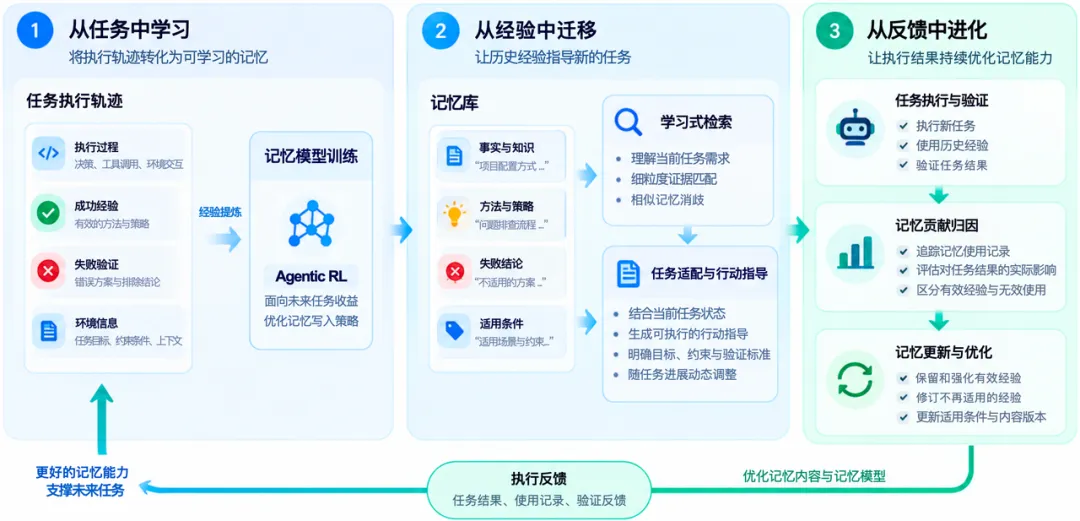
Evolution from Feedback: Continuing to optimize memory for execution results
In the ongoing iteration of the RSI, historical experience is not always effective. New tasks can both validate existing methods and expose their limitations. How to leverage the true value of feedback-judging experiences and thus continuously optimize memory is an important link in continuous self-improvement.
The core challenge is Memory Credit Assignment: Long-range tasks may involve multiple historical experiences, but which ones really affect the decisions of the Agent, which are just read and not working? Even if the final task is successful, how to judge the actual contributions of different memories remains a problem to be solved.
Around this challenge, MemoraX will associate memory versions, actual use records, with mission execution feedback, and track whether historical experiences actually involved the Agent's actions, as well as post-use mission performance and verification results. On this basis, continuous evaluation and retrieval of existing memories, preservation and reinforcement of effective experiences, and timely correction of experiences that are no longer applicable based on new mission feedback.
These real-world feedback also provide data bases and optimization signals for the ongoing training of memory base models, allowing memory improvements to be updated from a content level and extend further to memory model learning about experience values and memory strategies.
I'm not going to be able to do that.
The multi-scenario RSI of MemoraX
For Agent RSI, what is more important is not just how well a mission achieves, but whether the historical experience can be continually accumulated, modified, and continued to generate value in subsequent missions.
Around this process, the long-term complex coding, financial analysis, and complex mathematical reasoning triggers continuous iteration of experience, cross-task migration and feedback optimization capabilities, respectively, while further validating how memory drives enhanced quality and efficiency for Agents in long-term tasks.
(1) Long-term complex coding: Improving skills from experience to complex engineering
Long-range complex coding experiments in 5 major industries, including communications, finance, and logistics, and 13 industrial-level system development missions, cumulatively carried out 78 development runs with a total development time of more than 300 hours and a single maximum of more than 12 hours. Eventually, the memory enhancement program of MemoraX was increased by 20%+, while the cumulative Token consumption of the main coding agent was reduced by 20%+.
From accumulation of experience to recurrent improvement: the path of memory self-transformation
To address the difficulty of continuous accumulation and optimization of experience in task execution, the MemoraX team proposed the Memory Model-Driven RSI method: by synchronizing a self-researched memory model with the Agent system, by a dedicated memory model that is responsible for extracting and updating procedural memory from the Agent execution trajectory and online feedback, and by the Agent system that applies the memory to actual tasks, forming an experience-extracting, task application, performance verification, and memory update closed loop iteration mechanism that enables efficient experiences to continuously accumulate, optimize, and guide subsequent tasks.

Challenging 335 hours of sophisticated engineering development with repeated iteration experience
What role will the accumulated experience play when it moves away from the original learning tasks and faces new engineering challenges?
For this purpose, the accumulated experience will be used for a whole new complex engineering development task. Out of the 13 complex software engineering tasks, a total of 78 development runs were carried out, with a total development time of more than 335 hours and a maximum of 12 hours at a time. These tasks involve more than simple code modifications, but real engineering challenges involving complex business logic, cross-module dependence and a large number of tests.
Eventually, the rate was increased by 20%+, while the cumulative Token consumption of Coding Agent was reduced by 20%+.
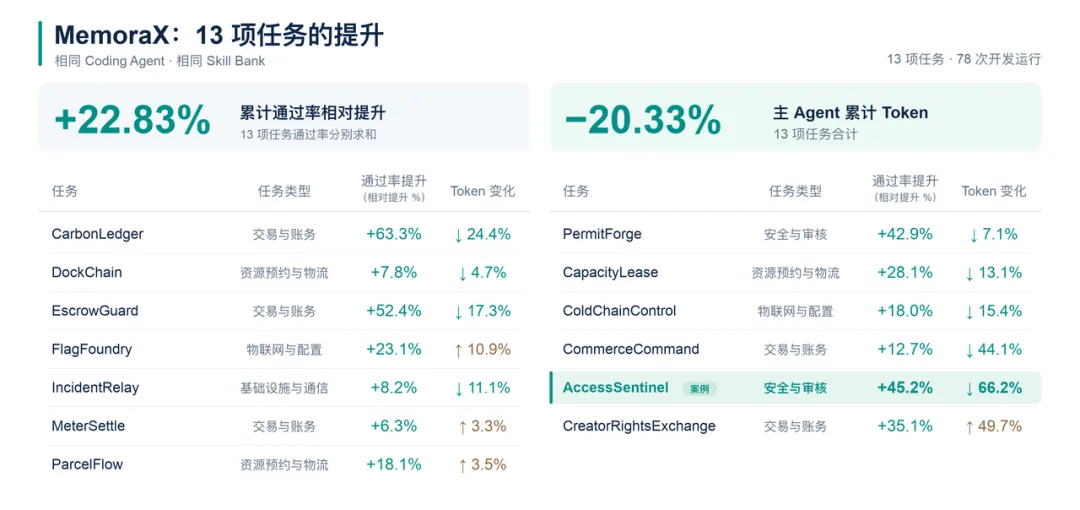
Among them, AccessSentinel is a representative case of high difficulty. Agents need to build a complete set of enterprise-level authorization control systems and ensure strict security constraints.
With the help of memory models, historical experiences are no longer confined to static information references, but are able to continue to participate in the execution and verification of the Agent as the task state changes. From the 43rd minute after the start of development to the 2nd hour and 30 minutes, memory actively provides targeted guidance at different key nodes:
When device permissions are revoked, it is not only forbidden for devices to log in again, but also to ensure that previously logged-in accounts cannot continue to access the system.
When the security policy restores the older version, both the historical record is preserved and the cancelled permissions are prevented from being accidentally restored.
When processing applications in bulk, all applications must first be checked to ensure that they meet the requirements and that all applications are executed in a unified manner to avoid partial success and partial failure.
In the test, the average pass rate of three runs increased by a relative 45%+, while the main coding agent's cumulative Token consumption decreased by 66%+.
(2) Complex financial analysis: continuous improvement from accumulation of evidence to autonomous
Financial research needs complete and reliable analytical judgments from a wide range of distributed materials. In addition to finding relevant data, Agents need to understand subjects, time and statistical qualities accurately in complex contexts, establish links between different evidence, and avoid influencing final conclusions due to information omissions or qualitative confusion.
MemoraX focuses on two interconnected questions: how evidence supports complete answers, and how to use the questions in the answers to improve the way evidence is stored and retrieved. For this purpose, MemoraX conducted an experiment based on the FinRank authority benchmark in the financial sector, which covers the actual financial statements of 22 U.S. publicly traded companies in industries such as pharmaceuticals, oil, and automotive, covering large amounts of cross-company, complex financial data across cycles.

From finding data, to the evidence that organizations can support judgments
For example, in the case of a large manufacturing company's financial analysis task, the task-related evidence is scattered across a large number of similar industry materials containing consecutive three-year financial statements, vendor disclosures, and risk statements. It is easy to find thematically relevant content that is not relevant to the target company or reporting period due to keyword or semantic similarity alone; it is possible to keep a summary and omit the terms and conditions for establishing a numerical value and risk.
To this end, MemoraX first translates the context material into structured memory and, in response to feedback, adjusts the way memory is organized to address the financial question-and-answer scenario, gradually forming a memory model output pattern that matches numerical accuracy, calibre alignment and source traceability; when retrieving, it then calls the evidence around the current issues and analyzes the current state of inventory, procurement structure and potential risks. This way of organizing the financial task in line with the requirements for numerical accuracy, consistency and source traceability.
MemoraX's final task completion accuracy has improved by nearly 20% compared to Codex controls. In addition, according to actual API usage statistics, the cost of the program has been reduced by nearly 98% compared to Codex controls, while achieving a higher pass rate, significantly reducing the cost of calling.
From answering feedback to strategy: how to improve memory, how to save, how to find feedback
MemoraX uses task-based feedback to address evidence-missing, relationship confusion and reference redundancies, continuously explores memory information selection and organization, and continually accumulates interaction samples of associated writing decisions, memory content and subsequent use effects in training tasks to optimize memory models. After training, the model participates in a new round of tasks, whose execution of feedback continues to improve writing strategies and follow-up training, forming a mutually enhanced RSI cycle that optimizes task interaction with model. In the process, the model gradually emerges with memory characteristics that are appropriate to the financial landscape: keeping key values associated with the applicable conditions, distinguishing between different subjects, periods and sources of evidence, and establishing correlations between facts and original data.

For researchers who need long-term tracking of financial statements and announcements, the same set of materials can serve different problems, dampen upfront inputs; feedback from subsequent analyses, and continue to modify memory content and usage strategies. To make answers more complete, to make use more economical, to allow experience to accumulate continuously, all together constitute the practical value of MemoraX in complex financial tasks.
(3) Complex mathematical reasoning: transitioning from experiential feedback to solving strategies
In high-difficulty mathematical reasoning experiments, MemoraX further explored the use of historical experience and verified feedback to support Agent's ability to continuously correct reasoning and optimize solving strategies in complex problems. In the IMO (International Mathematical Olympiad) complexity combination optimization problem, Agent, after about 4 hours of continuous solving, 600+ model calls, finally found the best optimization of 21 verified rectangular blocks. Compared to OpenAI Codex, the solving time decreased by 13% and the cost decreased by 98%.
From Failure to Optimization: Continuing to Improve Reasoning in Feedback
Matilda 16×16 is an IMO-level high-difficulty combination optimization problem: it requires the use of as few rectangles as possible to cover 240 squares in a 16×16 grid, while ensuring that each row, each column, leaves exactly one hole. There are about 20.9 billion possible arrays in empty positions alone. The difficulty is not only to find a workable solution, but to prove that there is no solution using fewer rectangles.
Faced with this challenge, the Agency continued to collaborate on constructing searches, form proofs, precise modeling and independent auditing. The system initially found 27 blocks, 23 of which were candidate constructs, but the argument that 23 blocks were universally optimal was rejected by independent auditors.
MemoraX is able to continuously accumulate previous candidate proposals, reasoning processes and verify feedback, extract memory base models from successful trajectories, and translate failed experiences into references for subsequent adjustment of solution strategies:
Memory self-correcting errors: from the wrong conclusion to memory correction. Independent audits rejected 23 best-performing proofs of errors, pushed Agent to re-evaluate the conclusions already reached, and used verification feedback to correct memory to avoid subsequent reasoning to repeat the same errors.
Strategy automation: from memory updates to method improvements. Prior candidate schemes based on memory base models refined with verification feedback, guiding Agent to adjust modeling methods, integrating hollow locations with rectangular boundaries into solution searches, and subsequently finding 22 blocks, 21 blocks of better solutions.
Memory iteration: from result verification to continuous optimization. Agent performs precise queries through step-by-step inspection and call tools, ultimately confirming the optimal response, and refines the memory base model to provide reference for subsequent similar questions.
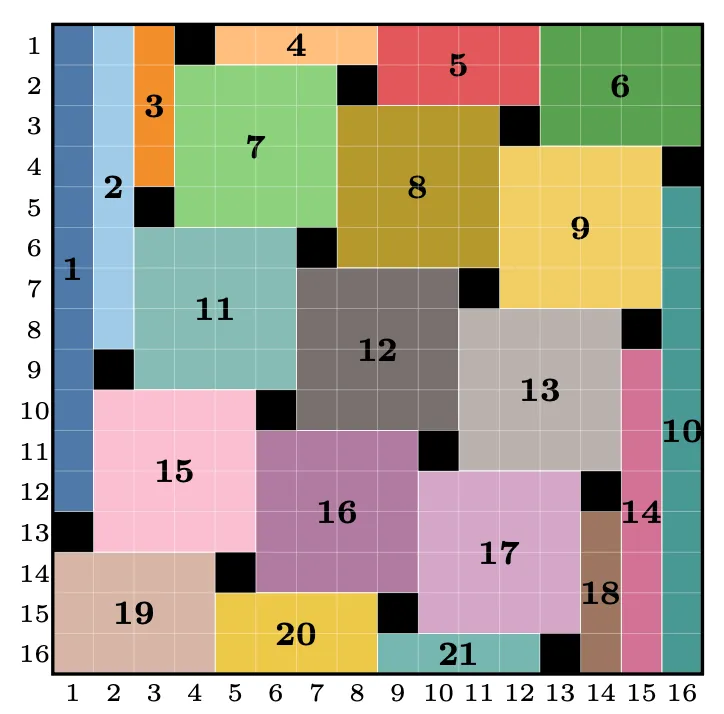
The Matilda 16×16 problem has 21 rectangular best paving methods. Black squares are hollow, and areas of different colors are rectangular.
This demonstrates Agent's continuous iterative ability in complex mathematical tasks: historical experience is no longer just a static log of reasoning, but can be combined with new verifiable feedback and continuously engaged in the adjustment of subsequent solving strategies.
From memory to continuous evolution, Agent
MemoraX AI (Remembrance Age) was founded by the director of the Big Model Algorithm Laboratory, the leading expert in the field of intelligent decision-making, and focuses on the next generation of learning and developmental Agent memory models.
The team's self-developed memory model, based on Agentic RL technology, has been crowned as a global authority on memory, widely reported and noticed by media outlets at home and abroad, including the MIT Technology Review. The team's memory solutions are widely deployed in leading enterprises in the fields of programming, medicine, finance, security, and smart home, and are a strategic partner of Huawei Cloud/Tencent Cloud.
Today, the team is further deepening the RSI based on memory-based models, allowing Agent to move from accumulating and reusing experiences to continuous learning and self-evolution, further demonstrating its leadership in the field of AI memory. At the same time, accelerating multi-scene landing applications, advancing memory module standardization R&D and scale commercialization towards B-end industries and C-end products.
Conclusion
The key to Agent RSI is not only that AI performs better in a single task, but that each execution becomes the basis for the next capacity improvement. Successful approaches, failed experiences and conditions are accumulated through long-term memory and transformed into repeatable actions in new tasks; new execution results in turn promote experience updating, memory strategy optimization and continuous learning of memory base models.
MemoraX is exploring a bi-directional evolutionary pathway where memory and the Agent themselves improve and facilitate each other: on the one hand, allowing memory to provide a continuous accumulation of experience for Agent RSI and cross-mission migration; on the other hand, allowing execution and feedback in real-world tasks to continually replenish learning and evolution of the memory itself.
When every task leaves behind experience and every feedback drives improvement, the Agency's ability to improve is no longer limited to single execution, but the opportunity to become a continuous process of accumulation and self-evolution.