On 6 October, OpenAI released 722 mathematical papers produced by AI, including proofs of Pre-Rhyman's conjecture. Former Google scientist and co-founder of xAI, Christian Szegedy, said that when mathematicians reach the peak of their career, machines can fly directly. But Szegedy believes that mathematics is not an end but a change in the way people explore.
Can this aircraft continue to fly to the broader scientific and engineering fronts, from cancer mechanisms, aging interventions, to complex engineering problems that have yet to be developed?
Global AI laboratories are focusing on RSI: allowing AI not only to complete tasks, but also to participate in the design, training and improvement of the next generation of AI. This systematic exploration is just beginning, and most of the exploration is still early.
A Chinese team has brought RSI to scale. It built Novix, which incorporates self-improvement mechanisms into real-world cutting-edge algorithms and engineering tasks, enabling AI to continue to absorb the judgments and feedback of top experts in the process of solving problems and using that experience for its next round of improvement.
This is the first time I've ever heard of this phenomenon.
Since its inception in just six months, Novix has served 200,000 experts in more than 40 countries and regions, covering more than 500 universities and research institutions. Its users include researchers from institutions such as China University, Beijing University, Zurich Federal Institute of Technology, Cambridge University, Carnegie Mellon University, South China University of Technology, National University of Singapore and Tokyo University.
Practical studies in different disciplines and fields have been carried out on the platform: how aquifers regulate ecological flooding, how steel reacts in cycles under unknown earthquake loads, how low-cost air quality monitoring networks achieve cross-site calibration, coordination of urban channels, high-frequency liquidity modeling of financial markets, and post-training of AI models.
Novix was founded by Ashutosh Goya and others, with core members from Google, Microsoft, Meta, Intel and Kimi, who have led or participated in projects such as Microsoft Copilot, Kimi K2, AgentOS and AutoAgent.
Why is this Chinese team the first to push the RSI into a global shutdown?
The answer is that Novix redefines the co-evolutionary relationship between AI and top human intellectuals at the product, system and algorithmic level. Novix calls this mechanism the Co-Evolutionary RSI and the Co-Evolutionary RSI.
It is responsible for accelerating the exploration of boundaries, with humans continually writing down values, aesthetics, and choices in the system.
In this cycle, AI proactively suggests directions, unlocks spaces, executes tasks and verifies results; experts continually feedback on what is important, what evidence is sufficient to establish, what evaluation criteria (rubrics) to adopt, and which directions meet their aesthetic and long-term judgments. Each adoption, rejection, correction and feedback becomes the next round of exploration of new goals and standards, and further improves the system's task breakdown, tool use, harness and model capabilities.
True high difficulty missions continue to expose the limits of the system's ability, and expert feedback continues to drive system evolution, evolving AI, and solving even more difficult problems. Novix scale is the RSI aircraft that continues to operate at the forefront of algorithms and engineering.
Shou Yu said: "RSI can be truly scalable, it must be the best system to leverage the aesthetics of top human experts".
Let every scientist have his own AI autonomous lab.
In continuous collaboration with global experts, Novix learns what concerns each researcher, how to judge evidence and explore preferences, and actively suggests candidate directions and completes verification. Scientists can also redefine evaluation criteria when choosing to continue, delay or correct biases at key nodes; these judgments are the starting point for the next round of exploration.
Putting this relationship into a typical material research scenario: a PI does not have to write a complete task to the system every day, only to judge in a candidate direction what is worthy of advancement, what is insufficient evidence, what are abnormalities worthy of questioning; the remaining exploration, experimentation, and verification continue to be carried out by AI. As judgments accumulate, the system gradually forms a path to exploration for the researcher.
In order to explore areas where even humans do not know the answer, the next step is the most valuable in space exploration. Every choice scientists make tells the system what is a good problem, how to judge the evidence, what risks they are willing to take, and what results are really worthwhile. The same basic model, therefore, develops different paths of exploration according to the taste of different experts.


In enzyme engineering (see below), a cluster aims to improve the performance of industrial enzyme clusters, gradually becoming a specific problem about mutation combinations, actual reaction conditions and experimental alternatives; in discrete distributed language models (see below), a new type of text generation direction, gradually developing into different research routes such as training, speed of production, reasoning ability.
The general model tends to pose roughly the same problem of distribution, while the feedback from human experts is that the RSI system determines the seed variables when exploring unknown human beings.
The longer the collaboration, assignment distribution, judgement standards, failure recording, and exploration connections are complete, the more research assets and data barriers that are difficult to replicate for individuals or laboratories end up being left behind. These data are kept in the exclusive space and only serve the corresponding users or organizations.
Novix is not waiting for scientists to deliver a complete list of tasks, but is continually discovering, screening, and validating the next steps worth advancing.
When AI squeezes the marginal cost of execution and verification to close to zero, the study limit is determined not by how many times hydrogen can be tested, but by how much hydrogen knows what is worth testing.
Novix wants to broaden the range of top expert judgments. In the past, judgments that could only affect a student, a project or a single experiment have been transformed into system variables that continually drive AI to explore the boundaries of knowledge.
The team's product partner Shimon mentioned that the scale of the system is measured not by how many tasks are completed at once, but by an expert's judgement of how far exploration can go.
RSI closures in three frontier missions
Once the direction is determined, Novix organizes multiple Agent scheduling, processing data, designing methods, building environments and running training or simulation. Scientists do not have to intervene every tool call, only when the evidence, standards or direction needs to change.
Frontline research is not about completing the task at hand: experiments will overturn the assumption, new evidence will force the system to modify the strategy, and improvements in local indicators may lead to a deviation from the real problem.
Therefore, Novix keeps the materials, goals, evaluation standards, tool calls, intermediate products and failure records in the same workspace. Researchers do not have to stick to every step, but can track why the system changes the parameters, which paths fail, where deviations occur when needed. Failure is not cleared noise, but system assets: it both tells the Agent which path is wrong, and exposes what tools, environments, evaluators, and models are missing.
Three open-ended missions provide a more specific observation window: training models, scheduling complex infrastructure, and predicting material responses under unknown working conditions. They have in the past relied heavily on the ongoing involvement of top experts.
Let AI be autonomous from end to end after completing the model.
This is a core RSI task: Training and selection of agents directly involved in model capabilities. Novix independently completes data construction, training code, SFT, GRPO or RFT, checkpoint comparison and final delivery. Qwen2.5-7B accuracy increased from 8.89% to 37.78% on SynLogic's 135 fixed assessment questions; Qwen2.5-7B-Instruct's average score increased from 11.2667 to 35.6333 in ScienceWorld's 30 representative missions.
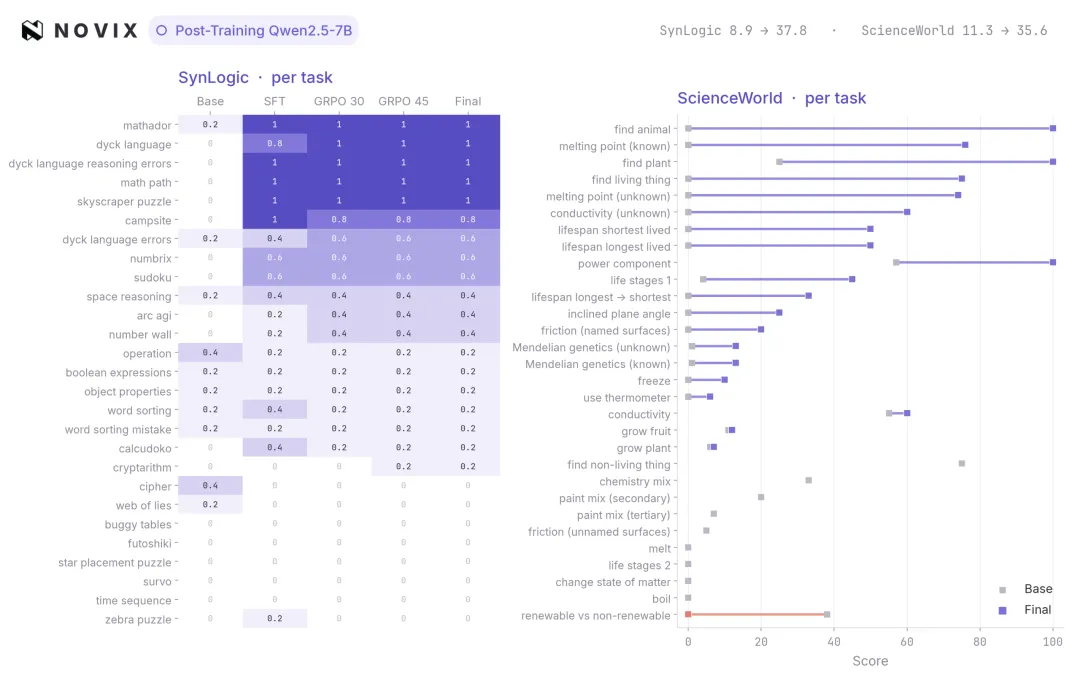
Novix found that the model's score in the real-world mission probe dropped from 38.7 to 21.1 tons. The model only matched the training trajectory, but did not become more problem-solving. Novix proactively rejected the update, restored and delivered a better model. AI for AI's most critical ability is not to keep every round of training going, but to determine whether the model really gets smarter and when necessary to stop, go back and re-select the direction of evolution.

More importantly, these training tasks not only improve the model being trained. Data, logs, failure paths, and evaluation results also flow back to Novix to improve its own task breakdown, tool selection, evaluator, and model, thus forming a recurring loop of AI for AI.
Federal Water Pollution Control in Multiple Restrictions
In a leakage regulation simulation mission based on real river records, Novix needed to allocate leakage per hour to eight dams on the Columbia and Snake Rivers. The leakage helps young fish bypass the motor pool, but it raises the total dissolved gas in the high water and poses ecological risks; upstream regulation also delays downstream effects.
In approximately 3.57 hours of effective use, Novix completed 578 tool calls, iterative data processing, algorithm development, running experiments, and continuously modified predictions and control strategies based on feedback. It found that a gas propagation time was incorrectly set to 44 hours and corrected to 16 hours after redirection; it also found that reducing predictions did not necessarily improve the scheduling effect, so it abandoned unstable scheduling across seasons and instead redesigned optimization goals based on the impact of prediction errors on the cost of scheduling.

Novix finds control strategies that work in sync with eight pumps between power requirements, gas caps and complex operating rules.
Eventually, Novix scored 0.719264 in 16 weeks of independent testing, which was invisible during the study, a 6.50% higher score than the subject-matter expert reference scheme, and all control instructions were executed through binding checks. It was delivered not as a general scheduling recommendation, but as a set of executable controllers capable of making decisions on an hourly basis. This case demonstrates how Novix can move a complex problem to a workable outcome through continuous call tools, corrective forecasting and adjustment strategies.
Predicting steel's cyclical response to unknown earthquake loads
When an earthquake occurs, the steel structure repeatedly undergoes stretching and compression. To predict how it deforms in such a process, one cannot only look at one force: what has been experienced before will also affect the material's subsequent performance.
Starting from existing stretching and looping experiments, Novix independently proposed the underlying hypothesis, modified numerical realization and repeated verification. Over the course of 60 studies, it scored 0.620034 test-reserved test scores, about 1.99 times the expert reference value of 0.310910, with all instances returning valid results.

All 60 examples yielded valid results, all exceeding the baseline. Proving that Novix was able to come up with this construct hypothesis, build models, complete parametric labeling, and then migrate the obtained material laws to unprecedented loading paths.
What these tasks have in common is that the answers cannot be generated all at once and must constantly coincide in experiments, failures and evaluations.
Each time the data is left behind, the paths fail and the expert judgments, the system flows back and forth, becoming the starting point for the next round of exploration. This is exactly what the RSI closed loop looks like in real-world missions.
Human-to-human relationships in a more intelligent age
He was involved in Microsoft's growth of Microsoft Copilot from zero to billions of users and was the founding product manager of MS AgentOS to advance cutting-edge AI product design. He holds a PhD from the University of Hong Kong, participated in post-Kimi K2 training and led the AutoAgent and AI-researcher open source projects.
Other members of the team included algorithm researchers from Meta, Microsoft, and members with experience with Google, Microsoft, and Amazon products, covering post-model training, Agent systems, infrastructure and product design. This background also explains why the Novix team sees model improvement, Agent systems and long-term collaboration with users as the same issue.
They increasingly feel in practice that a top expert is not a static knowledge base waiting for AI to extract it. He will be persuaded by new evidence, become interested in unexpected results, and abandon his past insistence on interpretation. New discoveries brought back by AI will change people's judgments, and new judgments will change the next round of AI exploration.
This collaboration will continue to generate value even if the Agent one day transcends existing human intellectual boundaries. The direction of open missions continues to evolve in real-world missions, expert feedback and new scientific discoveries; the more specialists with different tastes enter the circuit, the richer the goals, standards and constraints of reality achieved by the system, and the broader the boundaries of knowledge that can be reached.
Stronger basic models raise the thresholds of all people's abilities, but do not obliterate the problem-consciousness of different researchers. General capabilities determine how much AI can do, and long-term collaborative taste determines what these capabilities are used for. The two axes of ability intersect: the stronger the basic model, the greater the differential value of the individualized search engine.
As the RSI moves forward, the rarest human judgments become the key variables in the intelligent regression.
Novix has transformed this Co-evolution into an AI autonomous laboratory that every scientist can own. Here, AI relentlessly explores, scientists continue to harvest the results of their research and use their own taste to decide what is worth getting into the next round of research.
This is also the synchronous evolutionary RSI path Novix is validating for AI exploration of the unknown, human choice of the future.