It's the first time in the history of the world.
722 manuscripts, one at a time on GitHub!
Just now, OpenAI announced on Twitter: "We're releasing a whole new set of mathematical results generated by an internal front-end model".
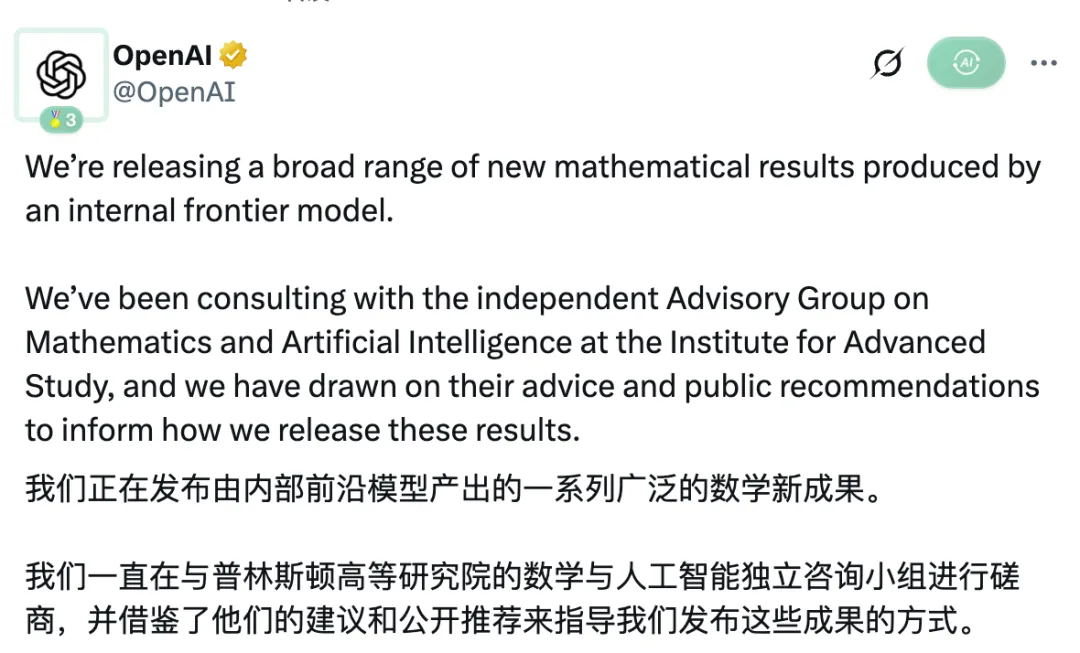
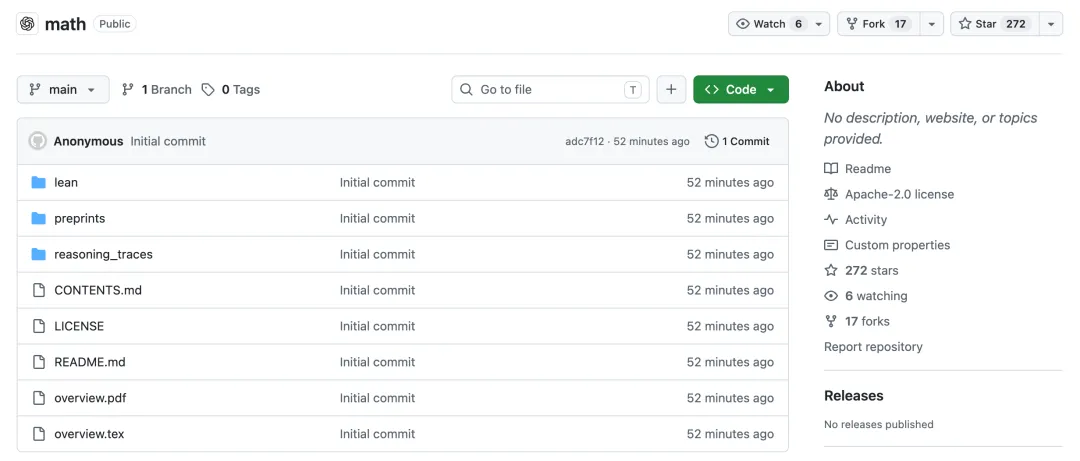
There is no sound, the GitHub warehouse is online.
Let's take a look at the 722 manuscripts, 372 family of questions, covering the multiplication function, the irrational index π, the Maller conjecture, the zero-point region of the Lymanzeta function, the spontaneous magnetization of the Heisenberg iron magnet, the free group factor synthesis...
Each of the names came up and was enough for a PhD student in mathematics for a few years. Now, they're neatly decorated in a GitHub warehouse, like shelves on a supermarket shelf, for anyone to use.
When the blogger @kimmonismus tweeted, he left only one word: "Literally intelligence explosion".
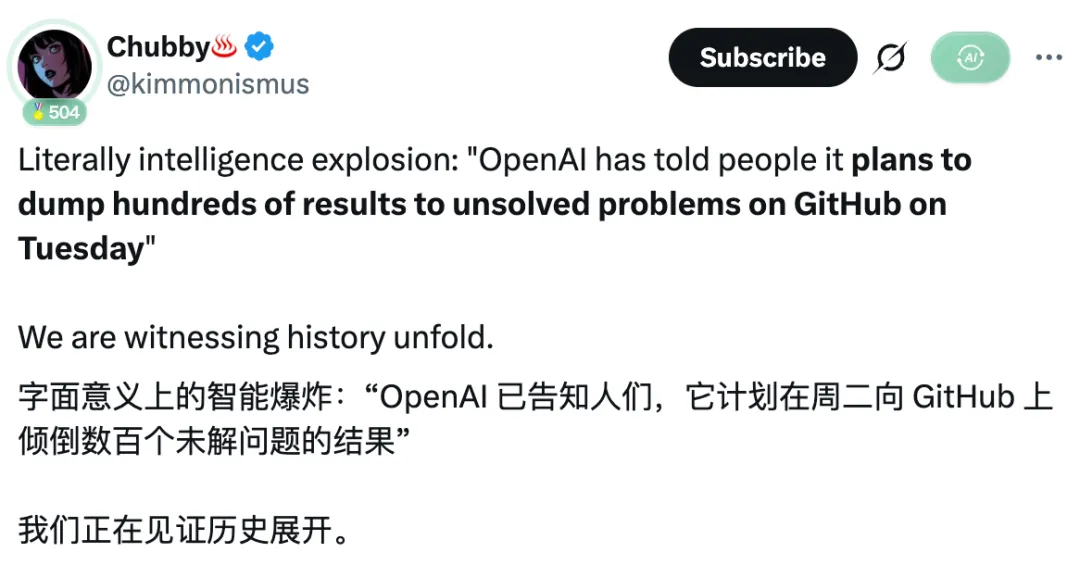
He didn't exaggerate.
From 10 to 722.It's fast enough to suffocate.In August, OpenAI released 10 unanswered mathematical problems on GitHub, called openai/ten-proofs, each with a formal proof of Lean 4 and a 249-page manuscript.
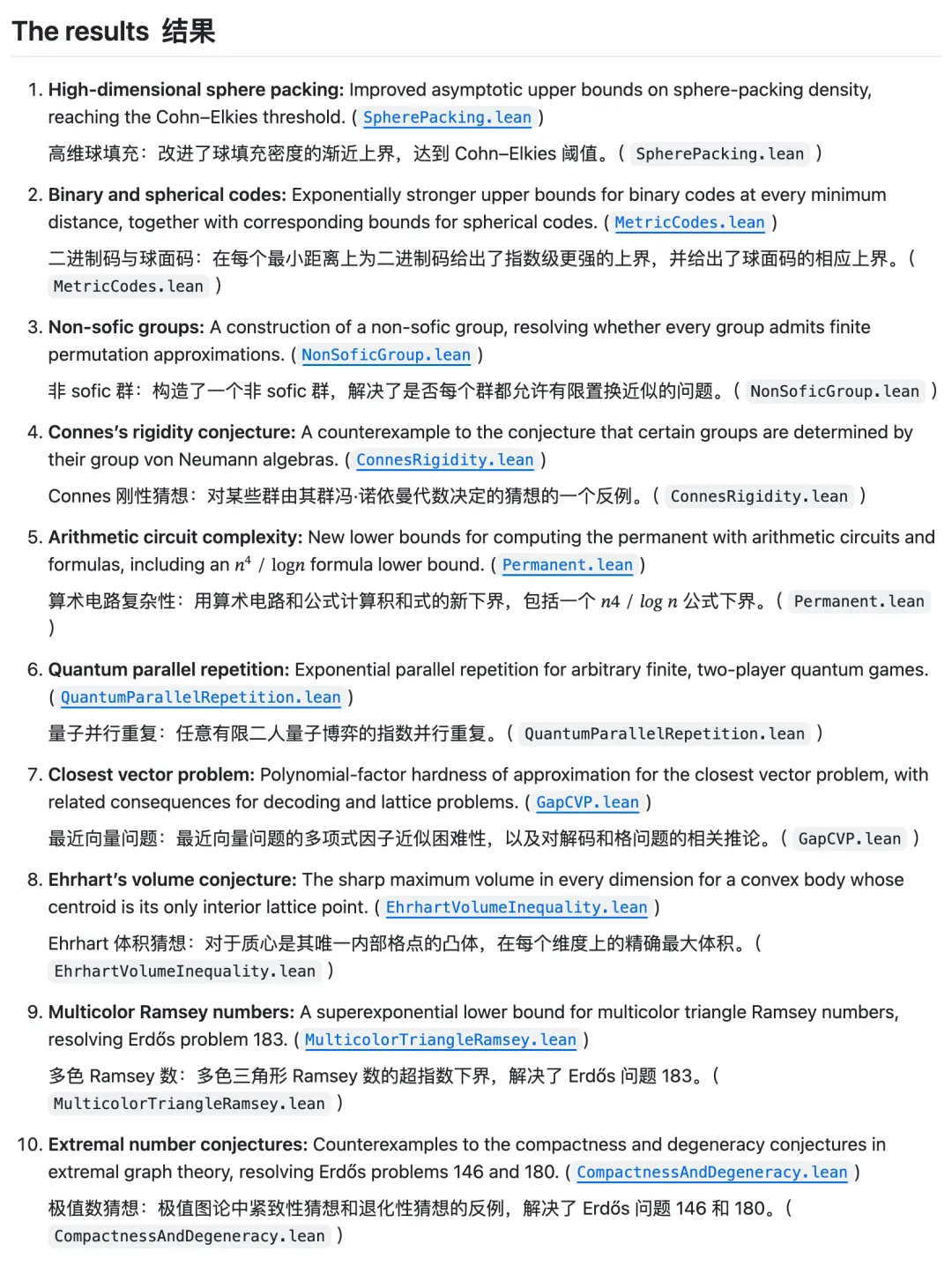
This is the first time AI has delivered a series of research-level mathematical results in a "machine-verifiable" way.
At that time, although the mathematical community had exploded, it was still a good idea to unravel the ten questions one by one, find a few opposing experts, spend a moment, and always finish them.
By September, OpenAI went even further, announcing that the internal model had solved the Navier-Stokes Millennium Problem, adding more than 100 long-standing unsolved issues across domains.
This directly exploded in the entire mathematical community, with 25 Fields Prize winners publishing a public letter together, with Tao Zedong himself at the helm, bombarding OpenAI with mathematics as a benchmark.
Then, on October 7th, the 722 manuscripts were poured directly into openai/math.
From 10 routes, to more than 100 routes, to 722 routes, and then, according to OpenAI, this is just "the latest batch" of tens of thousands of mathematical solutions that AI will produce in 2026.
This accelerating curve is no longer climbing but taking off.
This time, the 722 manuscripts belonged to 372 families of questions. The so-called "family" is the packing of a core result with its derivative arguments, inferences and alternative proofs.
The warehouse structure is divided into three layers: the preprints directory for PDFs and source files, the lean directory for Lean formalized proofs, and the reasoning_traces directory for a summary of model reasoning processes.
OpenAI has also released 10 logical summaries to show you how AI is "thinking" about these proofs.
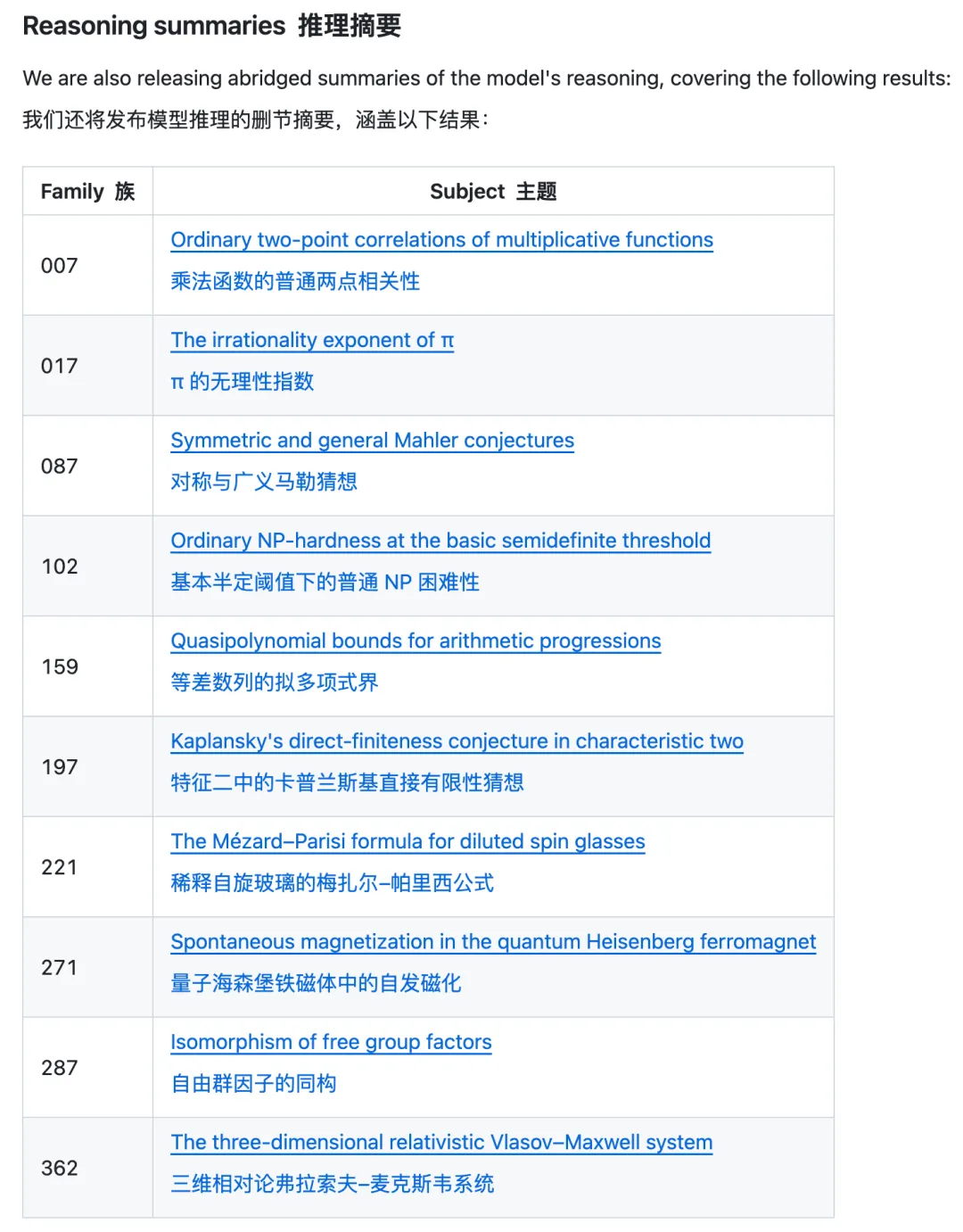
According to OpenAI, the vast majority of the results come from the same unpublished internal model, which consumes an average of 3 hours of ChatGPT Pro reasoning per question, asking a total of about 4,000 questions to the model.
3 hours. A puzzle that has plagued human mathematicians for decades, AI took 3 hours.
It's worth noting that OpenAI left a big statement in the README: "Partly unformalised results may be a problem". In other words, how much gold and silver is in the 722, and how much more to ask, OpenAI itself doesn't quite understand.
But it's still a brain full of it.
The mathematicians couldn't sit down.
If you think mathematicians are going to cheer for this "miracle of mass production", that's too naive.
OpenAI has gathered around 40 mathematicians for a meeting on the topic: What happens next when AI's mathematical capabilities exceed humans?
According to the participants, OpenAI suggested at the meeting that the model had solved hundreds of long-standing unresolved problems and had given assurances that it would not be released all at once.
The suggestion of mathematicians is also straightforward: follow the path published in the paper, one after the other, so that the mathematical community has time to digest it slowly.
A spokeswoman for OpenAI, Lindsay McCallum, responded that the company "didn't know" it had such assurances.
It's important to remember that there's a commitment and not know that there's a commitment.
On 6 October, Wired broke the window with an unflattering title: OpenAI Is Pissing Off a Bunch of Mathematicians. Again, "OpenAI has pissed off a group of mathematicians", and finally, "Again".
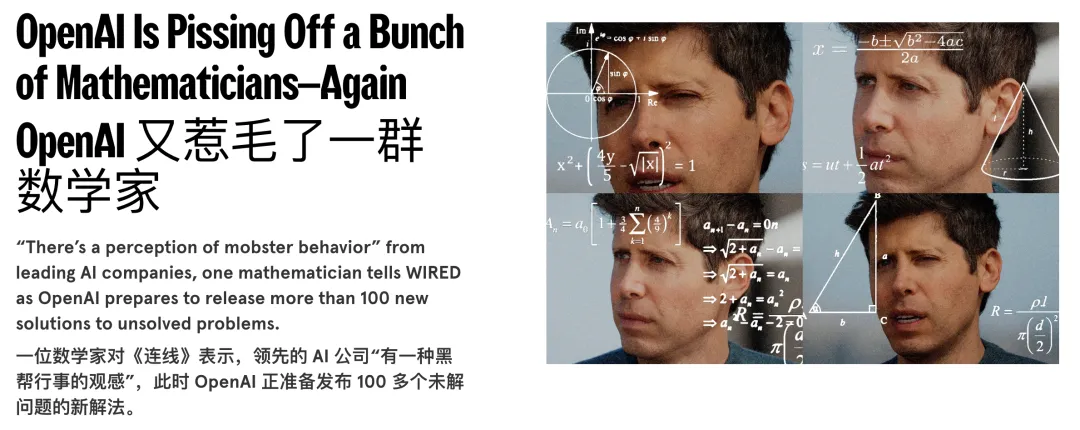
In the report, New York University visiting mathematics professor Nestor Guillen said directly: "There is a feeling among mathematicians that AI companies behave like 'gangsters.'"
Mathematician Bryna Kra of Northwestern University is more candid: they initially suggested OpenAI not to publish mathematical results in blogs or tweets, but to go for formal papers, and as a result these suggestions were "obviously ignored".
But mathematicians don't care if you don't, but how you do it, who says it.
In the past, a mathematical conclusion had to be recognized by the academic community and had to be reviewed by peer-reviewed experts to be read, commented, revised, and published in journals. This process was slow, but with slow value: every recognized result could be inferred.
What about now? 722 manuscripts were thrown to GitHub, when they were sent, when they were sent, how many times they were sent, all applauded by a company.
When the results are calculated, who says it and is turning people into masters.
Mathematicians are collectively dissatisfied, but what is most surprising is the reversal of Taoist attitudes.
A few months ago, he was Silicon Valley's most revered "AI class representative", and in March this year, his colleagues publicly shouted that AI was undergoing a Copernican revolution in mathematics.
After six months, the painting mutated.
Tootsiev threw out a conceptual puzzleProof Indigestion, proof of poor digestionHe means: A proven lifecycle has five steps: answering questions, machine verification, translating adult speech, peer digestion, writing textbooks.
AI keeps pushing big speculations, but no one writes papers, no one reports, and even the people who press the rear keys don't understand what just happened.
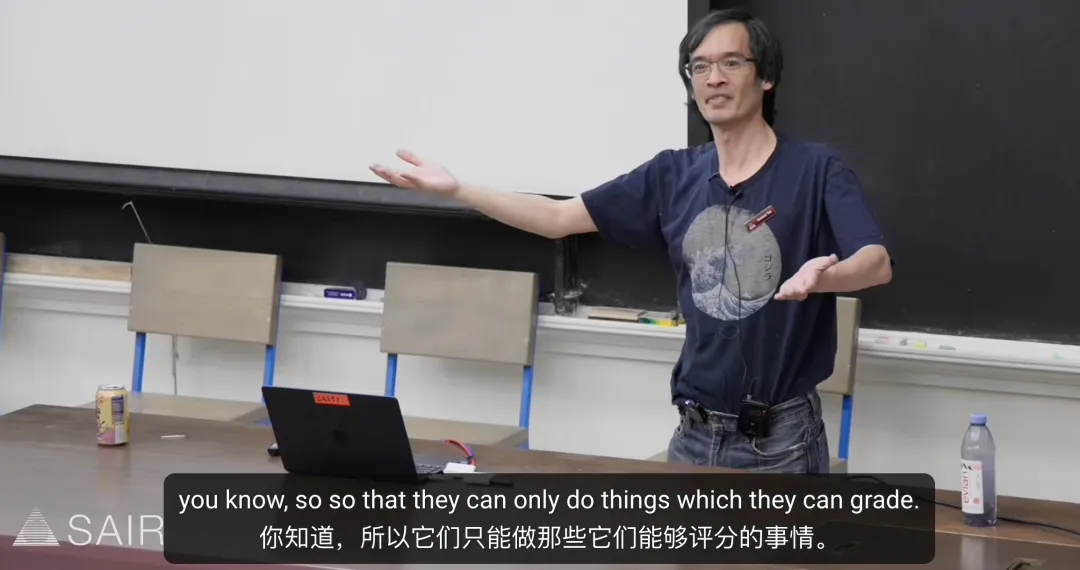
In September, Tao Zedong, the joint winner of the 25th Fields Prize, issued a public statement bombing AI as a benchmark for mathematics.
"You have to slow down. There's absolutely no reason to go so fast, no reason at all".
 Smart explosion, moving from paper to reality
This is about more than mathematics.
On September 28, more than 20 people in the heavyweight category, including Hinton, Bengio, OpenAI chief scientist Jakob Pachocki, and Jack Clark, co-founder of Anthropic, published a paper titled "What if automated AI exploded?"
The paper's core data is striking: As of August 2026, anthropic's internal AI systems have completed 26 percent of AI research and development independently under top supervision alone, up from just 1 percent five months ago.
The paper warns that once an AI system reaches a level of expertise in AI research and development, a developer can lead an AI team of "millions" of top human researchers.
"Once the smart explosion starts, the window of action may close".
One of the authors of the paper is the chief scientist of OpenAI. While discussing whether progress would be accelerated in the paper, his company has thrown 722 mathematical manuscripts into GitHub at once.
Mathematics, by far, is the easiest field to spot because its criteria are absolute: to prove right is right and wrong is wrong.
In the past, the speed at which knowledge is recognised by humans has determined the speed at which it progresses. Peer review is slow, but it is the foundation of the entire scientific credit system.
Now, for the first time ever, the system is behind the production of machines.
In mathematics, AI has entered a phase of "mass production". The difficulty has shifted from "unresolvable" to "untested by human experimentation".
Kimmonismus is right. This is literally an explosion of intelligence.