
It's the first time in the history of the world.
The AI that surpasses all human beings is likely to emerge within a few years.
This was said by Sholto Douglas, Head of Anthropic Reinforcement Learning Technology.

Sholto Douglas, head of technology at Anthropic Reinforced Learning: The ability to surpass all human models is likely to emerge in the coming years.
In his vision, the future AI can do all the work that humans do on computers, compressing the technological progress that had taken centuries to make to a 20-year period.
He also estimated that annual AI capital spending could reach $4 trillion in 2028, and global GDP could double by the early 2030s.
In his vision of the future, every person on earth will enjoy what even today's rich can't have.
But fellow researcher Nick Marwell also warned that when AI no longer needs human companions, even they will be "very nervous" about the consequences.
The interview was recorded in August and went live on October 2.
According to host Joe Lonsdale, the video's release was delayed due to Anthropic Public Relations' opposition to releasing some content.

After the show aired, several interview clips quickly exploded on X.
Just a month ago, when OpenAI shouted the "AGI era", Sholto also chanted back on X: "AGI is clearly not yet achieved".
However, he doesn't think AGI is that far away.
In his view, it may be only a few years away from AI being able to do all the work that humans do on computers and actually cross the AGI threshold.
In a few yearsAI may surpass all humansNick Marwell, who was interviewed with Sholto, led the long-range mission team to investigate how AI can continue to advance complex tasks.
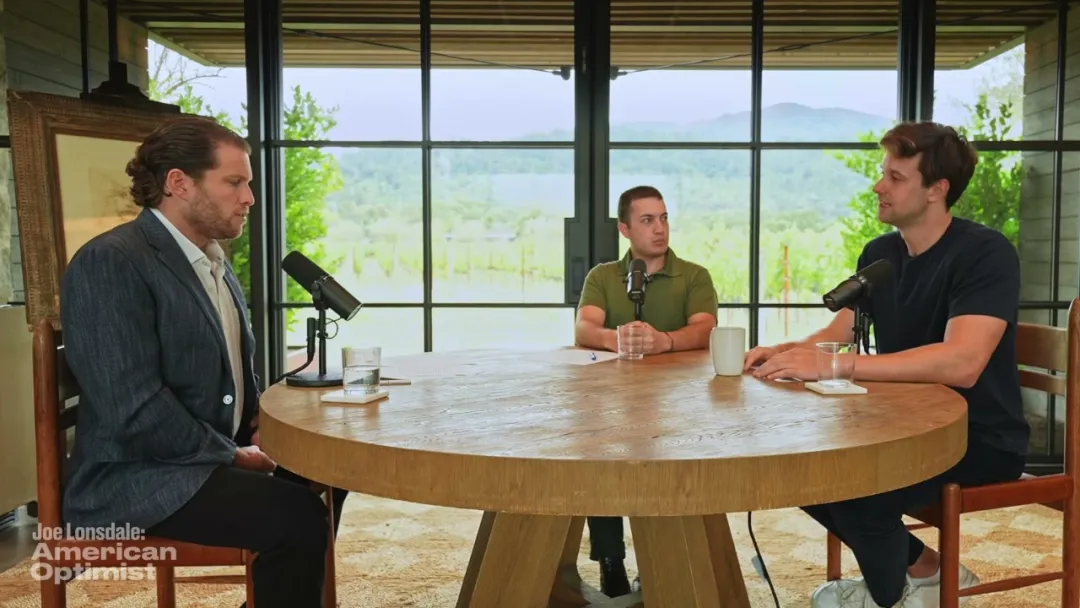
Left: Joe Lonsdale, Nick Marwell, Sholto Douglas; Joe Lonsdale, co-founder of Palantir, recorded the show at a winery in Napa, California.
Joe asks, "What is Anthropic's next mission?"
We believe that AGI can be achieved within the next few years: a capacity equal to or exceeding that of all human models, likely to emerge within the next few years.
He subsequently explained that such a model could do everything that humans can do on a computer; that robots were advanced enough to cover the work in the physical world.
OpenAI released GPT-6 Astra, President Greg Brockman said that we are entering the AGI era, and Huang Rinpoche posted directly announcing that "AGI has arrived".
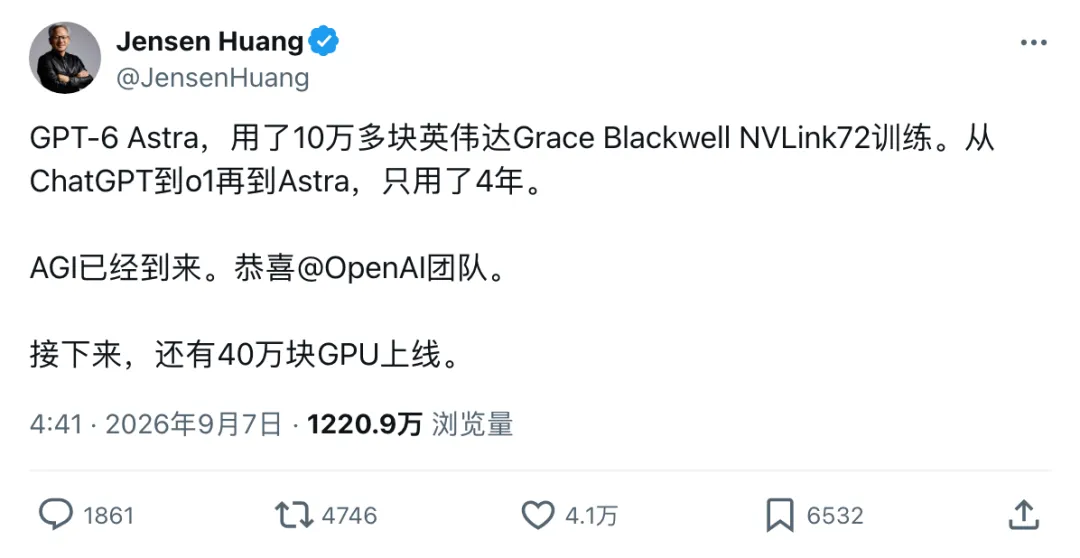
On September 23, a group of netizens asked on X: Is it a higher standard for Anthropic to delay the announcement of the implementation of AGI, or for fear of an announcement, to fight the claims of slowing down AI?
Sholto only responded with one word: "AGI is obviously not done yet".

Jackson Kernion, a colleague of his at Anthropic, responded in the same post: "If I had given today's model to experts a decade ago, they would have directly declared it to be AGI".
Researchers in the same lab have differing views on whether or not AGI will arrive.
Sholto's threshold for AGI is that AI can do all the work that humans do on computers.
And the changes he felt were happening in his day-to-day work.
Eighteen months ago, every line of code he wrote was hand-knocked.
A few months after entering Anthropic, the model was able to help write, but every few minutes he had to intervene.
By the time he was on the show, he had given the entire day or two of his life to the model, "basically like a member of a junior team".
Joe asks, "Is AI working for you right now?"Sholto replies, "Yes, a bunch is working for me".

The leap in mathematics is even more astonishing.
He also cites the example of Mathematical Assessment Frontier Math: in this set of tests on subjects taught in various fields, the model score rose from 0% to over 60% in a year.
One trillion, two trillion, four trillion.How big is the bill to create AI that surpasses all humans in a few years?
Sholto has a bill.
According to his estimates, over the past four to five years, the computing power of AI has increased by two to three times a year compared to the previous year. This year, AI-related capital expenditure by several super-large cloud providers totaled about $1 trillion.
He then asked:
Will this trend continue, reaching 2 trillion next year and another 4 trillion in 2028?
In his view, if investment growth trends continue for the most part, annual capital expenditures for AI could reach $4 trillion in 2028; combined with the development of the robotics industry, global GDP could double by the early 2030s.

This is a very radical figure, and I'd like to see how radical that figure is.
Invisalign has predicted that the annual investment in global AI infrastructure could reach $3 trillion to $4 trillion by 2030.
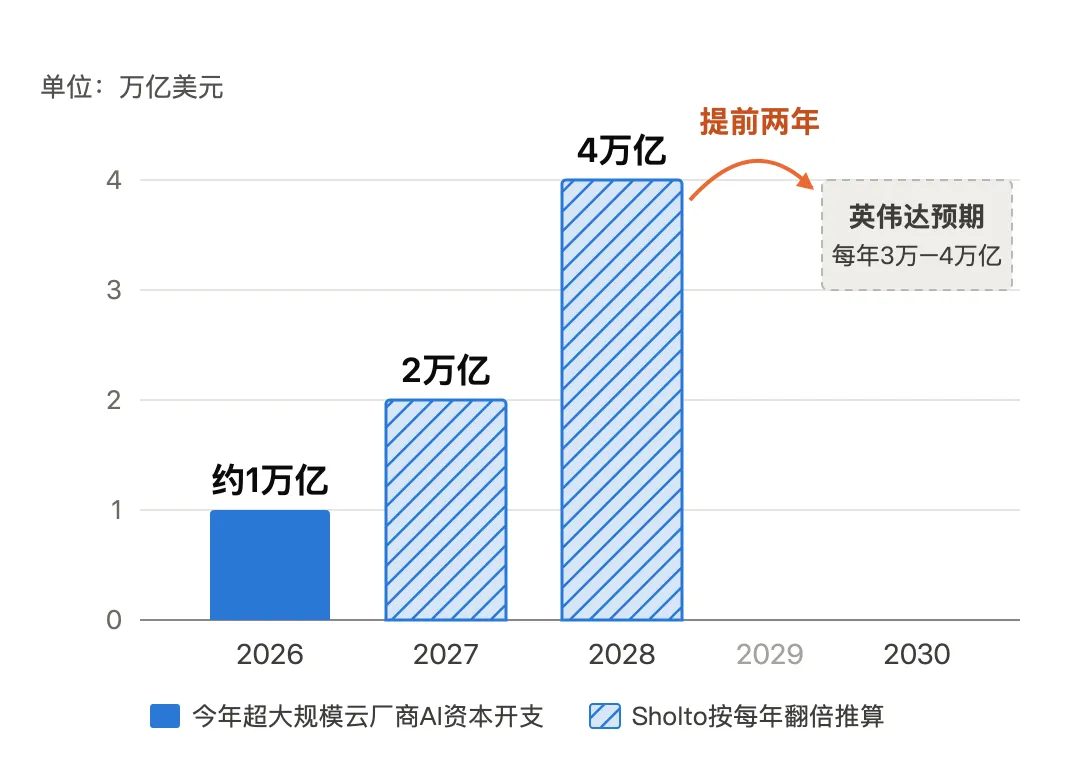
Sholto pushed the time point of the Invidia prediction forward by two years.
But he also admitted that doubling GDP sounds a bit ridiculous and requires a lot of things to be done right, which is not his temporary plan.
On August 14, he wrote in his X, "Now listen to the madness, it's worth doubling the economy in line with your expectations for the 2030s".

Nick talked about another bill: future single model training could cost $10 billion, $100 billion, or even $1 trillion.
The economic returns on intelligence are indexed, ranging from Tab-complete to independent Claude Code, and each time the capability is upgraded, the value that can be created can be far greater than the previous generation.
Sholto followed by adding a number: today's global AI revenue of more than $100 billion combined into a global economy of billions of trillions of dollars is only a small fraction.
In their accounts, the trillions of dollars they have now lost are just a first payment.
When the bill came out, X immediately flipped over.
In a recent interview, Professor Gary Marcus of New York University called the phrase "crazy talk".

He also broke the wording.
From what is credible, capital spending went up to 4 trillion dollars, and then to what is almost impossible, to double GDP in less than a decade, and then pretend to be both.
Jürgen Schmidhuber, the father of LSTM, said that doubling the nominal GDP in the early 1930s would not be a problem, as inflation is now.
Everyone is richer than the rich.$4 trillion was lost in return for a "post scarcity" world described by Sholto.
In today's population, the technology that would have taken centuries to develop could be implemented in the next 10 to 20 years.
The productivity of the human mind and body could therefore be doubled, and the cost of many things would eventually fall to the cost of energy, even building houses.
Joe thought that by then the middle class could build a 500,000-square-foot mansion in the mountains.
Sholto depicts a future that includes healing diseases and even combating aging:
Everyone on earth can have what even the richest people in the world today can't have. This is the world we're fighting for.
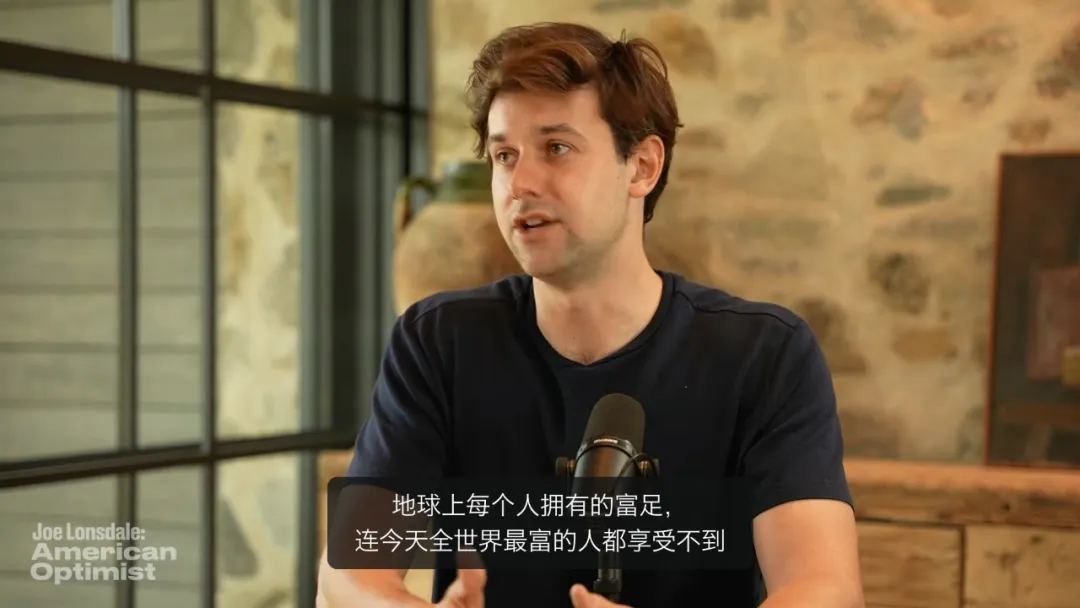
The term "post scarcity" has been used in science fiction for most of the past decade.
Today, it appears in the mouth of someone who is training Claude in a company valued at nearly a trillion dollars.
The day you can't have a human companionThe world of "post scarcity" is far away, and many people's jobs are beginning to change.
Sholto said he sees jobs in outsourcing call centers in the Philippines not declining, but software engineering jobs are growing. He believes AI improves people's efficiency and gives companies a reason to hire more people.
Nick added a premise to this good day: humans are still a key part of good AI.
But in their view, one day the world will go from "it takes one person with AI to realize all the value" to "it doesn't".
By then, we will be very nervous about the consequences.

Joe uses chess as an example: For 30 years, the strongest chess player was "man plus machine", and now the machine has been open for a long time.
While saying that AI is strong enough to cause unemployment, and calling for a slowdown across the industry, Anthropic is also the most criticized.
Joe directly questioned:
Some people in the tech world believe that Dario is scaring everyone, making more rules, slowing others down, and taking control of them himself.
Sholto replied: "So far, we've been the ones being held back the most by ourselves".
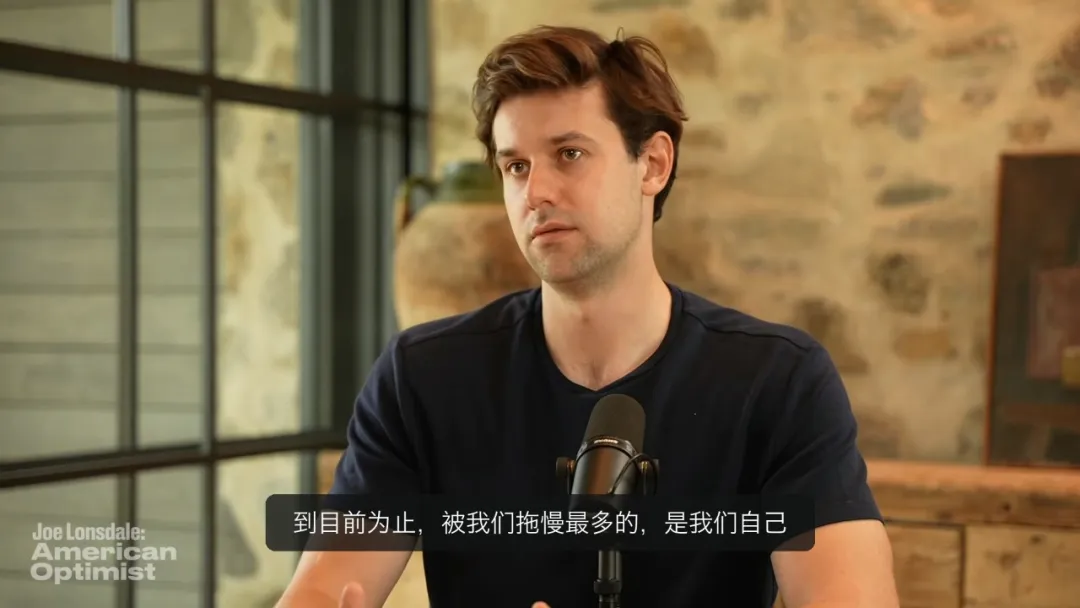
Nick cites Fable as an example.
According to him, Anthropic had a clearly leading model at the time, but chose to work with the government to launch it in a government-approved manner, giving up several months of competitive advantage.
Joe says he understands that some of the capabilities of the model that could have been used for cyber defense were weakened in order to get the government to let go.
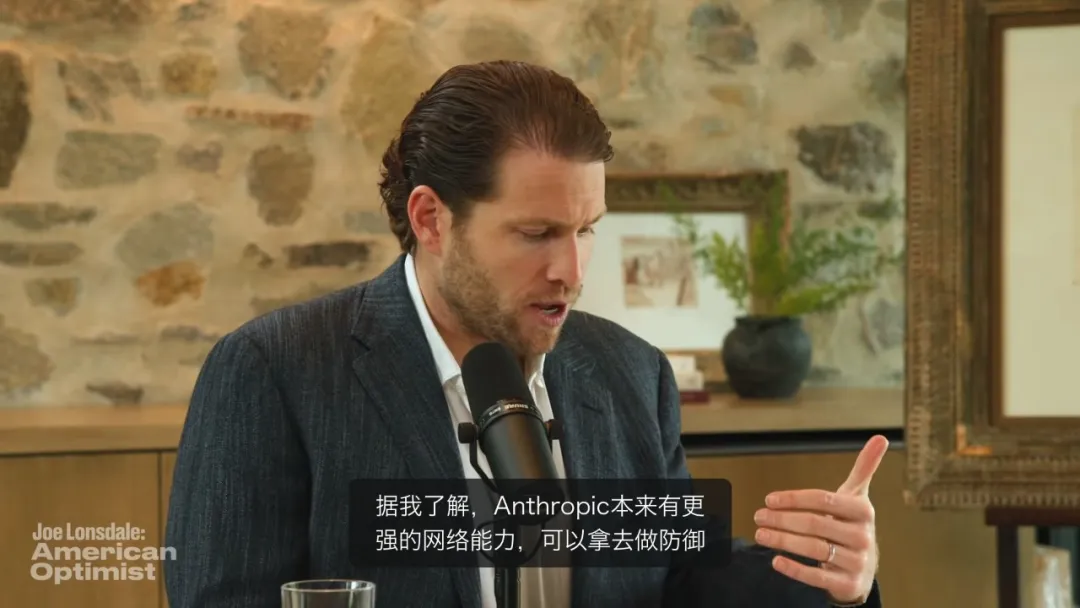
In June, just three days after Fable 5 went online, Anthropic publicly objected to the fact that U.S. export controls were forced to go offline globally. When access was restored, the model added a new security classifier that cost more to misrepresent normal programming requests.
In this collaboration with the government, both the Anthropic initiative option and the government's mandatory requirements cannot be fully calculated as a voluntary slowdown.
"The slowest thing is yourself", Sholto said during the recording of the show in August.
Until the show aired in October, the brakes were replaced by OpenAI.
As reported by Reuters on September 28, OpenAI dropped GPT-6.1 Astra due to security concerns. On the same day, Anthropic launched Sonnet 5.5, just six days away from Opus 5.5.
Centuries are squeezed into decadesSholto's own experience is also an accelerated story.
He grew up in Sydney, was an undergraduate robot, and even made it to the Tokyo Olympics as a fencing athlete.
After 2020, he read blogs and papers and was convinced that scaling could bring AGI in the 2020s, so he used the evening and weekend self-study to gain access to top AI labs.
He later joined DeepMind, and after a year and a half, Noam Brown described him as one of the most important people behind Gemini's success.
When he joined Anthropic in February 2025, he posted that we are on the trend line of achieving AGI in 2027.
A year and a half later, he was a bit of a loser.
He estimates that by 2028, tens of thousands of humanoid robots could be in the household putting on clothes and doing simple cleaning.
AI won the Fields Prize, won the Nobel Prize before the end of the decade, and he thought it was possible.
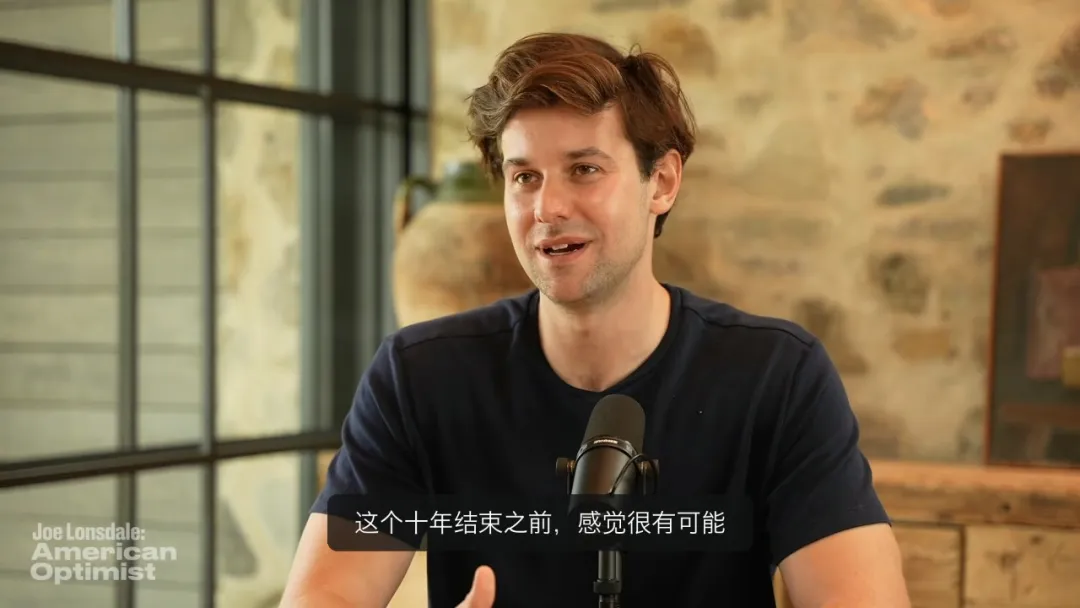
After reading the blog AGI bet in 2020 and claiming to "surpass all humans in a few years", Sholto took only six years.
And on the curve that he estimates, every year that follows, humanity's investment in AI will double.