The news of AMD's acquisition of World Labs immediately shook the AI circle.
On September 28, AMD announced that it had acquired World Labs for about $8.2 billion in an all-stock deal. Li Feifei will serve as AMD's executive vice president and chief scientist, reporting directly to CEO Suzhou Tong.
A few weeks before the announcement of the transaction, World Labs had just released a new generation of space world model Atlas. Unlike previous video generation models, Atlas trained from scratch to integrate text, images, video, camera positions and 3D depth into a unified space context, focusing on solving new perspective predictions and extending to 3D reconstruction and time-space simulation.
In China, a company took this route two years earlier than Atlas.
Shadow Body Intelligence was founded in 2024, and its founder and CEO, Zhao Wei, is an engineering professor at Tsinghua University and formerly head of the Alibaba Native Robot Team.
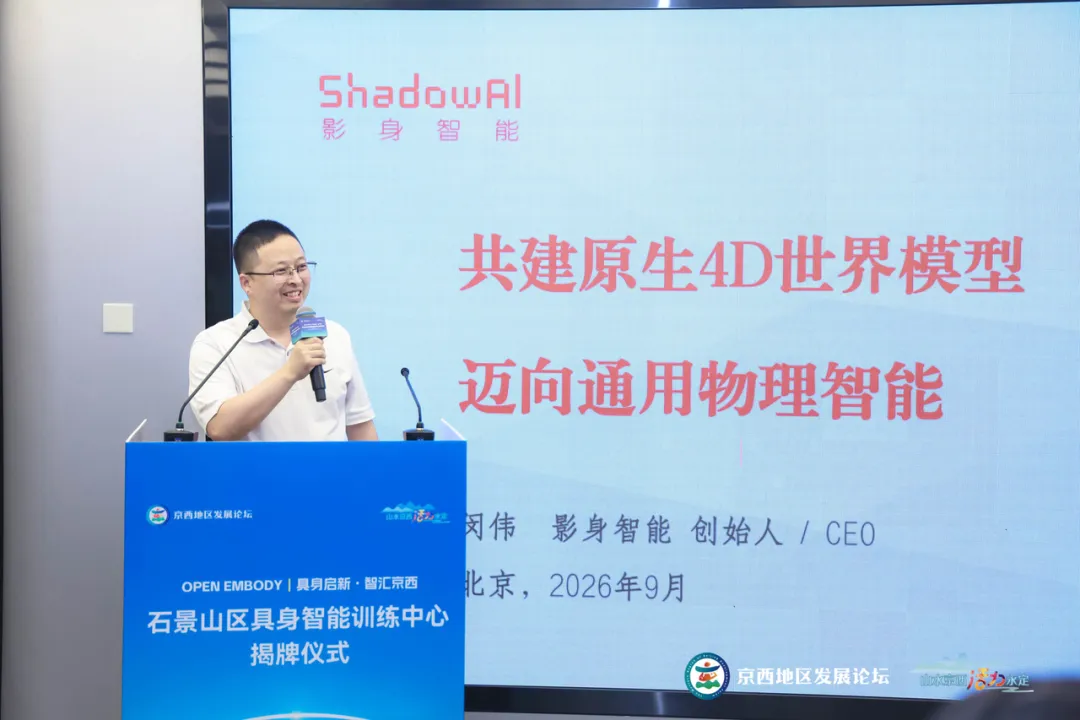
Since its inception, the company has chosen native 4D routes, built from multiple viewpoints and dynamic reconstructions, further trained 4D world models, and deployed the model into robots and real factories. In April this year, Shadow Intelligence has achieved real-time production of 4D data with 4 to 6 consumer-grade cameras, single consumer-grade GPUs; in September, the 4D live broadcast program supported by 6 cameras was shown at the China International Garment Fair.
In Liu Wei's view, what AMD sees is not just a technology company, but an opportunity to rebuild the ecosystem.
"AMD, as a chip company, must embrace the next generation of baseline models to shake Britain's position. The ecosystem of the big language model era is relatively mature, it continues to follow the old path and the windows are narrowing. The 4D world model offers a new technological path, a new baseline and new data that could lead to a new set of computational ecosystems".
He sees the transaction as a turning point in the exploration of the 4D world model from an early stage into a large-scale commercial landing.
Space intelligence needs a new foundation
AI has made remarkable strides in language, images and video over the past few years, but its limits are exposed when it really needs to get into the real world, drive robots to operate flexible materials, understand complex physical interactions.
The model can identify the object in the image without necessarily knowing why the object is moving; it can predict the next pixel, but it cannot guarantee that this change is consistent with true physical laws.
The problem is related to data representation.
The real physical world is four-dimensional, made up of three-dimensional space plus time, whereas large language models process text, and video models process a set of two-dimensional pixels, both of which are dimensional projections of the physical world. Once projected, information such as spatial structures, shadowing relationships, object contact processes, flexible shapes etc. is inevitably compressed and even lost.
Liu Wei explains this difference by using wind as an example. "In two-dimensional pixels, wind is difficult to directly represent because it has no obvious color, but in 4D space and time, wind can be understood as a group of objects with position, volume and motion".
4D Gaussian data describes the distribution of objects in space and how these states change over time by using a large number of Gaussian elements with location, scale, direction, transparency, and appearance characteristics. These Gaussian elements can be understood as directional, stretchable globular "small spots" with spatial distribution properties and can also be directly involved in scene rendering.
Compared to static 3D models that can only restore spatial structures, 4D data further records the movement trajectories, shadowing relationships, contact processes, and shape-shifting states of objects, providing a richer basis for robot positioning, path planning, and movement adjustments.
At the moment, the industry is forming roughly four types of technological thinking:
One is based on a large language model that extends upwards to understand the physical world in semantic space, but language itself is highly abstract symbols, and problems of hallucination and continuity in time and space are difficult to solve.
The second is based on a video generation model, the dimensions have been improved, but still cannot fundamentally solve the limitations of 2D pixels.
The third is hypnotic reasoning, which attempts to eliminate redundant features to achieve better causal modeling, but hypnotic features are difficult to monitor and uncertain whether they really align with the physical world.
The fourth route, Lee's Atlas and Shadow Intelligence's native 4D world model, is to align the characteristics of space with real four-dimensional time and space to understand, generate and predict on this basis.
"The physical world is 4D, and to model the world, you have to model four-dimensional space and time", Liu Wei said.
In 2024, the industry mainstream is also empowered by VLA, real-time data and video models, building large data collection centers nationwide, and companies are crazy about stacking real-time data in the belief that Scaling Law will work again in the field of physical intelligence. The 4D route requires more complex acquisition equipment, higher computing costs, and therefore faces long-term external questions.
Today, the industry's judgment is shifting. The release of Atlas is a high-profile back-book, and byte jumps are also reportedly being developed for AI models that generate real-time spatial video. 4D has gradually evolved from a technical choice by a handful of teams into an industry route that continues to attract attention.
How does the shadow intelligence build a 4D model of the world?
The technological path of shadow-body intelligence includes 4D data processing, world model training, and three links to get the model into real business and recycle execution results, thus forming a data flyer.
Multipurpose video is still a data input. After spatial alignment, dynamic reconstruction and information replenishment, it is converted into a time-changing 4D state and then used for model training. Video is responsible for recording real-world scenarios, and 4D data is responsible for carrying the space-time relationship in them.
The system's product format is "Shadow 360". It generates real-time 4D data from a narrow perspective through home-grade RGB cameras and consumer-grade GPUs. Early access to 4D data in the industry typically takes about 80 cameras, which takes a few minutes to process. Shadow intelligence first reduces input to a dozen cameras, then further reduces to four to six, and tries to complete real-time production with a single consumer-grade GPU.
Liu Wei called this process "data drilling".
Regular data collection mainly increases the amount of original video. Data training requires increasing the physical information density of the single piece of data. In addition to the trajectory of movement, 4D data also needs to restore the position of objects, geometric structure, shadowing relationships, contact processes, and shape-shifting states.
Currently, the 4D data set on body image intelligence has been measured for tens of thousands of hours and continues to grow.
Once this data enters the world model, the content of the model learning is no longer limited to the next image, but also includes how the state of space continues, whether the shadowed objects still exist, how collisions occur, and how the environment will change after the action intervenes.
It also helps models reduce their reliance on unrelated information to capture tasks such as background, lighting, desktop texture, and object text, often without determining the outcome of the action. 4D space expresses objects' positions and motions more clearly, with the opportunity to achieve more stable generalization with less data.
Throughout the entire process, rare multi-point video first enters the data engine, generating a 4D state; 4D data then enters the base model, forming a unified time-space representation; after task adaptation, the model can generate robot movements, new perspective images, future state and 3D dot clouds.
Two lines of business verifying value
The 4D world model is the technological backbone of image intelligence, while physical objects and digital entertainment are the two main business lines.
Among them, footwear manufacturing was the first real estate industry to be physically oriented; 4D live broadcasting and 4D gaming are currently pioneering applications in the digital entertainment industry.
The two lines of business use the same set of multi-point acquisition, 4D reconstruction and space generation capabilities, but undertake different tasks: industrial robots are responsible for verifying whether models can understand and change real objects, while digital content is responsible for expanding application scenarios and data inputs.
Shoemaking: Physical Fitness Tested in Flexible Manufacturing
Shadow body selection of shoes as an early landing scene is related to the complexity of the task itself.
Scenario stability such as bottled water, fixed workpieces, clear rules of operation, traditional programming or basic VLA models have been able to deal with some of the problems. But flexible objects such as footwear, footwear and fabrics can change shape, product styles, sizes and materials also change continuously, requiring more flexibility in processing patterns, and traditional simulation is difficult to fully restore the state of the original flexible objects, achieving flexible production.
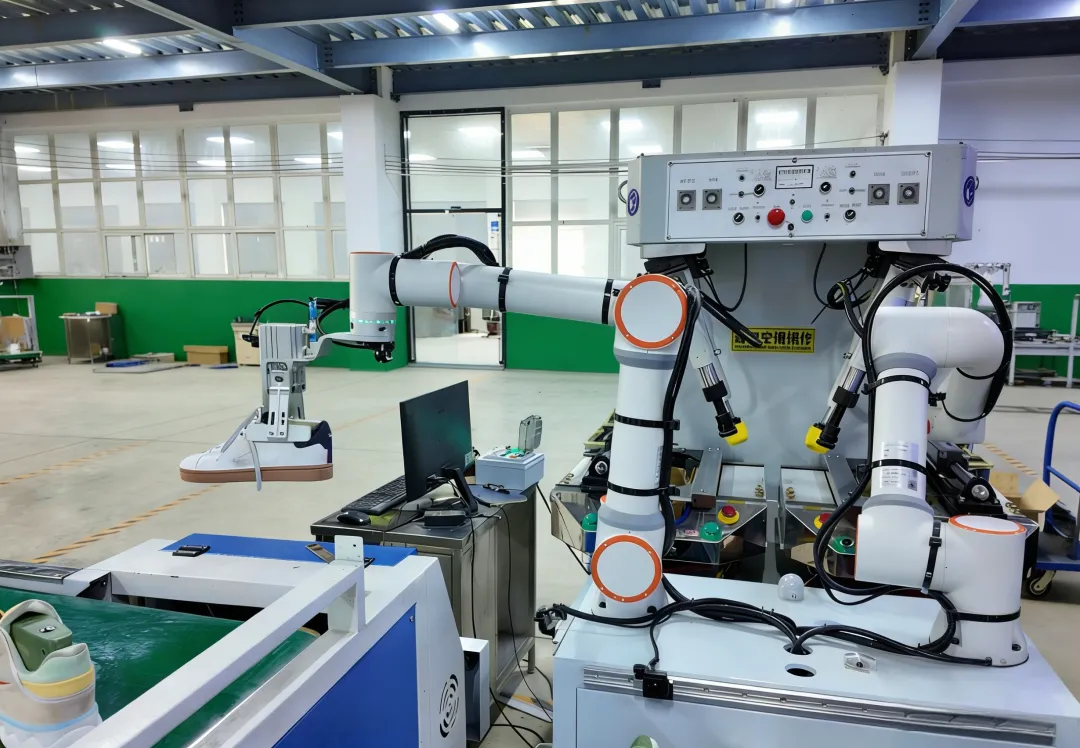
For example, wearing a shoelace. The shoelace may be temporarily obscured by the shoelace or mechanical arm, and in a two-dimensional image, the target may disappear briefly. A continuous 4D state can retain its position in space, allowing the robot to judge the target only by being obscured and adjusting the trajectory according to the posture of the shoe.
Similarly, the real decision-making process is often wrinkles and deformations, and surface textures are difficult to provide a complete basis on their own, while 4D world models have the advantage that 2D video models do not have in judging the laws of deformation of flexible objects. Based on this, the shadow-smart shoe manufacturing industry was the first industry to apply 4D world models to landing.
Digital Entertainment: expanding 4D data entry
Outside of physical objects, shadow intelligence is based on a 4D world model and uses digital entertainment as another business segment, covering scenes such as 4D live broadcasting, 4D games and more.
At the China International Service Trade Fair held in September this year, Shadowbody Smart demonstrated its 4D live-streaming program based on 6 cameras. After the camera collects live images, the model automatically fills in completely uncovered areas, allowing viewers to view dynamic scenes from a whole new perspective.
Live broadcasting, concerts, interactive video games, and social media can all be replicated with multi-faceted collection, spatial reconstruction, and real-time generation capabilities. In terms of image intelligence, these values are not only in content presentation, presenters, studios, and creators being 4D data producers, content tools reducing collection barriers, and real-world scenarios providing more action, characters, and spatial states.
Industrial robots are responsible for verifying whether models can understand and change the physical world, while digital content extends the data source. Both types of businesses share the same underlying capabilities, ultimately merging into the same data loop.
The next generation of bases is accelerating its formation.
In 2024, the native 4D world model is still a route that needs to be explained. Two years later, AMD acquired World Labs, bringing spatial intelligence to the focus of chips, models, and industrial capital.
In this competition, the body intelligence has accumulated two years ahead of the competition.
It's not just about whether a model can generate a new perspective, it's about getting 4D data into the model, getting the model into robots and the real business, and then getting the real business to generate more data in turn.
Liu Wei's judgement was that "native 4D models will be the next generation of platforms that work alongside big language models, video generation models", and then to see if this path could be taken in more factories, more robots, and more real worlds.