There have always been two hardships to overcome when it comes to video overload.
Traditional methods can increase the resolution, but it is difficult to actually recover the lost details. After the generative method can "repair the details", another type of problem arises: the shape of the characters, the configuration of the deviations, the placement in the continuous video, and the possibility of flashes and drag shadows.
The image should be clearer and the original content cannot be changed.
Now, RunningHub of Hyundai has officially released the self-developed video superdivision model RH Upscale, targeting the long-standing contradiction of this group. In the 13 group side-by-side evaluations, RH Upscale Ultra is ranked first with an overall score of 0.539!
RunningHub is a native AI-powered, all-in-one content creation platform that supports ComfyUI workflows, unlimited spreadsheets, AI applications, and model API calls, covering multiple creative links from model calls to content generation.
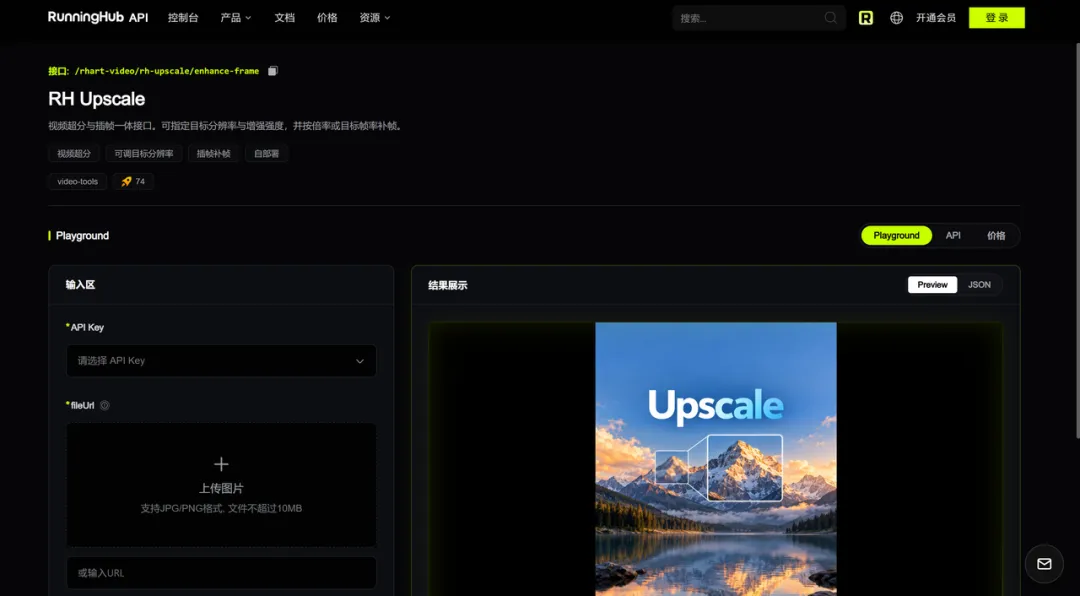
I'm going to try it again.
RH Upscale's core goal is to "enhance content without changing it", while improving resolution and restoring texture while maintaining consistency in character, composition, tone and movement.
13 group comments,
RH Upscale takes overall performance first
This horizontal assessment included a total of 13 parametric configurations, including the RH Upscale's five-level model and multiple video override schemes. The test consisted of 540P input, 1080P output, and a five-dimensional comparison of perceived image quality, texture restoration, original image similarity, facial consistency, and timed video quality.
In the end, RH Upscale Ultra finished first with a combined score of 0.539 points.
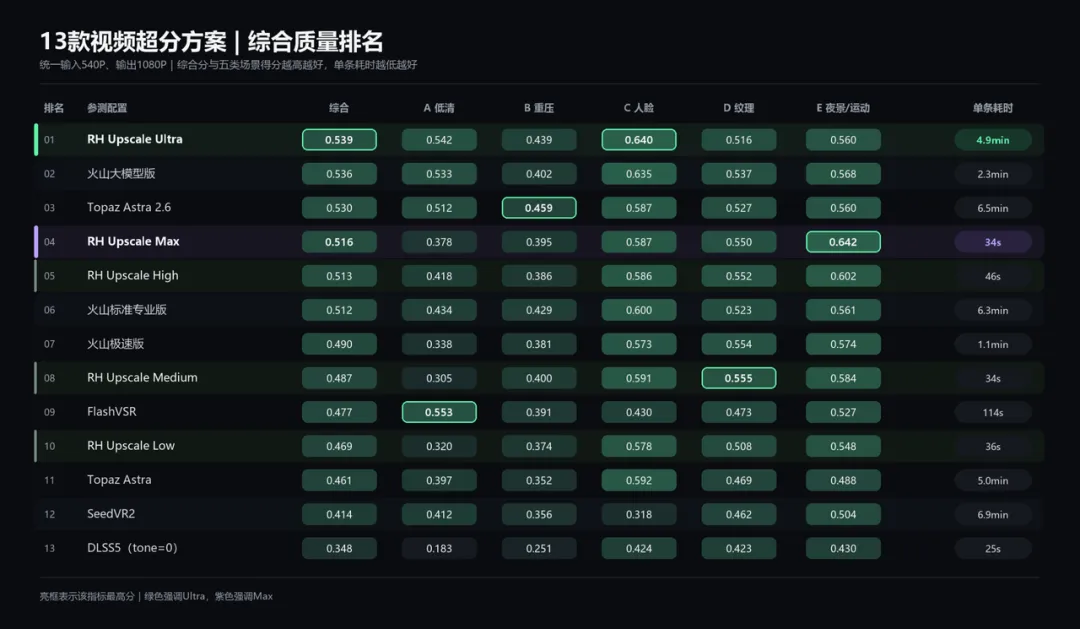
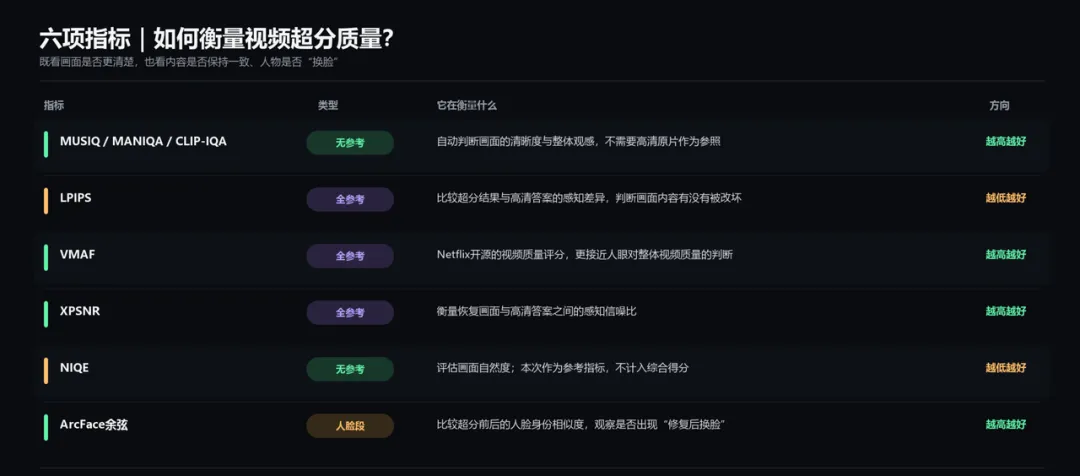
RH Upscale traces the problem back to the most central contradiction of generative oversplitting: the stronger the generative capacity, the more it is necessary to know what needs to be corrected and what cannot be moved.
I'm not going to change the content.
How does RH Upscale generate a boundary line?
Past videos are enlarged and more dependent on insertion and crystallisation. They can increase the resolution, but it is difficult to really recover the details that have been lost during the compression process. The threads, skin, fabrics, environmental textures, which once lost, the simple enlargement pixels can not put them back together again, and the noise and compression traces may instead be enlarged.
Productive oversplitting offers another path.
It not only magnifies existing pixels, but also attempts to reproduce missing details. The effect can be richer, but the risk also comes with: the characters and composition can change, reaching video, and facing flashes, textural shifts and motion drag shadows.
So for generated video overloads, the difficulty is not only "can't add details", but also how to maintain consistency in the process of adding.
RH Upscale's approach is to break down the problem into several sections using "container-restricted time-space joint reconstruction".
First of all, it's about determining where we really need to improve.
Different materials have different problems, some of which are blurred overall, some of which are more noticeable, and some of which lose local detail after compression. RH Upscale injected degradation perception and conditions to identify these differences and then decided to increase the intensity according to different regions.
In this way, the model does not need to have a unified treatment of the entire image. The areas that need to be restored can be further enhanced, and the areas where noise or compression damage is apparent can be treated differently, avoiding amplifying the problem at the same time.
The next step is to decide what content should be kept as original as possible.
RH Upscale uses structural bridging to reconstruct the two branches of detail, maintaining the structure and restoring the texture separately. The structure side tries to maintain the original layout, outline and shadow, while the detail side is responsible for restoring the already missing texture.
For areas where the information is insufficient, amplification is more conservative. Because generated oversplitting is the easiest place to solve problems, it is often when the model is "too full".
But the video is more of a problem than the picture. This is an appropriate replacement, and it does not mean that the next one will be as good.
Human movements, object shadows, and lens switching can all lead to a loss of continuity between the front and back shadows. RH Upscale also adds time-space modeling and reliability door controls, allowing models to use front and back shadows to maintain continuity and adjust context in shadows and lens switching, reducing flashes and drag shadows.
This is the core idea behind RH Upscale for "enhancing content without changing it".
From this technological path, it can also be seen that RunningHub is doing more than just plugging models into the platform. It has begun to move further downstream in video production, focusing on improving image quality, content authentication and timing, and doing self-development and engineering optimization.
When content producers are really good at RunningHub, another problem arises.
If the requirements for quality, speed and cost of different videos are completely different, is it necessary to have all the highest specs?
It's all about quality and efficiency.
It's a five-tiered model.
When you really go into production, you'll find that not all videos require high-speed supervision.
Feature short films, commercial advertisements, feature films, high-value clips, motherboards, are more concerned with the final quality of the images and the reliability of the content; while material previews, rapid iteration and large-scale video processing require both processing speed and computational costs.
If all materials use the same highest quality configuration, the quality is higher, but efficiency and cost are not necessarily calculated.
Therefore, RH Upscale offers Ultra-,Max-,High-,Medium-,Low five-tier modes, allowing different tasks to choose different quality and efficiency configurations based on themes, delivery standards and task sizes.
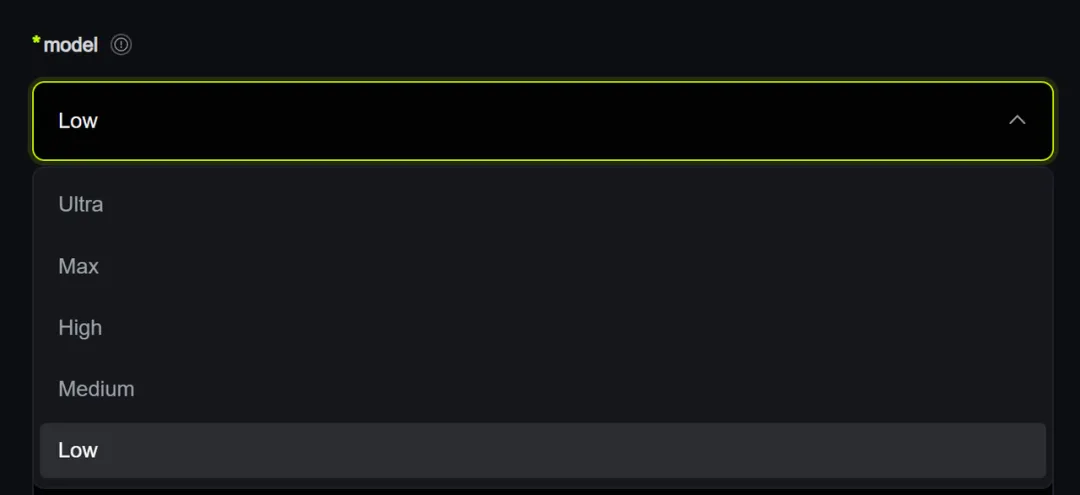
RH Upscale offers Ultra-,Max-,High-,Medium-,Low five-level models, covering a wide range of requirements from high-quality film to fast batch processing.
Among these, Ultra uses a more extensive iterative reconstruction budget, mainly aimed at more difficult to handle scenarios such as complex degradation and fine materials. In the previously mentioned 13 group side-by-side assessments, Ultra took overall quality first.
Max is significantly more biased in efficiency. It uses low-step consistency distillation to compress samples, shortening reasoning time while maintaining structure and timing constraints. According to test results, a 5×10-second video takes twice as long, and Max takes 34 seconds, about 1/8.6 of Ultra.
The same 4-second, 540P original video uses RH Upscale Max and Ultra respectively to supersede. Both films enhance detail performance in areas such as characters and textiles, while Ultra recovers more fully in details such as threads, sweat textures, and Max is more prone to processing efficiency.
These two grades have already clearly illustrated the idea. Some materials are worth the expense of drawing as much as possible; some materials need to be completed as quickly as possible under the premise that they are "enough".
High, Medium and Low continue to expand this range to medium and light scenarios to cover different budget and bulk processing needs.
But these five grades are not simply a few steps down the same logic process.
RH Upscale also combines the optimization of conditional characteristic caching, window attentiveness, block decoding, and different sampling budgets and training and reasoning strategies for configurations such as Ultra, Max and others. It ultimately derives five business models from the same model system without the need to maintain five independent models.
The five-stage design of the RH Upscale is very much in line with real production needs and is able to advance a simple modeling capability into a scalable, interchangeable production tool.
From generating, accelerating to oversplitting,
A gradually clearer AI video production chain
We take the view a bit further, and the RH Upscale is not an isolated model.
Previously, RunningHub had the ability to model access, workflow and content creation platforms. RH Enhanced and RH Lightning were recently launched around video production. The former focused on mass-produced video production, while the latter focused on optimization around reasoning acceleration.

RH Upscale has also accessed the RunningHub's creative link, which allows you to continue to complete the override and encode output after the video generation node is placed.
At the same time, its input is not limited to AI-generated materials. Real-time video, secondary clipping video and compressed-damaged low-resolution files can also be accessed by RH Upscale for resolution enhancement and image quality repair.
In addition to continuous access to the model, the platform has begun to complement its capabilities around the production efficiency, image enhancement, and delivery processes that video actually encounters after production.
Looking back at the bottom, this path is also related to the technological accumulation of Haima Cloud's past.
With the long-term accumulation of GPU container scheduling, graphical virtualization, real-time streaming and cloud rendering capabilities, the infrastructure now extends further to AI reasoning and content production, forming a "drive-in" capability: rendering and AI reasoning share underlying scheduling systems, and supporting content production tools such as RunningHub.
From RH Enhanced, RH Lightning to RH Upscale, the path is becoming clearer. When AI video really enters production, it needs to be addressed, far beyond "generation" itself.
It's harder to stay the same after you've changed.
In recent years, AIGC's most prominent capabilities have largely been related to "change".
People and scenes can be changed, and details that did not exist can be reproduced. It is becoming easier to change images.
But the further down the road, the harder it is to find that staying "invariable" is the hardest part of "changing".
The person, the composition and the tone should be as stable as possible, and the new details should also remain stable in the continuous loop. For video translations, the picture is clearer only the first step, and the real difficulty is that after reinforcement, the person or the person, the scene or the scene, the movement process has not been rewritten.
This is what RH Upscale emphasizes as "enhancing content without changing it".
As generating models become more and more skilled at creating change, the next thing that needs to be addressed in video production is how to preserve the things that shouldn't change.