Looking back at the 2026 AI circle themes: Memory, Skills, Harness, Agentic RL, Latent Reasoning, World Action Model, Self-Evolving... more and more research is starting to focus on how models remember information, call capabilities, complete long-term tasks, and work with less computational cost stability.
As an important entry point for real-world information into AI systems, OCR is also undergoing a transformation: from recognizing text, understanding printed pages, to processing photographic shapes, complex formulas, formulas, and scientific graphs, the problems that models need to solve are becoming more subtle and closer to real-world scenarios.
Recently, the document analysis model TeleOCR, launched by the Chinese Telecommunications Corporation's General Artificial Intelligence Laboratory, has attracted attention. It has only about 1.2B parameters, but it has taken the lead in several open document analysis assessments: OmniDocBench v1.6 combined score 96.87, Wild-OmniDocBench score 88.53, and PureDocBench three-track combined average of 78.41; in the ICDAR 2026 Sci-ImageMiner Scientific Chart Conversion Challenge, TeleOCR also took first place.
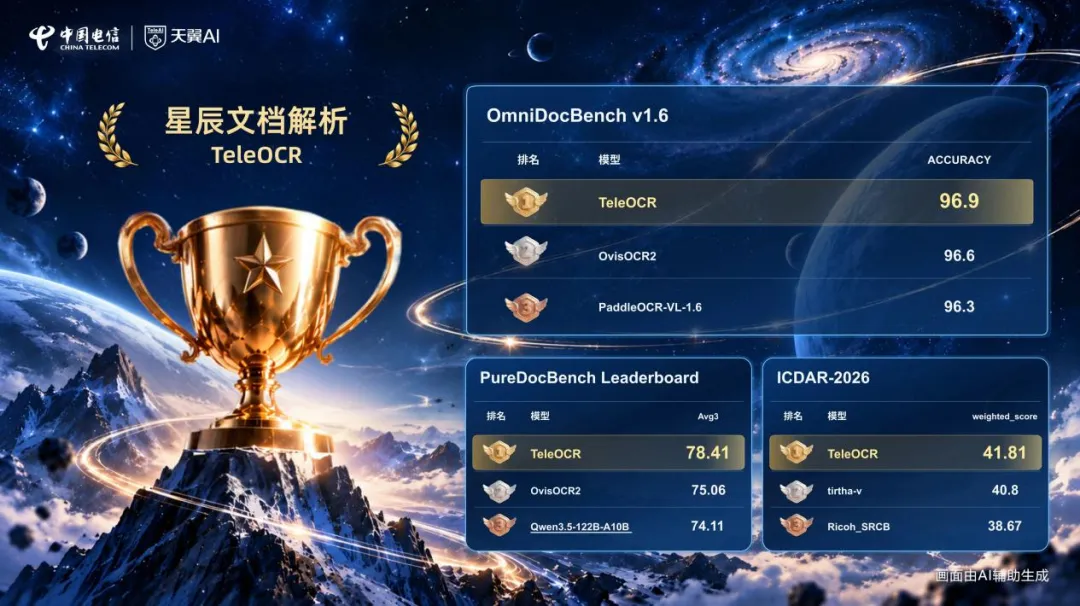
The model is now open-source and developers can access relevant resources through GitHub, Hugging Face, and directly experience document analysis via the open-source AI platform.
Recently, TeleOCR has made it to the top five of the HuggingFace trends list. Even HuggingFace officials have personally launched a ZeroGPU online demo for TeleOCR and subsidized free computing.
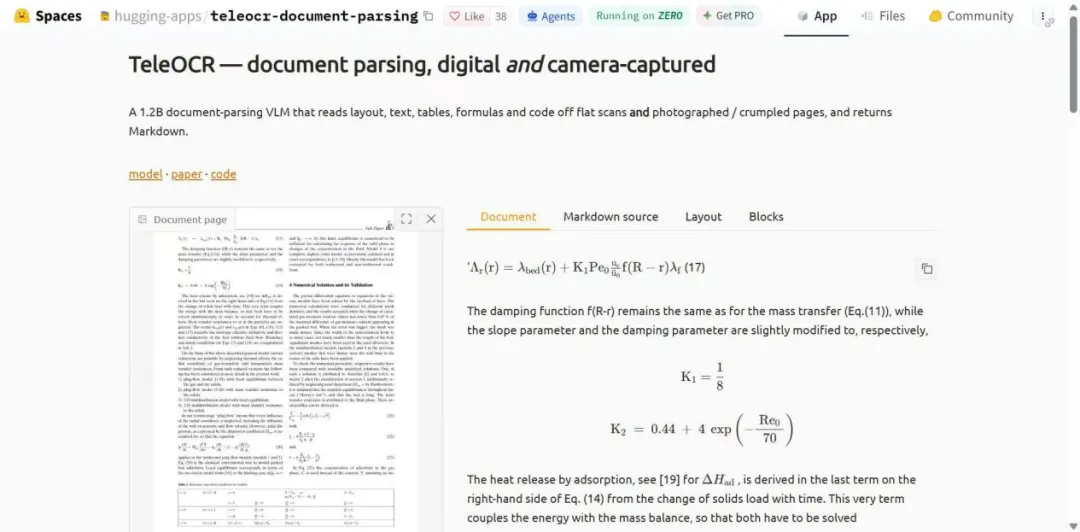
The model calls address:
The online experience of the model:
Behind these results, TeleOCR faces far more than simply "recognizing the words on a page". The real document is a regular electronic PDF, with footage of issues such as curves, scratches, visibility, shadows, and possibly more than a few lines of literature, complex tables, formulas, and scientific graphs.
It is in these more complex scenarios that OCR is experiencing a new round of capacity upgrades.
Why is TeleOCR, with a body size of about 1.2B, leading the way in multiple document analysis assessments, and how does it handle a curved, folded, or even slanted piece of paper?
The answer is to talk about the "new challenges" facing OCR today.
One-page document, generations of OCRs are solving different problems
Imagine an ordinary document like this: one page of a printed double-sided paper, drawn by a mobile phone with its hands slanted. There is a formula on the page, a cross-sided table, and a curved diagram in the bottom right corner.
It's easy to see how it looks: the title is on the top, the text reads from left to right, the corresponding numbers in the table, the formula has structure, and the direction of the curved graph is also obvious.
But given the machine, over the past two decades, in order to understand this paper, OCR has gone through several rounds of "test upgrades".
Question 1: What is written here?
In the first generation of OCR, the idea of solving puzzles was simple: first finding the text area and then identifying the characters one by one. For scanning pieces and rule pages, this method is quite mature, and today's identity card recognition, receipt entry, and book digitization are based on this ability.
Question 2: How are these words organized?
Even if each word is identical, the machine has to know which row the numbers in the table belong to, which row the numbers in the table belong to, what the mathematical symbols are for LaTeX, whether the text below the graph is true or not. A large number of two-dimensional relationships appear in the pages, and the document gradually becomes a spatially structured information carrier from "many words".
So document analysis gradually evolved into a complete flow of data: first through layout analysis to find the headings, text, images, tables, formulas; text to OCR, formulas to specialized models, formulas to formula modules; and finally, to write a document in readable order. This engineering idea supports a lot of mature products to this day, allowing machines to truly understand "what's in what position".
Question 3: What happened to paper deformities?
In electronic editions of PDF, text blocks and tables are usually arranged in a regularly rectangular area. However, in real photographic environments, the situation is quite different: paper curves will drag text lines into arcs, scratches will cause local distortion, slopes will lead to distortion of vision, and light may also leave shadows and reflections.
At this point, the model needs to figure out where the content was supposed to be and what it has to do with the content around it.
It was also at this stage that the Visual Language Model (VLM) began to enter into document analysis, studying text, images, printed pages, and structures in the same set of representations.
If we compare the hottest DeepSeek-OCR, MinerU, PaddleOCR-VL and TeleOCR on the market in a horizontal way, we find that they have some kind of implication in "lightweighting", but the solution is different:
• DeepSeek-OCR (3B) locks the "Visual Token" with a focus on how to compress bulk visual information and optimize the order of Token processing, making the model more economical, flexible to retain text and structure; the subsequent DeepSeek-OCR 2 also plays on the order of Token processing, making the model more flexible in the flow of information when faced with complex pages.
• MinerU 2.5 ((1.2B) is an intuitively packed "from rough to thin to coarse-to-fine" route. First to master the entire page's macro layout with low resolution, then cut back to the original resolution of the parsing focus area and use the computing power on the blade.
• PaddleOCR-VL (0.9B) extends a robust engineering system that integrates lightweight VLMs into the original system, mainly document understanding capabilities with mature OCR tool chains, SDKs and multilingual deployments.
• TeleOCR (1.2B) focuses directly on the "unflattering paper".
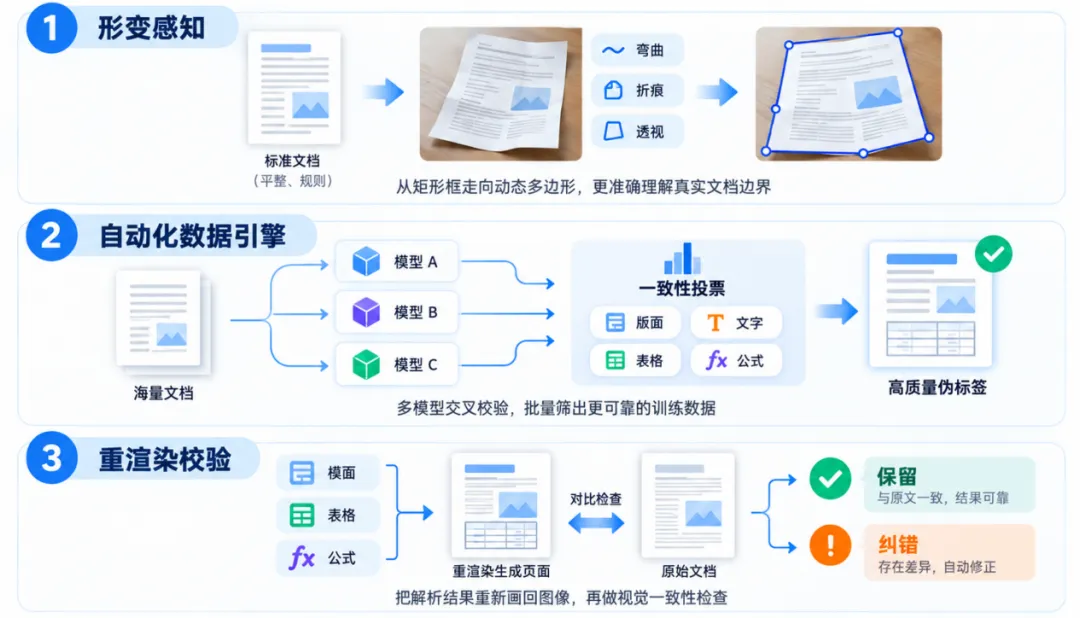
TeleOCR follows the VLM approach of "first understanding the surface, then analyzing the contents", but the key is to insert the physical shape directly into the training link. The rectangular frames of the original rules were replaced by dynamic polygons, allowing the model to actively learn control points and local distortions, bending, fracturing and visually absorbing perceptions.
This ability will eventually fall into some very specific scenarios. In the face of curved, transparent photographic documents, TeleOCR needs to restore the spatial position of distorted regions; in the face of cross-sectional columns and merged units, to restore the original column relationships; formulas must retain symbols and grammatical structures even after being photographed and deformed; folding diagrams and column diagrams in papers can be further transformed into structured tables for the program to continue statistics and analysis.
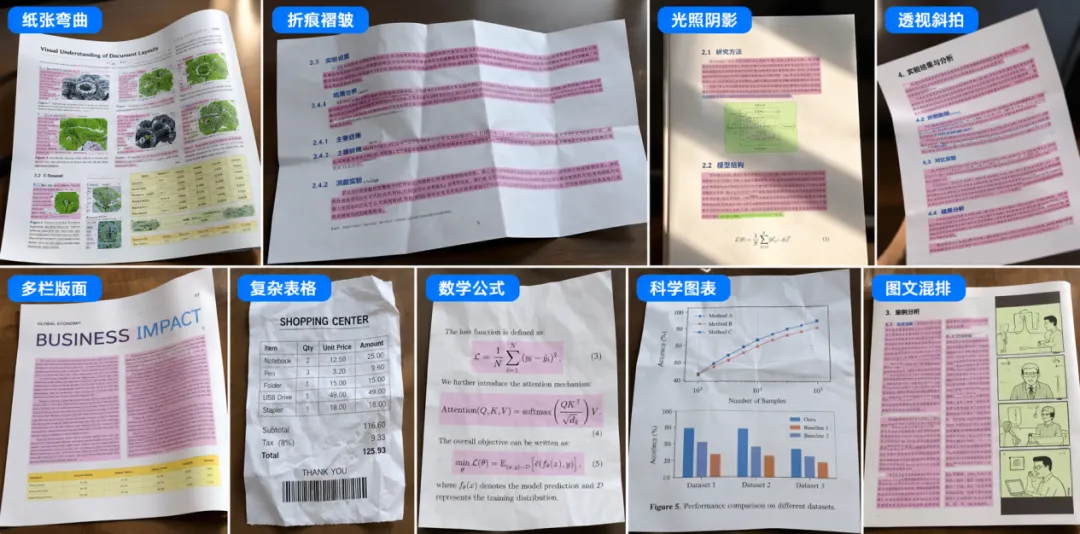
For most businesses, these analysis results are not final. After analysis, contracts, scans, papers, and historical files can be further converted into structured formats such as Markdown, HTML, LaTeX, and enter enterprise document systems, databases, and automated processes. Particularly in knowledge libraries and RAG scenarios, native PDFs, scans, and photo files are only structured in a clear, reliable content-reading order, and subsequent snippets, searches, and queries have a more reliable data base.
These capabilities will eventually need to be validated through different types of public assessments. Looking back at these tests that run on TeleOCR, they cover several key links between document analysis from the "standard environment" to the "real world": OmniDocBench examines the digital documentation base, Wild-OmniDocBench introduces curvature, vision and brightness, PureDocBench breaks down different types of degradation scenarios, and ICDAR 2026 requires data to be extracted from scientific graphs.
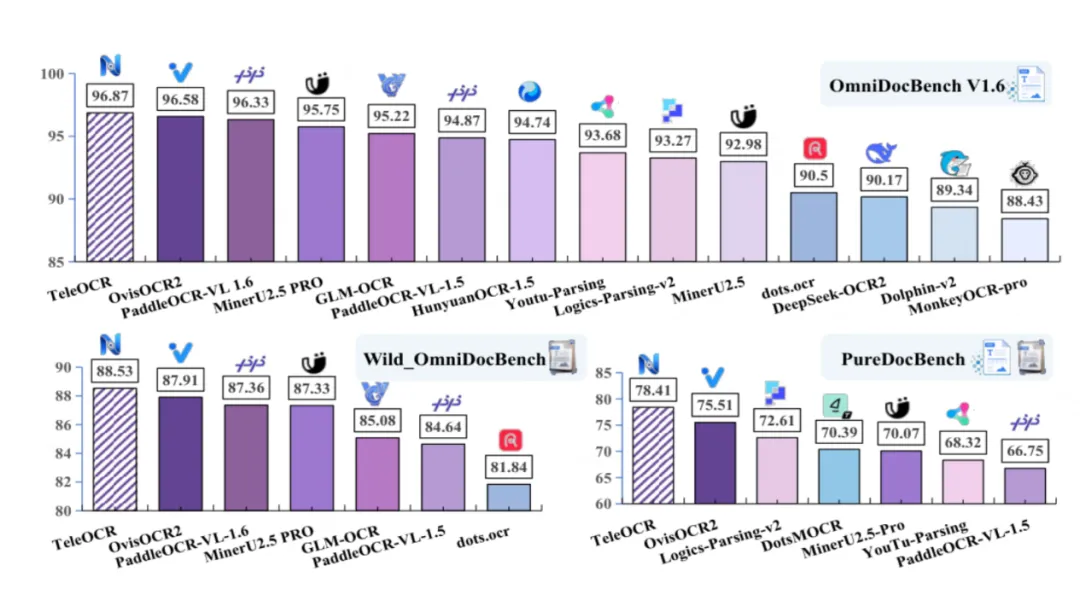
As the scene extends from digital native to mobile real-time, geometry becomes a new focus.
This is where TeleOCR is positioned: with the same set of models, it can handle both orderly digital documents and complex real-world shots.
As for how to teach a model this set of helmets? Next, we're going to turn off the technical baseline of TeleOCR.
TeleOCR gives the paper a little bit of a "spatial feel".
The human brain is born with a "geometrical rectifier". The paper is a little twisted, a little stretched, a little darkened, the light is a bit darker, and we can still produce "it's a flat flat page". But for the model, it's just a pixel image that has been distorted in physical space: the straight lines of text are bent into arcs, the regular patterns are drawn into gradients, and there are even localized mutations and ruptures.
This is also one of the breakthroughs of TeleOCR, which attempts to make visual models realise that paper has a physical shape.
TeleOCR generalizes this capability as Deformation-aware Learning. In the training phase, the model not only looks at the characters, but also explicitly learns the geometric control points and regional boundaries of the page to create a mathematical description of physical transformations. Compared to the rectangular frames of traditional digital PDF rules, the content areas of a document are photographed by a set of dynamic polygonal boundary points to be marked.
The reason for this is simple: a flat rectangular block can be framed with two points in the upper left and lower right corners; but once the paper is curved, the rectangular edge becomes an arc.
As a result, TeleOCR further advanced surface analysis to Layout Segmentation. The more polygonal sample points there are, the more accurate it is to fit complex curves. In order to avoid an increase in sample points, the team devised a rather ingenious algorithm: CGDP.
CGDP solves the problem of "where the finite point is", where the flat region requires only a small number of sampling points, while the shallow, pointed and strongly curved regions require more points to retain detail. It combines regional scale and localized curvature dynamics to allocate sampling priorities, leaving more resources to areas with complex geometrical structures.
Simply put, before formal semantics are read, the model builds on the perception of page geometry and spatial structure.
However, understanding physical transformation is only the first step. Another question is: Where did the massive, high-quality, complex document data come from?
To classify a typical image, the label may only be "cat" or "dog"; but the marking granularity of a real-time document can be complicated by reading multiple surface blocks, sequences, table topologies, LaTeX formulas, graph relationships, plus polygonal geometric boundaries.
TeleOCR's solution is to build an automated data engine with a core mechanism called Multi-node Consensus Voting.
The specific approach is to distribute the same document to multiple structurally different models in parallel analysis. Models A, B, C each give their answers, the system then performs multi-dimensional alignment checks on their results, the surface looks at the IoU, the text looks at the editing distance, the tables look at the TEDS, the formulas look at the CDM. When the results of multiple models are highly consistent, high confidence false labels are generated; when differences are apparent, they enter a more precise checking process.
In this way, mass-produced high-quality counterfeit labels can be produced in bulk.
At the end of this process, there is a critical quality control mechanism: visual rendering (Render-and-Compare).
The team reworked the structured results predicted by the model (such as HTML tables, LaTeX formulas) into a rendered graph and then visually contrasted it with the original document. Thus, the original abstract structural errors would turn into intuitive image differences: fewer columns of tables, fewer frames of formulas, and easier detection.
The team also found that Qwen3-VL-235B had a recall rate of less than 40% when making zero-sample visual consistency judgments. Therefore, they minimized a self-judgment model based on Qwen2.5-VL-7B-Instruct specifically for data quality mapping.
The third difficulty is the complexity of the internal structure.
Multi-column complex tables, layered embedded mathematical formulas, have always been one of the most difficult scenarios in OCR. Models not only identify characters, but also break down the structure and topological relationships between characters. TeleOCR introduces Content-Structure Decoupled Learning here.
When dealing with formulas, models prioritize learning structured tokens such as OTSL, focusing on expression arrays, units, and merging relationships; when dealing with formulas, they extract syntax tree structures from LaTeX, allowing the model to separate learning from "symbol content" and "syntax nest relationships".
This is equivalent to first constructing a "skeleton": the skeleton of a table is a row topology, and the formal skeleton is a nested relation and operator. Once the skeleton is determined, it is filled with specific letters, numbers, and symbols.
This set of solutions has also been extended to scientific graphs. The paper's curved graphs, columnar graphs, and thermal graphs differ in form, but are central to the correspondence between the coordinate axis, graphs, and data points. TeleOCR converts them into structured tables Token in OTSL format, which are then reassembled into data tables to support data extraction across 5 major classes of 19 discrete scientific graphs.
The above technical modules can ultimately be grouped into a four-stage training system:
1. Phase I: Visual language alignment: allow the model to master basic OCR and general editing comprehension;
2. Phase II: Transformation perception training: Injecting geometrical pioneers who specialize in dealing with physical transformations in real-life photographic scenes;
3. Stage 3: Structured specialties: training tables, topologies, complex formulas and scientific graphs;
4. Stage 4: Reinforcement Learning Modulation: Introducing the GRPO algorithm to align the final task level with the respective assessment indicators of the text, formulas and formulas.
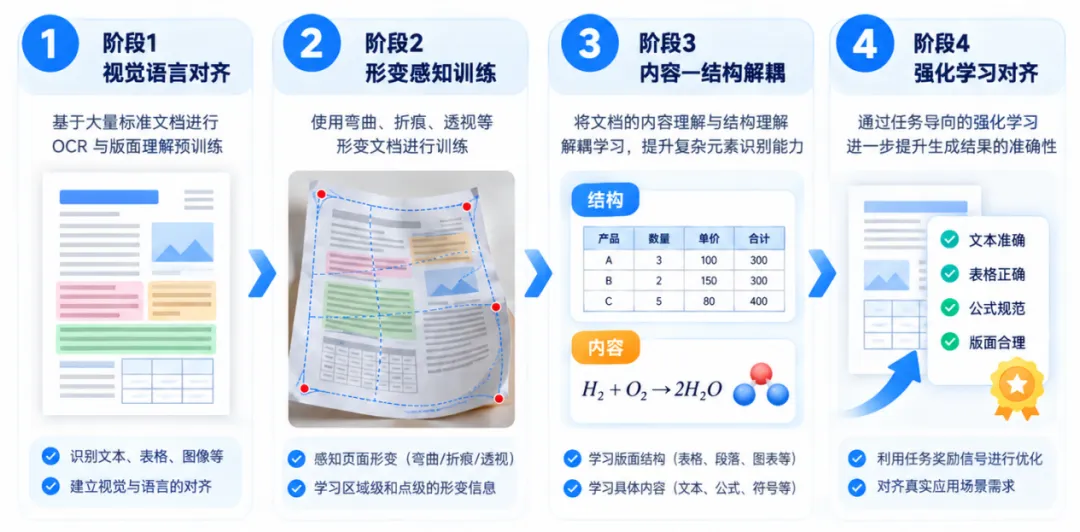
It can be seen that TeleOCR, in a relatively compact quantity of parameters, concentrates its computing and training resources on the critical links of "data quality", "spatial geometry", "structural decomposition" and "intensive alignment", thus achieving high-precision concentration in small models.
A paper looks simple, but for a model it contains layout, formulas, formulas, graphs and physical changes. TeleOCR transforms this complex information into a structure that is easier to understand and learn. Paper has a "space sense", complex content has a "skeleton", and training data also has automated production and quality control processes.
These technical capabilities explain how TeleOCR solves complex documentation problems, and as the perspective continues to extend outward from a model, there is a long-term layout behind China Telecom's underlying AI capabilities.
The telecom mission behind an OCR model
In recent years, China Telecom has continued to advance its "cloud computing transition" strategy to accelerate the deployment of AI around the cloud, computing, data, models and applications. From underlying infrastructure to upper business applications, AI has gradually entered China Telecoms' technical and business systems. The document analysis direction of TeleOCR is also an integral part of this overall layout.
Document analysis looks like a basic capability, but it connects a lot of real business data. Contracts, documents, scans, historical archives, scientific papers, and photographic documents within an enterprise often contain text, formulas, formulas, graphs, and complex pages at the same time.
This also allows OCR to play a very specific role in AI application chains: transforming real-world document information into data that can be processed by software systems. As enterprises continue to digitize, the source of document input is increasingly complex, with both native PDFs, as well as scanning materials, mobile phones, and long-term paper archives. Stable, unified analysis of these contents has gradually become a fundamental component in knowledge management and intelligent applications.
The technical route of TeleOCR also reflects this need. The parametric scale of about 1.2B gives the model a better adaptation space in terms of deployment costs, logical efficiency and engineering integration; shapeshifting perception, structured analysis, and other capabilities further cover real-world scenarios such as photographic documents, complex tables, formulas, and scientific graphs. For long-running document analysis systems, the model scale, parsing accuracy, and deployment efficiency need to be taken into account.
From the overall context of "cloud computing transition", TeleOCR also corresponds to "intelligence" and "intelligence" in specific businesses. On the one hand, document analysis capabilities can enter enter enterprise knowledge bases, data governance, research analytics and process automation; on the other hand, lightweight, open-source and localized deployments have also reduced the barriers to technology application, allowing more developers and business systems to access these capabilities.
From open-source, open-source models to online experiences, TeleOCR is gradually entering a more comprehensive network of developers. For China Telecom, the value of this type of base model is also reflected in its ongoing accumulation and engineering capabilities: models need to be trained, evaluated, deployed, and then into specific business systems, ultimately forming long-term operational technical capabilities.
From network connectivity, cloud and computing, to data, models and applications, the Chinese telecommunications technology system is continuing to extend to artificial intelligence. TeleOCR is responding to one of its relatively specific interfaces through document analysis, allowing more real-world information to be transformed into computable, retrievable, recoverable data, and further access to knowledge bases, data analytics and automation processes.
Starting with a specific capability such as TeleOCR, we can also see a change after AI enters the industry: technology will eventually fall into stable data processing, engineering deployment and actual use.
Conclusion: AI landing is redefining "good models".
When AI really comes into business, the criteria for evaluating a model become very specific. Many times, the determination of whether a system can run is often based on the basic capabilities that are backed up by the backstage silence: can it process complex real data steadily? can it control costs? can it access existing workflows seamlessly?
OCR belongs to this capacity, as it is the entrance of real-world documents into digital systems, and the prerequisite for the functioning of all kinds of knowledge bases, data analytics and automation systems. The value of TeleOCR lies in making this very specific foundation work deep and subtle, so that it can play a real role in the real business chain.
For China Telecom, refining such basic models is part of its ability to build AI. Combining models, data, engineering and real-world scenarios over a long period of time requires continuous technical accumulation and systematic input.
The deeper AI goes into the industry, the more isolated it becomes from these steady-running "buildings". TeleOCR's achievements in multiple public listings and international competitions also provide a phased test of China Telecom's ongoing contribution to its basic document analysis capabilities.