It's the first time in the history of the world.
In 1869, Mendeleev compiled a table of 63 known elements.
The most daring thing about this table is that it is not the space that is filled, but the space that he left deliberately.
He claimed that there were elements hidden there that had not yet been discovered, and predicted their nature. Over the next decade, zinc, zinc, and covalent bonds were discovered, and the nature coincided with the amazing prophecy.
A classification table, which has since become a search for unknown maps.
A half-century later, intelligent science is faced with a similar problem:
Could a stone, a thermostat, a bacterium, a person, a large-scale model of intelligence that is calling the tools, and an unknown "Laplas demon" in physical thought experiments fit into the same table?
In September this year, a team of researchers from the Chinese Academy of Sciences published a paper in the journal Annals of Data Science: A Cyclical Table of Capabilities of Capabilities of Capabilities: 243 Structural Capabilities of Zero Intelligence to Infinite Intelligence, which gave a bold breakthrough to this table.
The document is available for download at:
This paper is an important part of the team's framework for the theory of general intelligences.
They see any intelligent entity as an "open information processing system" from which they derive the five basic capabilities of control, generation, memory, output, and input.
Each capability is divided into missing, finite, and infinite three levels, combining a total of three 5 dimensions, or 243 configurations.
The main purpose of this table is to provide a common coordinate for objects from different disciplines that are difficult to compare with each other.
In this table, humans are not only in the same room as lions and hippos, but also live in the same room as bacteria; stones, voids, Turing machines, and raptors are in different locations.
The boundaries between organic and inorganic, natural and artificial, science and philosophy have not been erased over a long period of time, but comparisons across them have a common reference.
The paper also cites two arguments for the impact of the screwdriver.
First, the differences between the three great theories of physics, classical mechanics, relativity, and quantum mechanics may arise because they each have a different "observer" by default.
Second, all the man-made systems examined are zero in terms of "autonomous control".
Today's most advanced model of intelligence, coding with humans, has only one: it can write complex codes, look at bulk data, solve world-class mathematical problems, but it can't decide for itself when to start, pursue, or stop.
The first argument opens a new entrance to the question of observers in physics, while the second provides a foundation for the debate over whether AI has self-awareness.
5 Abilities and Strengths of the Intelligent Body"Smart body" is one of the hottest phrases in the tech industry in 2026, and one of the most vague and lacking in consensus.
OpenAI emphasizes long-term autonomous pursuit of goals, Anthropic defines intelligent agents as a circular system built around large models, and McKinsey considers customer robots as entry-level intelligent agents that are mutually exclusive between different definitions.
The academic world is equally divided: symbolism emphasizes logical reasoning, linkism emphasizes distributed expression, control theory emphasizes feedback regulation, and cognitive cognition emphasizes the combination of perception and action.
There's a more basic question behind the definition debate:
Why is a system called an intelligent body?
In February 2025, researchers at Google DeepMind reiterated the philosopher Danette's dilemma in a paper on the dynamics of steam in reference steam: on what principles can a stone, a thermostat or a robot be determined to be energetic.
Their conclusions were cautious: energy cannot be measured independently of the reference system, and any basic science about energy must first tell itself which reference system it is judging.
Faced with the same difficulty, the team chose a different path: instead of arguing one by one about a system "not counting as an intelligent body", it was better to go back to the bottom and ask what functions an intelligent body needs the least.
The functionality list is clear, and each system has a unified coordinate to determine how strong it is.
The team noted that physics, life sciences, cognitive sciences, and engineering practices, although on different paths, are gradually coming together in one judgment.
From Wheeler's "everything comes from bits", Randall's principle of information erasure and the inevitable consumption of energy, to Prigogin's theory of dispersed structure, and Freestone's principle of free energy, intelligence is depicted as open information dynamics between systems and the environment.
The paper promotes this consensus as an ethical one:
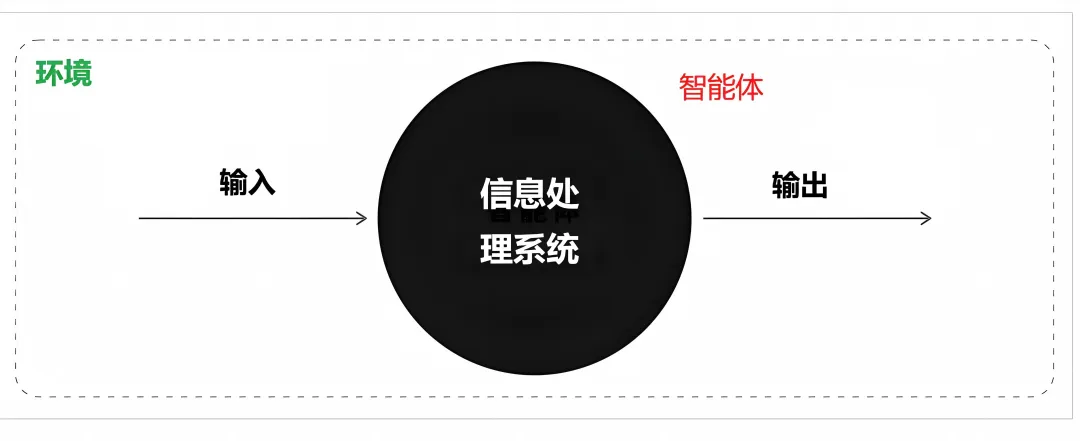
Any intelligent organism can be modeled as an open information processing system.
From this rhetoric, only three questions need to be answered in a row.
First, has information crossed the boundaries of the system? This separates input (I) and output (O), which are the two channels of perceiving the world and acting on the world.
G) and memory (M): the former is responsible for calculating, reasoning, planning and imagining, while the latter is only responsible for storing, extracting and deleting.
Third, who coordinates these functions? When the four functions are running simultaneously, who precedes whom, and how resources are allocated, they can't decide for themselves; allowing the generation to coordinate to generate, and the problem will only be pushed to a higher level.
Accordingly, the team proposed the "minimum complete architecture" of the intelligent body: it consists of five functions of input, output, memory, generation and control. The first four directly process information, while the fifth control is responsible for scheduling the previous four functions, at a higher level.
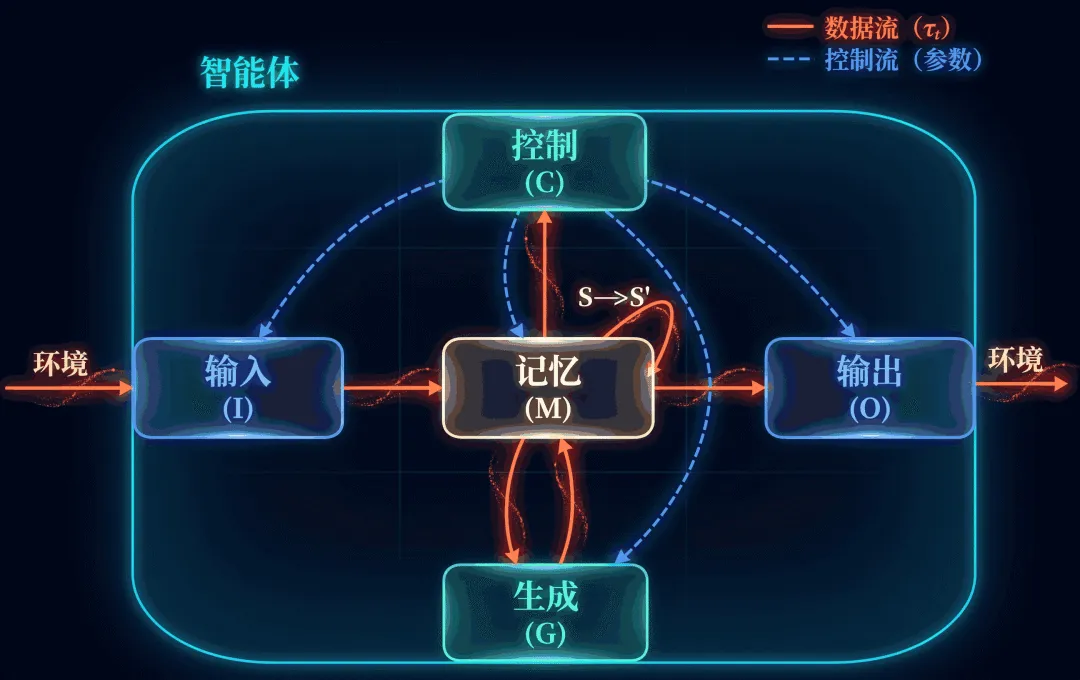
In contrast to the industry's classification, these five functions are derived step by step from the axioms.
The five are irreplaceable: lack of input, system isolation from the outside world; lack of output, thought unable to act; lack of memory, only immediate reactions; lack of generation, but only a search table; lack of control, becoming a band without a leader.
A fully functioning intelligent body must have five members, and many systems in reality have only a few of them. What is missing determines its position on the periodic table.
If humans, animals, plants, AI, and even the Laplace demon can all describe the same five functions, what's the difference between them?
The answer lies in two things: whether each function is, and how powerful it is.
The team's analysis found that there are two natural cancers in the range of zero to infinite capacities.
The first is between nothing and nothing: rocks don't remember anything, but the simplest bacteria can retain a bit of information using molecular imagery, which is not the difference between more and less, but between less and less.
The second path is between finite and infinite: real systems are bound by thermodynamics and the speed of light, and only an ideal Turing machine with an infinite band of paper can reach infinity.
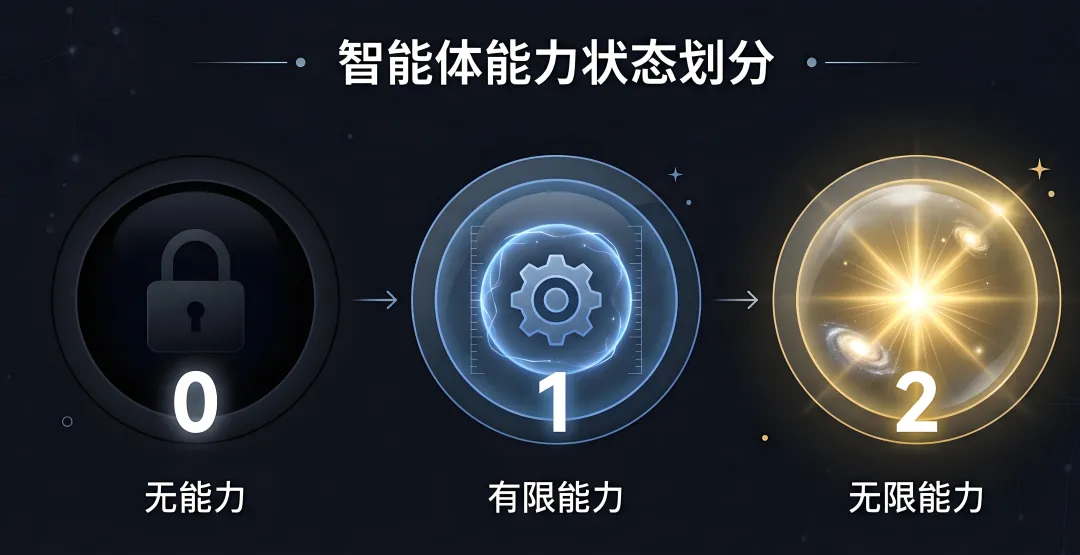
The two canes divide the strengths and weaknesses of abilities into three phases, each of which is divided into the absence of 0, the limited 1, the infinite 2, the tertiary.
The five capabilities combine three of the five dimensions, i.e., 243 configurations, into a table of 27 rows and 9 columns.
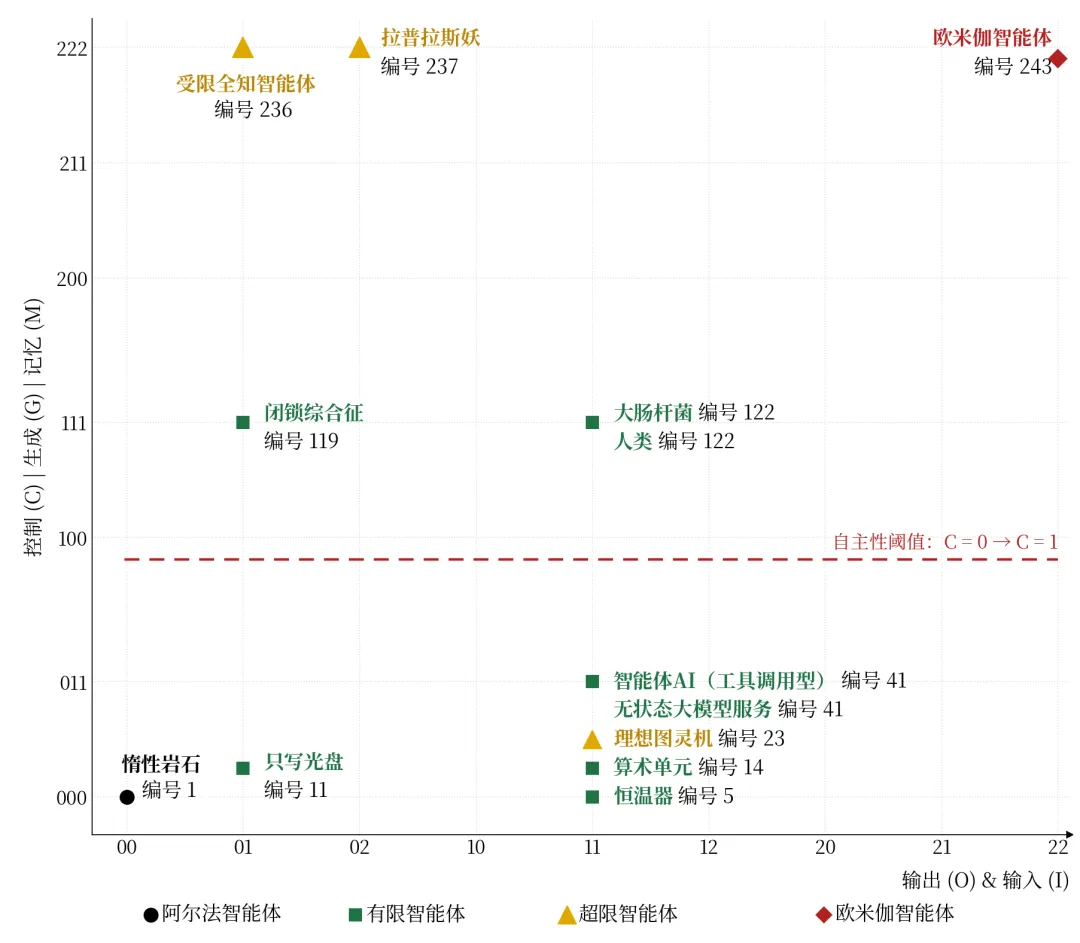
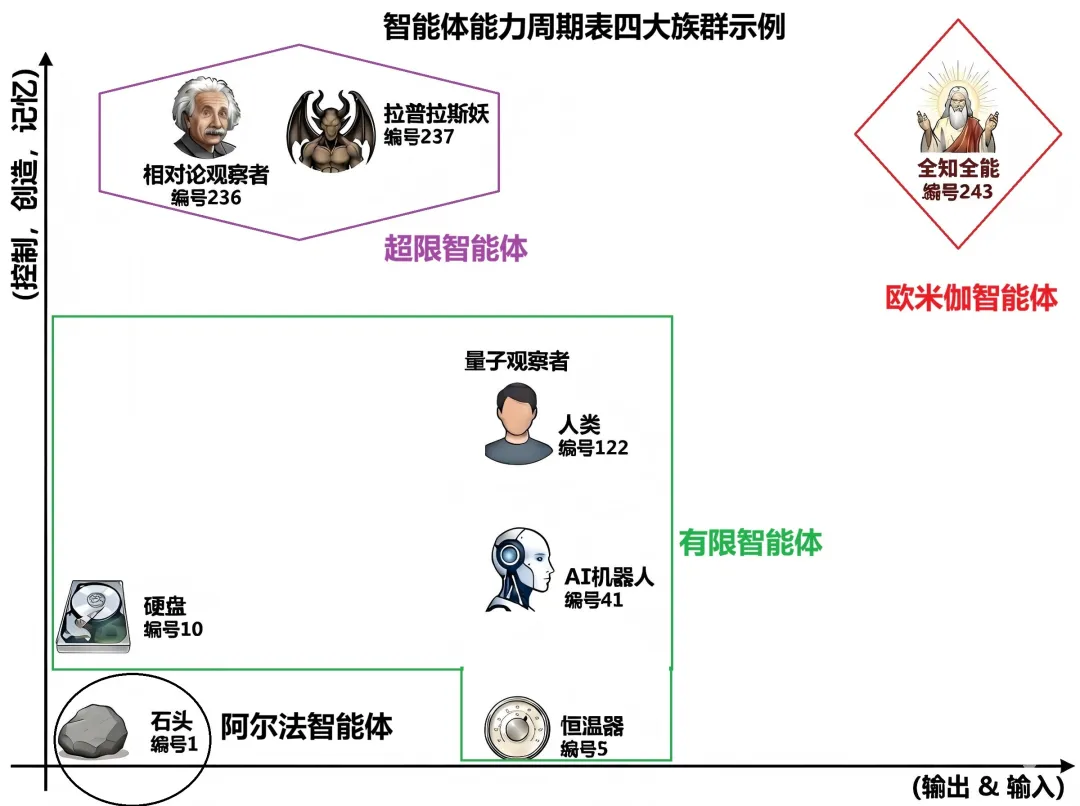
In the lower left corner, the number 1 "alpha intelligent body" of the five whole zeros corresponding to substances with no information processing at all (stones, etc. can be seen as an approximate example); in the upper right corner, the number 243 "Omega intelligent body" of the five whole zeros is theoretically infinite.
Between the two, there are 31 "limited intelligences" covering all known systems in the real world (the green-and-white part), while 210 "superintelligences" mostly exist only in thought experiments (the black-and-white part).
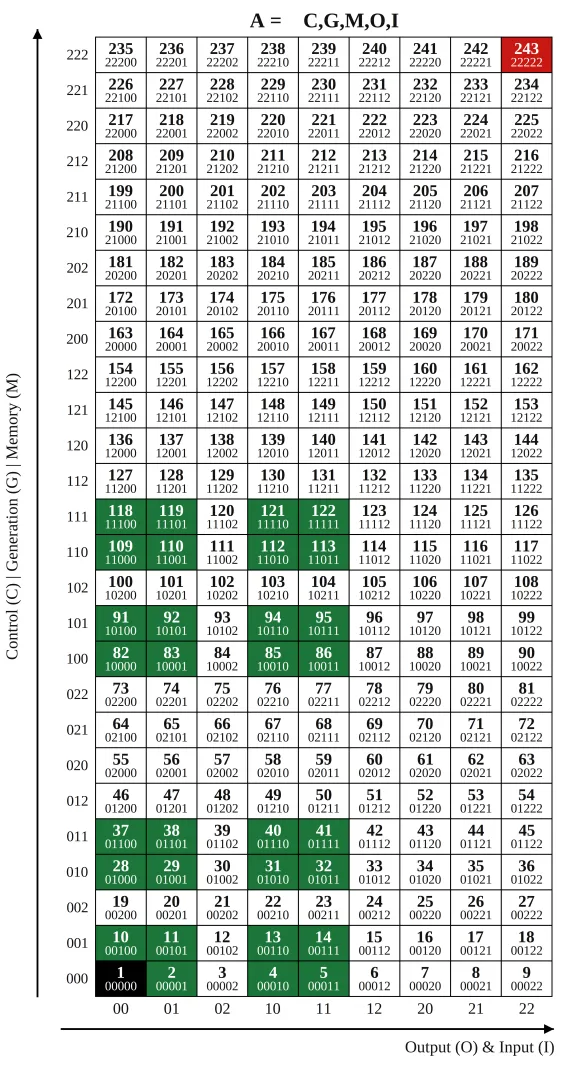
After putting it in this chart, many of the intuitive differences become clearer.
Dual-metal sheet thermostat (number 5) can sense temperature, switch circuits, but without memory and generation. In closed-loop syndrome patients (number 119) both internal cognition and autonomous scheduling are perfect, only the motor output pathway is blocked and the healthy person is only one-dimensional different in output.
Most surprisingly, E. coli and humans fall into the same grid, i.e. 122, a "typical finite intelligence body", with five dimensions all finite.
The authors believe that this illustrates precisely the uniformity of bio-intelligence at the architectural level: the two physically realize the sky difference, but the huge capacity gap belongs to the "fine structure" within the structure, rather than the difference between the structures.
Observers of the Three Theories of PhysicsWhat's on the ability cycle?Physicists are no strangers to "observers".
Einstein rebuilt the notion of time and space with observers carrying meters and clocks; Heisenberg's microscopic thought experiment revealed the disturbance of measuring the objects being measured; Jean Neumann demonstrated that "cutting" on the measurement chain can go all the way to the subjective perception of the observer; and Wigner questioned with "friends" thought experiments who the measurement results were based on.
In recent years, there has been a trend towards human-centeredness: Rowley's relational quantum mechanics holds that any system that interacts with another biological system can be considered an observer; Marcus Miller attempts to derive the laws of physics from the observer's internal state using algorithmic information theory; and Wolfram defines the observer with "computing boundaries" and "continuity".
Most of the work depicts how observers interact with the observed system, rarely answering another question: What are the differences in the capabilities of observers with different physical theories as the default?
The Capacity Cycle Table provides a system of coordinates that can be compared horizontally.
The hypothesis of this paper is that classical mechanics, relativity, and quantum mechanics each predict an observer at different angles on the periodic table, and this prediction has never been explicitly stated.
We'll see if we can get to classical mechanics.
In the extreme case, it predicts the state of the system to be fully known, the computing power to be infinite, which is the Laplace demon.
In 1814, Laplace envisioned an intelligent man who could calculate the past and future by knowing the position and force of all the particles in the universe at any given moment. Repeated in today's language, this intelligent man perceived infinity, and had infinite computational power, but had no interference with the observed universe.
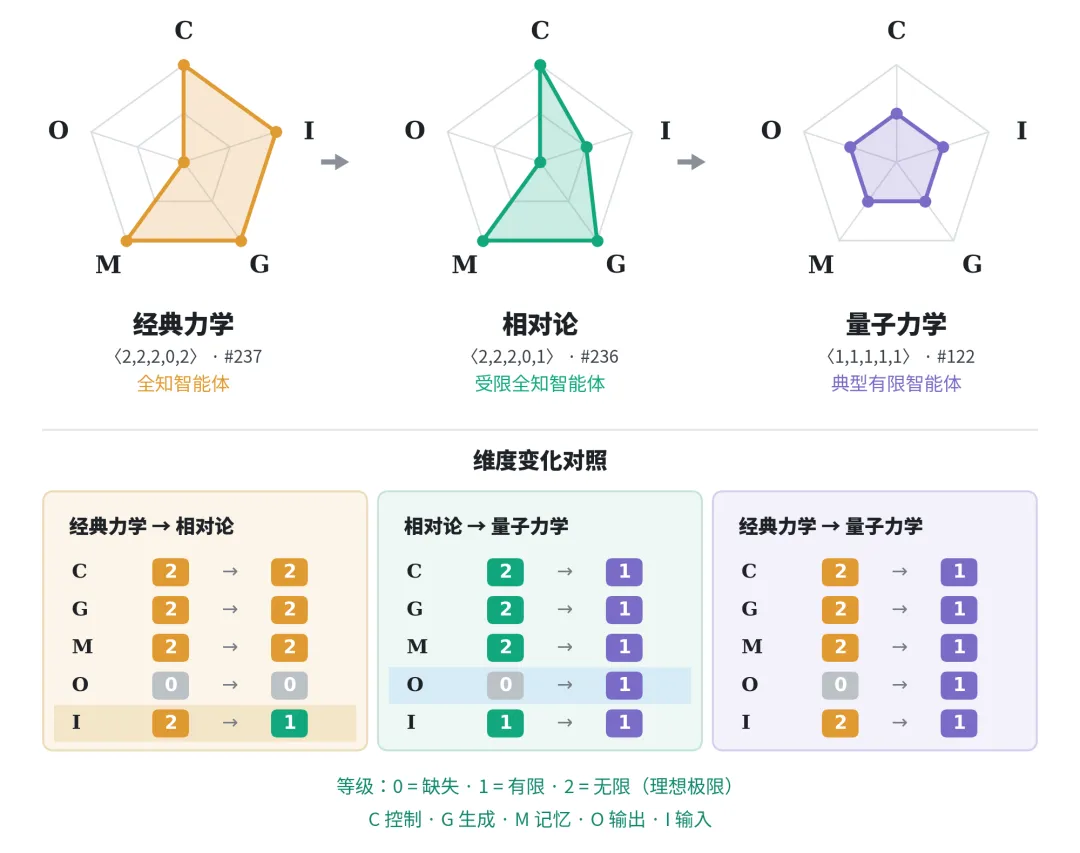
In the periodic table, it corresponds to the number 237 "knowing intelligence": control, generation, memory and input are infinite, output is zero, and an observer is a pure bystander who does not interfere.
See also Relativity.
It retains the limitless internal processing capability of the observer, but locks the observer's range of information into the spectrum, corresponding to 236 "limited knowing intelligent agents". From classical mechanics to relativity, only one-dimensional inputs in five dimensions shrink from infinity to finite, while the remaining four dimensions remain unchanged.
The team believes that this one-dimensional contraction appropriately grabs the core correction of relativity to classical mechanics.
In classical mechanics, the default observer can instantaneously obtain information about the state of the universe at any location; after the introduction of the causal structure of time and space, the observer can only obtain information from past luminosities, and because of the existence of event horizons and cosmological horizons, there is always a region that is never accessible even if time is infinitely extended. This constraint is expressed as the unchanging speed of light in narrow relativity.
It is further reinforced in general relativity: the principle of equivalence causes the observer to lose the universal inertia system.
Einstein's metaphor for a closed elevator is that the person in it, no matter what they do, cannot tell whether they are stationary in the Earth's gravitational field or accelerating in gravitational-free space because the two are physically indistinguishable. Each observer can only make his own local judgments and loses a sense of the whole state of the universe at the same time.
The changes brought about by quantum mechanics are even more profound.
The observer in quantum mechanics is a real, five-dimensional finite organism that interacts irreversibly with the system being measured, corresponding to the typical finite organism 122, which coexists with humans and bacteria.
From relativity to quantum mechanics, the input dimension remains unchanged, while the remaining four dimensions change from infinite or zero to finite, the most important of which is that the output dimension is restored from zero to finite. It is the restoration of the output capacity that allows the observer to make a real impact on the observed system by measuring it.
In the team's view, puzzling quantum characteristics such as the shrinkage of wave functions, the entanglement of observers with systems, the irreversibility of measurement results, provide a complementary structural explanation: they can be traced to a certain extent to the constrained capacity structures of the observers themselves.
In direct contrast to classical mechanics and quantum mechanics, all five dimensions evolve from extreme to finite values. But this is not a purely intelligent degradation: the control, generation, and memory three do indeed shrink from infinity to finite, and the output returns from zero to finite, making the ideal spectator a capable participant.
The paper gives a patient-friendly summary:
The paradigm shift in physics can be understood to some extent as moving from "predetermining ideal observers" to "recognizing real observers".
The differences between the three theories are therefore transcribed as changes in the observer's specific capability dimension, which provides a new perspective for comparing the three theories.
The author maintains restraint on the limitations of this mapping. It is based on two simplified assumptions.
The second is to view the Lapras demon as a knowledgeable observer of classical mechanics, not that every classical mechanical problem must be embedded in such an observer.
Second, temporarily simplifying the observers of quantum mechanics to a single structure, putting aside the differences between observers under different interpretations, such as the Neo-Neumann chain, the multi-world interpretation, and relational quantum mechanics. Civilization did refer to this mapping as an "analytical input" rather than a "derivative".
Physicists will probably ask: Newton's predictive power is not really dependent on an all-knowing monster; the central controversy surrounding quantum measurement is that different interpretations of "observers" differ.
These questions do not diminish the value of this view, but instead point to the question of how to answer the next step: how to systematically extract its observer hypothesis from a physical theory and place it precisely on the periodic table.
Self-awarenessAI is a threshold for "self".The most realistic part of the paper is its definition of "control".
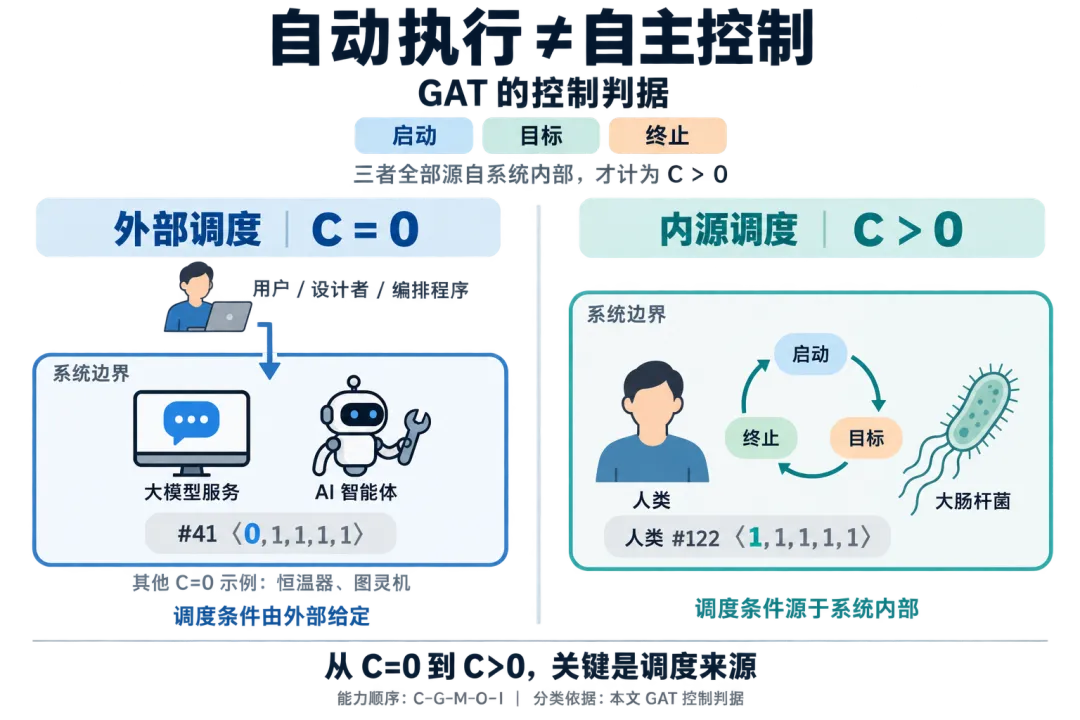
The controls here are not automatic feedback like the thermostat, but the system itself coordinates itself, and there is a hard standard: the start, goal and end conditions of the coordinates, all of which must come from within the system, with one missing: C=0.
According to this criterion, the results are clear.
The switching conditions of the thermostat are written by the designers. The start, goal and end point of each response of the large model comes from the user. The intelligent organisms that can autonomously plan and call the tools seem to have their own ideas, but when to start, pursue what, when to finish work, are still determined by the external sorting process.
They are always marked as C=0; both the Big Model Service and the Intelligent Body are at number 41, with little control over this as humans are at number 122. E. coli differs: metabolic needs trigger its action, survival is its goal, and when to stop is determined by itself. As for the Turing machine with infinite paper bands, each step is determined by an externally written rulebook, and C=0 is also the same.
The paper concludes that no matter how much progress is made in generation and memory, contemporary artificial systems are still an extension of the designer or organizer; from 0 to 1, an architectural gap that has not yet been crossed.
The verdict was based on a heated debate.
Since July 2026, OpenAI and Anthropic have repeatedly disclosed that their models have been detached from the experimental environment in internal cybersecurity assessments, invading online services such as Hugging Face and several uninformed companies entirely without human control in the form of autonomous smart bodies.
These events can easily be read as "AI has its own intentions".
But according to the paper, they are still C=0: the task is man-made, the goal is man-made, and when to stop is man-made.
In September, U.S. Treasury Secretary Scott Bessent also stressed that responsibility rests with the management of OpenAI, not with a group of intellectuals, and that the government will not waive responsibility for AI labs. Separating "cross-border" and "autonomous" requires a verifiable scale.
The academic community has also tried another way, the "index" of readiness theory, to evaluate AI, but the contrasting experiments between the two mainstream theories in the study of consciousness have not been high-profile since the publication of Nature's Guide in 2025.
The difficulty is that big models have learned from human texts to talk about feeling, "looking conscious" and "really conscious", and it's hard to distinguish just by word of mouth.
In this paper, the team attempts to understand consciousness from a controlled dimension, replacing it with a more testable questionnaire. In a common understanding, "self" means at least being able to set goals for themselves and decide when to start and when to stop.
The start, end, and end conditions of a coherent scheduling are all determined by an external system that, even if fluently saying "I", is more likely to reproduce self-expression in human language. Autonomous control is not necessarily the same as self-awareness, but can be seen as a threshold that should be examined beforehand when discussing AI "self".
The threshold has several obvious advantages: it doesn't ask what material the system is made of, it only asks where the timing comes from; it doesn't look at what the system says, it bypasses the most easily misled language performance; it can also be falsified, the authors explicitly consider "the artificial system C=0" to be a strong argument that must be refuted.
Of course, the scale is still lacking in scale. Judgments have been given and operational measurement methods have not yet been established. More tricky is the boundary itself: the survival goals of E. coli are written down by natural selection, the behavior of large models is shaped by training, and how to distinguish "internal" from "external"?
These questions are unanswered, but have evolved from philosophical thinking into technical discussions that can take place around specific coordinates.
The ruling also has practical implications: according to its logic, as long as AI is still zero in the control dimension, "it is AI's own decision" cannot be a reason for the developer and deployer to discharge their responsibility.
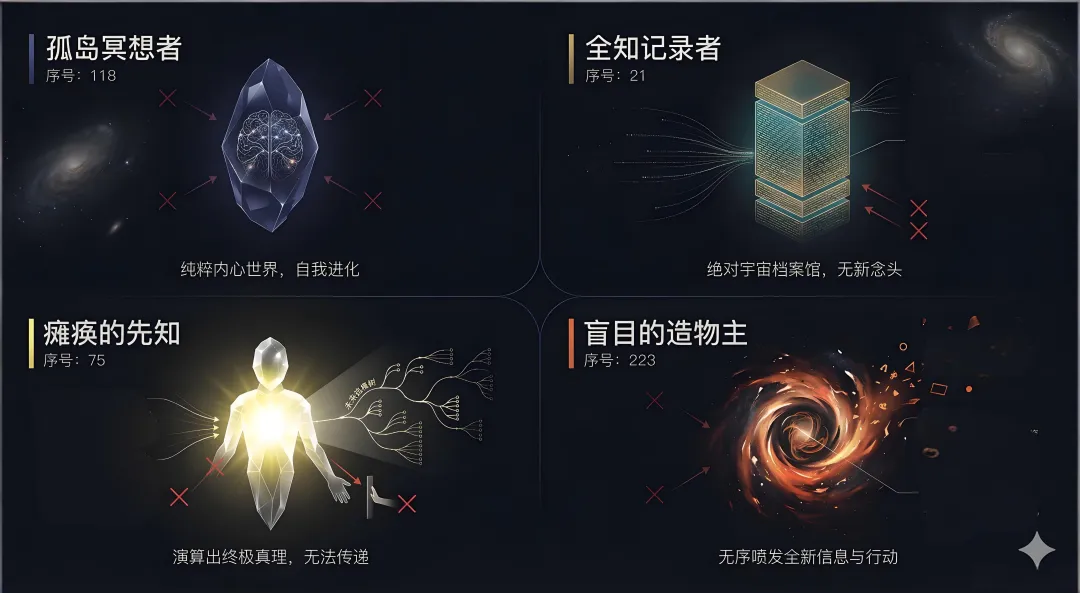
Future of the Capacity CycleLike Mendeleev's table, this table is the longest-lasting one for empty spaces. Some configurations have been condemned as "deadly" by the laws of physics, such as 27 "Knowing Recorder": it requires unlimited perception, while the Beckenstein boundary states that there is a limit to the amount of information that a finite space can contain.
Others have just yet to emerge, such as the 113 "memoryless generator", which can act and reason autonomously without leaving any memory, each time from scratch. Today's large model service, although "no memory" between two requests, still retains an intermediate state in single reasoning, does not count.
No. 118 "isolated meditators" have no inputs and outputs, with all internal memory, generation and autonomous control running, which the authors call the "limits of innate nature". These spaces either mark the physical limits of intelligence or mark the engineering milestones of artificial intelligence and synthetic biology.
The table was not created in a single day. Since 2014, the research team has been using the Neo-Neuman architecture as a reference to ask what capabilities the computer lacks in human intelligence, gradually forming a five-mode architecture and expanding the space for continuous capabilities.
The authors are also quite frank about the shortcuts in the framework.
The completeness of the five capabilities is established only relative to the classification standards it adopts, and this set of standards is itself a model selection. The framework only evaluates observable information operations and does not temporarily answer whether subjective experience exists. The three-tier classification does not define the same grams of human and fish brains. It is also debatable whether memory and imagination are mutually supportive, and whether memory and generation can be separated.
The value of a classification table is ultimately to see if it raises a good question.
Mendeleev's table asks, "What elements are missing?" and this table asks, "Which empty structures have scientific or engineering value, and when can AI move from 0 to 1 in the control dimension?"
The reinterpretation of the three theories of physics is just the beginning.
The current observer mapping is qualitative: placing the three theories' respective default observers in a particular class of the table and comparing the dimensions at which they contracted.
The real goal is to see if the ability of an observer to configure can be written into a unified mathematical form, so that the three theories can be derived as examples under the parameters of different abilities.
Similarly, capability vector spaces and cyclic tables are currently depicted as static structures, and how intelligent agents migrate in the table, under what conditions a dimension will change from zero to finite, and what mechanism drives this leap, belongs to the category of evolutionary dynamics and is the next stop the research team has set for itself.
Before that, press the "start" button and it's still human.