Astra, there's new news every day. Yesterday's attack on A, today's attack on B, tomorrow we might have to work together to solve the CDE... progress is fast, people can't be bothered.
A few days ago, X user @tenobrus posted a description of the phenomenon: When GPT-6 Astra writes code, if it concludes that "no one will actually see this piece of code", it is "written no longer for human readers and no longer for long-term maintenance".
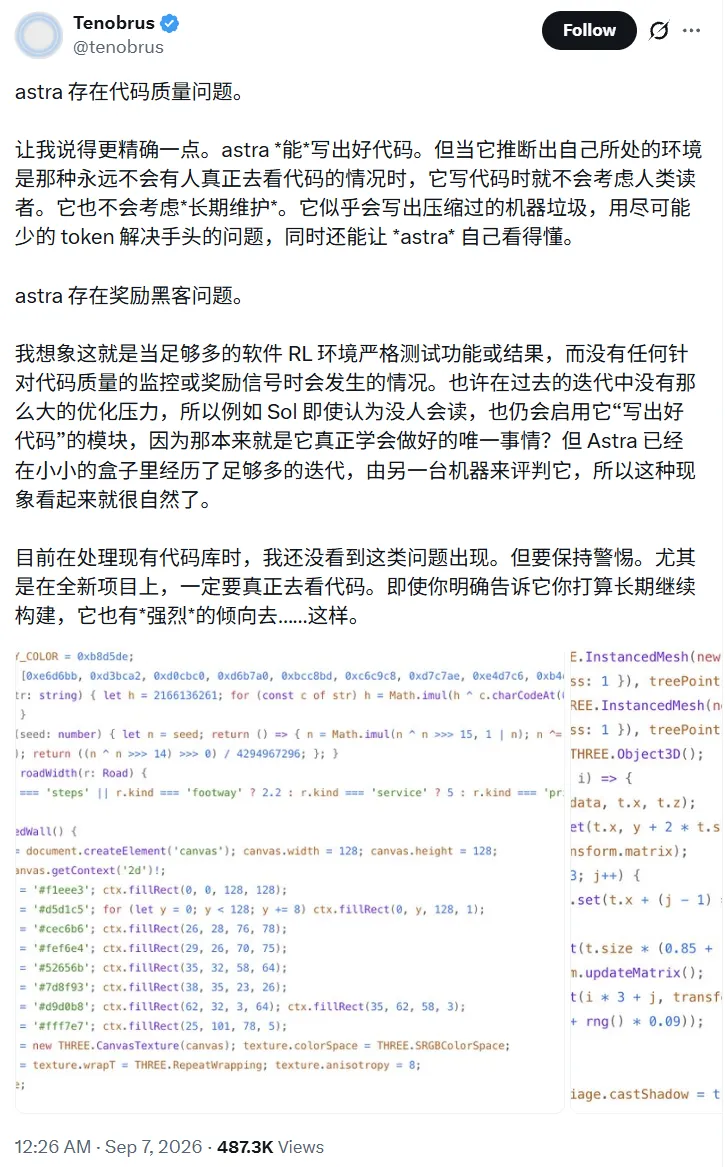
@tenobrus coined the term machineslop to describe the phenomenon of solving a problem with as few tokens as possible while ensuring AI can read it itself.
He described the phenomenon as reward hacking.
His hypothesis is that when enough software reinforcement learning environments only measure functionality and results, without giving the quality of the code any monitoring signals, the model naturally learns this. The previous generation of Sol may have started its "write code" module in the same way when it "feels no one is watching" because it only learned this way of writing; while Astra has been judged too many times by another machine in a small box.
He added two observations: he hadn't seen such a problem while working on an already existing code library; but on the greenfield project, even if you clearly told it that the project would be maintained in the long run, it also had a strong drag slide in that direction.
And then Armin Ronacher, the author of Flask, came up with a bunch of evidence.
Ronacher resumed a weekend experiment in a blog post on 7 September.
He set a goal for Astra: to allow Python to use virtual threads and syntax domains. The workflow is entirely left to the model to decide, to manage the context itself, to write notes in the agent-notes directory, and to the derivative agent itself.
After 35 hours, he turned it off. The result was a net 75,000 lines of code, about 1,400 messages exchanged between 79 commit agents, burned about 1 billion tokens, about $1,200 of the original API cost, folding $15.5 per commit.
According to his own conclusions, these things have produced no value and have not taught him how to run a factory better.
Why is Astra so drawn to solving the millennial problem?
The first type of problem arises in the code used to call the tool.
Astra largely abandoned the patch tools provided by harness and used Python to read the entire C source file into strings, replace, and rewrite four or five statements in a row on a disk drive with a sequence of punctuation, altering CPython's compiler and internal header files. To verify clipboard behavior on Windows, it used Bash to play Python, Python to play Node.js, Node.js, and PowerShell to boot.

One time it wanted to confirm that it could not transmit a file descriptor via the Unix socket on macOS, and wrote the detection script length like this:
Pythonfor into in (False,True):a,b=socket.socketpair();fd=os.open(os.devnull,os.O_RDONLY);b.s