OpenAI GPT-6 Astra has finally "arrived" this morning.
OpenAI President Greg Brockman, in particular, said "Welcome to the AGI era" to bring the live atmosphere to a climax.
Although the GPT-6 Astra is currently only open to a small number of organizations, there has been a lot of testing and discussion about whether or not it has approached "AGI" on X.
In addition to this "rabbit" about AGI, we found a hidden result behind the model's release: GPT-6 Astra made a breakthrough in the problem of bounded gaps between primes, pushing the previously known upper boundary from 246 to 186.
That's the way it is.
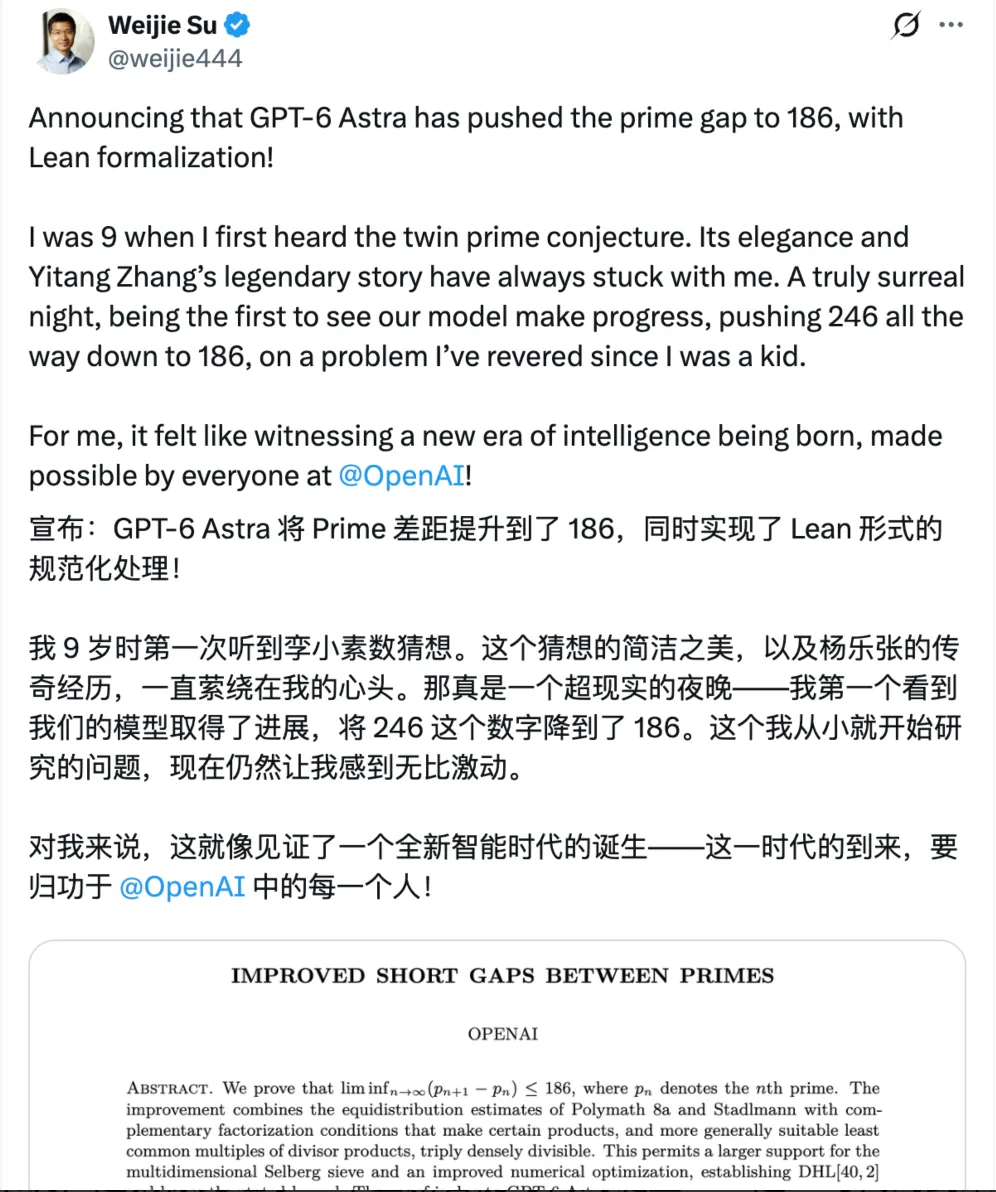
This morning, Professor of Statistics at the University of Pennsylvania, OpenAI researcher, and Grade 7 alumnus of the Northern Mathematical Institute Suzanne J. posted a message announcing that GPT-6 Astra had advanced the prime interval to 186 and completed its Lean formalization verification!
He writes:
"I was fascinated by this question when I first heard about the hypothesis of the atomic number when I was nine years old. Its concise and beautiful mathematical structure, and the legendary breakthrough story of Zhang Yi-dong, have remained in my memory.
The experience of tonight is very unreal, and I'm the first person to witness the model's progress: it pushes the previous best-of-the-line from 246 to 186... and this is a mathematical problem that I've admired since I was a kid.
For me, it's like witnessing the birth of a whole new era of intelligence -- and it's all part of the efforts of every member of OpenAI!"
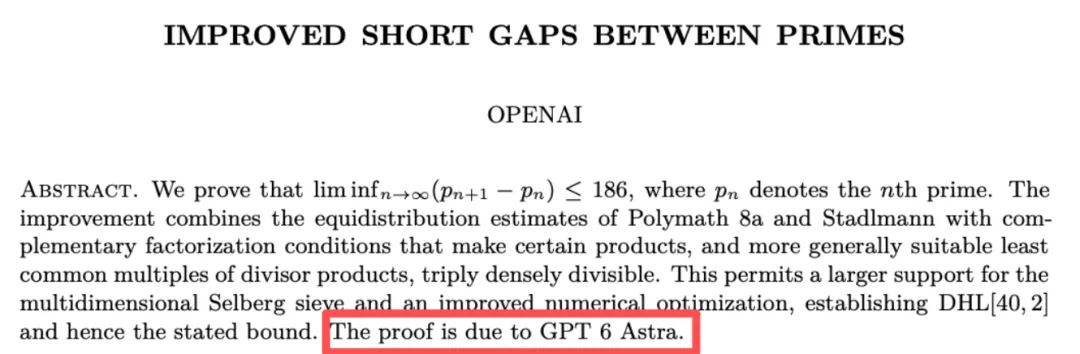
The following post is accompanied by a paper published by OpenAI: "Improved Short Gaps Between Primes", which states in the paper's abstract: "The mathematical proof is given by GPT-6 Astra".
After the post was posted, it quickly sparked a debate, with many netizens saying: "Although I can't see it, it looks great!"
It's true that this is important, not just because the number went from 246 to 186. More importantly, it may represent AI moving from "solving mathematical problems" to "engaging in mathematical research".
In the following, let's take a closer look.
From Zhang Yi-dong to Tao Zedong, "prime intervals" were the "long battlefield" of mathematicians.
First, to understand this breakthrough, we need to know what the problem is that it solves.
We all know that prime numbers seem to be randomly distributed, like 2, 3, 5, 7, 11, 13... but as the numbers get bigger, the distance between two adjacent prime numbers also changes, like the difference between 11 and 13 is 2, the difference between 23 and 29 is 6...
Mathematicians have long been concerned with the question of whether the distances between adjacent prime numbers are infinitely small.
The most famous of these is the so-called "pigenetic number conjecture", which is closely related to the prime interval: Is there an infinite number of primes that differ by 2?
For example, 11 and 13, 17 and 19, 29 and 31...
But this assumption has not been proven for over 100 years. However, in retrospect, mathematicians have proved a weaker conclusion: even if it is not possible to prove the existence of infinitely many prime pairs "at a distance of 2", it can be proven that there are infinitely many compounds whose distance between them does not exceed a fixed number.
And this figure is the goal that researchers are constantly competing to reduce.
The first thing to mention is that in 2013, Chinese mathematician Zhang Yi-dong made a breakthrough: there are infinitely many prime numbers, and the distance between them is less than 70 million. This is one of the most important advances in this direction in decades.
Subsequently, the mathematical community continued to improve on this result. Mathematicians such as Fields Prize winner James Maynard, Terence Tao, and others continued to push for the development of the hypothesis, continually pushing the boundary downward, and ultimately, the important record for this path remained at 246.
OpenAI's GPT-6 Astra results have further pushed this up to 186.
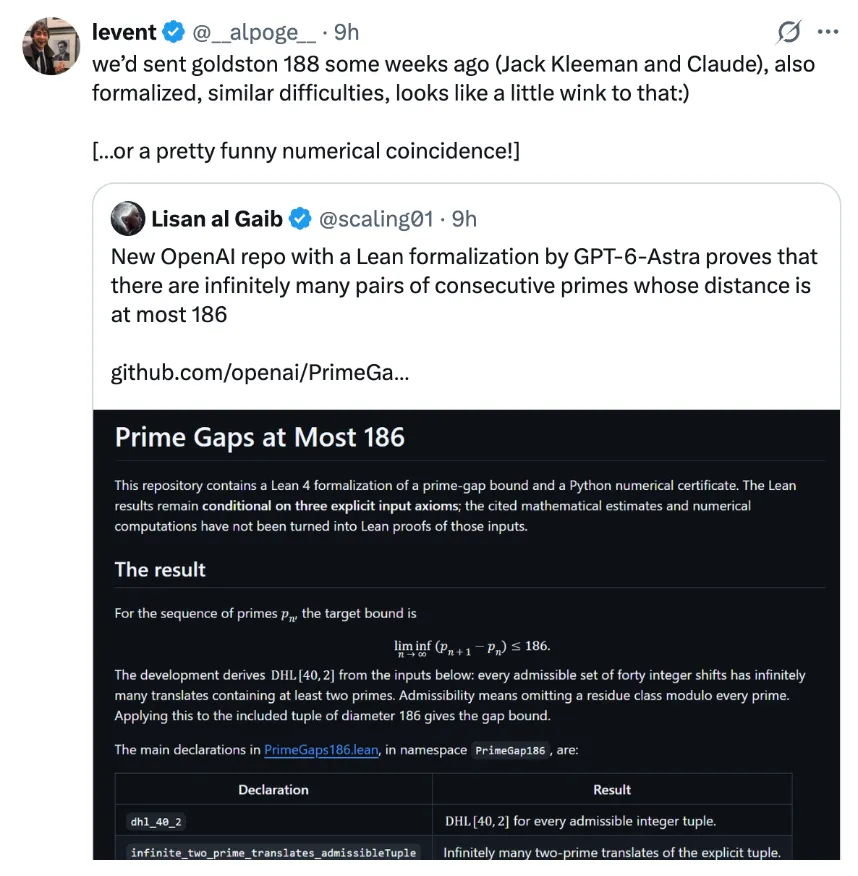
The PrimeGaps 186 project, published by OpenAI, focuses on:
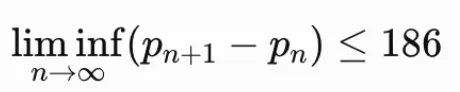
In other words, as the sequence of prime numbers continues to extend, the interval between adjacent prime numbers will be at least infinitely smaller than 186.
The mathematical tools behind it are derived from the classic method of numerical analysis: calculus.
In simple terms, mathematicians cannot directly predict the position of prime numbers, so they constructed a selection method to prove that certain combinations of numbers must contain prime numbers. This method has been developed over the years, and the focus of GPT-6 Astra's involvement is to help find better combinations.
According to Suzuki, this breakthrough is due to the fact that the GPT-6 Astra has expanded the use of multi-dimensional Maynard-Tao/Selberg hydrogen weighting by exploring new factor decomposition conditions, making better use of prime distribution estimates, and thus further improving the efficiency of existing methods.
In other words, the GPT-6 Astra does not have "a formula to be found out of thin air", mainly in the vast mathematical search space, which helps researchers find proof combinations that have not been used before.
Another key point is that the work has also completed Lean formalized verification.
Lean is a mathematical proof assistant, whereas traditional mathematical papers are often "mathematicians propose proofs by human peer checks", while Lean is "mathematicians or AI writes proof codes, and computers verify every step of logic".
Currently, OpenAI has open-source Lean 4 formalization projects for PrimeGaps 186, which include code-proving and numerical validation procedures.
OpenAI, Anthropic, Axiom are all about AI mathematics.
More interestingly, in the process of collecting the data, we found that not only OpenAI, but also some large models have conducted research around the problem of "prime intervals" and even published their findings on the same day.
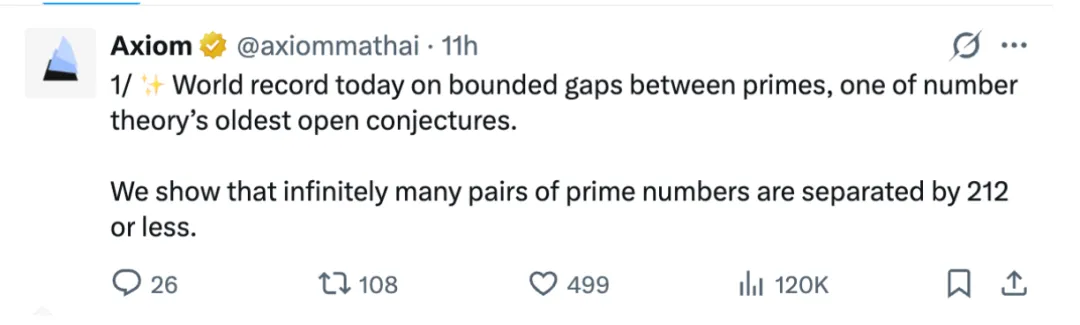
The first was Axiom, which stated: "Today, we have created a world record on the question of bounded gaps between primes. This is one of the oldest unsolved conjectures in the field of mathematics".
We proved that there are infinitely many primes, and the interval between them is less than 212".
Researchers at Anthropic also commented: "Previously, the Claude team had completed a formalized proof of pushing the prime interval to 188, and this time GPT-6 Astra published 186 is very close to that, so there may be some resemblance between the two results".
"Of course", he added, "it might just be a very interesting digital coincidence!"
And from this sort of "coincidence" we may see a trend: the next stage of big model competition may not just be about who can write code, chat, and be agents, but also about who can really help humanity advance scientific research.
Interestingly, as AI becomes involved in mathematical research, people even begin to re-examine the "degree of AI involvement" behind a study.
It's also a coincidence that human mathematicians have made an important breakthrough as AI models continue to advance this problem.
This is the result of Julia Stadlmann's research.
A few days ago, mathematician Thomas Bloom sent out a paper in which he commented: "An important new achievement on prime intervals (made by humans!) demonstrates by Julia Stadlmann that there are infinitely many prime numbers with a maximum distance between them of 240".
The previous record of 246 was held by the Maynard and Polymath projects".
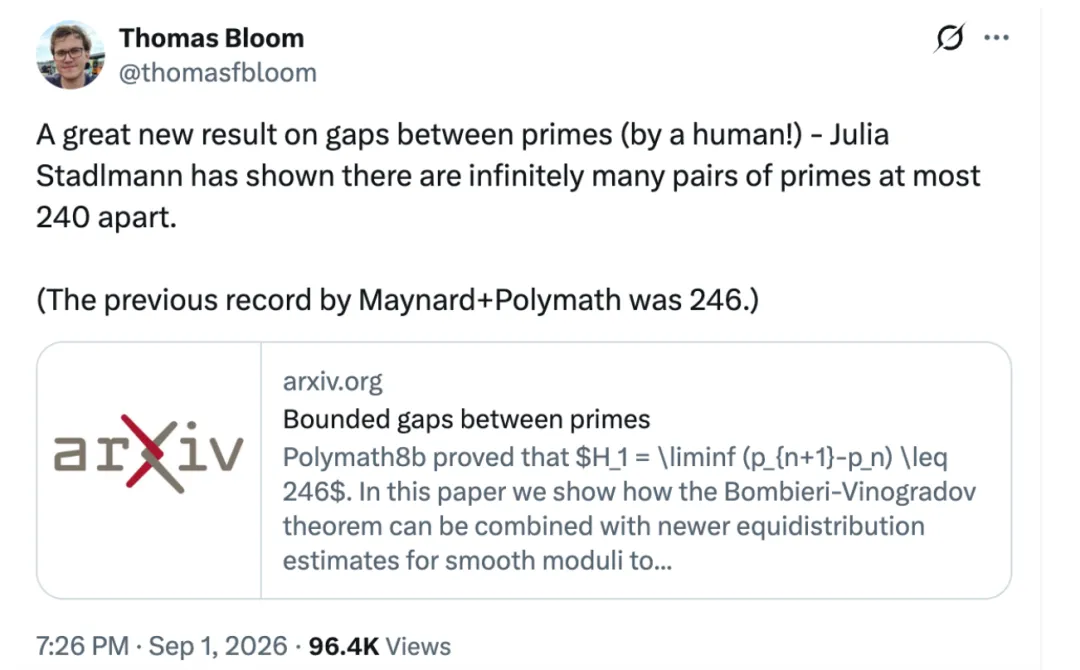
Yes, it's the same problem with the "interval of prime numbers", and Julia Stadlmann succeeded in pushing this up to 240.
It is worth noting that this time, without AI, it was a breakthrough entirely made by mathematicians.
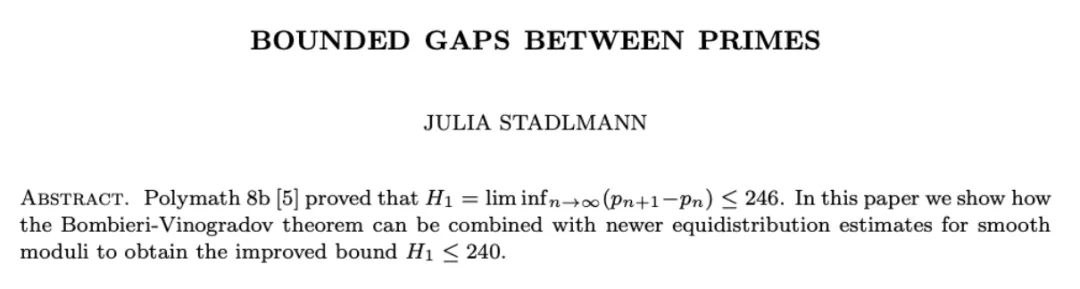
Link to the paper:https://arxiv.org/pdf/2608.31126
But interestingly, the study of this "pure human handkerchief" was even surprising.
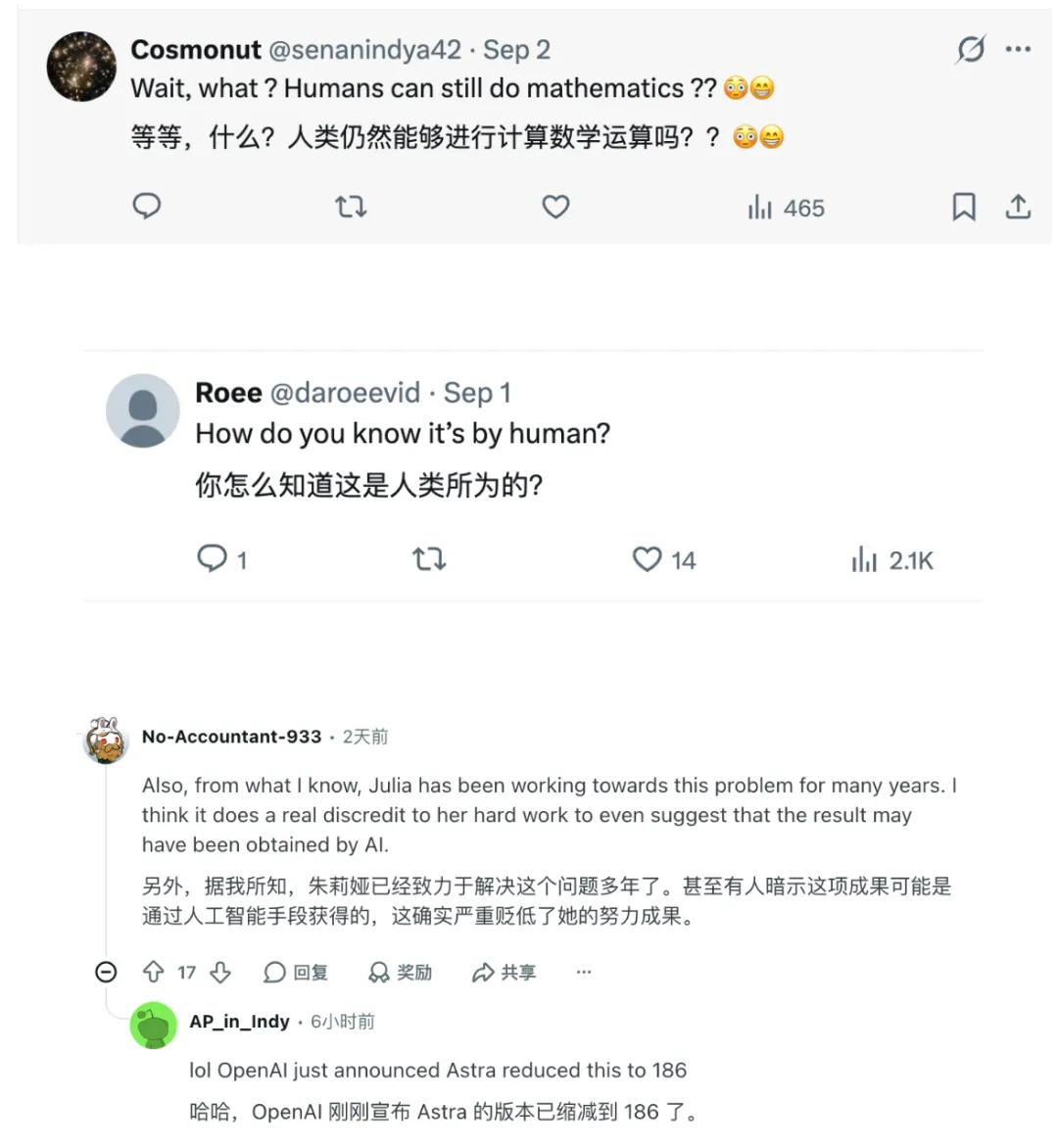
Such "small plugins" also seem to indicate that people are increasingly accepting the important role that AI plays in mathematical research, from Liman's speculative exploration to today's "numerical interval" problem, AI is no longer just an auxiliary tool, and has begun to go to research partners, engage in complex mathematical inference, and try to generate machine-verifiable proofs.
The link is as follows: